The rapid development of single-cell multi-omics sequencing technology has made it possible to measure gene expression and chromatin accessibility simultaneously, providing a comprehensive view of gene regulatory mechanisms at single-cell resolution. Cell type annotation is a core step in the analysis of single-cell multi-omics data. Common cell type annotation methods typically involve unsupervised clustering followed by manual assignment of cell type labels to each cluster based on prior knowledge. However, as the number of cells being analyzed grows exponentially, manual annotation methods face challenges of reproducibility and are extremely time-consuming.A more efficient and accurate approach is to perform automatic cell type annotation, which involves training a model using labeled datasets and then using the trained model to annotate newly generated datasets. Currently, various computational methods have been designed specifically for single-cell transcriptomic data or single-cell chromatin accessibility data. These single-omics annotation methods can be applied to the cell type annotation task of single-cell multi-omics data, using one type of omics to determine the cell type of each cell. However, single-omics annotation methods fail to fully utilize the information from multi-omics data, limiting their ability to capture the complexity and diversity of cells. Therefore, there is an urgent need to develop an automatic cell type annotation method specifically designed for single-cell multi-omics data.Recently, Protein & Cell published an article titled:MultiKano: an automatic cell type annotation tool for single-cell multi-omics data based on Kolmogorov-Arnold network and data augmentation, which proposes the first automatic cell type annotation method designed for single-cell multi-omics data, MultiKano.
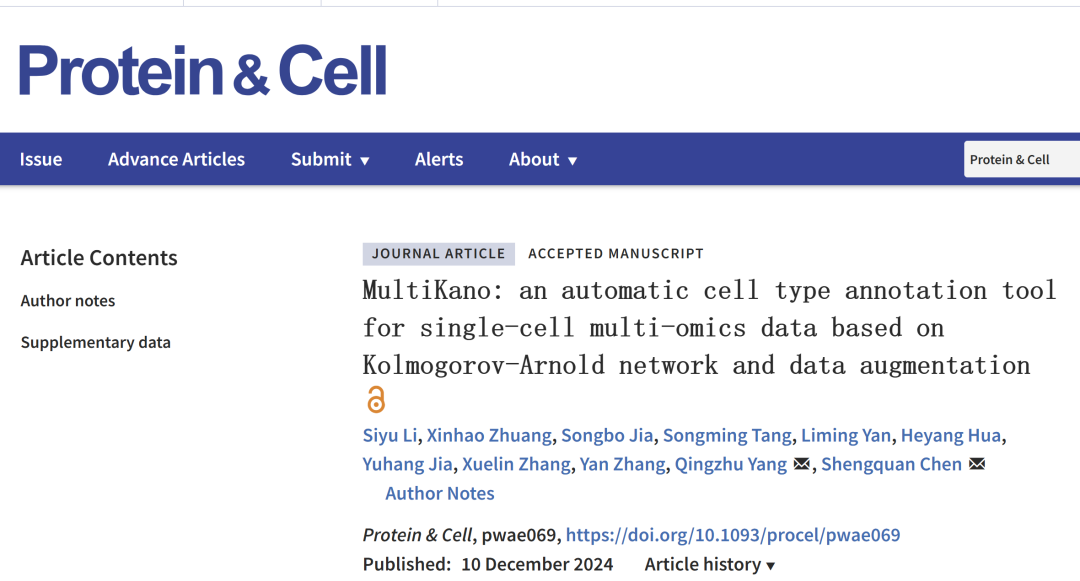 MultiKano introduces a data augmentation strategy based on paired single-cell multi-omics data and incorporates the Kolmogorov-Arnold network (KAN) to enhance the model’s generalization ability.The architecture of MultiKano consists of three main modules: the data preprocessing module, the data augmentation module, and the KAN module. Specifically, for a given paired single-cell multi-omics dataset, MultiKano first preprocesses the two types of omics data separately. To more effectively capture the cellular heterogeneity in single-cell multi-omics data, MultiKano further introduces a data augmentation module. The basic principle of this module is that two cells of the same cell type share similar biological characteristics, allowing the matching of different omics data from the two cells to generate simulated cells. Finally, MultiKano utilizes the KAN model for training. The KAN model is based on the Kolmogorov-Arnold representation theorem and is characterized by the absence of linear weight matrices, with each weight parameter replaced by a learnable one-dimensional function, providing strong flexibility and generalization ability, effectively learning complex nonlinear mappings and reducing the risk of overfitting.Comprehensive experiments conducted on multiple datasets demonstrate that MultiKano not only outperforms annotation methods using single-omics data but also surpasses traditional machine learning methods using multi-omics data. Ablation experiments further confirm the effectiveness of each module in MultiKano. Additionally, MultiKano exhibits stability in annotating datasets containing different numbers of cell types, validating its robust capability in handling complex datasets. More importantly, MultiKano shows good performance in cross-dataset annotation experiments, highlighting its significant advantages in practical application scenarios. Through a series of downstream analyses, including GO enrichment analysis, KEGG pathway enrichment analysis, GREAT analysis, and SNP enrichment analysis, MultiKano further demonstrates its tremendous potential in revealing the intrinsic mechanisms of complex biological systems.Original link:https://doi.org/10.1093/procel/pwae069
Editor: Eleven
BioART Strategic Partner
BioART Friendly Partners
Reprint Notice
[Non-original article] The copyright of this article belongs to the author. Personal forwarding and sharing are welcome, but reprinting without the author’s permission is prohibited. The author retains all legal rights, and violators will be prosecuted.
BioArt
Med
Plants

Talent Recruitment
Conference Information
Recent Live Broadcast Recommendations