Click the blue text to follow us

Otii
From Sweden
New Low Power Measurement Solution

Background
The previous article mentioned numerous industry challenges in low power design, such as the need for precise dynamic power capture, covering complex power management strategies, simulating real multiple environmental conditions, debugger interference issues, long testing cycles, and high efficiency requirements, as well as conflicts between multi-component interactions and overall system optimization, and the dilemma of consistent mass production requirements versus cost control.
Traditional measurement tools also face significant limitations: insufficient sampling rates, inadequate automation simulation capabilities, limited battery aging scenario simulation, and low efficiency in long-term real-time testing.
To meet the stringent requirements for low power testing in IoT and wearable devices, it is essential to break through the limitations of traditional measurement tools and achieve the following goals:
-
Dynamic high-precision measurement: Capture transient current changes.
-
Battery simulation in real environments: Simulate any battery curve through software-defined methods, accurately reproducing battery performance under different temperature, humidity, and aging conditions.
-
Deep integration of software and hardware data analysis: Automatically align software logs with power consumption curves for precise overall system debugging.
-
Automation and batch testing capabilities: Support multi-channel parallel testing to significantly improve testing efficiency.
To address the above challenges, Qoitech has launched a comprehensive Otii solution, including:
-
Hardware products: Otii Arc Pro and Otii Ace Pro.
-
Application: An intuitive and easy-to-use Otii software that supports real-time data monitoring and analysis.
-
Extended toolbox: Including Otii Battery Toolbox and Otii Automation Toolbox, further enhancing testing flexibility and accuracy.
“
01
What Makes Otii Unique
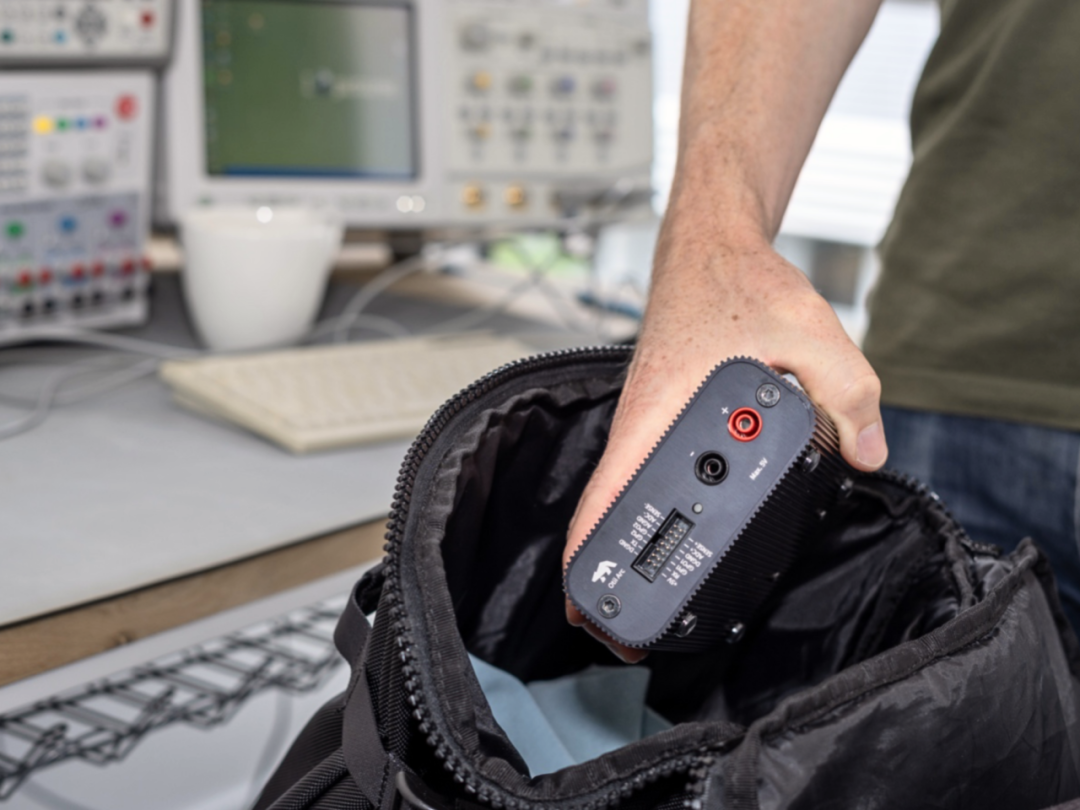
Portable and compact size, noiseless
The Otii hardware instrument weighs less than 1 pound. Engineers can carry it to any application scenario for testing, no longer limited to the “standard” conditions of a laboratory.
The fanless design ensures quiet operation, maximizing user-friendliness.
High precision and high sampling rate
The Otii Ace Pro instrument can monitor load currents from 25nA to 5A, with an accuracy of up to 0.05%, and both current and voltage measurement sampling rates can reach 50ksps.
The Otii Arc Pro can monitor load currents from 50nA to 5A, with an accuracy of up to 0.1%, and current and voltage measurement sampling rates of up to 4ksps and 1ksps, respectively.
Reject complex software operations
Anyone can register for the Otii software for free and download it from the Qoitech website. The interface is simple and organized, allowing users to start measuring within minutes.
Browse below to unlock the 6-part Otii quick start video series.
Whether within a company across departments or among upstream and downstream enterprises in the supply chain, Otii can be collaboratively operated. One-click generation of saved otii project files/csv files, etc., can be opened and used without hardware.
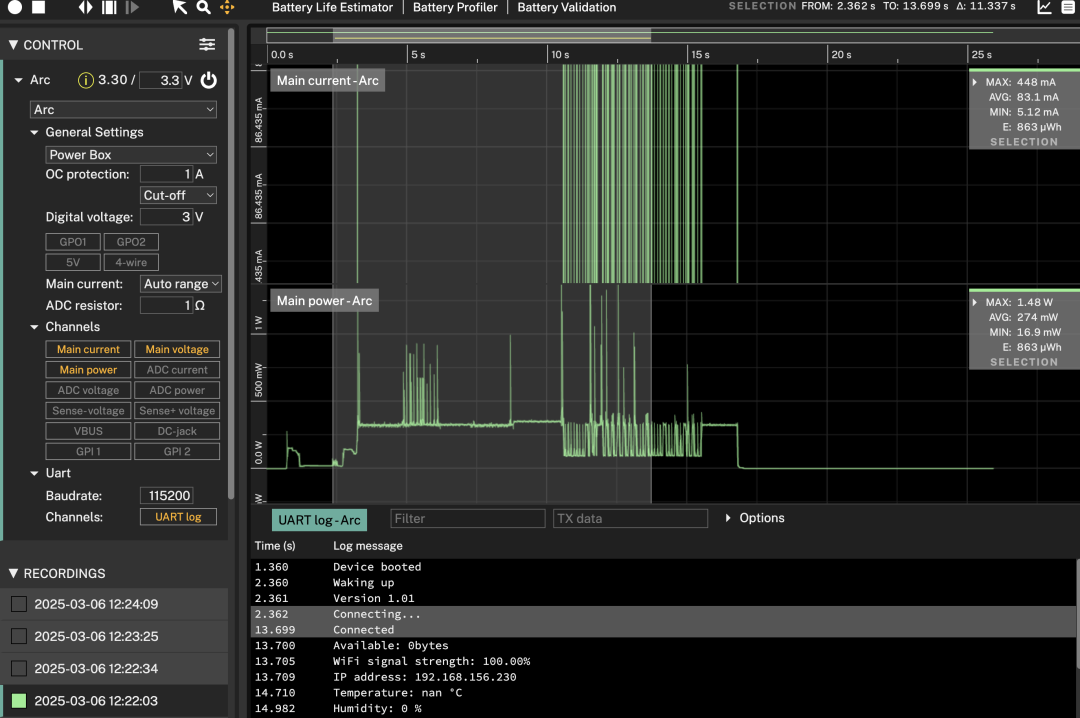
Using UART debug logs
Users can directly associate unwanted current peaks and increased energy consumption with UART output, allowing precise localization of specific areas that need optimization.
License 1: Otii Battery Toolbox
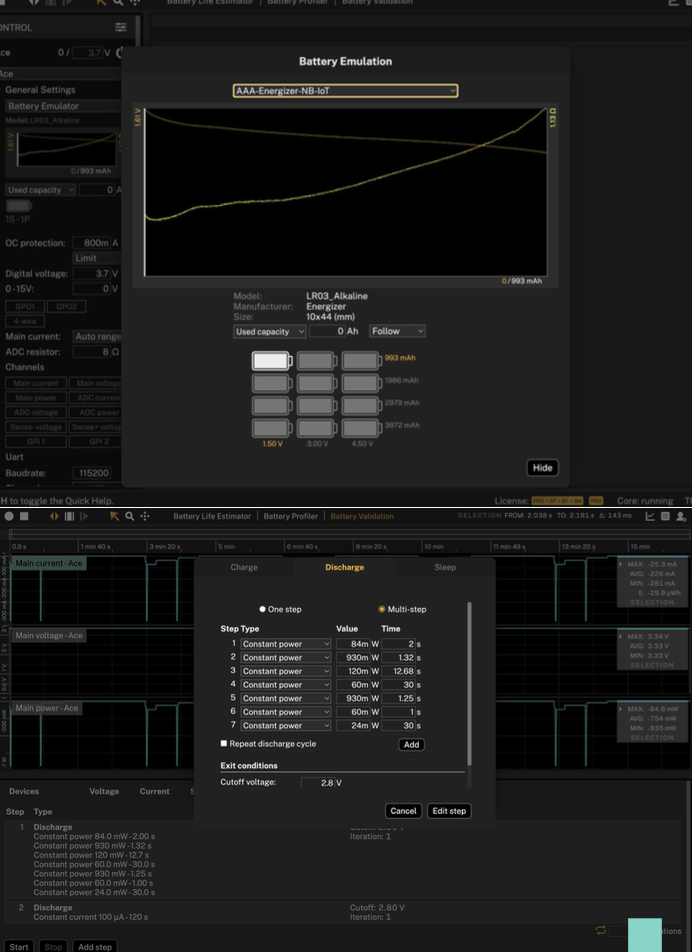
Battery simulation.
-
Can simulate and emulate battery behavior under different temperature, humidity, and aging conditions, supporting fine-tuning of parameters to ensure test results closely match actual applications.
-
Supports “follow” mode simulation and “fixed” mode simulation.
-
Can simultaneously use the Otii Automation Toolbox to automatically simulate batteries—switching between different charging states, battery types, and temperature profiles.
Battery analysis.
-
Simple setup: Connect a battery to the main connector of an Otii instrument.
-
Connect as many Otii instruments as possible for multi-channel use with a computer.
-
All connected batteries will discharge according to the selected profile.
-
The maximum charge current for Otii Arc and Ace is 2.5A and 5A, respectively, with a maximum discharge current of 5A.
-
Create discharge profiles with two types of discharge: low level for sleep mode and high level for active mode.
-
Discharge at a constant current. The current does not change as the battery voltage drops. This is similar to a load being a linear regulator.
-
Discharge at a constant power. Measure voltage and calculate discharge current to achieve the set power. During discharge, the discharge current will increase as the battery voltage drops.
-
Discharge by simulating the resistance connected to the battery. During discharge, the discharge current will decrease as the battery voltage drops.
Battery validation.
(This feature is only available for Otii Ace Pro)
-
Highly customizable test sequences—customizable discharge, idle mode, and charging, pulse width control, repeat cycles, cutoff voltage.
-
Unlimited cycle counts.
-
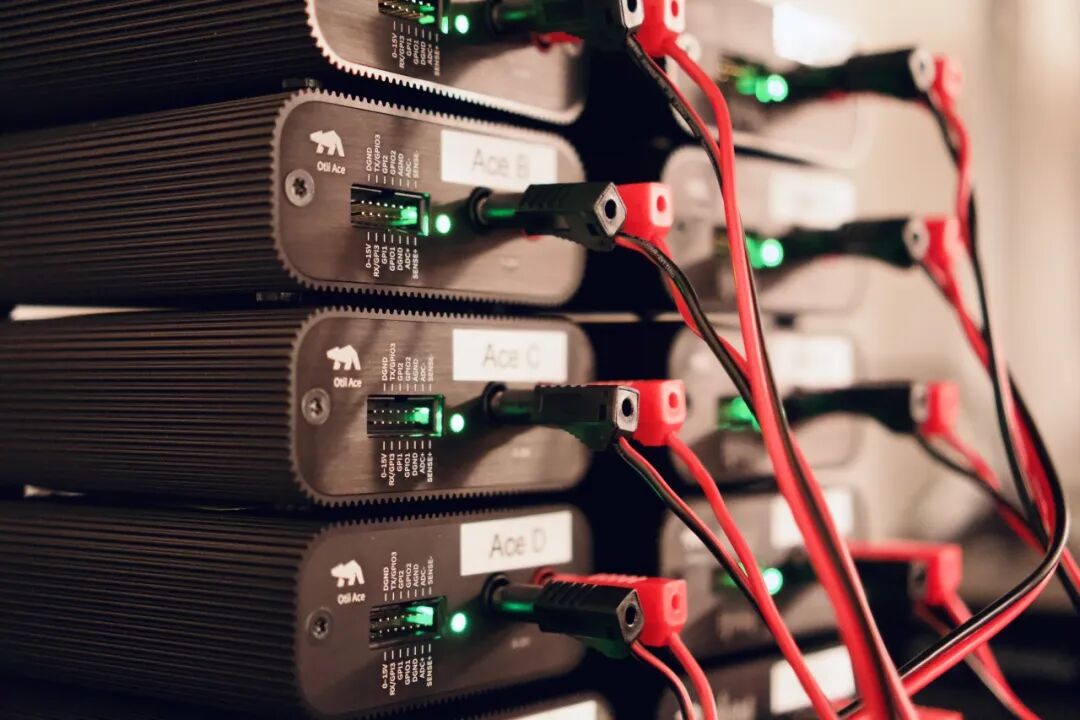
Unlimited number of batteries tested simultaneously. Connect any number of Otii Ace Pro as allowed by the computer.
Shareable licenses
-
The Otii Battery Toolbox is shareable.
-
Licenses can only be assigned to one user at a time. License management is done in the Otii user management system.
-
Licenses can be used in offline mode.
License 2: Otii Automation Toolbox
Write scripts in any language using JSON API..
-
The Otii Automation Toolbox makes Otii instruments programmable.
-
Control your Otii Arc/Ace using a JSON-based API through any language or system that supports TCP socket communication, using the built-in TCP server.
-
Examples of integrating Otii with the Python programming language into Jenkins can be found in the “Help” section of the Otii application.
-
Ideal for your continuous integration setup to track system energy consumption throughout the development cycle (from prototyping to production).
Script statistics API
-
The Otii core computing engine is designed to efficiently compute large amounts of data.
-
The TCP-API is continuously expanding, and its methods will simplify your energy optimization tasks.
-
New examples for the API include: recording_get_info, which returns recording information; recording_get_statistics, which returns minimum, maximum, average, and energy consumption over a specified time range.
Packaged script modules available for Python, Matlab, C#, Java
-
Write scripts using the JSON-based API or use our provided packaged script modules for common languages like Python, Java, C#, and Matlab.
-
Find these modules on Qoitech GitHub.
Command line tools
-
The toolbox includes a command line tool to run test scripts without a user interface.
-
Run your scripts in your favorite continuous integration (CI) environment.
-
Create test setups in remote locations.
-
The TCP API includes methods for logging in, logging out, and handling Otii licenses directly from scripts, making it easier to include scripts in automated environments.
Shareable licenses
-
The Otii Automation Toolbox is shareable. Licenses can only be assigned to one user at a time. License management is done in the Otii user management system.
-
Licenses can be used in offline mode.
“
02
Otii Quick Start Video Series Collection
Step 1: Connect Otii hardware and software
Step 2: Set up the IoT or embedded device under test
Step 3: Start measuring immediately, without time or frequency limits
Step 4: From recording to insight analysis
Step 5: Set up debug log UART
Step 6: Start battery life estimation immediately
Continue to follow Qoitech, and I will bring you more industry information and solution interpretations regarding IoT and embedded low power optimization design.


Official Website丨qoitech.com
▌Get a tailored solution
📩 Technical Consultation: [email protected]
📞 Contact Us: +46-73 5098 233
📍 Company Address: Lund, Skåne County, Sweden
About Qoitech
Qoitech, a Swedish company, has launched the low power measurement innovation solution Otii, as an energy consumption optimization expert in the field of battery-driven and energy harvesting power supply, empowering over 3,500 enterprises worldwide in low power design.
Clients cover key areas such as semiconductors, smart agriculture, smart home, and smart metering, including both Fortune 500 industry leaders and rapidly growing small and medium-sized innovative enterprises.
Through precise energy consumption analysis and full-cycle testing capabilities of electronic products, Otii continuously assists clients in meeting the stringent demands for ultra-low power design and cost-effective energy management in the context of large-scale deployment of electronic devices.