1193 – Angled II
Program Development Approach (For Beginners)
Hello everyone! Today we will understand step by step how the “Angled II” program is designed and implemented.
Step 1: Understand the Problem Requirements
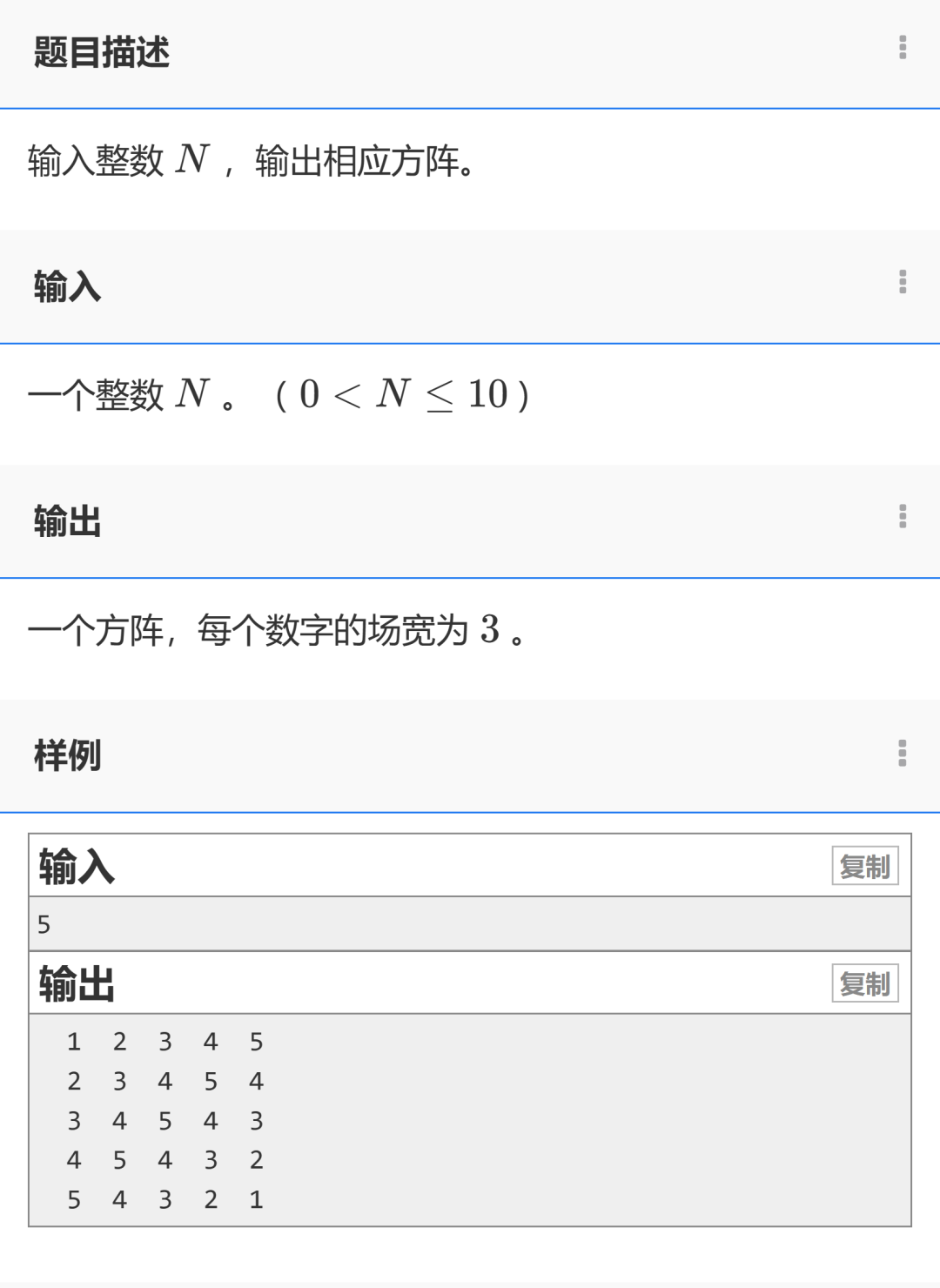
We need to create an n×n square matrix. Observing the output example, for instance when n=5:
Dark version

  1  2  3  4  5
  2  3  4  5  4
  3  4  5  4  3
  4  5  4  3  2
  5  4  3  2  1
We find that:
- The first row is: 1, 2, 3, …, n
- The second row is like the first row shifted left by one position, with the rightmost position filled with
<span>n-1</span>(which is 4 here) - The third row is again shifted left by one position, with the rightmost position filled with
<span>n-2</span>(which is 3 here) - And so on, each row is “shifted left” by one position and a decreasing number is added at the end.
This “shift left” actually means: removing the first number and shifting all subsequent numbers one position to the left.
Step 2: Choose Data Structure
We need to store an n×n table, so we will use a two-dimensional array <span>matrix[10][10]</span>. The reason for using 10 is that the problem states n does not exceed 10, which is sufficient.
Step 3: Fill the First Row
The first row is simple, it is arranged in order from 1 to n. We use a loop:
for (int j = 0; j < n; j++) {
    matrix[0][j] = j + 1;
}
Thus when <span>j=0</span> it places 1, when <span>j=1</span> it places 2, …, when <span>j=n-1</span> it places n.
Step 4: Generate Subsequent Rows
Starting from the first row (i=1), each row depends on the previous row:
- Copy the values from the second element of the previous row to the current row’s front.
- For example, if the previous row is
<span>2,3,4,5</span>, we copy<span>3,4,5</span>to the first three positions of the current row.
<span>n - i</span>- For the first row (i=1) place
<span>n-1</span> - For the second row (i=2) place
<span>n-2</span> - ……
- For the n-1 row (i=n-1) place
<span>n-(n-1)=1</span>
The code is as follows:
for (int i = 1; i < n; i++) {
    for (int j = 0; j < n-1; j++) {
        matrix[i][j] = matrix[i-1][j+1];
    }
    matrix[i][n-1] = n - i;
}
Step 5: Format Output
Using <span><iomanip></span> with <span>setw(3)</span> makes each number occupy 3 character widths, ensuring a neat and beautiful output.
cout << setw(3) << matrix[i][j];
Each row outputs a newline after completion.
Summary of Development Approach:
- Understand the Pattern: Observe the example and find the relationship between rows (shift left + fill number)
- Implement Step by Step: First do the first row, then use a loop for the subsequent rows
- Utilize Arrays: Use a two-dimensional array to store intermediate results
- Pay Attention to Boundaries: Handle the last column separately
- Format Output: Make the results look neat
📄 Program Documentation (For Beginners)
1. Program Name
Angled II Matrix Generation Program
2. Function Overview
This program generates a special n×n matrix based on the user’s input of a positive integer <span>n</span> (n ≤ 10). The characteristics of the matrix are: each row slides left by one position compared to the previous row, and a decreasing number is added at the end.
3. Input Description
- Input an integer
<span>n</span>, representing the size of the matrix (n×n) - Range: 1 ≤ n ≤ 10
4. Output Description
- Output an n×n integer matrix
- Each number occupies 3 character widths, right-aligned
- Each row ends with a newline
5. Detailed Explanation of Matrix Generation Rules
Taking <span>n=4</span> as an example:
| Row Number | Content | Generation Method Description |
|---|---|---|
| 0 | 1 2 3 4 | First row: arranged in order from 1 to n |
| 1 | 2 3 4 3 | Previous row removes the first number (1), shifts left, and fills the end with <span>n-1=3</span> |
| 2 | 3 4 3 2 | Previous row removes the first number (2), shifts left, and fills the end with <span>n-2=2</span> |
| 3 | 4 3 2 1 | Previous row removes the first number (3), shifts left, and fills the end with <span>n-3=1</span> |
6. Code Structure Explanation
| Code Segment | Function |
|---|---|
<span>#include <bits/stdc++.h></span> |
Includes all commonly used header files (like iostream, iomanip, etc.) |
<span>using namespace std;</span> |
Uses the standard namespace to avoid writing <span>std::</span> |
<span>int n; cin >> n;</span> |
Reads the user input n |
<span>int matrix[10][10];</span> |
Defines a 10×10 integer array to store the matrix |
| First for loop | Initializes the first row: 1, 2, …, n |
| Nested for loop | Fills from the first row to the n-1 row, implementing the “shift left + fill number” logic |
| Final nested loop | Formats and outputs the entire matrix |
7. Key Variable Explanation
| Variable | Type | Function |
|---|---|---|
<span>n</span> |
<span>int</span> |
User input for matrix size |
<span>matrix</span> |
<span>int[10][10]</span> |
Two-dimensional array storing the entire matrix |
<span>i</span> |
<span>int</span> |
Outer loop variable representing the current row number (from 0 to n-1) |
<span>j</span> |
<span>int</span> |
Inner loop variable representing the current column number (from 0 to n-1) |
8. Formatting Output Explanation
<span>setw(3)</span>: From<span><iomanip></span>, sets the output width to 3 characters- For example: the number
<span>1</span>displays as<span>" 1"</span>,<span>12</span>displays as<span>" 12"</span>, ensuring alignment - This makes the matrix look neat and beautiful
9. Example Run
Input:
Dark version

5
Output:
Dark version

  1  2  3  4  5
  2  3  4  5  4
  3  4  5  4  3
  4  5  4  3  2
  5  4  3  2  1
10. Learning Suggestions
- First manually simulate the case of
<span>n=3</span>or<span>n=4</span>, to understand the pattern - Draw the changes of
<span>matrix[i][j]</span>on paper - Try printing intermediate results (like outputting each row after generation) to help with debugging
- Understand how “the j+1 position of the previous row” corresponds to “the j position of the current row”
11. Frequently Asked Questions
❓ Why is the array defined as [10][10]?
Because the problem limits n ≤ 10, so a maximum of 10×10 is needed, and a fixed size is sufficient.
❓ <span>setw(3)</span> what is it?
It sets the output width to 3, aligning the numbers neatly.
❓ Why <span>matrix[i][n-1] = n - i</span>?
Because the number to fill at the end of the i-th row is decreasing from n, the 0-th row theoretically ends with n, but the filling starts from the first row, so it is
<span>n - i</span>.
I hope this detailed commentary and explanation can help you fully understand this program! Keep going, programming starts with understanding each small example 💪!
Reference Code
#include <bits/stdc++.h>
using namespace std;
/*1193 - Angled II Problem Description: Input a positive integer n, output an n×n matrix. The pattern of the matrix is: starting from the first row, each row slides left by one position compared to the previous row, and fills the last position with a decreasing number (starting from n down to 1). For example: when n=5, the output is as follows:
  1  2  3  4  5
  2  3  4  5  4
  3  4  5  4  3
  4  5  4  3  2
  5  4  3  2  1*/
int main() {
    int n;
    cin >> n;  // Read user input integer n, indicating the size of the n×n matrix
    // Create a 10×10 two-dimensional array to store the matrix
    // Here using fixed size 10×10 simplifies the problem, guaranteed n ≤ 10
    int matrix[10][10];
    // Fill the first row: the first row is a sequence from 1 to n
    for (int j = 0; j < n; j++) {
        matrix[0][j] = j + 1;  // matrix[0][0]=1, matrix[0][1]=2, ..., matrix[0][n-1]=n
    }
    // Fill the remaining rows (from the 1st row to the n-1 row)
    for (int i = 1; i < n; i++) {
        // Copy the values from the second element of the previous row to the first n-1 positions of the current row
        // That is matrix[i][j] = matrix[i-1][j+1], implementing the "shift left" effect
        for (int j = 0; j < n - 1; j++) {
            matrix[i][j] = matrix[i-1][j+1];  // The first n-1 numbers of the current row come from the last n-1 numbers of the previous row
        }
        // Fill the last position (the n-th position) of the current row with a decreasing number
        // This number is n - i, decreasing as the row number i increases
        matrix[i][n-1] = n - i;  // The last of the first row is n-1, the second row is n-2, ..., the n-1 row is 1
    }
    // Output the entire n×n matrix
    for (int i = 0; i < n; i++) {
        // Traverse each row
        for (int j = 0; j < n; j++) {    // Traverse each element of the current row
            cout << setw(3) << matrix[i][j];  // Each number occupies 3 character widths, right-aligned output
        }
        cout << endl;  // After outputting a row, newline
    }
    return 0;  // Program ends normally
}