Many parents accompany their children in learning programming, monitoring problems and correcting code daily, often feeling more exhausted than the kids, yet their competition scores just won’t improve—have you encountered this situation too?
I once had a student, rg, who was very interested in programming and electronic devices, dedicating a lot of practice time each week. His mother would stay up with him every night after work, helping him correct code until 10 PM, diligently guiding him through each problem and investing a significant amount of time and energy. On weekends, she would take him to tutoring classes, yet despite all this, he failed to pass the preliminary round of a competition in sixth grade, regressing compared to his fifth-grade performance.
The child worked hard, and the parent did their best, but the results did not follow the script.
Why is this happening?
Thinking Habits
In the above case, dear parents, did you notice this phrase: “diligently guiding through each problem, instructing on coding”?
This micro-operation, helped the child in the moment but ruined their future.
Excessive guidance from parents leads to a lack of independent problem-solving skills in children. When faced with new problems, they instinctively seek help from their mother, waiting for her to explain, or wait until she finishes explaining before they attempt to understand.
What are thinking habits?
Thinking habits refer to the ability of children to independently analyze, reason, and argue when faced with problems. In simple terms, it means allowing children to figure out how to solve problems on their own, rather than immediately seeking answers from others when they encounter difficulties.
A weak thinking habit can lead to being stuck when faced with new problems, while improvement in scores relies on the ability to tackle new problems.
Signs of Lacking Thinking Habits
When children encounter problems they cannot solve, their first reaction is to seek external help (such as asking parents, teachers, or directly looking for answers), rather than proactively attempting to analyze the problem. This passive dependency is a sign of lacking thinking habits.
Children with strong thinking abilities will gradually improve their scores, while those with weak thinking abilities often see a decline. Moreover, this has little to do with how hard the child works or how many problems they solve, indicating that thinking habits are the core factor affecting learning outcomes.
Child A, with parental guidance in fourth grade, could win awards, but in fifth grade, faced with new problem types, completely faltered;
Child B, who progressed slowly in fourth grade but whose parents only guided without spoon-feeding, showed a significant improvement in problem-solving speed and accuracy in fifth grade compared to Child A.
Common Educational Misconceptions
Many parents, including many teachers, tend to use the method of “directly providing answers” when guiding children. This is no different from reading the answers at the back of a book to the child; essentially, it is just a different way of copying answers.
Have you ever found yourself in a situation where “the child gets stuck, and you just can’t help but give the answer”? Share your thoughts in the comments.
When children encounter difficult math problems, parents often cannot bear to watch from behind. They rush to provide guidance, explaining the steps in detail, breaking it down until the child understands.
Many parents keep their children up late to solve problems, enroll them in expensive tutoring classes, and overly pursue “hard work,” yet forget to invest effort in “cultivating thinking habits.”
This approach has three issues: First, the child has no opportunity to think for themselves; Second, they gradually become accustomed to relying on others; Finally, they simply stop wanting to think for themselves.
Correct Guidance Methods
The key to cultivating thinking habits lies in “guidance,” not “spoon-feeding.”
How should we guide? Here are three simple methods that parents can use regularly.
- 1. Encourage the child to try independently (e.g., “I believe in you, figure it out yourself”)
- 2. Remind them with questions (e.g., if the child says “I can’t do this problem,” the parent doesn’t directly answer but asks, “What numbers and conditions are given in the problem? What did we do in similar problems before? What did we calculate first?” After hearing this, the child picks up a pen and starts writing and drawing on paper)
- 3. Encourage the child to attempt reasoning (e.g., “Try reasoning it out; it’s okay if you’re wrong”)
When a child encounters an error and is about to give up, how do you determine if it’s “lack of patience” or “truly unable to proceed”? Should you intervene?
Different stages of learners have different standards, which vary from person to person.
There is no fixed time limit.
If a child who is just learning C++ has been thinking independently for about 10 minutes without any clues, parents need not panic; just offer a little assistance.
If the child is not interested in programming, should we first cultivate interest or focus on thinking habits?
Interest actually comes in two types: “curiosity-driven” and “research-driven.” Most parents only notice curiosity-driven interest.
However, merely nurturing “curiosity-driven interest” is not very useful; we should focus on cultivating “research-driven interest” as early as possible.
“Research-driven interest” must be built on the foundation of “being able to do.”
As long as they can do it, they will develop interest.
Guidance Case Sharing
In this case, the child asked me via WeChat, “I can’t do 1979, can you help me take a look?”

I looked at the child’s code in the backend, and my initial analysis showed that the problem lay in the understanding of the problem statement—there was a slight logical deviation.
When the child asked the question, they didn’t bring their own thoughts, just saying ‘I can’t do it,’ without mentioning what methods they had tried.
I analyzed the current state for the child using a 1-2-3-4-5 approach and introduced a method to solve the problem.
The remaining work still needs to be done by the child.
(Competing is a method for finding the optimal value)
In another case, the child asked me via WeChat, “I don’t understand the error.”
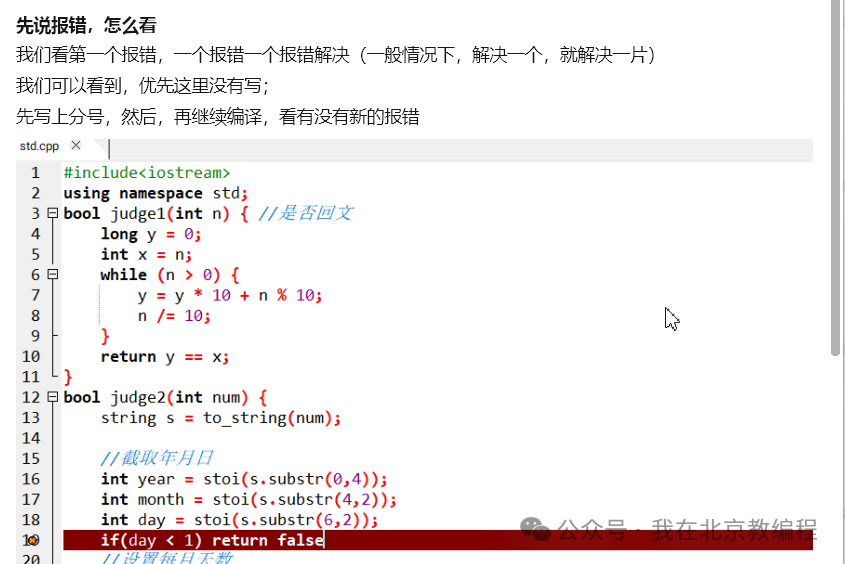
The child saw a screen full of red errors, frowned, threw the mouse aside, and picked up their phone to message me: “I don’t understand, it’s all red,” without even clicking on the error message.
The first instinct was to say they didn’t understand, and they directly messaged me saying “I don’t understand.”
In reality, it wasn’t that they didn’t understand; it was that they lacked the patience to look—more bluntly, they just didn’t want to move when they saw the red lines.
As long as they expand the error message and follow the prompts to address it, it can all be resolved.
What we teachers and parents need to do is teach children how to read error messages, rather than directly telling them where they went wrong and how to fix it.
More Articles
Is Your Child Stuck Learning Programming? The Real Barrier is Not the Code, but the Inner “Noise”
Hua Luogeng’s Learning Method: Thorough Understanding, From Shallow to Deep, Analyzing and Summarizing, From Deep to Shallow
Poor Programming Skills Due to Inadequate Comprehension
About the Author

When you accompany your child in learning programming, do you directly provide answers or guide them to think for themselves? Share your methods in the comments, and let’s avoid pitfalls together.
If you find these guidance methods useful, feel free to share them with other parents who are helping their children learn programming, so we can collectively help children develop independent thinking habits; you can also save this for reference next time your child gets stuck.