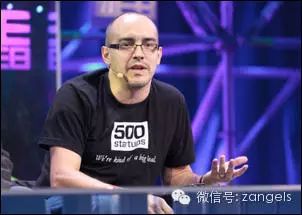
Introduction: Dave McClure, a former technology advisor for Microsoft and Intel, later served as the marketing director at PayPal. In 2011, he founded 500 Startups, a startup incubator and investment firm. At the TechCrunch International Innovation Summit in Beijing, Dave McClure was invited to give a keynote speech. The day before his speech, he shared his investment philosophy and insights on startups in an exclusive interview with “Entrepreneurship”.
“I often feel like a failure, but when I’m being optimistic, I tell myself I’m just a late bloomer.”
This is a quote shared by Dave McClure on his blog. As a former executive at PayPal, he watched several of his former colleagues found great companies like LinkedIn, YouTube, Yelp, and Yammer, so he was naturally eager to catch up by founding 500 Startups, an investment and incubation company based in Silicon Valley.
500 Startups has recently experienced rapid growth, with many of its invested companies performing well. For example, the social media marketing company Wildfire Interactive was acquired by Google for $350 million, 3D printing company MakerBot was acquired by industry giant Stratasys for $400 million, and cloud communication service company Twilio reached a valuation of $500 million after its fourth round of financing.
Recently, at the TechCrunch International Innovation Summit in Beijing, Dave McClure was invited to give a keynote speech. The day before his speech, he shared his investment philosophy and insights on startups in an exclusive interview with “Entrepreneurship”. 500 Startups employs a strategy of making lots of small investments (make lots of little bits) and incremental investments. In Dave McClure’s view, ideas, markets, and teams are all important, but products are king. Moreover, he bluntly stated, “It’s a pure waste of time for startups to draft a five-year plan; business plans are also nonsense because early-stage product market positioning is still an unknown, making long-term predictions very difficult.”
Regarding the current entrepreneurial environment in China, Dave McClure believes that the overall environment in China is somewhat similar to the United States in the late 1990s, with irrational exuberance existing in the short term.
When asked about the differences between them and the well-known Silicon Valley incubator Y Combinator (YC), he joked, “If we were to make a comparison, they might be Steve (Wozniak), while we are (Steve) Jobs.”
Entrepreneurship: How does 500 Startups ensure a certain success rate for incubated companies?
Dave: In 2008, at the invitation of Facebook co-founder Sean Parker, I joined the Founder’s Fund to manage a seed fund, during which I also managed the incubation project of Facebook’s fbFund. A year and a half later, I founded 500 Startups (hereinafter referred to as 500), an early-stage seed fund and business incubator. In June 2010, we raised our first fund of $29 million; in October of the same year, we moved into a new office and launched our incubation program; in 2011, we incubated three rounds of projects, with 12 companies in the first round, 24 in the second, and 34 in the third.
We have offices in Mountain View, California, San Francisco, and Mexico City. Currently, we typically incubate 30 projects per round in San Francisco and 15-20 in Mexico City. If the number of incubated projects is small, the success rate is low. Typically, around 20% of the incubated companies operate relatively smoothly, meaning that out of 25 teams incubated, about 5 will eventually stand out.
In the first year of establishment, we continuously explored how many companies to incubate per round and what budget would be appropriate. Two years later, we basically figured out a cost-benefit ratio that suited our incubation model, which is why we began our internationalization process. Currently, half of our investments are in Silicon Valley, a quarter in other parts of the United States, and a quarter around the world. We provide four months of incubation training for startups from around the globe in Silicon Valley, hosting three sessions a year, while offering amounts ranging from $10,000 to $250,000 based on the company’s valuation for 5% equity in the startup team.
Entrepreneurship: As of now, how many companies have graduated from the 500 Startups incubator?
Dave: About 300 companies. We have incubated 10 rounds in San Francisco, with 25 companies each; in Mexico City, we have incubated 4 rounds, with 15-20 companies each. Although we compete with YC, TechStars, and other incubators, we also collaborate with them. For instance, we have invested in 70 companies that have been incubated by YC, 35 companies from TechStars, and 10 companies from Seedcamp. This means that one-third of our incubated projects come directly to 500, one-third go through YC first, and the remaining one-third go through other incubators before coming to 500.
Entrepreneurship: What are the unique aspects of 500 Startups compared to YC?
Dave: I respect Paul Graham (founder of YC). To some extent, we might be standing on YC’s shoulders, but we come from different worlds. If we were to make a comparison, they might be Steve Wozniak (the early inventor of Apple computers, co-founded Apple with Steve Jobs), while we are Steve Jobs.
Why do I say this? First, YC is hacker culture, good at engineering and programming; 500 is more like a hustler, good at marketing, design, and storytelling (selling ideas to investors). Of course, Paul sometimes says they are intermediaries, but we are relatively less enthusiastic about computer engineering.
Secondly, YC looks for “black swans” like Airbnb and Dropbox, expecting to get the highest valuation during roadshows (the valuations of these two companies might account for three-quarters of their total investment); 500 believes that seed-stage valuations must be realistic, and that A and B round valuations are more important, but at the early stage, what you want are professional industry investors, not non-professional fund providers.
Finally, YC focuses more on teams gathered from all over the world in Silicon Valley, while 500 is more inclined towards internationalization and diversity. We invest in places like Mexico, Brazil, China, India, Australia, and Europe, and our team speaks Mandarin, Hindi, French, Spanish, Hebrew, and more. Additionally, we prefer female entrepreneurs.
Entrepreneurship: Please share your investment philosophy.
Dave: In 2005, Steve Blank wrote a book called “The Four Steps to the Epiphany,” which first proposed the concept of “lean startup,” which is to first launch a minimal viable product in the market, then accumulate user feedback and rapidly iterate and optimize the product to adapt to the market. I believe this theory also applies to the investment field, termed “lean investment.”
It is essentially a strategy of making lots of small investments and incremental investments. First, small amounts are invested in numerous startups, then the best startups are selected through market competition. We then selectively make follow-up investments in these winners, usually led by other VCs. For instance, the first round of investment amounts to $25,000 to $100,000, the second round $100,000 to $500,000, and if all goes well, there may be third and fourth rounds.
Our investment scale is enormous. Traditional VCs might communicate investment intentions with 50 to 100 startups but may only invest in a few of them, while we diversify our investments; for our first fund, we invested in 260 companies, the second fund in 320, and the third fund in 400. This approach helps to spread risk and reduce decision-making time costs.
Some may view this as a “spray and pray” investment method, which belittles our investment strategy. We do diversify, but we are never passive. We have our own assessment and forecasting models and utilize large-scale quantitative experiments for rapid upgrades and iterations; we believe this is a scientific investment operation mechanism.
Entrepreneurship: What are some well-known projects that 500 Startups has invested in?
Dave: Our investment projects include Twilio, Wildfire, MakerBot, SendGrid, Credit Karma, etc., among which the social media marketing company Wildfire Interactive was acquired by Google for $350 million; the 3D printing company MakerBot was acquired by industry giant Stratasys for $400 million; and the cloud communication service company Twilio reached a valuation of $500 million after its fourth round of financing.
Entrepreneurship: It is said that big ideas are not the most important in your view?
Dave: Uber primarily established a network between drivers and users through software, providing point-to-point transportation services. I believe this is incremental innovation, not disruptive innovation. The same goes for Airbnb; initially, it allowed anyone to rent out their idle houses, which is not a big idea, but they achieved significant breakthroughs in execution. For example, Amazon started by selling books online, and his model was not sexy at all.
Entrepreneurship: So you emphasize that “the product is the soul of the team and reflects the team’s execution capability?”
Dave: Yes. Many people say that ideas are important, teams are important, and markets are important, but these are often hard to prove. If a team is truly smart and excellent, I believe it will be reflected in the product; they can prove to others that their product is also excellent. If the product is great and the experience is good, consumers will be willing to pay.
For instance, whether they have created something users need, how the user experience is, and how user growth is, the answers to these questions are straightforward and not conceptual. Therefore, the product is a very direct proof of the team’s capability. However, proving that someone is a great entrepreneur may take many years to conclude.
Entrepreneurship: Your viewpoint may differ from most investors in China, who believe that having reliable founders is the most important, and that it is acceptable if the product is not yet perfect because they believe that reliable founders and teams will surely create something in the future.
Dave: Founders and teams are indeed very important, but most entrepreneurs may be first-time founders, making it difficult to judge whether they can create a great company in the future. Did we know years ago that Uber would become a great company? Looking back, we might say its founder was indeed impressive, but at the time, those 20 entrepreneurs seemed very capable, and we could likely have misjudged 19 of them. I think it takes several years of close interaction to truly understand a person’s potential.
Entrepreneurship: What kind of entrepreneurs can persuade you to invest when they pitch?
Dave: It’s best not to dramatize the entrepreneurial story. Don’t start by painting a grand dream of becoming the next Steve Jobs. First, you need to present your project clearly to investors. Jobs’ presentations were always very clear; secondly, it should be interesting and impressive. Additionally, it’s best to use the past tense rather than the future tense. You need to clearly explain how you turned your idea into a product, what value you created for users, what difficulties you encountered in the process, and how the team responded, rather than telling me how many users you have now or what your plans are for the next five years.
For newly established startups, discussing a five-year plan or grand vision is purely a waste of time; business plans are also nonsense. Business plans are written like this: “After I achieve certain goals, what will I do next?” The premise is that you already possess sufficient information, which applies to financially stable, clearly modeled, low-risk companies.
For startups, at the early stage, product market positioning is an unknown, making long-term predictions very difficult. What you can do is keep trying, first testing option A to see how it goes, then continuously adjusting based on market and user feedback. Once you create a product with strong user stickiness, you may need to start adjusting the market structure and user acquisition structure model, requiring precise analysis of users, which we call a reactive strategy. We need several alternative plans: if this succeeds, what will I do next? If it fails, what should I do next? What I want to see is a model of iterative cycles, an experimental thinking process driven by cycles rather than long-term planning.
At this stage, this is far more important than the vision. There may come a time when I want to hear about your vision, but only if you can do your current work well, the team is fully formed, the product is refined to a certain extent, user accumulation has reached a certain stage, and funding has been successfully completed. Historically, excellent companies stem from continuous execution.
Entrepreneurship: What is your relationship with entrepreneurs?
Dave: I see myself first as an entrepreneur and only then as a VC. Our relationship with founders is informal, like family, and community-oriented. This relationship is built on shared dreams and mutual efforts, with a strong sense of trust, rather than just a partnership contract.
Entrepreneurship: How do you build trust?
Dave: Perhaps our transparency, openness, and way of working have earned us trust. For example, we hold many sharing sessions offline, and I often share personal insights on Twitter and blogs, so many people feel they know me well, even if they have never met me. (Laughs)
Entrepreneurship: What is your impression of the entrepreneurial environment in China?
Dave: As the second-largest economy, China has endless opportunities in the long run, a strong entrepreneurial atmosphere, and plenty of talent. There are indeed entrepreneurs who want to create something real, and investors are excited; but in the short term, the overall environment in China is somewhat similar to the United States in the late 1990s, with irrational exuberance.
Additionally, the tripartite competition among BAT (Baidu, Alibaba, Tencent) is similar to the early days of Amazon, Yahoo, and eBay in the United States, where investors poured money into startups, but the actual situation was not as optimistic as we imagined. This investment behavior will go through an adjustment period before we understand what constitutes a reasonable price.
Entrepreneurship: How long will this adjustment period take?
Dave: The United States took about 5 to 10 years. From 1995 to 2000, there was an investment boom, but this investment-led growth model was unsustainable; from 2000 to 2005, investment fell to a low point, making it difficult for entrepreneurs to raise funds; by 2005, things had basically returned to normal; and in 2008, the financial crisis hit, severely impacting startups. Currently, the state in China is “Go! Go! Go!” with a very fast pace, real estate speculation, investment speculation, and inflated prices.
Entrepreneurship: Do you think it’s a bubble?
Dave: I wouldn’t predict that this is a bubble, but at least it seems to me that valuations are too high. Therefore, it is crucial to choose the right price cautiously when investing. Entrepreneurship: In this case, what companies has 500 Startups invested in within China? Dave: Ma Rui is our head for the Greater China region. In the past few years, we have invested in nearly 15 startups in mainland China, Hong Kong, and Taiwan, including the joke-sharing platform 9GAG in Hong Kong, the e-commerce site Shopline, the photo collage app PicCollage in Taiwan, the social chat tool Cubie, and the cloud service provider ChinaNetCloud in mainland China, etc. We will continue to maintain 5 to 10 investments annually, and may increase that to 10 to 20 in the future.
Entrepreneurship: 500 Startups may be well-known in Silicon Valley, but for some particularly outstanding Chinese startups, they can easily find excellent domestic investors and incubators. What resources can you offer these entrepreneurs?
Dave: We help them build connections, establishing relationships with mentors, advisory boards, and investors. We have a strong community of mentors and investors, with over 2,000 founders and more than 200 mentors. Mentors teach them how to persuade investors and help them find suitable partners and investors in Silicon Valley. Additionally, we excel in user acquisition and marketing, such as online marketing through Facebook, Twitter, and other mobile platforms. Even if they do not come to Silicon Valley for incubation, we can still assist them in market distribution.
Of course, China’s value proposition may differ from other countries. For instance, in Latin America, the Middle East, and Europe, common search engines are Google, social platforms are Facebook and Twitter, and mobile platforms are iOS and Android. But in China, people use Baidu for search, WeChat for social interactions, and Alibaba for e-commerce. We are also considering how to build partnerships with these platforms. However, regardless, there are still entrepreneurs who wish to establish a connection with Silicon Valley and expand into international markets, and we can help in terms of funding, market access, and networking.
Entrepreneurship: 500 Startups has reached a stage where you can talk about your plans for the next three years?
Dave: In the past few years, we have achieved certain results, but sometimes I feel I haven’t run fast enough. I truly wish I could achieve these accomplishments in five years rather than a long 25 years. One of my beliefs is that excellent entrepreneurs can be found not just in Silicon Valley, but all around the world. If a company generates $1 million to $10 million in annual revenue and provides 50 to 100 jobs, that is considered successful; then, 1% of the world’s population has this potential, even more.
Calculating based on a population of 7 billion, there could be 70 million entrepreneurs. Perhaps only 1 million to 10 million of these entrepreneurs have the ability to raise capital and build a brand with a significant impact; our goal is to meet the needs of this group of entrepreneurs. Moreover, we will consider any vibrant city with a population of 1 million; there may be 500 such cities in the world that we hope to explore in the next 5 to 10 years. Therefore, opportunities are endless, and nothing can stop us from stepping into the world.
(Source: Entrepreneurship)