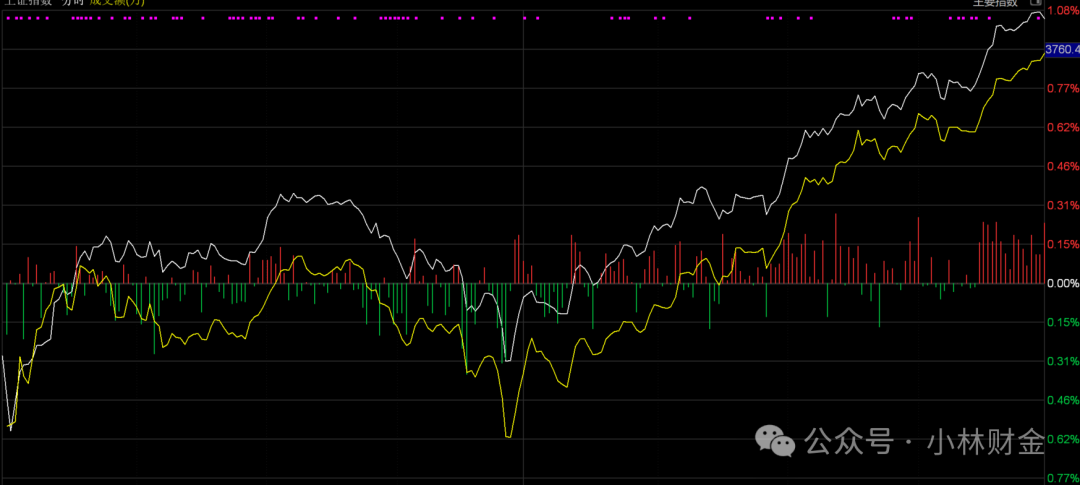
Today, the market played a game of “deep V temptation”; it opened sluggishly but surged over1% in the afternoon! However, don’t just look at the index with joy; the underlying competition was quite exciting. Let’s discuss it in several parts:
1. A-shares: The semiconductor king returns, while liquor quietly fills the gap!
Market performance: The Shanghai Composite Index rose by1.04%, firmly standing above3766 points. The CSI 300 rose even more, by1.14%. However, trading volume shrank a bit, totaling2.45 trillion, which is about2000 billion less than yesterday. What does this indicate? There was a rebound, but the enthusiasm for chasing high hasn’t fully ignited yet; there’s some hesitation.
Key reversal: In the morning, the market was still in the red (the Wind A-share index once fell over0.5%), but suddenly in the afternoon, a “mysterious force” entered the market and pulled it up sharply! Especially in the semiconductor sector, which suddenly gained momentum around lunchtime, becoming the “leader” of the entire market. Observing this sector, it had already been quietly strengthening in August, and today’s surge clearly indicates that funds want to use it to ignite market sentiment, and the effect was indeed good!
Liquor’s rebound: Another highlight is liquor. Don’t underestimate its slow rise (it has only risen less than5% since the end of June), but such blue-chip stocks often have a rebound demand in a bull market. Funds feel that its position is relatively low and safe, so they are gradually moving in.
Leverage funds are bold: Yesterday (the 19th), the financing balance (the money borrowed for stock trading) surged by294 billion! This is more than any day this year. What does this indicate? High-risk preference funds were not scared away by the adjustments of the previous days; instead, they felt it was a “bull market pullback” and rushed to get in and grab profits. However, I remind you that leverage is a double-edged sword; the stocks they aggressively bought yesterday performed poorly today, even correcting, so one must be cautious when chasing hot stocks.
2. Commodity futures: A collective “crash”, the “anti-involution” theme hit hard!
Here, I want to emphasize this point! While the stock market is smiling, the commodity market is crying, experiencing a severe drop! Why is it called “anti-involution”? It refers to those industrial products that may have excess capacity or weak demand.
Leading the drop: Lithium carbonate! It directly hit the limit down (-8%)! The trigger was a major lithium mine in Yichun, Jiangxi (Yinlithium) announcing its resumption of production. Previously, the market had expected strict inspections on Jiangxi lithium mines and a supply disruption, but the sudden resumption of production shattered the bullish expectations, leading to a frantic exit of profit-takers. However, I believe this wave of sharp decline is more about sentiment than substance! Why? Looking at the data:
In August, the supply and demand of lithium carbonate is still in a tight balance, supported by downstream stocking demand during the peak season.
Other major mines in Jiangxi (like the one in Ningde) have not resumed production yet, and the supply risk has not been alleviated!
(Look at this chart, lithium carbonate futures have recently taken a roller coaster ride! Today’s large bearish candle is particularly eye-catching.)
Falling brothers: Glass, soda ash, and double coke (coke and coking coal): Glass fell4.4%, and soda ash fell even more, by5%. Their declines are mainly due to weak demand. Glass inventories are high, and prices have been continuously dropping; coking coal wants to raise prices, but steel mills are uncooperative and are still in negotiations. The production limits in Tangshan steel mills have also significantly suppressed demand.
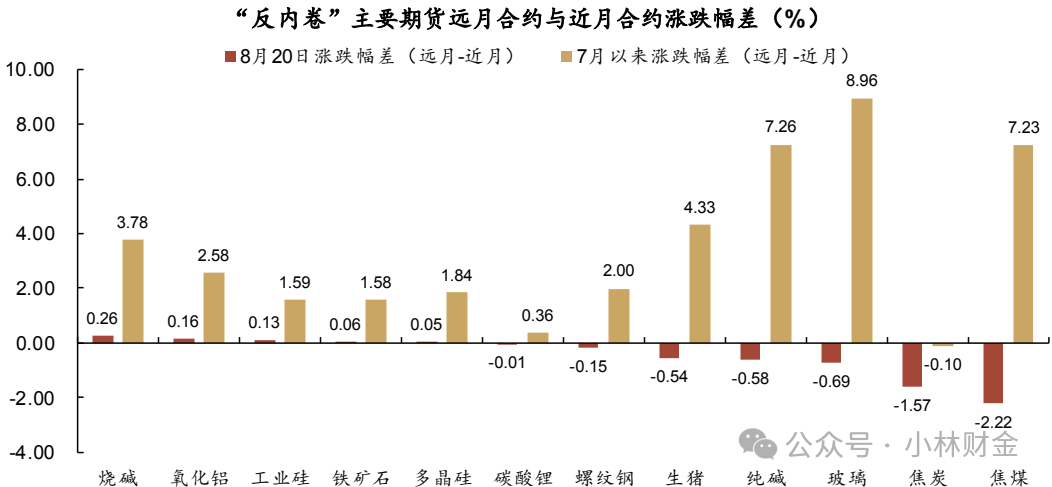
Market sentiment has changed: There’s an important signal! For popular commodities like lithium carbonate, coking coal, and glass, futures prices are cheaper than spot prices (futures contango). Moreover, long-term contracts are cheaper than short-term contracts! What does this indicate? Funds have a very pessimistic outlook for the future, believing that prices will continue to fall. This table makes it clearer:
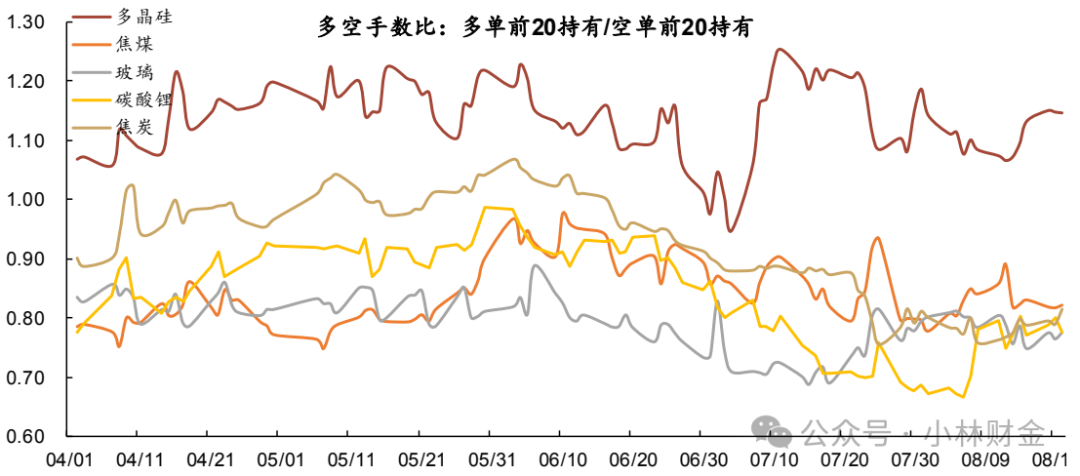
(Note the line for lithium carbonate; the long-short ratio has turned downward, indicating that short positions are gaining strength!)
Commodity summary: Overall, industrial products are experiencing a “cooling down”, returning from speculative expectations to the reality of weak demand. Only lithium carbonate, due to unresolved core supply issues, is likely to continue to fluctuate wildly, creating a thrilling experience!
3.Bond market: The stock market’s little brother, a steady follower!
Today, the bond market acted more like a “drama queen”, completely led by the stock market:
In the morning, seeing the stock market drop, the bond market thought “an opportunity has come”, and interest rates (yields) fell.
In the afternoon, when the stock market surged back into the green, the bond market immediately “got scared”, and interest rates shot up. Even though the liquidity at the end of the day had clearly loosened, it didn’t bounce back much.
Why so timid? I analyze that there is actually money (the scale of wealth management increased rapidly in July by2 trillion!), but the wealthy investors (wealth management, banks, insurance) are afraid to buy bonds in large quantities. Wealth management fears large fluctuations, banks worry about losses affecting their balance sheets, and insurance companies only want to wait for clear opportunities on the right side. As a result, the bond market cannot stand firm and can only look at the stock market’s face. When will it turn around? Either the central bank releases a lot of liquidity, or the stock market collapses (but we don’t want to see that, right?).
4.Hong Kong stocks& southbound: Slightly warming up, but funds run away at high points?
The Hang Seng Index rose slightly by0.17%, while tech stocks fell slightly. Consumer and semiconductor stocks performed well, but pharmaceuticals dropped significantly.
Key signal: Southbound funds had a net outflow of146 billion HKD! Moreover, this mainly occurred when the Hong Kong stocks rose at the end of the day. What does this indicate? There’s a strong desire to take profits! Investors want to cash out after making a profit. Tencent (net inflow) and Alibaba (net outflow) received different treatments.
Pop Mart dazzles! Performance skyrocketed (profit year-on-year +396%!), and it even announced that next year’s revenue might reach20-30 billion, causing its stock price to soar12.5%! During the mid-year report season, it’s essential to keep an eye on stocks with performance exceeding expectations.
Summary by Xiaolin:& Tomorrow’s highlights:
1. The strength of the rebound depends on trading volume: Today’s rebound was on reduced volume; whether tomorrow can increase volume is key to confirming strength. Keep an eye on the transaction amount.
2. Semiconductor sustainability: Today it led the market sentiment; whether it can continue to hold the flag tomorrow will affect the entire tech sector and market sentiment.
3. Commodity differentiation: After the sharp drop in lithium carbonate, will there be a rebound? Will the contango of other industrial products (glass, soda ash, double coke) deepen? This reflects how pessimistic the market is.
4. Movements of leveraged funds: They are aggressive, but the stocks they bought today performed poorly; will they cut losses or continue to hold tomorrow? This will affect local hotspots.
5. Mid-year report treasure hunting! Pop Mart is a good example. The end of the month is a concentrated period for performance reports; real performance growth is the hard truth! Pay more attention to announcements.
6. Volatility (IV) hides secrets: This afternoon, the options volatility index (IV) jumped, indicating that short-term speculative funds are active. If there are continuous large increases accompanied by risingIV, we need to be wary of the risk of overheating in the short term!
Xiaolin’s advice: The market plays with “expectation differences” and “emotional pendulums”. Today’s collective collapse of commodity futures is a concentrated release of emotion, especially for lithium carbonate. The bond market’s “follower” attribute is difficult to change in the short term. In terms of operations, don’t blindly chase high, especially for highly volatile products. During the mid-year report season, it’s more prudent to study companies with solid fundamentals and surprising performance!
Xiaolin’s analysis is quite down-to-earth, right? Wishing everyone successful investments!
(The views are for reference only. The market has risks; decisions should be made cautiously.)