Click the blue text
Follow us
Article Introduction
Recently, the Intelligent Detection and Edge Computing Research Group of the School of Electronic Information published their latest research results titled “DGPAS: DQN-GRU Guided Distributed DNN Pipeline Training and Adjacent Scheduling in Edge Networks” in the internationally renowned journal ‘Computer Networks’ (CCF Class B, JCR Zone 1). This achievement is led by Shanghai University of Electric Power, with master’s student Li Jiayi as the first author and Professor Wang Xiaogang as the corresponding author, in collaboration with other graduate students from the research group, the School of Computer Science at Shanghai Jiao Tong University, and the Cloud and Distributed Systems Laboratory at the University of Melbourne, Australia.

Deep Neural Networks (DNNs) are increasingly being deployed in distributed edge computing environments to meet the demands of real-time computer vision detection tasks in various industrial applications. However, the training and inference of DNN models at the edge often face challenges such as competition for computational resources, limited transmission bandwidth, and heterogeneous communication devices. Existing methods have failed to effectively address issues such as unbalanced task scheduling and idle waiting of devices in heterogeneous edge environments. To this end, this study proposes a DQN-GRU guided distributed deep neural network pipeline training and adjacent scheduling model (DGPAS), which significantly improves the training efficiency of DNNs on resource-constrained devices in heterogeneous edge networks. By combining deep reinforcement learning and temporal feature modeling, the model framework is divided into preparation and execution phases, where DNN model partitioning and device scheduling are performed respectively based on a synchronous pipeline parallel mechanism.
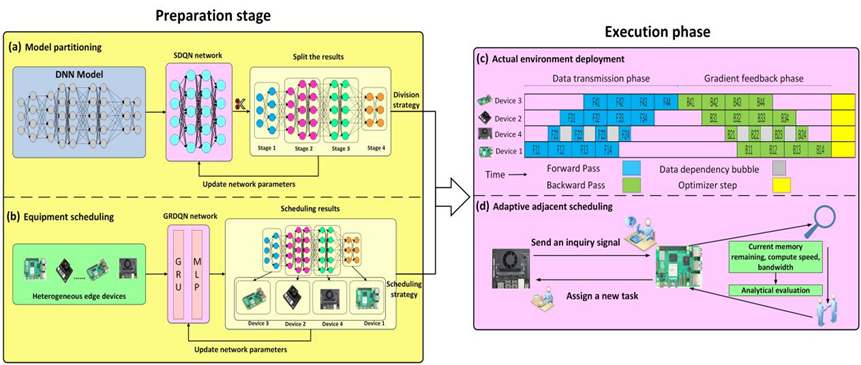
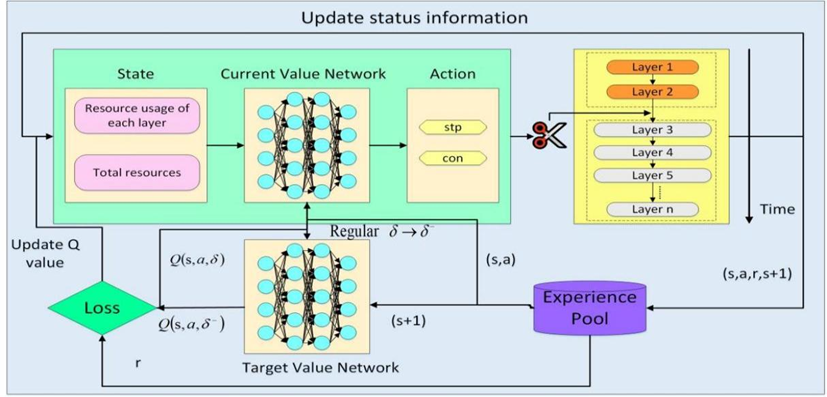
By combining Deep Q-Networks (DQN) with Gated Recurrent Units (GRU), two network models, SDQN and GRDQN, were designed to optimize the decision-making process, thereby obtaining optimal strategies in model partitioning and device scheduling, effectively enhancing the training efficiency of the model. Additionally, a new adaptive adjacent scheduling strategy was designed in the execution phase, which dynamically adjusts task allocation based on the resource status and computational capabilities of adjacent devices (i.e., optimizing the computational load among edge devices through time synchronization and load balancing) to address the “data dependency bubble” problem caused by performance discrepancies among devices, ensuring good training efficiency even in complex dynamic environments.
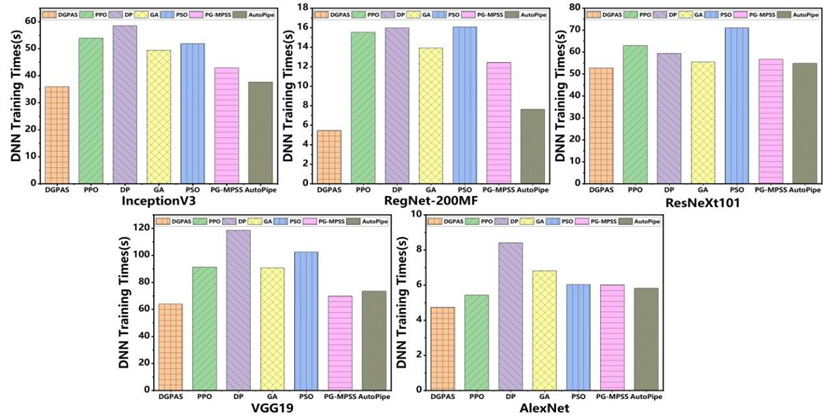
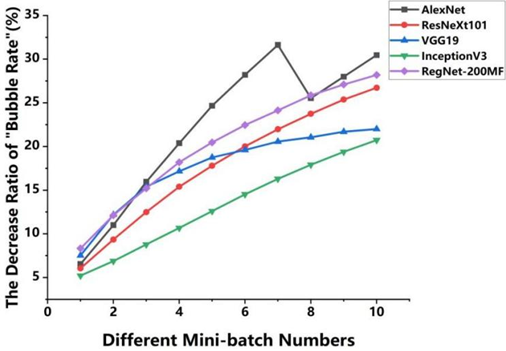
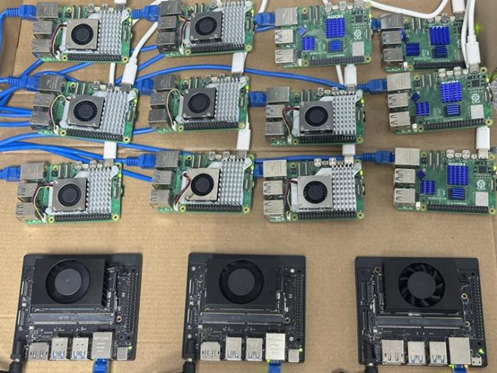
The experiments were conducted on a distributed platform consisting of 15 heterogeneous edge inference boards equipped with GPUs and Raspberry Pi 5. The experimental results show that under five mainstream DNN models, compared to baseline and existing related methods, the proposed DGPAS, which combines GRU and DQN, reduces the average training time by 36.5%. After adopting the adaptive adjacent scheduling method, the “bubble rate” during training decreased by an average of 36.96% under the same DNN model and different mini-batch sizes, significantly improving the training efficiency and robustness of edge DNN models.
Paper link:
https://doi.org/10.1016/j.comnet.2025.111592
END

WeChat ID | SDJU School of Electronic Information
Scan the QR code
Follow us
Edited by: Xuanmei Liu Yuchun
Guidance: Wang Xiaogang
Review: Yu Huiwen