Currently, the cultivation of intelligent factories has achieved initial results. More than 30,000 basic-level intelligent factories, over 1,200 advanced-level intelligent factories, and more than 230 excellent-level intelligent factories have been established nationwide.
This is a new change in Chinese factories: robotic arms can automatically adjust working parameters based on environmental changes; a large number of sensors are placed on the production line, and each process can be precisely controlled by a “digital brain”; relying on industrial large models, one production link can connect the entire supply chain…
Industry insiders believe that artificial intelligence and robotics are reshaping production logic at an unprecedented speed. With the emergence of more efficient and smarter “super factories,” the manufacturing industry is accelerating into the “intelligent manufacturing era.”
Robotic “Operators” Continue to Evolve
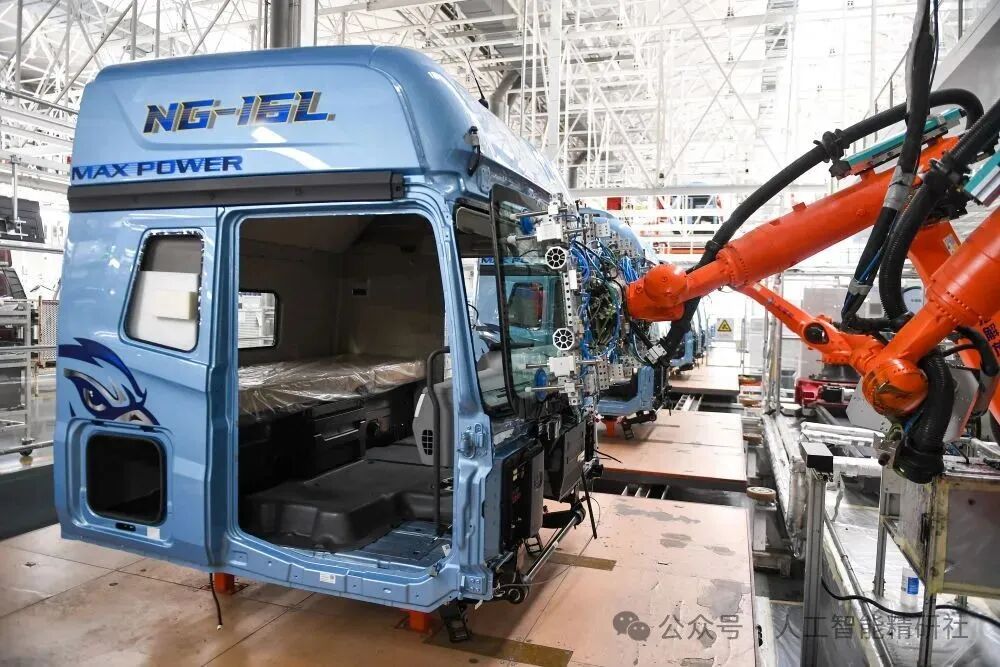
What changes will occur when robotic arms can “think”? Entering the painting workshop of China Yituo’s assembly line, the production front line provides the answer.
In the workshop, the painting operation of tractor chassis is underway, with robotic arms skillfully maneuvering, controlling the paint film thickness error within millimeter levels. Technicians told reporters that robotic arms integrated with intelligent technology can automatically generate spraying paths and adjust relevant parameters based on on-site temperature and humidity. “Industrial robots can now sense changes in the production environment and achieve adaptive intelligent processes.”
Smarter and more flexible—this is a reflection of the application of industrial robots in today’s factories.
Recent investigations by reporters in the automotive, electronics, and textile industries found that through AI empowerment, industrial robots have increased their capabilities in perception and task understanding, enhancing their agility, and are accelerating their evolution from traditional automated mechanical devices to embodied intelligence.
Achieving “Hand-Eye Coordination.” In the Luoshi Intelligent Manufacturing Industrial Park in Zoucheng, Shandong, a collaborative robot equipped with tactile and visual sensors is accurately demonstrating the assembly of a computer USB interface. The robotic arm seems to be endowed with human-like touch and vision, sensing contact force in real-time during the connection process and dynamically adjusting angle and force. Luoshi Robot CEO Tuo Hua stated that by enhancing the robot’s perception and decision-making capabilities through artificial intelligence technology, this robot can handle micron-level precision assembly.
Unlocking More Skills. Industrial robots require corresponding process packages to provide “experience points” for completing different processes. In recent years, robots have entered production lines, with domestic robot manufacturers focusing on different trades such as palletizing, spraying, and welding, launching corresponding process packages. Meanwhile, the research and development of “universal robots” compatible with multiple skills is also accelerating.
“We are developing a universal technical base for intelligent robots to support the development of various process packages for different industrial scenarios on this basis,” said You Wei, Chairman of Efort Intelligent Equipment. In the future, industrial robots will not only be able to follow a model similar to “a smartphone loading different apps” to meet the “universal + personalized” needs of various industries but will also be able to adjust production more flexibly and adaptively according to market changes.
Production Lines Empowered by “Data”
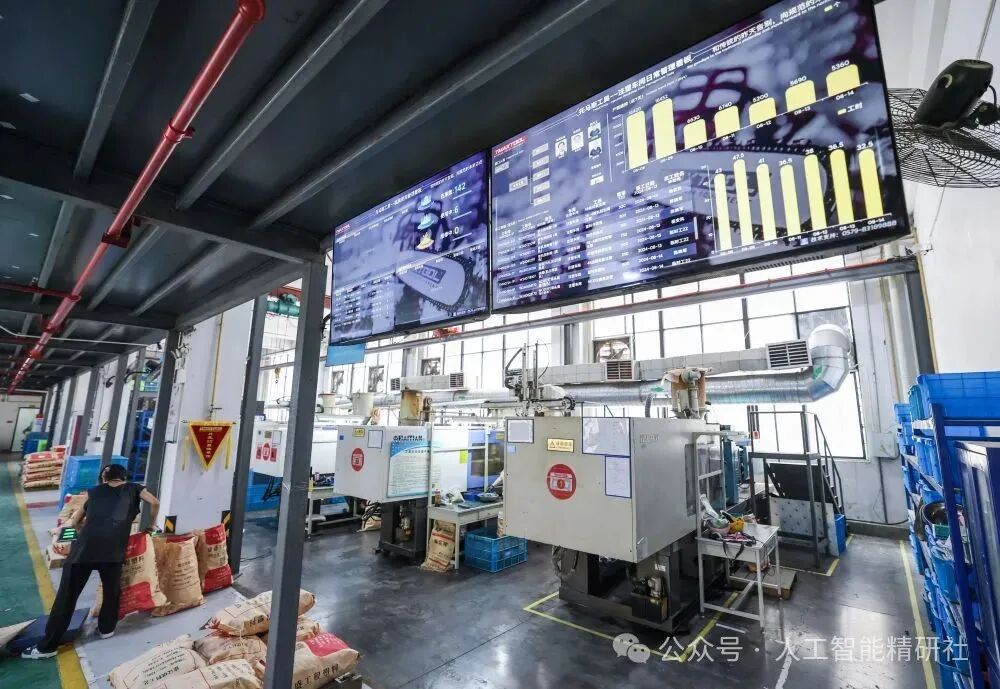
The intelligence of factories involves not only the “upgrading” of robots but also the renewal of production lines.
At the intelligent factory of Luozhou Group’s wind power gearbox bearings, the offline physical production line and the cloud-based “virtual factory” are organically combined.
Wang Xinying, Chairman of Luozhou Group Co., Ltd., introduced that the factory uses a digital twin system to display key production data in real-time, such as equipment operation information and product processing cycles, and connects with the company’s production execution system to obtain relevant data on production, inventory, and market orders, achieving more efficient resource allocation and intelligent operational management.
Today, new generation digital technologies such as artificial intelligence are forming a multidimensional empowerment pattern on industrial production lines, opening up new possibilities for industrial production.
Looking at R&D design, China Shipbuilding is promoting the combination of generative design and autonomous industrial software, rapidly simulating tens of thousands of schemes, compressing the new ship design cycle by about 40%.
Looking at production scheduling, the Chongqing Midea General Water Machine Factory utilizes supercomputers to issue key parameters and drawings for components, conducting intelligent production scheduling, significantly reducing material waste and raw material inventory, with operating costs reduced by 15%.
Looking at factory maintenance, the “Oriental Wisdom Source,” the first industry-specific vertical large model focusing on major energy equipment developed by Dongfang Electric Group, can accurately generate operation and maintenance suggestions, providing users with a “digital prescription”…
As of the end of March, the penetration rate of digital R&D design tools in industrial enterprises was 83.5%, and the CNC rate of key processes was 66.2%. More and more production lines are being empowered by “data”.
Super Factories Accelerate Emergence
What will future factories look like? We can explore this through various practical cases from different regions.
——Smarter.At the GAC Aion Intelligent Ecological Factory, a new energy vehicle rolls off the production line every 53 seconds at the fastest. This high efficiency is attributed to the integration of artificial intelligence, big data, robotics technology, advanced process design technology, quality management, and intelligent logistics solutions in the factory.
Typical scenarios of intelligent manufacturing are the foundation of intelligent factory construction. The Ministry of Industry and Information Technology recently issued the “Reference Guidelines for Typical Scenarios of Intelligent Manufacturing (2025 Edition),” which further highlights the integration and application of new artificial intelligence technologies in typical scenarios, strengthening the guidance for enterprises’ intelligent upgrades.
——More Flexible.Located in Wuhan, the Pansheng Technology Intelligent Factory operates multiple high-performance computer flexible customization production lines efficiently. Customers place orders online, and the factory can ship within 24 hours, meeting large-scale personalized customization needs. Industry insiders believe that flexible manufacturing can adapt to market changes and is a concrete manifestation of strengthening the resilience of the industrial chain, which will further become one of the core competitive advantages of manufacturing enterprises in the future.
——Greener.At Schneider Electric’s factory in Wuxi, greening is everywhere: combining artificial intelligence genetic algorithms to optimize process parameters, reducing energy consumption of a single device by 25%; the AI dynamic control system for HVAC achieves a 56% reduction in water usage per product group… When technology meets the era’s proposition of green transformation, factories achieve a dual leap in economic and ecological benefits.
The Chief Engineer of the Ministry of Industry and Information Technology, Xie Shaofeng, stated that the next step will be to promote the comprehensive and full-chain integration of digital technology to empower the high-end, intelligent, and green development of the manufacturing industry, providing strong support for high-quality economic development.