
[Submission Focus] 2022 Special Call for Papers
Table of Contents for Issue 1, 2022 ▏Special Topic: 5G Core Network
Review of the Communication Industry in 2021 and Outlook for 2022
Research on Key Technologies for 5G Edge Computing Networking
Exploration of Enhanced Application Strategies for 5G Access and Mobility Management
Discussion on the Evolution Requirements of 5G-Advanced Networks and Services
Analysis of 5G Dual-Domain Private Network Solutions
Application of Federated Learning in Intelligent Mobile Communication Networks
UPF Forwarding Model Supporting 5G LAN
Progress of 5G Applications in the Industrial Internet
Research on Voice Service Evolution for 5G Advanced Networks
Research on the Integration and Evolution of 5G and Satellite Networks
Overview of 5G-Advanced Core Network Technologies
5G Multi-Access Coordination Solutions and Key Technologies Based on AI Algorithms
Application Demonstration of IoT Systems Based on 5G Smart Parks
In-depth Analysis and Future Enhancements of Two-Step Random Access Mechanism
“Mobile Communication” Issue 1, 2022 · Research and Discussion
Research on Key Technologies for Operator IMS Interconnection Networking
Zhai Zhenhui, Qiu Wei, Wu Qian, Li Xintian, Ma Hongyuan
(China Mobile Communication Group Design Institute Co., Ltd., Beijing 100080)
[Abstract]With the rapid development of 4G and 5G network technologies in recent years, traditional interconnection methods can no longer meet future business development needs. Therefore, achieving IP-based interconnection through IMS networks has become an essential path for the evolution of operator networks. This paper conducts an in-depth analysis and research on the key networking technologies involved in IMS interconnection and the adjustments and transformations of existing networks, providing important ideas and methods for the subsequent commercial deployment and engineering construction of operator IMS interconnection.
[Keywords]Interconnection; IBCF/TrGW; IMS
doi:10.3969/j.issn.1006-1010.2022.01.015
Classification Number: TN915 Document Identification Code: A
Article Number: 1006-1010(2022)01-0091-05
Citation Format: Zhai Zhenhui, Qiu Wei, Wu Qian, et al. Research on Key Technologies for Operator IMS Interconnection Networking[J]. Mobile Communication, 2022, 46(1): 91-95.

0 Introduction
In recent years, with the rapid development of communication technology, voice services have gradually evolved from traditional circuit-switched methods to VoLTE (Voice over Long-Term Evolution) based on IMS (IP Multimedia Subsystem) networks. With the rapid advancement of 5G technology, voice services will further evolve towards the 5G standard voice solution VoNR (Voice over New Radio). Both VoLTE and VoNR are based on IMS networks.[1] IMS, as a core technology of the next-generation network, can provide a unified control core, support various fixed/mobile access methods, and flexibly and quickly provide service capabilities. Operators can offer multimedia services to both fixed and mobile users through IMS networks.[2]
Although domestic basic telecom operators have built IMS networks covering the entire country, interconnection between operators still relies on traditional circuit domain gateways, and interconnection between IMS networks has not been achieved. To meet the future development of voice services and adapt to the rapid development of IMS networks, the Ministry of Industry and Information Technology decided to promote IMS network interconnection nationwide in 2020. This paper focuses on the key networking technologies in the IMS interconnection scheme and their impact on existing networks, providing a technical foundation for the formulation of subsequent IMS interconnection schemes and engineering construction.
1 IMS Interconnection Scheme
1.1 Current Status of Interconnection Between Operators
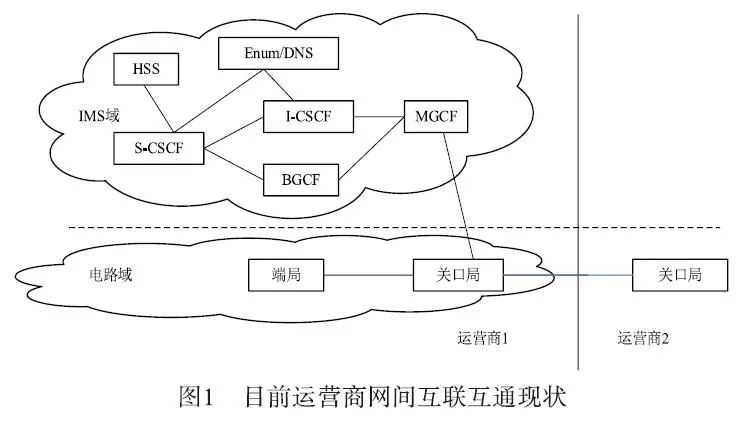
Currently, interconnection between operators is achieved through gateways set up in various provinces using TDM methods. All 2G/3G/4G users, including IMS users (both mobile and fixed users registered in the IMS network), must revert to the circuit domain when making inter-network calls, routing to the gateway in the destination’s province to achieve interconnection. With the rapid development of 4G/5G networks, 2G/3G networks are facing gradual elimination and shutdown, and the current interconnection method through circuit domain gateways will severely restrict the evolution and development of each operator’s network. Therefore, achieving interconnection through IMS networks has become a common choice for operators. The current status of interconnection between operators is shown in Figure 1:
1.2 IMS Interconnection Scheme
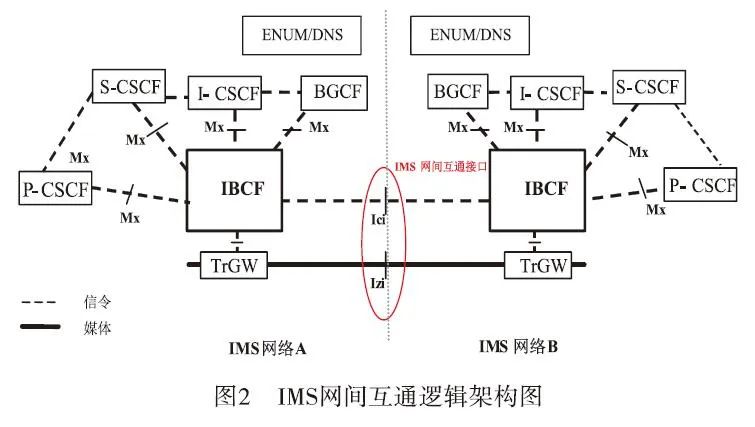
Interconnection of voice and multimedia services based on IMS networks is achieved through IBCF (Interconnection Border Control Function) / TrGW (Transition Gateway) set up by each operator within the province. IBCF/TrGW is deployed between different IMS core networks or between IMS core networks and other IP networks, with interconnection using IP trunk connections.[3] IBCF connects to the P-CSCF/I-CSCF/S-CSCF/BGCF within the network via the Mx interface, while the signaling plane of IBCF connects to other networks via the Ici interface, and the media plane (TrGW) connects to other networks via the Izi interface.[4] Considering the significant risks associated with Enum/DNS (Electronic Numbers to URI Mapping/Domain Name System) interconnection queries between operators, Enum/DNS interconnection is not selected. The networking architecture diagram for IMS interconnection is shown in Figure 2:
Interconnection services between operators in each province are conducted through the provincial interconnection points IBCF/TrGW, with inter-provincial long-distance routing methods remaining consistent with the existing network, still adopting the traditional inbound network approach[6], that is, interconnection is achieved through the IBCF/TrGW of the province to which the called user belongs.
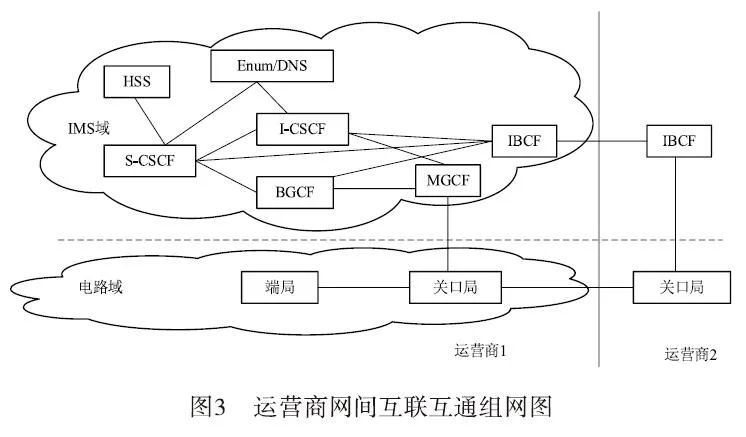
Since all operators currently have a certain number of non-IMS users, there remains a necessity for traditional gateways in the short term. Therefore, interconnection will maintain a coexistence of traditional gateways and IBCF/TrGW. Each operator needs to choose interconnection nodes based on the nature of the calling user:
(1) When the calling user is an IMS user, interconnection will be achieved through IBCF/TrGW.
(2) When the calling user is a non-IMS user, interconnection will still be achieved through traditional interconnection gateways, maintaining consistency with the current network routing.[7]
The interconnection networking diagram for operators is shown in Figure 3:
Static routing is configured between the networks of different operators, and to avoid conflicts with internal addresses, the external service addresses of interconnection devices use public IP addresses.
In addition, interconnection must also have network layer disaster recovery and service layer disaster recovery capabilities. The routers of each operator are connected in a mesh topology, configured with bidirectional routing to ensure that in the event of a single link failure or a failure of a single device, services can be rerouted through the second route. Each operator must deploy at least two IBCF/TrGW; when one IBCF/TrGW fails, the disaster recovery switching mechanism supports other IBCF/TrGW in the network to take over the services of the failed IBCF/TrGW. When the failed IBCF/TrGW recovers and can handle services, the disaster recovery back mechanism supports the gradual migration of interconnection services back to the original IBCF/TrGW.[8]
2 Analysis of Key Networking Technologies
2.1 Analysis of Multi-IBCF/TrGW Networking Technologies
According to service disaster recovery requirements, each operator needs to deploy IBCF/TrGW in pairs, meaning at least two sets of IBCF/TrGW must be deployed, and the devices can work in load-sharing or primary-backup modes. However, during actual deployment and engineering construction, due to the processing capacity limitations of IBCF/TrGW devices from manufacturers, provinces with high interconnection traffic may require multiple pairs of IBCF/TrGW. Various networking schemes and working modes can exist between multiple pairs of IBCF/TrGW devices, and different schemes also have varying impacts on network data configuration and functional transformation. Therefore, this paper will conduct further in-depth research and analysis on different networking schemes.
(1) Scheme 1: Multiple sets of IBCF/TrGW operate in a POOL load-sharing manner, responsible for all interconnection services within the province.
In this scheme, multiple sets of IBCF/TrGW within the province form a POOL and are assigned a common hostname. The naming principle for each province’s domain name remains consistent with the existing network domain name, requiring only one domain name for the entire province. Since ENUM/DNS interconnection is not achieved among operators, the secondary ENUM/DNS must be configured with data for all number segments of other networks in the province and the mapping relationship between domain names and each network element within the IBCF/TrGW POOL. The networking architecture diagram for this scheme is shown in Figure 4:
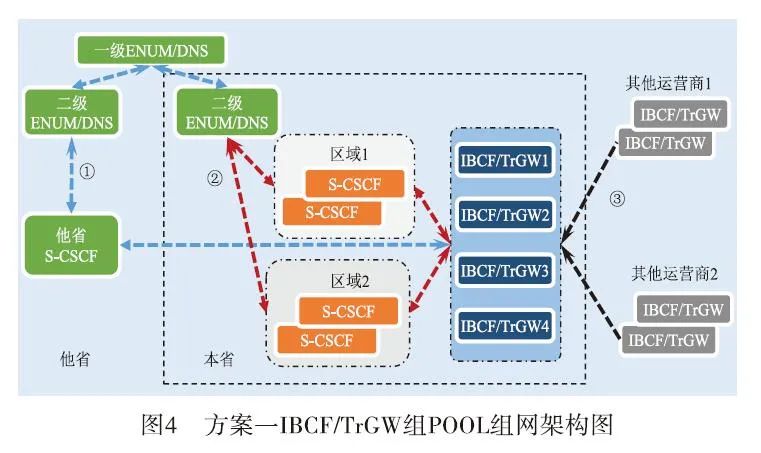
Using this networking scheme, the routing for several main scenarios is as follows:
Scenario 1: Users from other provinces’ IMS call users in this province.
The S-CSCF of the other province queries the secondary Enum/DNS of that province to find the primary Enum/DNS, then queries the secondary Enum/DNS of this province. It returns the common hostname of the IBCF POOL, followed by SRV and A record queries to obtain the IP address, achieving load-sharing among multiple IBCFs.
Scenario 2: Users in this province call users from other networks.
The S-CSCF of this province queries the secondary Enum/DNS to obtain the common hostname of the IBCF POOL, then performs SRV and A record queries to obtain the IP address, achieving load-sharing among multiple IBCFs.
Scenario 3: Users from other networks’ IMS call users in this province.
Calls from other networks are routed to a certain set of IBCF/TrGW within the POOL for interconnection.
(2) Scheme 2: Multiple sets of IBCF/TrGW are deployed regionally to facilitate service routing by business area.
This scheme requires dividing the province into multiple business areas, with one pair of IBCF/TrGW deployed in each business area. The networking architecture diagram for this scheme is shown in Figure 5:
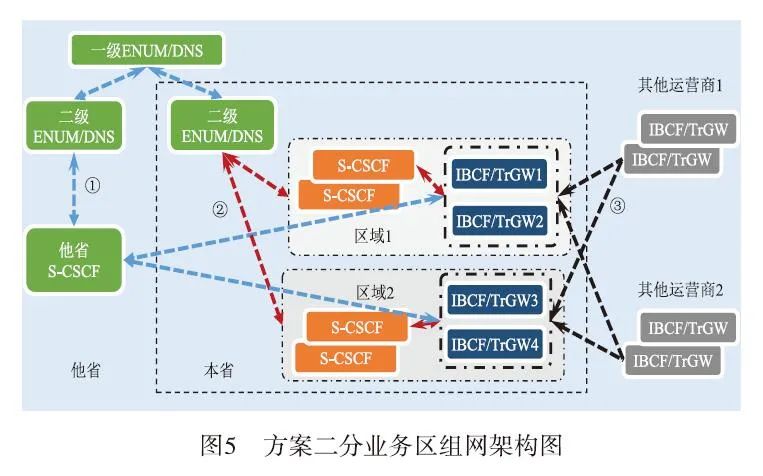
This scheme can be implemented in two ways:
1) Method 1: Assign independent domain names for each business area, distinguishing by domain name.
This scheme requires assigning separate domain names for the number segments of other networks in each business area and configuring the data for these number segments in ENUM/DNS.
Scenario 1: Users from other provinces call users in this province.
Calls from other provinces are routed through the primary ENUM/DNS to the secondary ENUM/DNS of this province, achieving interconnection of IP addresses corresponding to the IBCF/TrGW for that area based on the different domain names of the called numbers.
Scenario 2: Users in this province call users from other networks.
The S-CSCF of this province queries the secondary ENUM/DNS, achieving address interconnection of the IBCF/TrGW for that area based on the different domain names of the called numbers.
Scenario 3: Users from other networks call users in this province.
Other network operators must configure routing according to the same business partition for their number segments. If the other network’s IBCF does not support these requirements, they can only achieve load-sharing among multiple IBCF/TrGW, and cannot achieve interconnection by business area.
If operators adjust their business areas in the future, other operators must synchronize updates to domain name divisions and data configurations.
2) Method 2: Enable view functionality in ENUM/DNS to support business from different areas being routed by different IBCF/TrGW.
The secondary ENUM/DNS within the province must support view functionality, returning different query results based on different query sources to enable interconnection services for different business areas to be routed by different IBCF/TrGW devices.
Scenario 1: Users from other provinces call users in this province.
For calls from other provinces’ users to users in this province, it is not possible to select the IBCF/TrGW based on the calling S-CSCF address information through the ENUM/DNS view function, and only load-sharing among multiple IBCFs can be achieved based on weight.
Scenario 2: Users in this province call users from other networks.
The S-CSCF of this province queries the secondary ENUM/DNS, and with the ENUM/DNS view function enabled, can select the corresponding IBCF/TrGW based on the business area of the calling S-CSCF.
Scenario 3: Users from other networks call users in this province.
Other networks must configure routing according to their mobile business partitions. If the other network’s IBCF/TrGW does not support these requirements, they can only achieve load-sharing among multiple IBCF/TrGW, and cannot achieve interconnection by business area.
Using this method, the core network area planning must be coordinated with the interconnection area planning, and the IBCF/TrGW area should be greater than or equal to the coverage area of the S-CSCF POOL. For scenarios where users from other provinces call users in this province, interconnection by area cannot be achieved.
Through research and analysis of the above schemes, it can be concluded that the regional deployment scheme, regardless of the method adopted, has additional requirements for device functions or data configurations, and future adjustments to business areas will require data configuration adjustments, making planning and implementation relatively complex. In contrast, Scheme 1’s province-wide POOL scheme has the following main advantages:
(1) Simple network planning. The POOL scheme only requires that the overall provincial traffic connects to the POOL without needing to plan by city or number segment. Even if business area adjustments occur, it will not affect the IBCF/TrGW devices.
(2) Simple data configuration. The POOL scheme only requires one domain name to be assigned for each province, unaffected by regional divisions. In contrast, the regional deployment scheme requires each area to have a separate domain name or requires ENUM/DNS to have functionalities for data configuration by area, making data configuration relatively complex.
(3) No special requirements for other operators. The POOL scheme does not impose special configuration requirements on other operators. In contrast, the regional scheme requires other operators to route according to the province’s area divisions, placing higher demands on them.
Based on the analysis above, it is recommended to prioritize the IBCF/TrGW POOL scheme.
2.2 Surrounding Transformation Analysis
The implementation of IMS interconnection changes the way calls initiated by IMS users exit the network, shifting from traditional gateways to exiting from IBCF/TrGW within the IMS network. This may necessitate transformations of surrounding network elements, requiring specific analysis of which network elements will be affected, and such transformations must be synchronized during engineering construction.
From a data configuration perspective, since ENUM/DNS interconnection is not achieved among operators, each province’s secondary ENUM/DNS must be configured with routing data for the number segments of other network operators, and the primary ENUM/DNS must configure routing data for other network operators’ number segments to the corresponding secondary ENUM/DNS in the province.[9]
Moreover, routing adjustments have resulted in changes to the traffic handling capacity of certain network elements, analyzed as follows.
(1) Outbound routing for calls initiated by IMS users in this province.
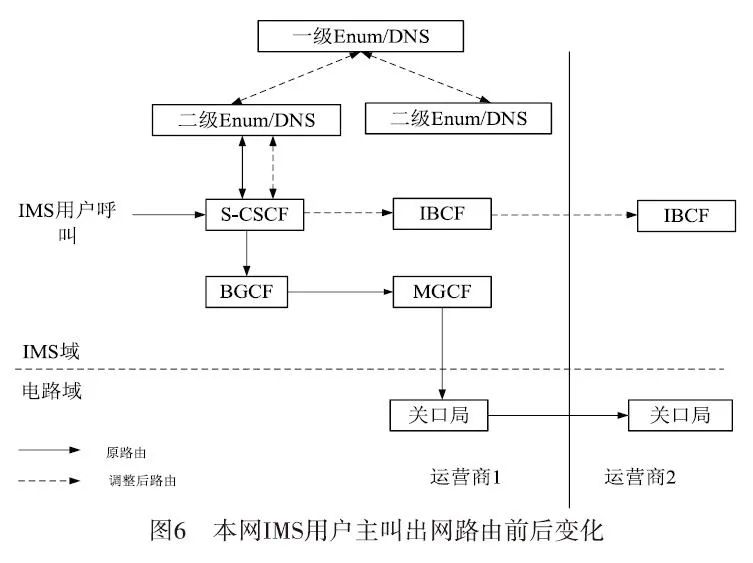
Original routing: Outgoing calls from the calling IMS user’s belonging S-CSCF query the secondary ENUM/DNS of the province where the calling user belongs. When the called number is found to be from another network, it is routed through BGCF and MGCF, reverting to the CS domain for exiting the network.
Adjusted routing: Outgoing calls from the calling IMS user’s belonging S-CSCF query the secondary ENUM/DNS of the province where the calling user belongs. If the primary and backup calls are from different provinces, it must also undergo a primary ENUM/DNS query to find the secondary ENUM/DNS of the province where the called number belongs, ultimately routing the call to the IBCF/TrGW of the called user’s province. Changes in outbound routing for IMS users in this province are shown in Figure 6:
(2) Inbound routing for calls initiated by IMS users from other networks.
Original routing: Calls initiated by IMS users from other networks enter through gateways. If the called number is an IMS user in this province, it is routed through MGCF and BGCF into the IMS network; if the called number is a non-IMS user, the call is routed within the CS domain.
Adjusted routing: Calls initiated by IMS users from other networks enter through IBCF/TrGW, querying HSS and ENUM/DNS via I-CSCF. If the called number is an IMS user in this province, it enters the IMS network; if the called number is a non-IMS user, the call is routed through BGCF and MGCF to the circuit domain.[10] Changes in inbound routing for IMS users from other networks are shown in Figure 7:
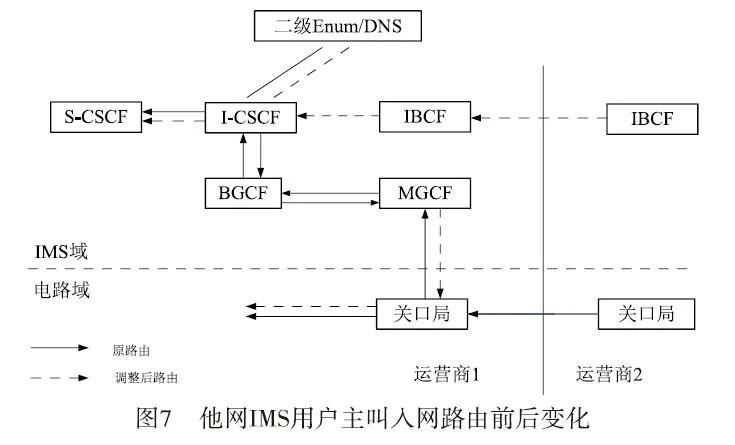
From the analysis, it can be concluded that if the number of IMS users in the current operator exceeds that of non-IMS users, it can be inferred that the processing capacity demands for BGCF, MGCF, and gateways will slightly decrease. Meanwhile, I-CSCF will increase related queries for non-IMS users in this province; the secondary ENUM/DNS will see an increase in queries for calls from IMS users in other provinces to users in this province and for calls from IMS users in other networks to non-IMS users in this province; the primary ENUM/DNS will experience an increase in cross-province query counts for calls from IMS users in this province to users in other provinces.
For network elements requiring additional processing capacity due to IMS interconnection, this paper provides the following algorithms to estimate the additional processing capacity needed for these elements. The specific algorithms are as follows:
(1) Additional query counts for the secondary ENUM/DNS:

Where: e is the additional query count for the secondary ENUM/DNS; ai is the number of IMS users in this province; z is the average number of calls initiated by each IMS user during peak hours; s is the proportion of long-distance calls; d is the proportion of calls exiting the network; C0 is the number of non-IMS users in this province; f is the average number of calls received by non-IMS users during peak hours; y is the proportion of calls from other networks; t is the proportion of IMS users from other networks.
(2) Additional query counts for the primary ENUM/DNS:

Where: E is the additional query count for the primary ENUM/DNS; ai is the number of IMS users in this province; z is the average number of calls initiated by each IMS user during peak hours; s is the proportion of long-distance calls; d is the proportion of calls exiting the network.
(3) Additional query counts for the I-CSCF in this province:

Where: I is the additional query count for the I-CSCF in this province; C0 is the number of non-IMS users in this province; f is the average number of calls received by non-IMS users during peak hours; y is the proportion of calls from other networks; t is the proportion of IMS users from other networks.
3 Conclusion
The promotion of IMS interconnection shifts the interconnection of basic networks from traditional TDM methods via gateways to IP methods via IBCF/TrGW, aligning with the development and technological evolution of communication networks and providing a technical foundation and network assurance for subsequent cross-network calling services of VoLTE and VoNR to users. Meanwhile, the numerous network elements within the IMS network, along with complex routing and the involvement of various surrounding systems, make the construction scheme for IMS network interconnection complex. Therefore, the research and analysis of the key technologies involved in networking in this paper hold significant reference value for operators in subsequent commercial deployment and engineering construction.
★Scan the QR code to read and download this paper on CNKI

★Original article published in “Mobile Communication Issue 1, 2022★
doi:10.3969/j.issn.1006-1010.2022.01.015
Classification Number: TN915 Document Identification Code: A
Article Number: 1006-1010(2022)01-0091-05
Citation Format: Zhai Zhenhui, Qiu Wei, Wu Qian, et al. Research on Key Technologies for Operator IMS Interconnection Networking[J]. Mobile Communication, 2022, 46(1): 91-95.
 Author Information
Zhai Zhenhui(orcid.org/0000-0001-5700-8597): Senior Engineer, Master’s degree from Beijing University of Posts and Telecommunications, currently an engineer at China Mobile Communication Group Design Institute Co., Ltd., with research interests in the core network field of mobile communications, including 4G/5G converged core networks, IMS core networks, and service platforms.
Qiu Wei:Senior Engineer, Master’s degree from the University of Surrey, currently an engineer at China Mobile Communication Group Design Institute Co., Ltd., with research interests in the core network field of mobile communications, including 4G/5G converged core networks, IMS core networks, and service platforms.
Wu Qian:Senior Engineer, Bachelor’s degree from Beijing University of Posts and Telecommunications, currently an engineer at China Mobile Communication Group Design Institute Co., Ltd., with research interests in the core network field of mobile communications, including 4G/5G converged core networks, IMS core networks, and service platforms.
The submission method for “Mobile Communication” is online submission
Please log in to the web submission system
Link: http://ydtx.cbpt.cnki.net
 Highlights【2022 Issue 1】 Collection of papers on “5G Core Network” (11 papers)【Comprehensive Integration Special Call for Papers in May】Submission deadline: April 5, 2022 Table of Contents for Issue 2, 2022 ▏Special Topic: 5G Enhanced Technology【100 papers】 Collection of papers from “Mobile Communication” Issues 1-6, 2021“6G Special Issue” launched with great fanfare / Table of Contents for Issue 6, 2020
 #Scan to follow us# “Mobile Communication” interprets communication with papers
“Mobile Communication” magazine is supervised by China Electronics Technology Group Corporation and hosted by the Seventh Research Institute of China Electronics Technology Group Corporation. It is a core journal of Chinese science and technology, a “double-effect journal” in the Chinese journal matrix, a boutique electronic journal of the Ministry of Industry and Information Technology, an excellent journal in Guangdong Province, and a source journal for Chinese scientific and technological papers.Domestic Continuous Publication Number:CN44-1301/TN, International Continuous Publication Number:ISSN1006-1010, Postal Publication Code:46-181.