 Get 10 hours of free video coursesChina Food and Drug Administration® Smart Education Management Platform
On September 2, 2025, the CFDI website published a Q&A regarding online monitoring of the C+A area environment.
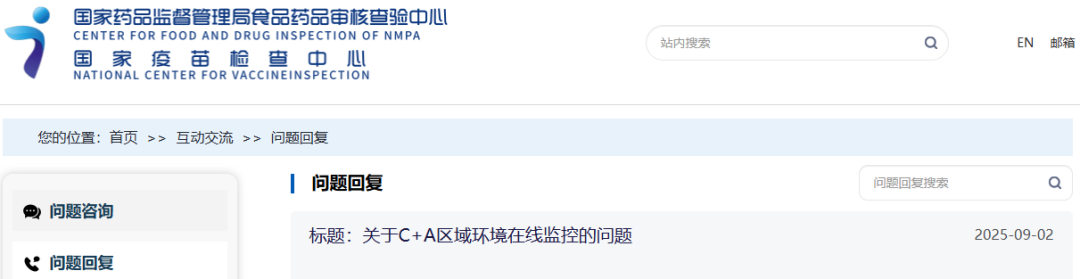
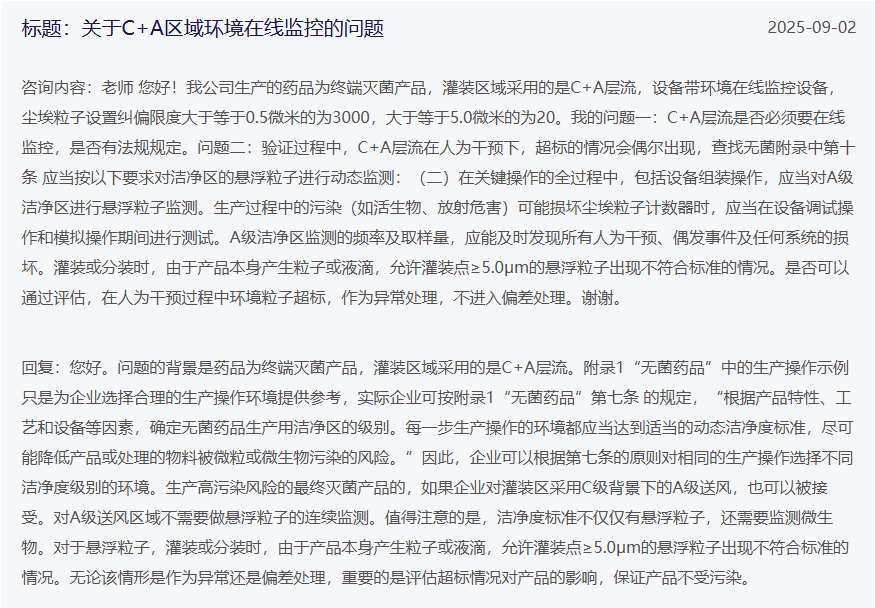
Consultation Content: Hello, teacher! The pharmaceutical products produced by our company are terminal sterilization products, and the filling area uses C+A laminar flow. The equipment is equipped with online environmental monitoring devices, with a corrective limit for dust particles set at greater than or equal to 0.5 microns at 3000, and greater than or equal to 5.0 microns at 20.
Question 1: Is online monitoring necessary for C+A laminar flow, and are there any regulations that stipulate this?
Question 2: During the validation process, instances of exceeding standards occasionally occur under human intervention in C+A laminar flow. According to the sterile appendix, Article 10 states that suspended particles in clean areas should be dynamically monitored as follows: (2) Throughout the entire process of critical operations, including equipment assembly operations, suspended particle monitoring should be conducted in Class A clean areas. If contamination during the production process (such as viable organisms or radiological hazards) may damage the dust particle counter, testing should be conducted during equipment debugging and simulation operations. The frequency and sampling volume of monitoring in Class A clean areas should be able to promptly detect all human interventions, incidental events, and any system failures. During filling or packaging, due to particles or droplets generated by the product itself, it is permissible for suspended particles at the filling point ≥5.0μm to exceed standards. Can we assess that during human intervention, exceeding environmental particle limits can be treated as an anomaly and not enter deviation handling?
Response: The background of the question is that the pharmaceutical products are terminal sterilization products, and the filling area uses C+A laminar flow. The production operation examples in Appendix 1 “Sterile Pharmaceuticals” are only for reference in selecting a reasonable production environment. Actual enterprises can follow the provisions of Article 7 in Appendix 1 “Sterile Pharmaceuticals”, which states, “Based on product characteristics, processes, and equipment, determine the level of clean areas for sterile pharmaceutical production. Each step of the production operation environment should meet appropriate dynamic cleanliness standards to minimize the risk of contamination of products or materials being handled by particles or microorganisms.”
Therefore, enterprises can choose different cleanliness levels for the same production operation based on the principles of Article 7. For terminal sterilization products with high contamination risk, if the enterprise uses Class A air supply under Class C conditions in the filling area, it can also be accepted.
Continuous monitoring of suspended particles is not required in Class A air supply areas.
It is worth noting that cleanliness standards not only include suspended particles but also require monitoring of microorganisms. For suspended particles, during filling or packaging, due to particles or droplets generated by the product itself, it is permissible for suspended particles at the filling point ≥5.0μm to exceed standards. Regardless of whether this situation is treated as an anomaly or deviation, it is important to assess the impact of exceeding standards on the product to ensure that the product is not contaminated.
 END
END China Food and Drug Information NetworkFollow us for more information!
Source: CFDI
Disclaimer: The copyright of the article belongs to the original author. If there are issues regarding the content, copyright, or other matters, please contact us for deletion! The content of the article represents the author’s personal views and does not represent the endorsement or support of this public account. This public account reserves the final interpretation rights of this statement.