S7-1200 is a compact, modular PLC that can perform various tasks such as logic control, HMI, and network communication. The S7-1200 features a compact design, low cost, and a powerful instruction set, making it the perfect solution for controlling various applications. The S7-1200 models and Windows-based programming tools provide the flexibility needed to solve automation problems. The S7-1200 pairs perfectly with the new SIMATIC HMI, ensuring automation tasks are particularly efficient, easy to develop, and debug. Portal is used for engineering system programming, debugging, and management for the S7-1200.
1. S7-1200 PLC Models and Parameters
For the Siemens S7-1200 series PLC, there are currently five common models: CPU1211C, CPU1212C, CPU1214C, CPU1215C, and CPU1217C. Let’s take a look at their parameters for the commonly used CPU types.
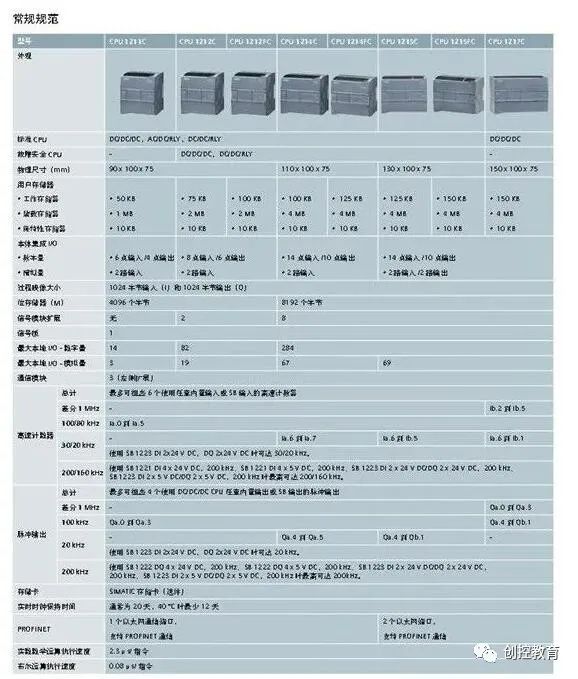
Different models of S7-1200 vary in terms of user memory, integrated IO, expansion capabilities, high-speed counting functions, high-speed pulse output capabilities, PROFINET interfaces, and processing speed. In practical applications, choose the 1200 model based on actual configuration.
2. S7-1200 Features
The notable features of SIMATIC S7-1200 include:
(01) Integrated Profinet interface; (02) Power supply integrated in wide AC or DC form (85 – 264 V AC or 24 V DC); (03) Integrated digital output 24V DC or relay; (04) Integrated 24V DC digital input; (05) Integrated analog input 0-10V; (06) Pulse sequence output with frequencies up to 100 kHz (PTO); (07) Pulse width modulation output with frequencies up to 100 kHz (PWM); (08) High-speed counter with frequencies up to 100 kHz (HSC); (09) Modular and scalable through connection of additional communication modules (such as RS 485 or RS232); (10) Modular and scalable through signal boards directly on the CPU to expand analog or digital signals while maintaining the original space of the CPU; (11) Modular and scalable through a large number of analog and digital input and output signals on signal modules (except CPU 1211C); (12) Optional memory (SIMATIC memory card); (13) PLCopen motion control for simple motion control; (14) PID controller with self-tuning function; (15) Integrated real-time clock; (16) Password protection; (17) Time interrupts; (18) Hardware interrupts; (19) Library functions; (20) Online/offline diagnostics.
(21) All terminals on the modules are detachable.
3. S7-1200 Modular Concept
The modular concept of S7-1200 greatly enhances its flexibility and cost-effectiveness, allowing for shorter engineering and service cycles through an efficient and consistent programming environment.
(1) Consistent software tools for hardware, HMI, and network configuration, with a unified user concept, shared data storage, and centralized services.
(2) Code modularity allows existing automation parts, such as SCL programs, to be reused in other series products.
(3) Common project concept automatically recognizes the relationships between multiple HMI and multiple controllers in a project, eliminating the need to save each user program separately in multiple projects, allowing the entire system to be saved in one project.
(4) Integrated PROFINET/Ethernet ports eliminate the need for additional dedicated programming cables and Ethernet expansion modules, reducing spare parts and costs.
(5) Flexible expansion concept using modular signal boards, which can provide additional I/O ports without requiring extra CPU space.
(6) Integrated digital I/O, analog I/O, and motion control I/O reduce unnecessary hardware expenses, space requirements, and costs.
4. S7-1200 Communication Functions
The S7-1200 has comprehensive network options.
(1) PROFINET controller & intelligent devices: discrete Profinet architecture can connect I/O, HMI, drives, and other Profinet field devices without additional communication modules.
(2) PROFIBUS master & slave: discrete PROFIBUS architecture can connect I/O, HMI, drives, and other PROFIBUS stations, including integration into existing system networks.
(3) AS-i master: fully configured AS-i-Master in TIA Portal, allowing easy configuration of AS-i networks without additional software.
(4) CANopen master: allows connection of CANopen devices, including those operating under the Transparent CAN2.A standard.
(5) Modbus TCP: allows communication as a Modbus master or slave, with a functional block corresponding to both master and slave.
(6) IO-Link master: facilitates rapid integration of SIRIUS compact starters, M200D starters, and SIRIUS soft starters for simple start control.
(7) GPRS/LTE module: convenient for discrete computer recording and control.
(8) TCP/IP: enables communication with other CPUs, other PCs, and devices using the TCP/IP communication protocol standard through open communication instructions, without additional communication modules.
(9) Integrated WEB server: access system process status, diagnostics, identification data, user-defined web pages, and firmware upgrades.
(10) RS485, RS422 & RS232: S7-1200 CPU supports point-to-point (PtP) communication, following character-based serial communication protocols, making it very flexible and convenient to use PtP communication instructions in user programs.
(11) Modbus RTU: uses Modbus instructions to communicate as a Modbus master or slave with other devices that comply with the Modbus RTU protocol.
(12) USS: uses simple USS instructions to control drive products that support the USS protocol.
5. S7-1200 Integrated Processes
(1) Integrated high-speed counters
The S7-1200 high-speed counters support working modes such as: single-phase counting, direction controlled by internal or external means; two-phase; A/B quadrature counters; A/B quadrature counters with quadruple frequency.
The S7-1200 high-speed counters support three functions: counting; period measurement; frequency.
(2) Integrated PID controller
Designed for various control tasks; includes continuous output controllers and step output controllers; self-tuning controller parameters; simple and intuitive configuration interface; integrated TRACE debugging interface; key is integrated PID_COMPACT, piD_3step, PID_temp instructions.
(3) Control functions
Flexible connection of drives via PROFINET, PROFIBUS, or analog interfaces.
CPU1217C has 1.5V differential output for speed and position control, up to 1MHZ.
Convenient programming of motion control programs using PLCOPEN motion control modules.
Unified configuration for controllers /HMI/ drives.
Convenient diagnostic and debugging tools.
Use automatic alarm messages to conveniently resolve issues.
Utilize PTO/PWM motion control processes.