This series of documents aims to help IT engineers gain a deep understanding of the digital transformation in the automation industry and manufacturing, providing clear career development insights for technical personnel to accurately position and plan in both technical and managerial dimensions.
The Industrial Gateway is one of the core communication devices in the Industrial Internet of Things (IIoT), tasked with integrating different devices, protocols, and networks, akin to routers and data bridging devices in the traditional IT world. As a critical node in industrial digitization, the Industrial Gateway plays an important role in promoting device networking, edge computing, data collection, and protocol conversion.
This article focuses on the technical characteristics, system composition, functions, application scenarios, and the indispensable importance of the Industrial Gateway from the perspective of IT professionals.
What is an Industrial Gateway?
The Industrial Gateway is the central hub connecting different network environments and devices, mainly used for protocol conversion, data collection, edge computing, and device control in industrial scenarios. The network environments include traditional industrial devices, PLC controllers, sensors, upper-level machines (SCADA / MES), and cloud platforms.
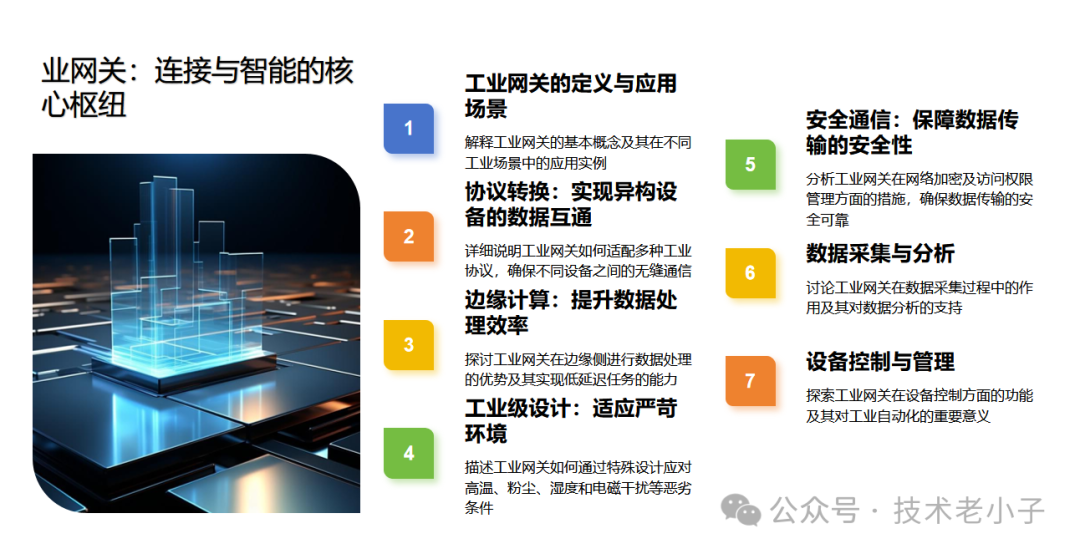
Core Functions of Industrial Gateways
The primary role of the Industrial Gateway is to act as a “data pipeline” in production systems, connecting the operating states, control information, and execution tasks of devices. Here are several key functions:
1. Protocol Conversion
-
Multi-Protocol Support: The Industrial Gateway supports the conversion of various mainstream industrial communication protocols, including:
-
PLC protocols (such as Modbus RTU/TCP, PROFINET, EtherCAT, EtherNet/IP)
-
Sensor protocols (such as IO-Link, CANopen)
-
Fieldbus protocols (such as Profibus, DeviceNet)
-
Cloud interface protocols (such as MQTT, HTTP/HTTPS, OPC UA)
-
Significance: Solves the problem of inconsistent “languages” among devices in the industrial field, enabling seamless collaboration between old and new devices.
2. Data Collection and Distribution
-
The Industrial Gateway is responsible for obtaining real-time operating data (such as temperature, pressure, vibration, liquid level, etc.) from devices like sensors, PLCs, and smart instruments.
-
Data can be distributed according to rules:
-
Sent to upper-level machines (such as SCADA systems);
-
Uploaded to cloud platforms for big data storage and analysis;
-
Executed locally on the gateway for edge computing to complete rapid response tasks.
3. Edge Computing
-
The edge computing capability allows the gateway to handle urgent or latency-sensitive data tasks:
-
Data preprocessing (such as outlier filtering, data formatting)
-
More complex logical decisions (such as device status judgment, alarm triggering)
-
Artificial intelligence inference modules (deploying lightweight AI models such as TensorFlow Lite)
-
Significance: Reduces reliance on cloud platforms or data centers, saves bandwidth resources, and improves real-time response capabilities.
4. Secure Communication and Device Management
-
Network Security: Provides HTTPS/TLS encryption, VPN, IP whitelisting, and digital signature verification to ensure the security of industrial communication environments.
-
Device Management: Supports OTA (Over-the-Air) firmware upgrades, remote parameter configuration, and log management, facilitating rapid iteration and maintenance of traditional devices by IT operations teams.
5. Connecting to Cloud Platforms
-
The Industrial Gateway acts as a bridge between devices and the cloud:
-
Supports integration with mainstream IIoT cloud platforms, such as AWS IoT, Azure IoT Hub, and Alibaba Cloud IoT platform.
-
Enables data upload and download, such as real-time monitoring data, alarm messages, and work order assignments.
System Composition of Industrial Gateways
The Industrial Gateway is a device that combines software and hardware, featuring a robust and durable hardware design and an extensible software architecture. Here are its main system components:
1. Hardware Architecture
The hardware design of the Industrial Gateway considers reliability, stability, and environmental adaptability, including the following parts:
-
Processor (CPU): Typically an embedded low-power ARM processor or a powerful X86 chip.
-
Communication Interfaces:
-
Serial interfaces: RS-232, RS-485 for communication with traditional devices.
-
Ethernet interfaces: For LAN industrial device communication.
-
Wireless interfaces: Wi-Fi, 4G/5G, LoRa support for distributed wireless monitoring.
-
Built-in Storage: For device configuration, temporary data caching, and operating system storage.
-
Industrial-Grade Enclosure: Designed to be heat-resistant, shockproof, and dustproof, especially suitable for harsh environments.
2. Software Architecture
The software framework of modern Industrial Gateways is flexible and diverse, supporting plugin-based extension capabilities:
-
Operating System: Embedded Linux/RTOS operating systems.
-
Protocol Stack: Built-in Modbus, OPC UA, MQTT, CoAP protocol stacks.
-
Edge Computing Framework: Supports edge management tools like EdgeX Foundry and KubeEdge.
-
Development Environment: Supports custom development in programming languages such as Python, C/C++, and Node.js.
-
Management Interface: Provides Web UI or CLI interfaces to meet local and remote device management needs.
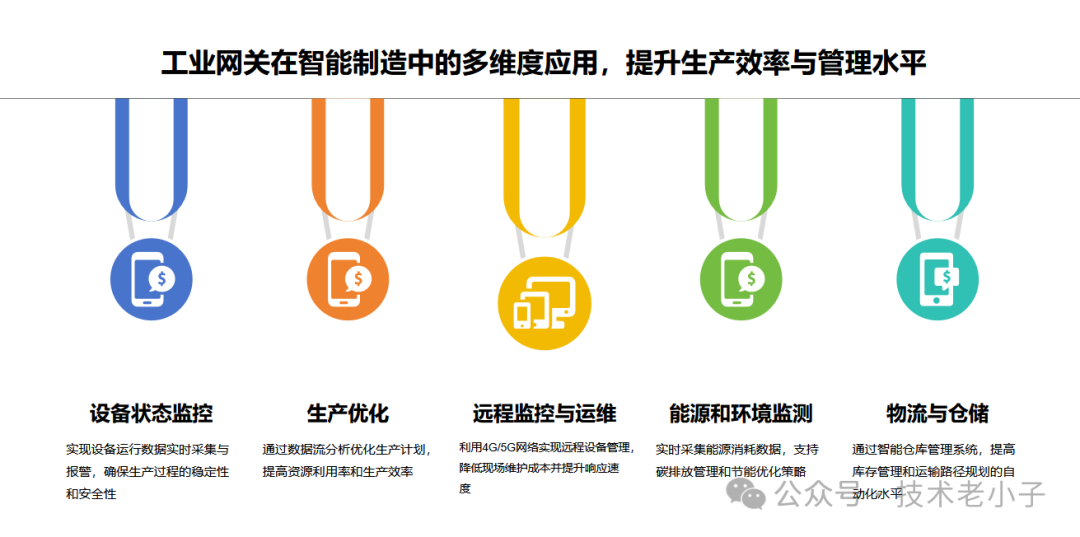
Application Scenarios of Industrial Gateways in Industrial Digitization
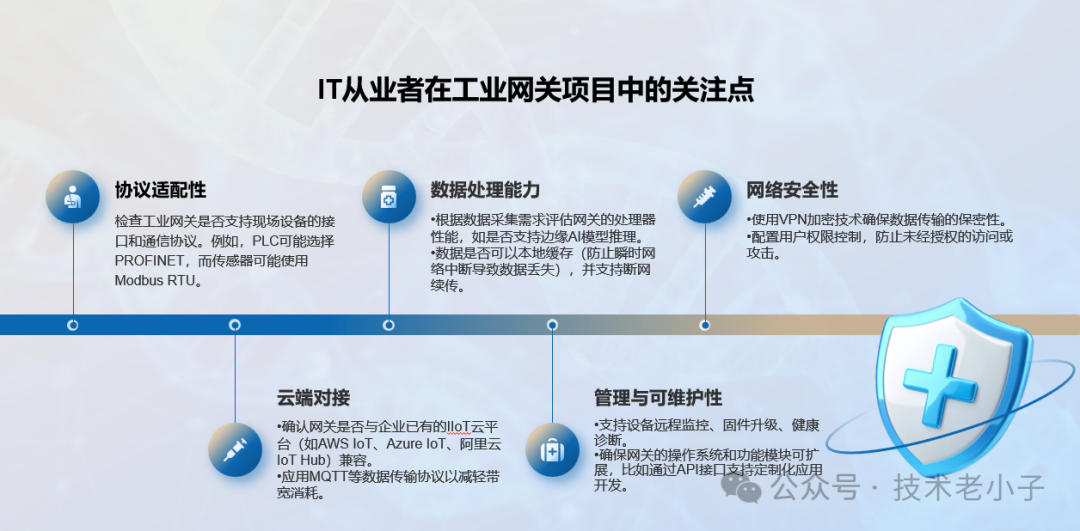
IT Professionals’ Focus Points in Industrial Gateway Projects
In the deployment and application of Industrial Gateways, IT professionals need to pay attention to the following technical details:
Trends in Industrial Gateway Technology Development
-
Integration of 5G and LPWAN (such as LoRa): Communication methods are evolving toward high-speed, low-latency, and low-power directions, supporting more distributed devices.
-
Enhanced Edge AI Capabilities: Industrial Gateways are gradually becoming edge intelligent computing nodes, achieving real-time decision-making in conjunction with lightweight AI models.
-
Cloud-Edge Collaborative Architecture: More enterprises are adopting integrated industrial gateway solutions, improving deployment flexibility and response speed.
-
Strengthened Network Security: With the expansion of the industrial attack surface, industrial gateways will support more protective mechanisms, such as multi-factor authentication and encryption protocols.
Conclusion
The Industrial Gateway, as a core communication device connecting devices, networks, and the cloud, is the cornerstone of smart manufacturing and industrial digitization. For IT professionals, understanding how the Industrial Gateway achieves protocol conversion, data collection, edge computing, and cloud integration will provide solid technical support for device expansion and system integration.
With the correct gateway deployment architecture, enterprises can build an efficient, secure, and intelligent data collection and analysis system, laying the foundation for the future Industrial Internet of Things. We look forward to the Industrial Gateway creating more value for the digital transformation in the industrial sector through the integration of 5G, AI, and edge technologies in the future.
I hope this article provides you with a comprehensive perspective on Industrial Gateways and helps you in your work!
If you are engaged in upper-level machines, automation, machine vision, IoT projects, or digital transformation, feel free to join my WeChat group! Here, we can easily discuss the latest technology trends and industry dynamics, as well as help and support each other with technical issues. I will do my best to use my knowledge and experience to assist you in solving problems, and I also look forward to learning and growing from everyone’s professional insights. Whether you are a novice or an expert, I look forward to exchanging ideas with like-minded friends and progressing together!