Hello everyone, today I want to talk to you about a super practical feature in C++—the selection structure.
It allows your code to flexibly execute different branches based on conditions, making the program smarter.
Whether you are a beginner or looking to review, I will guide you step by step through the core knowledge points with simple examples. The content is based on actual code, ensuring logical rigor without any fluff.
First, the selection structure is like giving the program a “decision-making brain”.
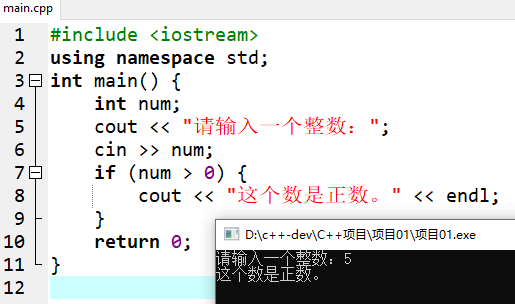
For example, the single if statement is the foundation of foundations. For instance, to determine if a number is positive: if the input is greater than 0, then output a prompt. The code is clear and easy to understand, suitable for beginner practice. The following example demonstrates the specific implementation:
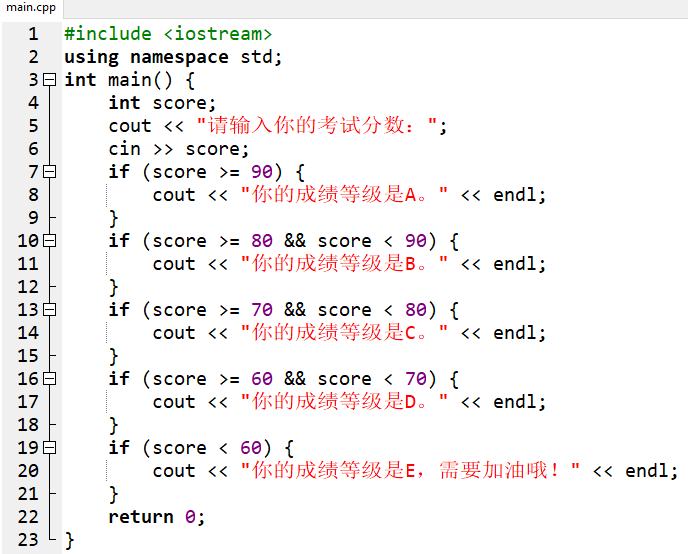
Next is the multiple if statements, which can handle multiple conditions. For example, outputting grades based on scores: above 90 is an A, 80-89 is a B, and so on. This involves logical operators (like && and ||), which I will explain in detail shortly.
The program will check each condition in order to ensure accurate results. Look at the code below and test with different scores:
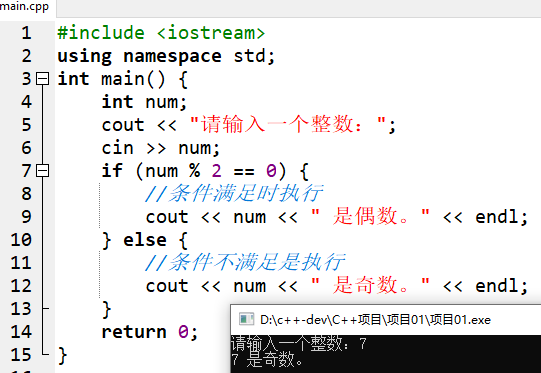
If there are only two possible conditions, the if-else statement is more efficient. For example, to determine odd or even numbers: if a number divided by 2 has a remainder of 0, it is even; otherwise, it is odd. The code is concise and easy to learn:
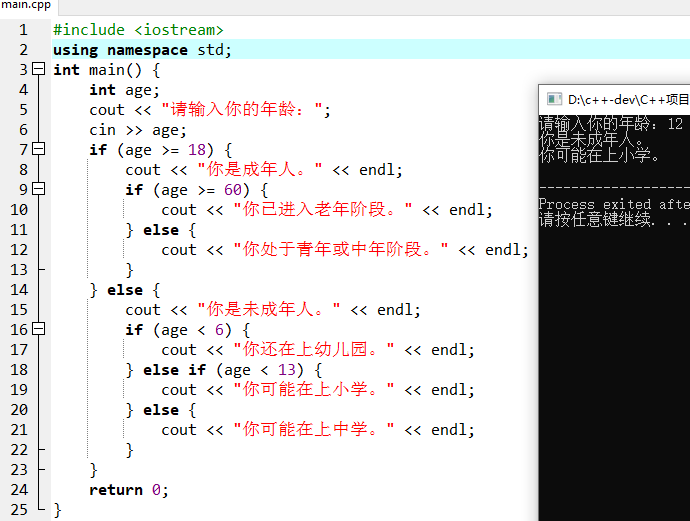
When the conditions are more complex, nested if statements come into play. For example, to determine age groups: first separate children and adults, then further divide adults into youth and middle-aged. Nesting allows for more detailed logic:
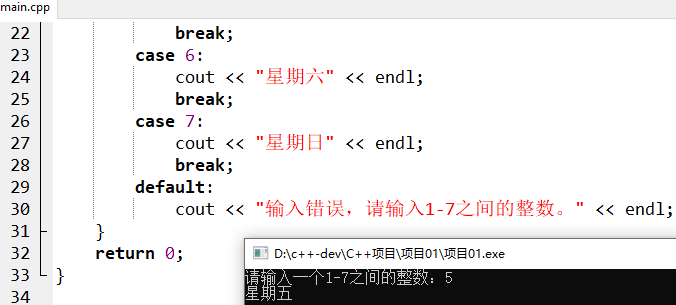
Another common method is the switch statement, which is suitable for handling fixed values. For example, inputting a number to output the day of the week: 1 corresponds to Monday, 2 corresponds to Tuesday, and so on. Remember, switch only supports integer types (like int or char) and cannot be used for floating-point numbers:
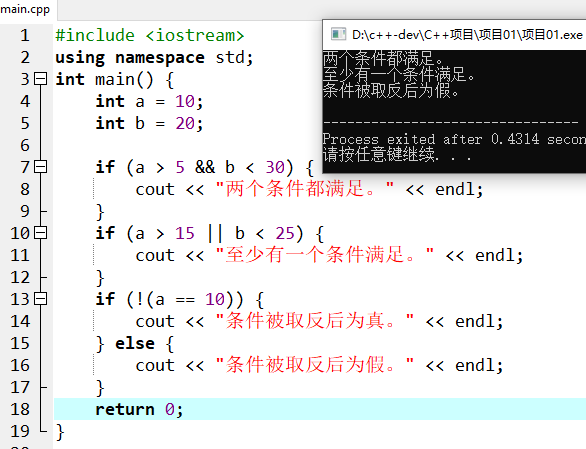
Logical operators are the “glue” of selection structures. && (and) means both conditions must be true to execute, || (or) means if one is true, execute, and ! (not) negates the condition. The example below combines these operators, and the test results are clear at a glance:
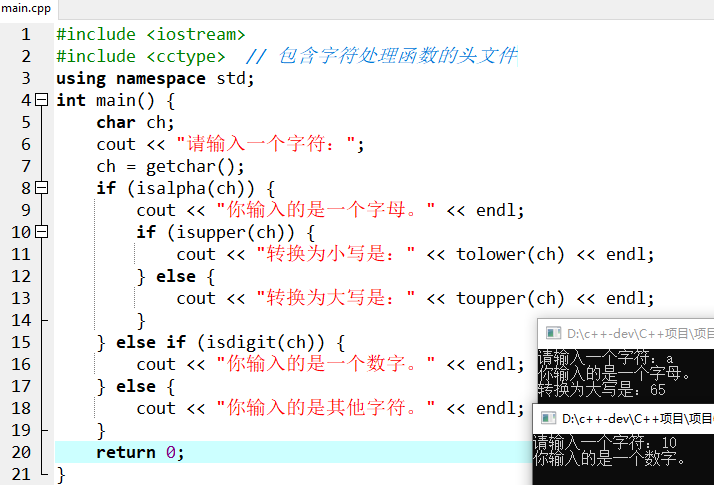
System functions can also enhance efficiency. The C++ cctype library provides useful tools: getchar() reads a character, isalpha() checks for letters, isdigit() validates numbers, tolower() and toupper() convert case. Look at this code, which makes handling input characters super convenient:
Finally, the ternary operator replaces simple if-else with a single line of code. The syntax is “condition ? expression1 : expression2”, for example, comparing two numbers: if a > b, return a; otherwise, return b. It is concise and efficient, suitable for use after becoming proficient.
To summarize, the selection structure is the cornerstone of C++ programming. From single if to switch, combined with logical operators and system functions, you can write clear and flexible code. I personally believe that practicing small projects is key to mastering it. If you want to delve deeper, I recommend a practical course “Decisions at the Crossroads 2 – Selection Structure Expressions”.
It explains the details of expressions through examples, suitable for consolidating the basics.
Selection structure expressions:https://pan.quark.cn/s/92807f4380f2
I hope this sharing is useful to you! Feel free to follow me as we explore the world of programming together.