The development of mobile networks drives application transformation: The 4G-based mobile internet era has seen rapid development in AI, short videos, shopping, voice, gaming, ride-hailing, and other services, with explosive data growth pushing the internet into the era of cloud computing; meanwhile, the rapid development of 5G IoT/edge computing has spawned IoT applications such as mobile healthcare, vehicle networking, smart homes, industrial control, and environmental monitoring, achieving the interconnection of all things.
Trends in Cloud Computing and IoT Network Technology
In the context of a data explosion, the scale of business carried by cloud computing is experiencing exponential growth, making the combination of software and hardware a necessity; cloud computing data center networks are also thriving, having developed from 1G, 10G, 25G to 100G, 200G in just a decade, and are still rapidly advancing;
The demand for interconnectivity across multiple regions, interconnection between cloud-based IDC and cloud networks, and hybrid cloud construction is growing significantly, driving continuous innovation in cloud networks, evolving from simple VPC isolation to elastic IP, load balancing, firewalls, and routing calculations;
In the 5G IoT scenario, edge computing is rapidly developing, and edge computing gateways have become a necessity.
Trends and Demands for Cloud Computing and IoT Gateways
The rapid development of cloud computing networks and IoT networks poses significant challenges for cloud and IoT gateways:
The public/private line/cross-region VPC traffic carried by cloud network Gateways is increasing dramatically, with traffic bursts becoming more intense;
Traditional gateways are insufficient in performance, are bloated and difficult to iterate quickly, lack interconnection hash and routing convergence capabilities, and face single-core performance issues in DPDK-based X86 clusters, making them unable to handle large traffic and attack traffic, leading to frequent occurrences of capacity expansion issues and uneven cluster loads, becoming one of the bottlenecks for business development;
The personalized features required by cloud network Gateways are increasing, while traditional MIPS multi-core gateways and DPDK clusters under X86 architecture have weak support capabilities, and their hot start capabilities are poor;
Edge node data center space and energy consumption are constrained, making it difficult to accommodate various gateways and switching routing servers;
Under the rapid development of cloud computing infrastructure and business, the current direction of cloud and IoT gateway development is towards the integration of hardware and software, with more specific requirements for the functionality and performance of cloud networks and IoT gateways:
Highly virtualized, providing hybrid cloud and cross-region networks to meet the demand for seamless cloud services for a massive number of branches & mobile endpoints;
Cloud-native, with increasing demand for public gateways, dedicated line gateways, NAT gateways, L4/L7 LB, host AVS, Private-Link, etc., requiring extremely strong elastic scalability;
Automation capabilities, providing cloud network services through service methods, achieving cloud network business orchestration and automated configuration services;
High performance, with increasing demand for public bandwidth, hardware-based basic gateways, intelligent network cards, underlying network resources for cloud networks, and high-performance low-latency networks.
The Microsoft Asia Research Institute initiated the ServerSwitch project around 2009, connecting commercial switching chips and servers through high-bandwidth PCI-E interfaces, fully exploring the programmable capabilities of switching chips and CPUs to achieve high-performance programmable forwarding engines for data center architecture. The papers published based on this foundation won the Best Paper Award at the 2011 USENIX Symposium on Networked Systems Design and Implementation (NSDI), marking the prototype of ServerSwitch.
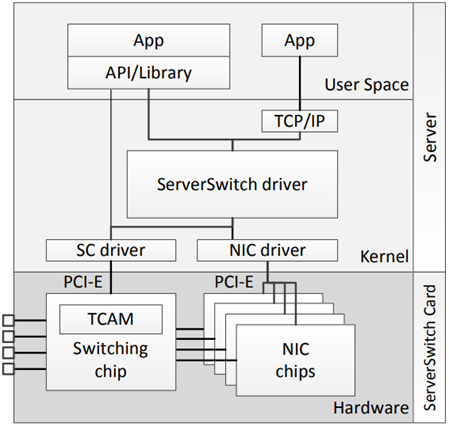
The industry’s first internet programmable switching chip, Barefoot Tofino, based on Protocol Independent Switch Architecture, has emerged, providing high-performance, high-reliability, and high-flexibility forwarding combinations through customer-customizable forwarding logic and dynamically allocated table resources, providing fertile ground for the development of ServerSwitch.
Application Scenarios of Cloud Networks and IoT Gateways and H3C’s Efforts
Initially, cloud networks and IoT gateways were constructed using physical servers and DPDK-based software, especially in the context of the failure of Moore’s Law, which led to a sharp increase in traffic demands and adverse impacts on installation deployment, delivery operations, cost Capex and Opex, and power consumption. Therefore, the integration of hardware and software has become an inevitable choice, adopting high-performance CPUs, 100G or T-level memory, ultra-large storage, and high-performance processing cards such as multi-FPGA or multi-GPU, high-performance switching chips. The integrated cloud computing and IoT gateways are mainly applied in the following scenarios:
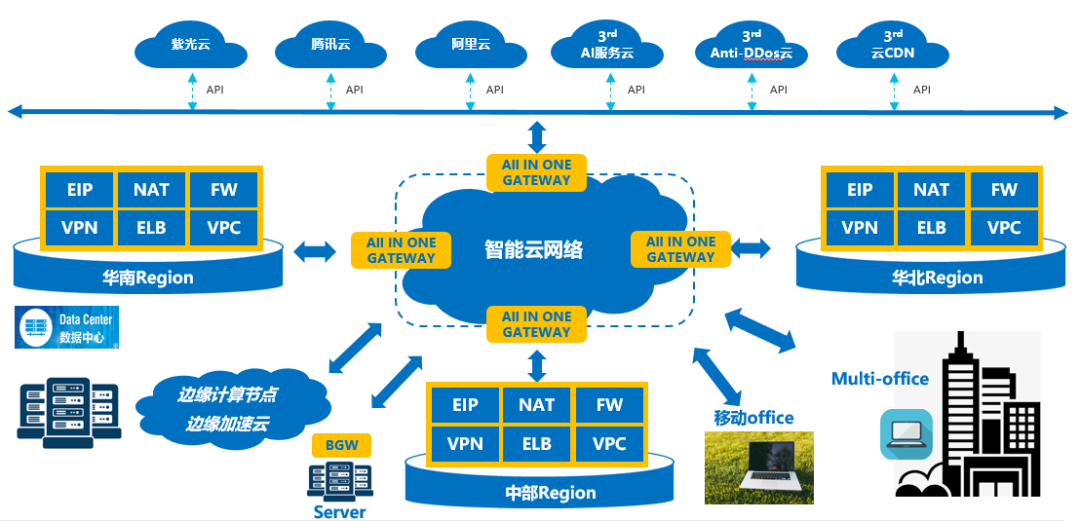
High-performance secure access scenarios for cloud networks and IoT, providing high-performance network forwarding, offering channels for user data centers or office access to public/private clouds, providing encrypted low-latency jitter-free access tunnels, firewalls/NAT, and load balancing capabilities, and offering GPU and FPGA computing capabilities for specialized computing tasks;
Cross-region communication within the cloud or dedicated line scenarios for edge data centers, providing shared T-level large bandwidth and high-quality channels between availability zones in the North China Region and the South China Region, and between data centers and edge computing nodes;
Intelligent scheduling scenarios for data center exit traffic, providing elastic IP capabilities, optimizing forwarding logic pipelines and table item formats to offer network QoS for cross-region businesses and millions or even tens of millions of table lookup capabilities, intelligently orchestrating and scheduling special tasks, and providing T-level logs containing various network flow information;
In distributed forwarding within cloud data centers, providing bare metal machines and public cloud VXLAN encapsulation and decapsulation capabilities, as well as tenant isolation, consistent hashing, ARP proxy, and other functions, supporting data sharding and version gray release capabilities.
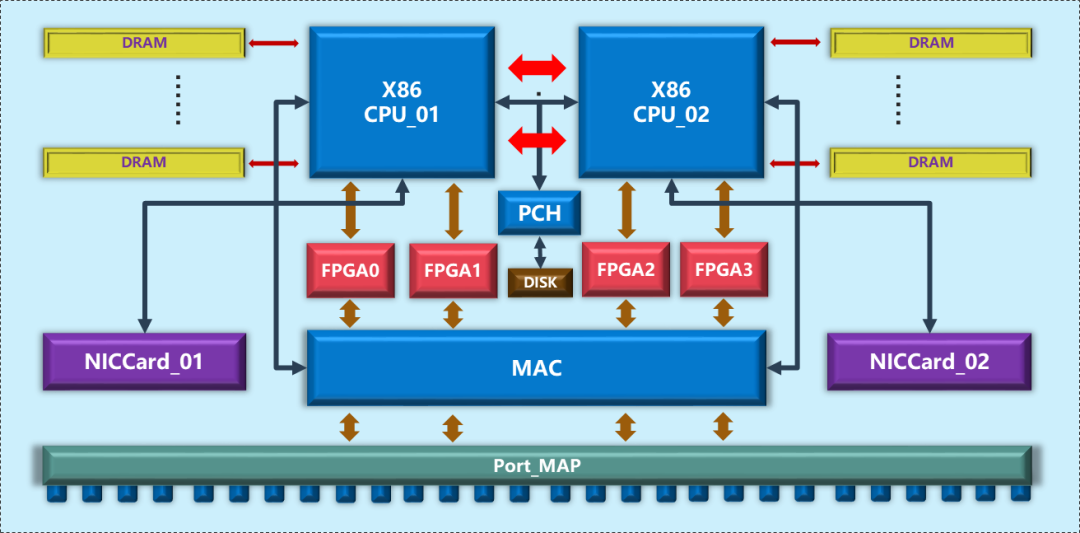
Currently, H3C is collaborating with several internet clients on the research and development of Serverswith cloud network edge gateways, leveraging the industry’s open-source ONL system or Sonic network operating system software, based on Barefoot Tofino/Tofino2 chips and high-performance multi-core X86 CPUs to provide ultra-large bandwidth forwarding capabilities and high-performance general computing power, equipped with multiple GPU/FPGA chips and large-capacity storage media to provide multi-dimensional computing capabilities and data forwarding state storage capabilities, creating a new generation of high-speed programmable gateways with TB-level performance.