
On September 9, 2025, Fiber Online reported that in August 2024, Huaxin Microelectronics announced a significant milestone — the official commissioning of a 6-inch compound semiconductor commercial production line, which completes the last link in the consumer electronics supply chain in Guangdong Province. A year later, in August 2025, Huaxin Microelectronics successfully delivered the first batch of small-volume GaAs (Gallium Arsenide) RF wafers to customers. Achieving a leap from “0 to 1” in just one year from the establishment of the production line to commercial delivery marks another key breakthrough for Huaxin Semiconductor in the field of compound semiconductors after the mass production of optical chips in 2022, signifying a solid and milestone step for China in the core manufacturing segment of compound semiconductors.
In just one year, the entire process from equipment installation, production line commissioning, process modeling to bulk commercial order delivery was completed. What logic and secrets lie behind the efficient progress of Huaxin Semiconductor? To explore this question, we interviewed Mr. Peng Lingyong, Chairman of Huaxin Semiconductor, and Mr. Vincent, Vice President of Operations at Huaxin Microelectronics’ Zhuhai factory, to uncover the breakthrough code of Chinese compound semiconductor enterprises.
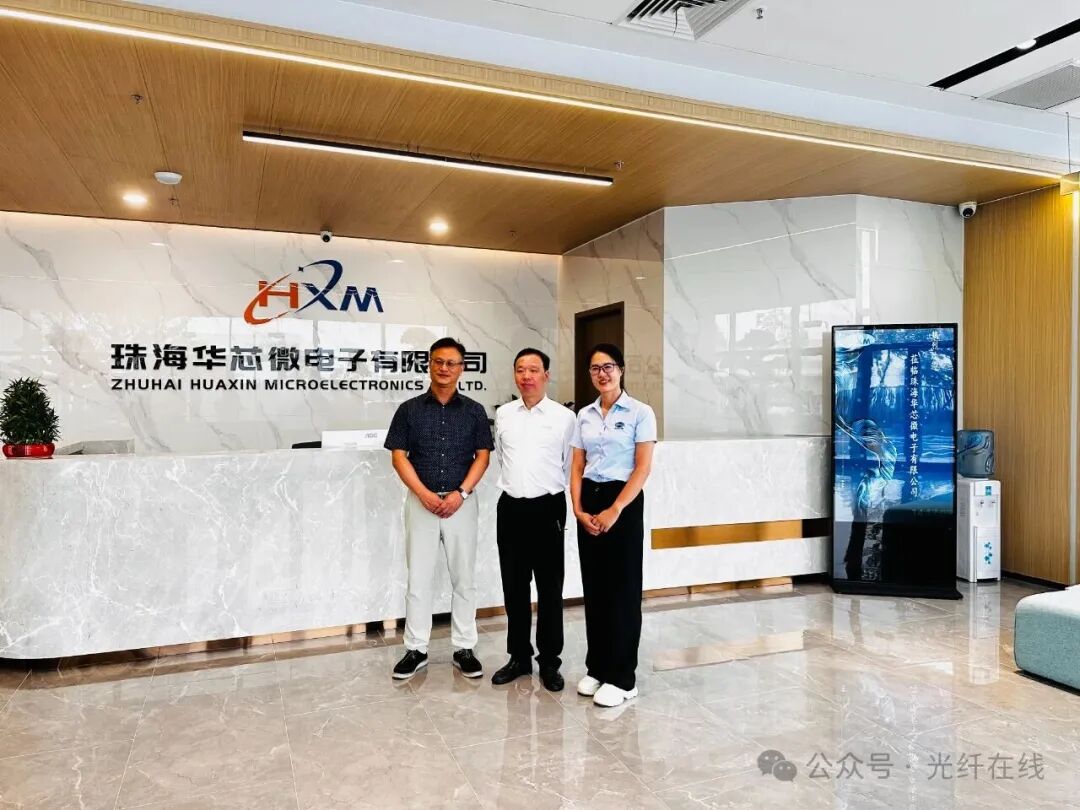
Image Caption: Vincent, Vice President of Operations at Huaxin Microelectronics, Chairman Peng Lingyong of Huaxin Semiconductor, and the editor of Fiber Online
The “One-Year Sprint”: 10 Years of Accumulation and Overcoming Four Critical Challenges
“This speed essentially reflects the ‘thick accumulation and thin release’ of team experience and technical accumulation.” When discussing the core reasons for the rapid establishment and delivery of the production line, Vincent, Vice President of Operations at Huaxin Microelectronics, first emphasized the supporting role of the team. He introduced that the technology and team foundation of Huaxin Microelectronics stem from years of accumulation at the Taizhou Huaxin optical chip factory — as a GaAs chip company adopting the IDM (Integrated Device Manufacturing) model, the Taizhou Huaxin optical chip factory has accumulated mature experience in process technology and mass production management; moreover, the core team members of Huaxin Microelectronics come from the world’s leading compound semiconductor foundries, each with over 15 years of experience in GaAs chip manufacturing.
“Since 2019, our team joined Taizhou Huaxin, completing collaborative integration and achieving large-scale, stabilized manufacturing of GaAs optical communication VCSEL chips,” Vincent revealed.
Based on this foundation, after the equipment arrived at Huaxin Microelectronics at the end of September 2024, the production line was commissioned in just over a month, process development was rapidly achieved within two months, modeling was completed in two months, and samples were successfully delivered after the Spring Festival in 2025, with the first commercial order delivered in August of this year. So far, six commercial customers have completed sample validation, and the chip yield has stabilized at 97%-99%, “this level is among the top tier in the global GaAs RF chip manufacturing field,” Vincent added.
In contrast to Vincent’s interpretation of the “core team,” Chairman Peng Lingyong of Huaxin Semiconductor places more emphasis on a “long-term perspective.” In his view, the journey from “equipment debugging to order delivery in one year” is the result of the company’s ten years of arduous exploration and accumulation. “Huaxin Semiconductor was established in 2015, but it wasn’t until 2022 that we truly achieved large-scale deliveries. During this period, we overcame four critical challenges related to the survival of the enterprise.”
Peng Lingyong summarized these four critical challenges into four key stages: the first is the “factory construction period,” which requires simultaneous completion of product planning, factory planning, equipment selection, and financial planning to build a suitable manufacturing system; the second is the “equipment commissioning period,” which involves breaking through the technical barriers of compound semiconductor equipment debugging to achieve stable operation of the production line; the third is the “customer recognition period,” which establishes market trust through rigorous testing and validation by customers; and the fourth is the “stable mass production period,” which achieves large-scale, high-yield chip shipments — this is also the most challenging hurdle.
“Even when we began to deliver VCSEL (Vertical-Cavity Surface-Emitting Laser) chips in bulk to customers in 2022, we suddenly encountered mass production batch issues. However, Huaxin Semiconductor has made ‘reliability first’ the core principle of our company culture, and whether in technology research and development or production management, everything revolves around this principle,” Peng Lingyong recalled. The unified belief within the company at that time was that no chip with reliability risks should reach customers. Of course, Huaxin Semiconductor quickly resolved the delivery crisis by leveraging the advantages of the IDM business model and utilizing previously reserved inventory.
Dual Brand Strategy: IDM + Foundry, Precise Positioning for Different Fields
During the interview, both executives mentioned Huaxin Semiconductor’s “dual brand layout” — Taizhou Huaxin Semiconductor and Zhuhai Huaxin Microelectronics, which align with market business models, differentiating products and adopting IDM and Foundry (foundry) models respectively, covering optical communication chips and RF chips. This differentiated positioning reflects the company’s deep insights into industry trends.
Peng Lingyong explained that Taizhou Huaxin Semiconductor has been positioned in the optical communication VCSEL chip field since its inception, focusing on high-speed optical module chips such as 10G/25G/56G/112G, and has chosen the IDM model, which requires greater capital and technical investment. The optical communication field has extremely high requirements for chip specialty processes and precision, and must achieve full-process control from design, manufacturing to packaging testing through the IDM model to ensure product performance and reliability.
In contrast, Huaxin Microelectronics, established in 2023, is positioned as a Foundry, providing foundry services for RF, LiDAR, optical sensing, and other fields. Peng Lingyong stated that this choice follows the rules of industry development. In the 3D Sensor field, VCSEL chips were initially completed through collaboration between Lumentum (design) and Win Semiconductors (foundry), forming a mature “Fabless + Foundry” industry chain model. In such fields, chip manufacturers do not need to build their own production lines, and the Fabless model is more flexible and efficient, while Foundry companies can help more manufacturers quickly launch products through mature processes.
He further stated that Huaxin Microelectronics’ core advantage lies in “technology inheritance” — relying on Taizhou Huaxin’s process accumulation and innovation capabilities in the GaAs optical communication VCSEL chip field to provide stable and mature foundry services for domestic RF and LiDAR enterprises. “We hope to accelerate the product landing of domestic chip manufacturers in related fields through our process accumulation, promoting the maturity and upgrading of the entire industry.”
From 10G to 112G, VCSEL Chips Stable Shipment Exceeds Ten Million
In the optical communication VCSEL chip field, Huaxin Semiconductor has achieved a leap from “following” to “running alongside.” According to Peng Lingyong, since starting bulk shipments of 25G VCSEL chips in 2022, Huaxin Semiconductor’s 10G/25G/56G series products have all achieved bulk shipments at the level of tens of millions, with zero customer complaints, indicating that Huaxin Semiconductor has achieved stable shipments and has become one of the core suppliers for domestic optical communication module companies.
More notably, for the 112G PAM4 VCSEL chip, which meets the demand for higher speeds, Huaxin Semiconductor has also completed key breakthroughs. “This product, set to launch in 2024, has already completed 5000 hours of reliability testing internally, and clients have passed 3000 hours of testing, with expectations to achieve shipment levels in the tens of millions soon,” Peng Lingyong revealed. The launch of the 112G product will further meet the demand for high-speed optical modules in the context of the explosion of AI computing power, providing more core technical support for the domestic optical communication industry chain.
When discussing how to ensure stable shipments, Peng shared Huaxin Semiconductor’s high-quality five-element rule: namely, people, machines, materials, methods, and environment (personnel, machinery, raw materials, methods, environment) — none of which can be missing. Among them, the most critical are ‘people’ and ‘machines.'”
He cited that Huaxin Semiconductor’s production team has extremely high stability; since the factory’s establishment, the core engineers and production workers have hardly changed, and their familiarity with the equipment and processes is the foundation for ensuring production stability; in terms of equipment, a comprehensive maintenance and calibration system has been established to ensure that each piece of equipment is in optimal operating condition.
Such achievements have also gained recognition from investors, as Huaxin Semiconductor recently completed a new round of financing amounting to 350 million yuan. In this round of financing, Unisplendour Fund invested 200 million yuan, and existing shareholders added 150 million yuan.
Unisplendour Fund Chairman Que Li stated: “The reason Unisplendour Fund invested in Huaxin Semiconductor is based on the massive shipment data and excellent performance of the chips online. As a private equity fund management platform wholly owned by the new Unisplendour Group, Unisplendour Fund has always focused on investments across the entire semiconductor chip and information communication industry chain. Relying on the new Unisplendour system covering the complete industrial ecosystem of ‘chip semiconductors, ICT equipment, cloud services, and digital solutions,’ we focus on innovative enterprises with strategic synergy value.” Unisplendour Fund is very optimistic about Huaxin Semiconductor’s development prospects and is willing to continue supporting Huaxin Semiconductor to grow stronger.
The project leader of Zhuhai Technology Industry Group stated: “The reason Zhuhai Technology Industry Group has continuously invested in Huaxin Semiconductor for two rounds is due to the professional and efficient technical and management teams of Huaxin Semiconductor and its outstanding mass production capabilities. Huaxin Semiconductor’s two fabs, whether for optical communication VCSEL chips or RF wafer foundry, are significantly scarce in the current domestic stage. Semiconductor manufacturing plants face four critical challenges: factory construction, production line commissioning, customer validation, and scale mass production. At each stage, semiconductor manufacturers have fallen. Huaxin Semiconductor’s Taizhou optical chip factory has been stably shipping for five years. What is even more commendable is that the Zhuhai RF wafer foundry completed customer certification and received mass production orders just two years after starting operations. This speed is rare in the country.
The Battle Between Single-Mode and Multi-Mode: VCSEL’s Advantages Remain
With the explosive demand for AI computing power, the high-speed optical module market is experiencing explosive growth, and the continuous increase in single-channel chip rates has sparked discussions in the industry regarding “single-mode vs. multi-mode” and “VCSEL chip competitiveness.” Some opinions suggest that when the rate increases to a single wave of 200G, VCSEL chips will face technical bottlenecks; moreover, in the field of rates above 100G, the cost gap between single-mode and multi-mode is gradually narrowing, which will weaken VCSEL’s advantages.
In response, Peng provided his judgment. He acknowledged that there was a price increase due to VCSEL chip shortages at the end of 2025, but with domestic companies’ breakthroughs in the 112G PAM4 VCSEL chip field, market supply is gradually stabilizing. “The low-cost advantage of multi-mode optical modules still exists, which is one of the core competitive advantages of VCSEL chips,” he emphasized. The 112G VCSEL chip that Huaxin Semiconductor is about to supply in bulk has passed customer validation, and the launch of this product will further enhance the market value of VCSEL chips in the high-speed optical module field, making the cost-performance advantage of multi-mode solutions even more prominent.
Huaxin Microelectronics is Sprinting Towards the “Last Hurdle” to Join the Global Top Foundry
Regarding the future of Huaxin Microelectronics, Peng has a clear goal — to benchmark against the global GaAs foundry leader Win Semiconductors and become a top foundry enterprise in domestic RF, optical sensing, and LiDAR fields. “Since its establishment, Huaxin Microelectronics has taken Win Semiconductors as a benchmark, hoping to help more domestic chip design companies achieve rapid mass production through mature process capabilities.”
Currently, Huaxin Microelectronics has delivered its first foundry order to customers, marking a key step in the company’s foundry business. However, in Peng Lingyong’s view, challenges still lie ahead — Huaxin Microelectronics is currently in the fourth stage of the aforementioned “four critical challenges,” namely the “stable mass production period.” “Only by successfully crossing this hurdle and achieving large-scale, high-yield foundry services can we truly rank among the top global GaAs foundries,” he stated.
He expressed that in the future, Huaxin Microelectronics will continue to iterate process technologies and expand more application scenarios, hoping to become an ‘enabler’ of the domestic compound semiconductor industry, promoting the maturity of more Chinese chip companies through its technological accumulation and collectively enhancing China’s voice in the global compound semiconductor field.
Click the video to watch the full interview
END


If you find the content useful, feel free to like, share, and forward~