In the context of global consensus on carbon neutrality and negative carbon emissions, Direct Air Capture (DAC) is one of the most representative Carbon Dioxide Removal (CDR) technologies, rapidly transitioning from scientific concepts to engineering implementation. However, DAC is not merely an “air purifier”; it encompasses a comprehensive interdisciplinary, cross-system, and cross-scale technological framework involving materials science, thermodynamics, fluid engineering, process control, and even low-carbon economics.
This article will focus on the mainstream technological routes and engineering evolution of DAC, guiding you from the first-generation solid amine adsorption systems to the efficient desorption systems integrated with heat pumps, analyzing their working principles, system structures, key indicators, and development bottlenecks.
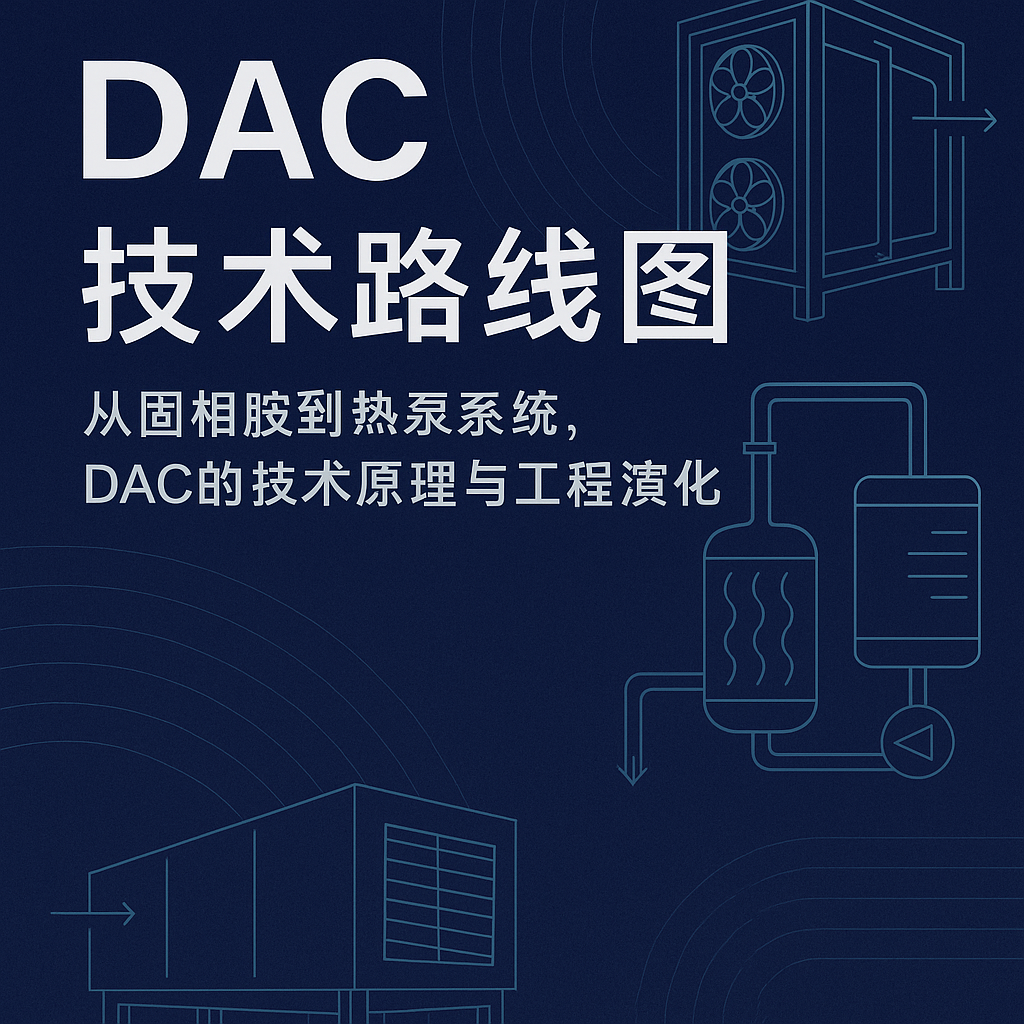
1. Starting with “Carbon Capture”: Basic Principles and Components of DAC
The core goal of DAC is to efficiently separate and concentrate CO₂ from the atmosphere at approximately 400 ppm concentration. This differs from traditional industrial flue gas carbon capture (typically with CO₂ concentrations >5%), which imposes higher demands on material activity, reaction kinetics, and energy consumption.
A typical DAC system consists of five core modules:
-
Air pre-treatment system (fans, pre-filters)
-
Adsorption unit (material selection is key)
-
Desorption regeneration system (temperature/vacuum/humidity driven)
-
CO₂ collection and compression
-
Thermoelectric synergy and control module
2. Comparison of Mainstream Technological Routes: Two Camps of Solid and Liquid Phases
Currently, global DAC systems are mainly divided into two routes:
| Type | Adsorbent Medium | Representative Companies | Desorption Method | Applicable Environment |
|---|---|---|---|---|
| Solid Amine Adsorption | Amine-modified porous materials (e.g., PEI resin) | Climeworks (Switzerland) | Low-temperature thermal regeneration (80–100°C) | Dry/low-humidity areas |
| Liquid Alkali Absorption | NaOH/KOH solution | Carbon Engineering (Canada) | High-temperature sintering + calcium cycle and electrolysis (>600°C) | High humidity air, requires industrial heat sources |
Among these, the solid phase route has gained more attention in recent years due to its modularity, lower energy consumption, and suitability for modular deployment, making it more compatible with China’s existing technological framework.
3. First Generation System: Solid Amine Adsorption + Hot Air Regeneration
This is currently the most mature and commercially clear DAC solution. Its key technological nodes include:
-
Adsorption materials: Polyethyleneimine (PEI), amine-modified silica gel, resin
-
Carrier structure: Honeycomb, fiber mat, porous ceramics
-
Desorption method: Using low-temperature hot air (80–100°C) for purging
-
Energy consumption level: Approximately 5–9 GJ/t CO₂ (thermal energy)
Representative companies: Climeworks, Global Thermostat
Advantages: Mild conditions, flexible modularityChallenges: Adsorbent aging, high fan energy consumption, low thermal recovery efficiency
4. Engineering Evolution Path: From Hot Air Systems to Vacuum + Heat Pump Integration
To address the high energy consumption of traditional hot air regeneration, the second-generation DAC systems are evolving towards “low temperature + vacuum + heat pump” collaborative desorption:
Vacuum-assisted desorption (VSA)Reduces the equilibrium adsorption pressure of CO₂ and increases the desorption rate; representative: Heirloom uses dynamic calcium carbonate cycling + vacuum desorption.
Heat pump thermal source coupling (Heat Pump + TSA)Utilizes electrically driven heat pumps to improve thermal efficiency (COP > 2); achieves precise control of adsorption bed temperature and waste heat recovery.
Multi-tower alternating switching + dynamic balancing systemAlternating adsorption/desorption between two towers increases system utilization and CO₂ flux; paired with intelligent control systems to optimize operating parameters.
The target energy consumption is reduced to <4 GJ/t CO₂, while also reducing system footprint and investment cost per ton.
5. Key Engineering Parameters and Scaling Challenges
| Indicator | Excellent System Target Value |
|---|---|
| Adsorption capacity | >2 mmol/g |
| Regeneration temperature | <100°C |
| Desorption time | <30 min |
| System CO₂ recovery rate | >90% |
| Annual operating time | >7500 hours |
| Energy consumption per ton of CO₂ | Electric: <500 kWh / Thermal: <4 GJ |
Current scaling processes still face challenges:
-
Module airflow organization is difficult to scale uniformly;
-
Adsorption bed structure design (pressure drop, heat exchange) optimization is insufficient;
-
Adsorbent cost and cycle life have not yet met industrial requirements;
-
The conflict between high-flow fans and low-noise operation.
6. Outlook for Next-Generation Systems: DAC as an Interface Node for “Energy-Carbon-Systems”
Future DAC systems will not just be “air purifiers” but will become interface systems for “energy → carbon chain reconstruction”:
-
Cooperating with renewable energy (wind/solar) for peak shaving and energy storage
-
Coupling with e-fuels synthesis systems to form a “CO₂ → fuel” closed loop
-
Coupling with industrial/data center waste heat recovery to reduce desorption energy consumption
-
Integrating with carbon credit/carbon asset mechanisms to transform “cost centers” into “carbon value units”
Action Perspective of Yipus Energy
In the global trend towards a negative carbon era, DAC is not only a technology for carbon capture but also the starting point for reconstructing the energy-carbon-materials system.
Yipus Energy (EPC) is advancing a system development path centered on modular design, promoting “adsorption material optimization + modular regeneration systems + DAC–PtX coupling solutions,” exploring low-energy DAC solutions suitable for China’s scenarios and resource endowments, and aiming to build an industrial blueprint for a “carbon resource platform system” in the future.
We believe that what is truly worth building is not just a device, but a system that can penetrate the logic of technology and the times.
We welcome you to follow our series of content, with the next issue focusing on “Full Analysis of DAC Cost Structure and Energy Consumption Calculation”If you need cooperation discussions, material support, or technical exchanges, please contact:[email protected]Official website:www.electropowercell.net