Click the blue text aboveTansy Laboratory
Get more automotive cybersecurity news

01
HSM (Hardware Security Module)
In today’s digital world, the importance of information security is increasingly prominent. HSM, as a specialized computer device used to protect sensitive information and provide security services, plays a crucial role.
The full name of HSM is Hardware Security Module. It is a hardware-based security solution designed to provide high-strength encryption, digital signatures, key management, and other security functions.
From a basic feature perspective, HSM has the following important characteristics:
-
High Security: It employs specialized hardware design and encryption technology to ensure the security of keys and sensitive data stored within. The physical properties of the hardware provide an additional layer of protection against unauthorized access and tampering.
-
Key Protection: HSM can securely store and manage keys, including the entire process of generating, storing, distributing, and destroying keys. Keys are strictly protected within the HSM, and only authorized operations can access and use them.
-
Encryption Acceleration: Typically equipped with specialized encryption hardware, it can quickly perform encryption and decryption operations, improving system performance and efficiency.
-
Isolation: It maintains a certain level of isolation from the host system, reducing security threats from the host system. It operates independently of the operating system and applications, ensuring its security is not affected by other software.
-
Authentication: Supports various authentication methods, such as passwords and smart cards, ensuring that only authorized users can access the HSM.
The role of HSM is mainly reflected in the following aspects:
-
Protecting Sensitive Data: It can encrypt sensitive data for storage, ensuring that data is not stolen or tampered with during transmission and storage. For example, in the financial sector, it is used to protect customer account information and transaction data.
-
Ensuring Message Confidentiality and Integrity: By encrypting messages and applying digital signatures, it guarantees the confidentiality and integrity of messages. The recipient can verify the digital signature to ensure that the message comes from a trusted sender and has not been tampered with during transmission.
-
Supporting Secure Communication: HSM can integrate with other security devices and systems to establish secure communication channels. For example, in VPNs (Virtual Private Networks), it is used for establishing and maintaining encrypted tunnels.
-
Meeting Compliance Requirements: Many industries and regulations impose strict requirements on data protection and information security. HSM can help enterprises meet these compliance requirements, avoiding legal risks and reputational damage due to security vulnerabilities.
-
Providing a Trusted Computing Environment: By establishing a trusted computing foundation within the HSM, it ensures the security and reliability of systems and applications.
For example, in Trusted Platform Modules (TPM), HSM can be used to store and manage the platform’s identity keys and encryption information. In different application scenarios, the specific implementation and functions of HSM may vary. For instance, in the financial sector, HSM is typically used to protect critical banking systems, such as ATMs and online banking. In data centers, it is used to protect sensitive data in servers and storage devices. In the Internet of Things (IoT) sector, HSM can provide secure identity authentication and data encryption functions for smart devices.
As an important information security device, HSM plays an indispensable role in protecting sensitive information, ensuring message confidentiality and integrity, and supporting secure communication. With the continuous development of information technology and the increasing severity of security threats, the importance of HSM will continue to rise, and its application fields will continue to expand. In the future, we can expect HSM to achieve greater progress in technological innovation and functional improvement, providing stronger guarantees for information security.
02
Core Functions of HSM
The Hardware Security Module (HSM) is a hardware device specifically designed to protect and manage encryption keys. Its core functions revolve around encryption and decryption, playing a crucial role in protecting sensitive data and ensuring message confidentiality and integrity.
In protecting sensitive data, HSM provides a high-strength security mechanism. It can encrypt critical data for storage, making it difficult to access and interpret sensitive data even if the device is stolen or attacked. For example, in the financial sector, customer account information, transaction records, and other critical data are effectively protected through HSM’s encryption capabilities, preventing serious consequences from data breaches.
The specific manifestations of HSM ensuring message confidentiality mainly include the following aspects. First, it uses advanced encryption algorithms to encrypt messages in transit, ensuring that only the recipient with the correct key can decrypt and understand the message content. This prevents messages from being stolen or tampered with during transmission. Second, HSM can verify the source of messages, ensuring that messages indeed come from trusted senders, avoiding malicious attackers masquerading as legitimate users to send false information. Furthermore, by digitally signing messages, HSM guarantees the integrity and non-repudiation of messages, allowing the recipient to verify whether the message has been tampered with during transmission, while the sender cannot deny having sent the message.
In terms of implementation, HSM typically possesses the following key characteristics. First, it has powerful encryption processing capabilities, capable of quickly and efficiently executing encryption and decryption operations to meet the demands of high-concurrency business scenarios. Second, it has a secure key storage mechanism, with keys stored in encrypted form within the hardware module, preventing easy theft of keys. Third, it provides strict access control mechanisms, allowing only authorized users or applications to access and use the keys and encryption functions within the HSM.
HSM also plays an important role in ensuring message reliability. By encrypting messages and applying digital signatures, HSM reduces the risk of messages being erroneous or tampered with during transmission and storage. Even in complex network environments, it can ensure the accuracy and consistency of messages. For example, in e-commerce transactions, HSM ensures the reliable transmission of transaction information, avoiding transaction failures or disputes due to message errors.
Moreover, HSM can closely integrate with other security technologies and systems to form a comprehensive security protection system. It can work in conjunction with firewalls, intrusion detection systems, etc., to jointly protect the security of networks and information systems. In enterprise applications, HSM can be combined with identity authentication systems to implement strict control over user access permissions, ensuring that only authenticated users can use the encryption functions of HSM, further enhancing system security.
To better understand the core functions of HSM, we can analyze a practical case. Suppose a financial institution needs to transmit a large amount of sensitive customer data between different branches. Without using HSM, this data faces the risk of being stolen or tampered with during transmission, potentially leading to customer information leaks and financial losses. By using HSM, the financial institution can encrypt customer data, ensuring that only legitimate recipients can decrypt and read the data. Additionally, HSM can digitally sign the transmitted messages, ensuring the source and integrity of the messages. In this way, even if hackers obtain the encrypted messages, they cannot decrypt and understand the content, greatly enhancing data security and reliability.
The core functions of HSM play an irreplaceable role in protecting sensitive data and ensuring message confidentiality and integrity. Through advanced encryption technologies and security mechanisms, it provides reliable security guarantees for information systems. As information technology continues to develop and network security threats become increasingly severe, the importance of HSM will become more pronounced, and its application fields will continue to expand and deepen. In the future, we can expect HSM to achieve more breakthroughs in technological innovation and functional enhancement, playing a greater role in building a safer and more reliable information society.
03
Application Fields of HSM
The Hardware Security Module (HSM) plays a key role in several important fields. Below, we will explore its extensive applications and the importance and advantages it exhibits in financial services, data protection, enterprise security, government, and military sectors.
In the financial services sector, HSM is the cornerstone of ensuring the security and reliability of financial transactions. For banks and financial institutions, protecting customer account information, transaction records, and fund security is crucial. HSM is used to encrypt and decrypt sensitive financial data, such as customer identity information, account balances, and transaction details. Through high-strength encryption algorithms, it ensures that this information is not stolen or tampered with during transmission and storage. In electronic payment systems, HSM guarantees the security and non-repudiation of the payment process, preventing fraudulent transactions. For example, in credit card transactions, HSM can encrypt transaction data, allowing only authorized institutions to decrypt and process this data, thus protecting the interests of consumers and financial institutions. Its advantage lies in providing highly reliable security protection, reducing financial risks, and enhancing customer trust in financial services.
In data protection, HSM provides a strong defense for enterprises and organizations. With the continuous growth of data volume and the increasing value of data, protecting data from unauthorized access, theft, or destruction has become a priority. HSM can encrypt databases, file systems, and backup data, ensuring that only personnel or systems with the correct keys can access this data. In cloud environments, HSM provides enterprises with a way to manage encryption keys under their control, ensuring data security even when stored with third-party cloud service providers. Additionally, HSM can be used for managing digital certificates, ensuring the security of identity verification and authorization for websites and applications. Its importance lies in preventing the significant losses caused by data breaches, including financial losses, reputational damage, and legal liabilities. Its advantage is providing flexible encryption solutions that can adapt to different data protection needs.
In the enterprise security sector, HSM is a key component in building enterprise security architecture. It can be used to protect the intellectual property, trade secrets, and critical business systems of enterprises. For example, in the R&D department of an enterprise, HSM can encrypt R&D data to prevent competitors from stealing sensitive technical information. In supply chain management, HSM can protect information about suppliers and customers, ensuring the security and stability of the supply chain. Enterprises can also use HSM for internal employee authentication and authorization, ensuring that only authorized personnel can access specific systems and data. Its importance lies in protecting the core competitiveness and business value of enterprises, avoiding business interruptions and losses due to security incidents. Its advantage is providing centralized key management and security control, simplifying the complexity of enterprise security management.
In government and military sectors, the application of HSM is even more critical. Government agencies need to protect national secrets, citizen information, and the security of critical infrastructure. HSM is used to encrypt government communications, file transfers, and database storage, ensuring that national security information is not leaked. In the military sector, HSM is used to encrypt military communications, weapon systems, and intelligence data, ensuring the security and effectiveness of military operations. For example, in military satellite communications, HSM can encrypt communication signals to prevent interception and decryption by adversaries. In military command and control systems, HSM can encrypt command instructions and intelligence information, ensuring the confidentiality and accuracy of military operations. Its importance is self-evident, directly related to national security and stability. Its advantage lies in its extremely high security and reliability, capable of addressing complex security threats and challenges.
HSM has extensive and important applications in financial services, data protection, enterprise security, government, and military sectors. By providing powerful encryption capabilities and key management, it ensures the secure and reliable transmission, storage, and processing of sensitive information. In different scenarios, HSM demonstrates its unique importance and advantages, providing a solid foundation for security protection in various fields. With the continuous development of technology and the growing security demands, the application prospects of HSM will be even broader, and its role in ensuring information security will become increasingly important.
04
Comparison of HSM and Software Key Storage
1. Introduction
With the continuous development of information technology, data security and key management have become crucial. In the process of protecting sensitive information, choosing the appropriate key storage method is one of the key factors in ensuring security. Hardware Security Modules (HSM) and software key storage are two common key storage methods, and they exhibit significant differences in terms of security.
2. Characteristics and Advantages of HSM
HSM is a hardware device specifically designed to protect encryption keys and perform encryption operations. It has several important characteristics and advantages that make it excel in terms of security:
-
Physical Security: HSM typically employs tamper-resistant designs, with robust enclosures and security mechanisms to prevent physical attacks and unauthorized access. It can be installed in secure environments, such as data centers or secure rooms, further enhancing its physical security.
-
Key Protection: HSM uses highly secure encryption algorithms and key management mechanisms to protect the keys stored within. Keys are typically stored in encrypted form, and access and use are only permitted after strict authentication and authorization. Additionally, HSM supports key backup, recovery, and migration to ensure the availability and security of keys.
-
Performance and Efficiency: Since HSM is specifically designed for encryption operations, it can provide high performance and efficient encryption processing capabilities. In contrast, software key storage typically relies on general-purpose computer hardware and software, which may experience performance bottlenecks when processing large amounts of encrypted data or high-concurrency requests.
-
Isolation: HSM provides isolation from the host system, ensuring that keys and encryption operations are separated from other parts of the host system. This helps prevent keys from being stolen by malware or attackers, while also reducing the impact of key leaks on the entire system.
3. Characteristics and Limitations of Software Key Storage
Software key storage involves storing keys in the memory or storage media of software applications or operating systems. While software key storage may be a convenient option in some cases, it also has several limitations and security risks:
-
Lower Security: Software key storage is vulnerable to various software attacks, such as malware, viruses, and hacking. Attackers can exploit software vulnerabilities, steal passwords, or crack encryption algorithms to obtain keys stored in software. Additionally, software key storage may be affected by security vulnerabilities in the operating system or application.
-
Complex Key Management: Managing software key storage is often more complex, requiring developers or system administrators to possess certain encryption knowledge and skills. The processes of key generation, storage, distribution, and updating must be handled carefully to avoid key leaks or misuse.
-
Performance Limitations: As mentioned earlier, the performance of software key storage may not match that of HSM, especially when processing large amounts of encrypted data or high-concurrency requests. This may lead to decreased system performance or extended response times.
-
Lack of Physical Security: Unlike HSM, software key storage lacks physical security measures. It relies on the security of the operating system and host system to protect keys, which may themselves have security vulnerabilities or be under attack.
4. Security Differences Between HSM and Software Key Storage
By analyzing the characteristics and advantages of HSM and software key storage, we can see the following significant differences in terms of security:
-
Physical Security: HSM has a robust physical enclosure and security mechanisms that effectively prevent physical attacks and unauthorized access. In contrast, software key storage lacks physical security measures, making it vulnerable to physical attacks and theft.
-
Key Protection: HSM employs highly secure encryption algorithms and key management mechanisms to protect the keys stored within, which are typically stored in encrypted form and can only be accessed and used after strict authentication and authorization. In contrast, the protection mechanisms of software key storage are relatively weak, making it susceptible to software attacks and cracking.
-
Performance and Efficiency: HSM can provide high performance and efficient encryption processing capabilities, suitable for handling large amounts of encrypted data or high-concurrency requests. In contrast, the performance of software key storage may be limited by the operating system and host system, potentially leading to performance bottlenecks when processing large amounts of encrypted data or high-concurrency requests.
-
Isolation: HSM provides isolation from the host system, ensuring that keys and encryption operations are separated from other parts of the host system. This helps prevent keys from being stolen by malware or attackers, while also reducing the impact of key leaks on the entire system. In contrast, software key storage is typically tightly integrated with the host system, lacking this isolation and being more susceptible to security vulnerabilities in the host system.
05
Future Development of HSM
With the rapid development of information technology and the advent of the digital age, Hardware Security Modules (HSM), as one of the key technologies for ensuring information security, are facing unprecedented opportunities and challenges. In the future, HSM will exhibit broad development prospects in terms of technological innovation and application expansion.
1. Technological Innovation
-
Quantum-Resistant Encryption Technology: As quantum computing technology matures, traditional encryption algorithms face the risk of being compromised. Future HSM will continuously develop and adopt quantum-resistant encryption technologies to ensure reliable security guarantees in the quantum computing era. These technologies may include lattice-based encryption, hash-based signatures, etc., which can withstand quantum computing attacks and provide long-term protection for sensitive information.
-
Stronger Encryption Performance: To meet the growing demands for information processing, HSM will continuously enhance the speed and efficiency of encryption and decryption. By adopting advanced chip manufacturing processes, optimizing algorithms, and utilizing parallel processing technologies, HSM will be able to handle large volumes of encryption tasks in shorter timeframes, ensuring system real-time performance and high efficiency.
-
Integration of Biometric Authentication: Biometric technologies such as fingerprint recognition and facial recognition are increasingly applied in the security field. Future HSM may deeply integrate with biometric technologies to provide more convenient and secure authentication methods. Users can directly access keys and sensitive data within HSM using biometric features, reducing the complexity and risks associated with password management.
-
Cloud-Native Support: With the popularity of cloud computing, more and more enterprises are migrating their businesses to the cloud. HSM also needs to adapt to this trend by providing cloud-native solutions. This may include deploying HSM services in the cloud and closely integrating with the security mechanisms of cloud platforms to safeguard information security in cloud environments.
2. Application Expansion
-
IoT Security: With the explosive growth of IoT devices, IoT security has become an increasingly important issue. HSM can play a significant role in the IoT field by providing secure key storage, identity authentication, and data encryption functions for IoT devices. For example, in smart homes and smart vehicles, HSM can ensure secure communication between devices and protect user privacy.
-
Blockchain Applications: As a decentralized distributed ledger technology, blockchain has extremely high requirements for information security. HSM can provide secure private key management and digital signature services for blockchain nodes, ensuring the security and immutability of blockchain transactions. Additionally, HSM can be combined with blockchain technology to develop more secure digital asset wallets and other applications.
-
AI Security: The application of artificial intelligence technology is expanding across various fields, but it also brings new security challenges. HSM can provide security protection for AI models and data, preventing models from being stolen or tampered with. For example, by encrypting AI models, only authorized users can decrypt and use the models, ensuring the intellectual property and security of the models.
-
Healthcare Sector: Healthcare data contains a large amount of personal privacy information, with high security requirements. HSM can play an important role in the healthcare sector by providing security guarantees for electronic medical records and medical devices. For example, HSM can authenticate medical devices and encrypt communications to prevent malicious attacks or data leaks.
3. Market Trends
-
Global Market Growth: As global attention to information security continues to increase, the HSM market is expected to maintain a sustained growth trend. According to market research institutions, the global HSM market size is projected to continue expanding at a high growth rate in the coming years, especially in key sectors such as finance, telecommunications, and government.
-
Increased Industry Consolidation: With the continuous development of the market, the HSM industry may see more mergers and consolidations. Large security vendors may acquire smaller HSM companies to expand market share and product lines while enhancing technological research and development capabilities and service levels. This will help improve the competitiveness and innovation capabilities of the entire industry.
-
Strengthened International Cooperation: Due to the global and complex nature of information security issues, international cooperation will become increasingly important. Governments and enterprises in various countries will strengthen cooperation in HSM technology research and development, standard formulation, and security incident response to jointly address the increasingly severe information security challenges. In summary, in future development, HSM will demonstrate tremendous potential and prospects in technological innovation, application expansion, and market trends. However, it will also face numerous challenges, such as the unification of technical standards, the improvement of laws and regulations, and the enhancement of user awareness. Only through continuous innovation and breakthroughs can it maintain a competitive edge in the fierce market and safeguard information security.
Source:
https://blog.csdn.net/lijigang100/article/details/139469307
end
Recommended Premium Events



AutoSec Series Salon

Professional Community

Some experts in the group come from:
New Force Car Companies:
Tesla, Hozon New Energy – Nezha, Li Auto, Zeekr, Xiaomi, Binnli Auto, Jiyue, Leap Motor, Avita, Zhiji Auto, Xpeng, Lantu Auto, NIO, Geely Auto, Seres…
Foreign Traditional Mainstream Car Companies:
Volkswagen China, Volkswagen Cool Wing, Audi, BMW, Ford, Daimler-Benz, General Motors, Porsche, Volvo, Hyundai, Nissan, Jaguar Land Rover, Scania…
Domestic Traditional Mainstream Car Companies:
Geely Auto, SAIC Passenger Cars, Great Wall Motors, SAIC Volkswagen, Changan Automobile, Beijing Automotive, Dongfeng Motor, GAC, BYD, FAW Group, FAW Liberation, Dongfeng Commercial, SAIC Commercial…
Global Leading Tier 1 Suppliers:
Bosch, Continental Group, United Automotive Electronics, Aptiv, ZF, Calsonic Kansei, Schaeffler, Honeywell, DJI, Hitachi, Harman, Huawei, Baidu, Lenovo, MediaTek, Preh, Joyson Electronics, Wuhan Guangting, Xingji Meizu, CRRC Group, Wintech, Weichai Group, Horizon, Unisoc, ByteDance…
Tier 2 Suppliers (500+):
Upstream, ETAS, Synopsys, NXP, TUV, Shanghai Software Center, Deloitte, Qihoo 360, Weichan Xinan, Yunchi Future, Xinda Jiean, Xinchangcheng, Zelu Security, Niuchuang Xinan, Fudan Microelectronics, Tianrongxin, Qihoo 360, China Automotive Center, China Automotive Research, Shanghai Automotive Inspection, Ruangan Technology, Zhejiang University…
Personnel Proportion
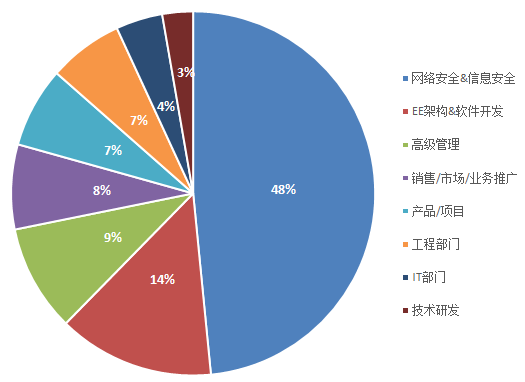
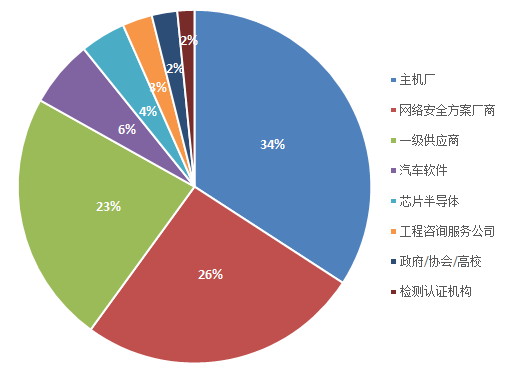
Company Type Proportion
Articles
Don’t miss out, this could be the largest exclusive community in the automotive cybersecurity industry!
Lawyer’s statement regarding the alleged imitation of the AutoSec conference brand
An article to help you understand the in-vehicle network communication security architecture of smart cars
Cybersecurity: TARA methods, tools, and cases
Key analysis of automotive data security compliance
A brief analysis of automotive chip information security and secure boot
Exploration of automotive in-vehicle communication security solutions in domain centralized architecture
System security architecture for vehicle network security
Privacy protection issues in the Internet of Vehicles
Research on cybersecurity technologies for intelligent connected vehicles
AUTOSAR information security framework and key technology analysis
What are the information security mechanisms in AUTOSAR?
Underlying mechanisms of information security
Automotive network security
Use of AUTOSAR hardware security module HSM
First release! Lei Jun from Xiaomi made suggestions on automotive data security issues at the two sessions: Suggestions for building a complete automotive data security management system