
Abstract
To clarify the jetting mechanism during the formation of Lahn-Dill type iron ores, the enrichment process of iron particles in seawater, and the chemical characteristics of seawater at that time, the research team conducted relevant studies. The team analyzed ore from the Fortuna mine in Germany, combining whole-rock geochemical analysis with micro-regional in-situ detection methods to study the distribution of elements in different mineral microdomains. The study found that this type of iron ore is formed by the mixing of low-temperature jetting fluids and seawater, with the jetting being more “diffusive” rather than the traditionally believed “concentrated” type, and the iron reduction during the diagenetic stage also led to changes in some ore components.
Written by|Yuan Lin
Edited by|Zhong Tian
Citation|Leanne Schmitt, Thomas Kirnbauer, Thomas Angerer et al. Genesis of Devonian volcanic-associated Lahn-Dill-type iron ores – part II: trace element fractionation evidences diffuse fluid venting[J]. MINERALIUM DEPOSITA, 2024, 59.
Note|Click the “mini program code” at the end of the article to access the original material
→This is the 214th article of “Mineral Research Prospects”
01
Full Interpretation
Iron oxide deposits in the ocean serve as a “geological chronicle”—they carry key information about the sources of iron in ancient times, ancient marine environments, and the entire chemical evolution of the ocean (research by Grenne and Slack 2003b, Bekker et al. 2010 has confirmed their recording value). However, in the critical research area of Lahn-Dill type iron ores, core scientific questions such as “how do hydrothermal jets operate?”, “how are iron particles captured and deposited in seawater?”, and “what was the chemical state of seawater during mineralization?” have long been shrouded in mystery.
Lahn-Dill type iron ores are marine iron oxide deposits associated with alkaline basalt volcanic activity during the late Devonian (approximately 380 million years ago). These deposits were formed in restricted small basins, with two scenarios: either during brief volcanic quiescence, they formed as thin layers intercalated with volcanic rocks (similar to “intermittent deposits”); or during a phase of weakened volcanic activity, they accumulated into ore bodies several meters thick (the thickest being less than 10 meters). The main ore consists of hematite and quartz, with local occurrences of siderite and magnetite, and an iron content (measured as Fe₂O₃) of about 25% – 35%.
Previous studies have inferred through lithofacies analysis that ore formation is closely related to the “biological/non-biological oxidation” of Fe(II)—where gel-like iron oxides (similar to ferrihydrite) first form in seawater, followed by the adsorption of silicon to form iron-rich silicate gels (Schmitt et al. 2023). However, key details such as whether the hydrothermal fluids are concentrated or slowly diffusive, the “capture” deposition mechanism of iron particles in seawater, and the redox chemical properties of seawater during mineralization have remained unclear.
To solve these problems, the research team focused on the Fortuna mine in the Rhenish Massif region of Germany—one of the largest mining areas of Lahn-Dill type iron ores, with samples that are “highly representative”. The team employed a set of “analytical combinations” to achieve multi-dimensional breakthroughs from macro to micro:
- Whole-rock geochemical analysis (WDXRF, ICP-MS/OES): Anchoring the overall characteristics of the ore, determining whether volcanic clasts are mixed in, and how later hydrothermal processes modified the ore body;
- In-situ laser ablation ICP-MS (LA-ICP-MS): Focusing on “microdomains” (such as small areas of different mineral combinations like quartz-hematite, pure hematite, siderite-hematite, etc.), analyzing the distribution patterns of trace elements at a microscopic scale;
- Transmission electron microscopy energy dispersive X-ray mapping (TEM EDX): Penetrating the mineral interiors to present fine details of element distribution.
This combination of “macro background + micro processes” is an innovative path not attempted in previous studies. It captures the “large environment” of ore formation (such as the degree of volcanic clast contamination) while also magnifying to a “cellular level” to analyze the subtle chemical processes during mineral growth.
In the analysis results, the “fractionation patterns” of trace elements became key clues to unraveling the mystery:
- Hematite microdomain: The rare earth element (REY) patterns in most areas highly match the typical characteristics of “iron oxides in seawater adsorbing trace elements”—indicating that during the formation stage of hematite, Fe(II) in seawater was rapidly oxidized to iron oxides, capturing REY from seawater in the process;
- Siderite-hematite microdomain: REY are jointly regulated by hematite and apatite, with signs of element “remigration”—suggesting that Fe(III) reduction occurred during the diagenetic stage (possibly driven by microbial involvement or environmental changes), with some elements experiencing redistribution in pore water;
- Apatite within the quartz-hematite microdomain: Its REY pattern is highly similar to that of “original seawater”—indicating that these apatites were directly formed by the adsorption of phosphorus and REY from seawater, belonging to “syngenetic” products.
Connecting these clues, the team reached a disruptive conclusion: The formation of Lahn-Dill type iron ores originates from the mixing of “low-temperature hydrothermal fluids” with “surrounding seawater”—and the ratio of seawater to hydrothermal fluids is extremely high. This means that hydrothermal fluids did not “concentrate erupt” from the seafloor (similar to the intense jetting of black smokers), but rather released slowly in the form of “diffusive jets”. In this environment, Fe(II) rapidly oxidizes into iron particles and precipitates directly in seawater, ultimately forming hematite-quartz type ores; the Fe(III) reduction during the local diagenetic stage then transforms some areas into siderite-hematite type ores, accompanied by the “secondary migration” of trace elements in pore water.
For geologists, this ends decades of academic debate: the traditional view held that the formation of Lahn-Dill type iron ores was dominated by “concentrated jets”, while the new research, through a chain of evidence from micro to macro, proves that “diffusive jets” are the core mechanism. This cognitive revolution not only rewrites the theory of iron ore formation but also provides a new framework for understanding the “iron cycle” and “hydrothermal activity patterns” of the Devonian ocean.
For the broader scientific community, it showcases the powerful potential of “technical crossover”: the combination of whole-rock analysis + in-situ microdomain analysis + electron microscopy characterization transforms the “ancient sedimentation process” from a vague “geological story” into a quantifiable, verifiable “chemical chain”. For example, using the microdomain REY patterns, one can reverse-engineer the redox state of seawater during mineralization, the temperature and composition of hydrothermal fluids—providing more precise tools for reconstructing ancient marine environments.
For the resource exploration field, the Fortuna mine, as a “typical sample” of a large ore deposit, its new model of “diffusive jet mineralization” may provide a new logic for finding similar iron ores (for instance, no longer focusing solely on “concentrated jet structures”, but rather paying attention to broader diffusive sedimentation areas).
From the interpretative dilemma of the “geological chronicle” to the cracking of the “microchemical code”, and then to the innovation of mineralization theory—this research transforms the formation process of Lahn-Dill type iron ores from a “vague hypothesis” into a “clear chemical-geological narrative”. Whether you are a scholar studying ancient marine evolution, a geologist exploring ore genesis, or an enthusiast curious about the “geochemical archives”, it opens up a new perspective for observing ancient oceans and ore deposits.
02
Table of Contents
1IntroductionPART ONE
- Detailed introduction to the background of the article
2Geology and samplesPART TWO
- Explanation of geological background and sample conditions
3ResultsPART THREE
- Presentation of ore geochemical analysis results
4DiscussionPART FOUR
- Discussion of key mechanisms of ore formation
5ConclusionsPART FIVE
- Summary of the full content of the article
03
HIGHLIGHT Image
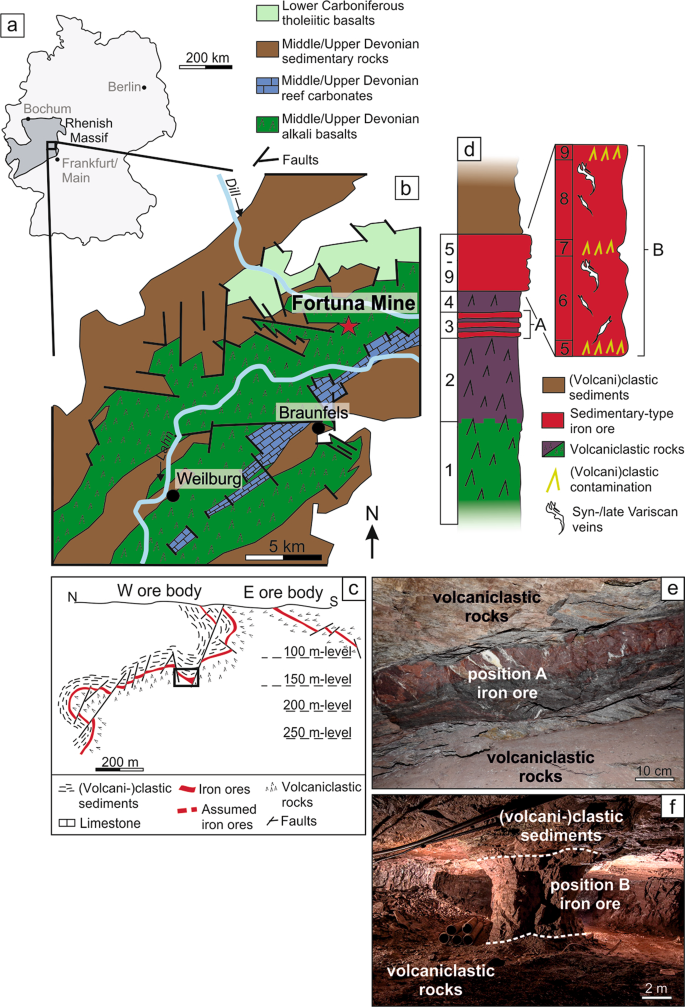
Geological overview of the Fortuna Mine and analysed samples. (a) Fortuna Mine location in the eastern Rhenish Massif (black square) and (b) enlarged in the Lahn Syncline (modified after Kegel 1922). Older and younger rocks than Middle Devonian to Lower Carboniferous, respectively, are shown in white. (c) Cross-section of the Fortuna Mine displaying the heavily dissected and folded western and eastern ore bodies; black square marks approximate sample location on the 150 m-level (modified after Dengler 1963). (d) Lithostratigraphic profile of the sampled area within the Fortuna Mine (modified after Schmitt et al. 2023). Numbers separate the profile into lithostratigraphic zones from which samples were taken. Note that depicted thicknesses of drawn stratigraphic units do not correspond with true thicknesses due to graphic reasons. For true thicknesses the reader is referred to chapter “sampling location and sample characteristics”. (e) Image of one of the position A ore lenses and (f) of the 5-m-thick position B main ore body (Schmitt et al. 2023). Image in (e) can be used due to courtesy of Roger Lang/Geowelt Fortuna e.V
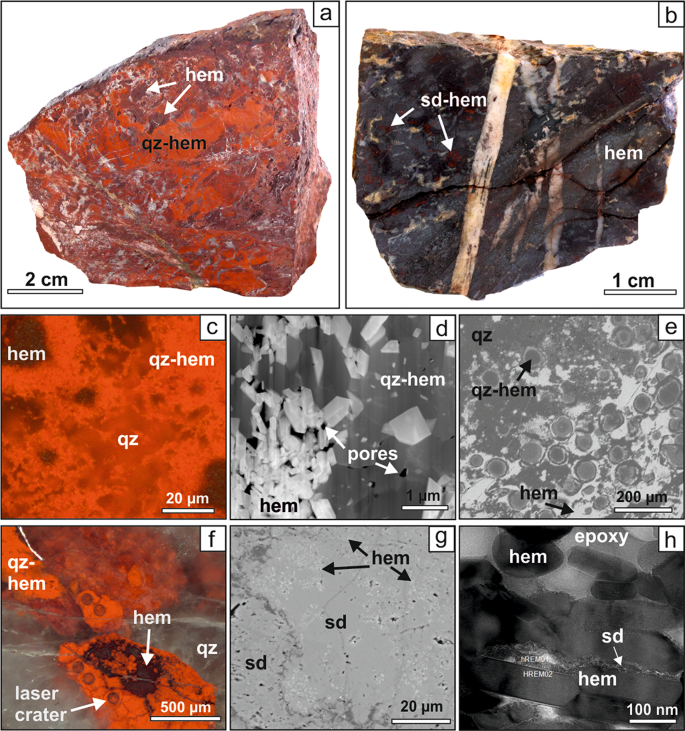
Haematite-quartz and siderite-haematite ores and ore-forming microdomains. a Photo of slab of position B haematite-quartz (DLFo008) and (b) of siderite-haematite ores (DLFo028.2). c Haematite microdomain spherules surrounded by quartz-haematite microdomain and quartz microdomain matrix. d Haematite microdomain associated with pores in quartz-haematite microdomain at the interface between haematite and quartz-haematite microdomains. e Quartz-haematite microdomain spherules surrounded by quartz microdomain filled crescent-shaped cracks and by haematite microdomains. f Haematite microdomain aggregate surrounded by quartz-haematite microdomain. Note the laser crater in quartz-haematite microdomains (sample DLFo008). g Nanocrystalline haematite (white) distributed patchily in siderite single grain (grey) forming siderite-haematite microdomains. h Haematite from haematite microdomain replaced by nanocrystalline siderite. c + f = crossed polarised reflected light photomicrographs, d = TEM HAADF image, e + g BSE SEM images, h = TEM BF image. qz-hem = quartz-haematite microdomain, hem = haematite microdomain, qz = quartz microdomain, sd-hem = siderite-haematite microdomain (hem: haematite; qz: quartz; sd: siderite). All images (except f) are from Schmitt et al. (2023)
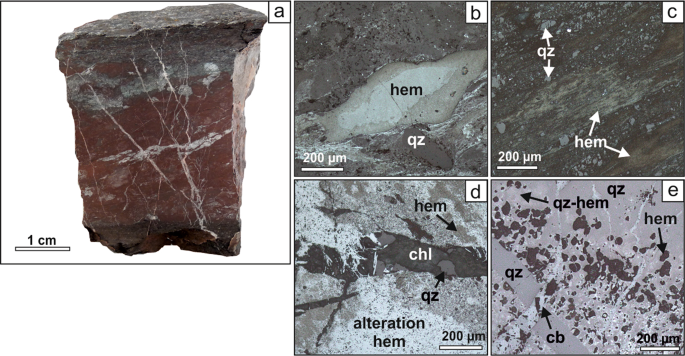
(Volcani)clastic components and hydrothermal alteration in Fortuna Mine ores. a Photo of slab of position A haematite-quartz ore displaying incorporated volcaniclastic material (ash-sized) and cross-cutting hydrothermal calcite veinlets. b Haematite microdomain replacing (volcani)clastic components in the middle of position B ore layer (DLFo031) and (c) replacing fine-grained clastic material in the uppermost sample of position B (DLFo026), where ores are intercalated with clastic sedimentary rocks. d Chlorite-quartz veins and haematite alteration cross-cutting haematite microdomains in position B siderite-haematite ore. e Quartz and carbonate veins cross-cutting quartz-haematite, haematite and quartz microdomains in position B haematite-quartz ore. b-e = plain polarised reflected light microphotographs. hem = haematite microdomain (cb: carbonate; chl: chlorite; hem: haematite; qz: quartz). All images (except e) are from Schmitt et al. (2023)
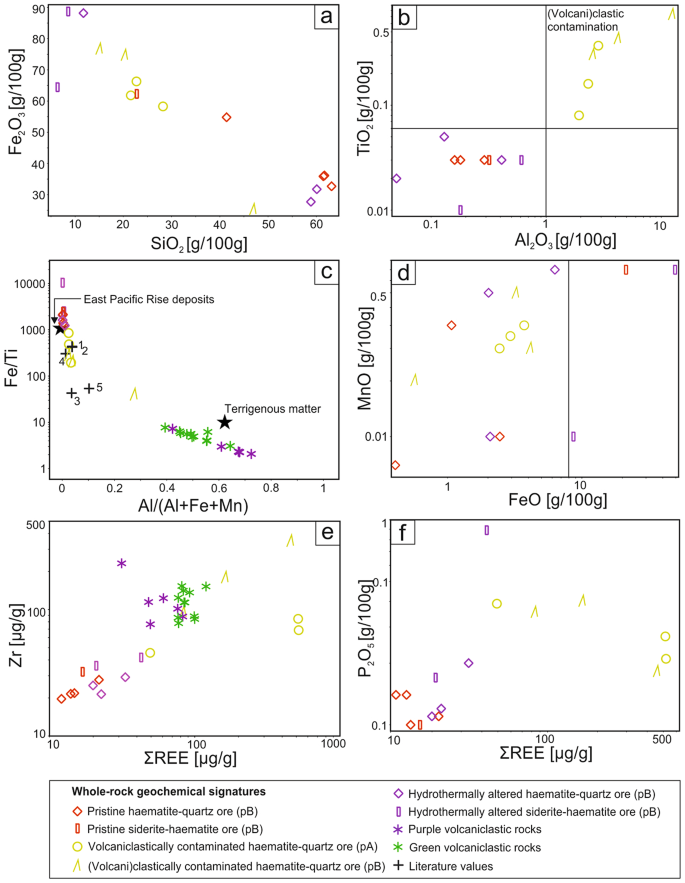
Whole-rock geochemical plots of position A (pA) and B (pB) ores on (a) SiO2 vs. Fe2O3(t) and (b) Al2O3 vs. TiO2 diagrams. c Al/(Al + Fe + Mn) vs. Fe/Ti diagram (adapted from Boström 1983; average values for terrigenous matter and East Pacific Rise deposits are from Boström (1970) and Boström et al. (1976)) with position A and B ores, footwall volcaniclastic rocks and other Fe-oxide deposits and occurrences through time (1: Neoproterozoic Wadi Hamama iron formation (Abd El-Rahman et al. 2019); 2: Ordovician Lokken Jasper beds (Grenne and Slack 2005); 3: modern Tagoro vent precipitate (González et al. 2020); 4: modern Loihi vent precipitate (Rouxel et al. 2018); 5: particulate Fe from the eastern Pacific (Feely et al. 1996; Rouxel et al. 2016)). d Plot of FeO vs. MnO to discriminate siderite-haematite from haematite-quartz ores. ƩREE vs. (e) Zr and vs. (f) P2O5 diagrams

OIB-normalised (Sun and McDonough 1989) whole-rock REY fractionation patterns in footwall volcaniclastic green and purple rocks, as well as in position A (pA) and B (pB) ores. Order and numbers of REY patterns on the right side are a relative estimation of their stratigraphic position depicted on the left side
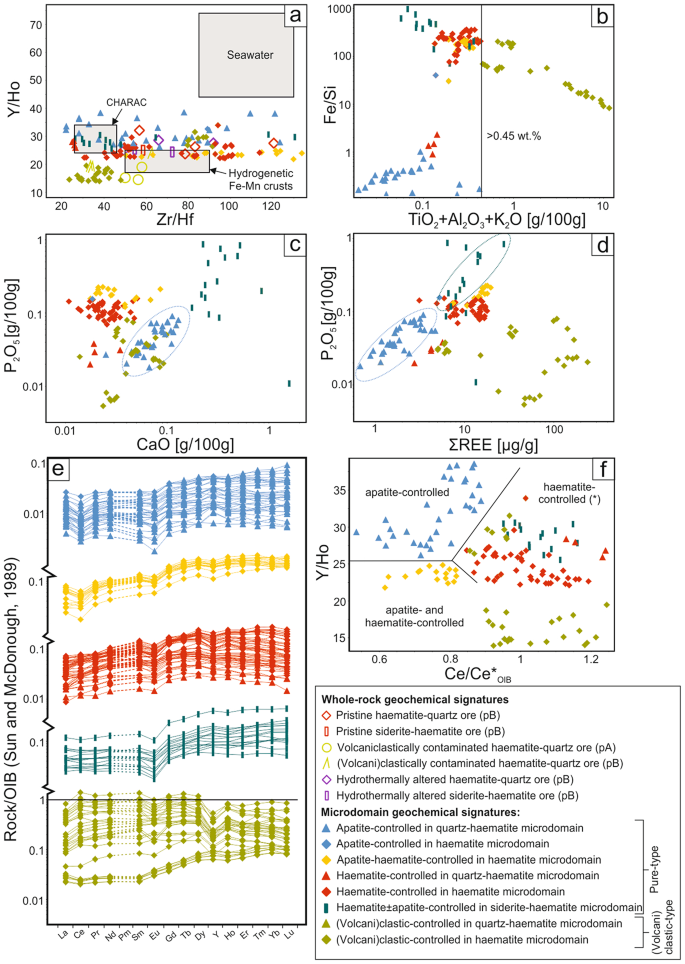
Plots of LA-ICP-MS data obtained for different microdomains. a Zr/Hf vs. Y/Ho diagram (adapted from Bau 1996) with microdomains and whole-rock data for position A (pA) and B (pB) ores. b TiO2 + Al2O3 + K2O vs. Fe/Si diagram to differentiate pure- from (volcani)clastic-type microdomains. c CaO vs. P2O5 plot of microdomains with most quartz-haematite microdomains displaying a positive correlation (blue circle). d Plot of ƩREE vs. P2O5 displaying a positive correlation in most quartz-haematite and several siderite-haematite microdomains (blue and turquoise circles). e OIB-normalised (Sun and McDonough 1989) REY fractionation patterns of microdomains. f Ce/Ce*OIB vs. Y/Ho discrimination diagram for microdomains. (*) = some siderite-haematite microdomains show additional trace element-control by apatite (cf. Figure 7d and section “Mineralogical controls of trace element budgets in microdomains”)
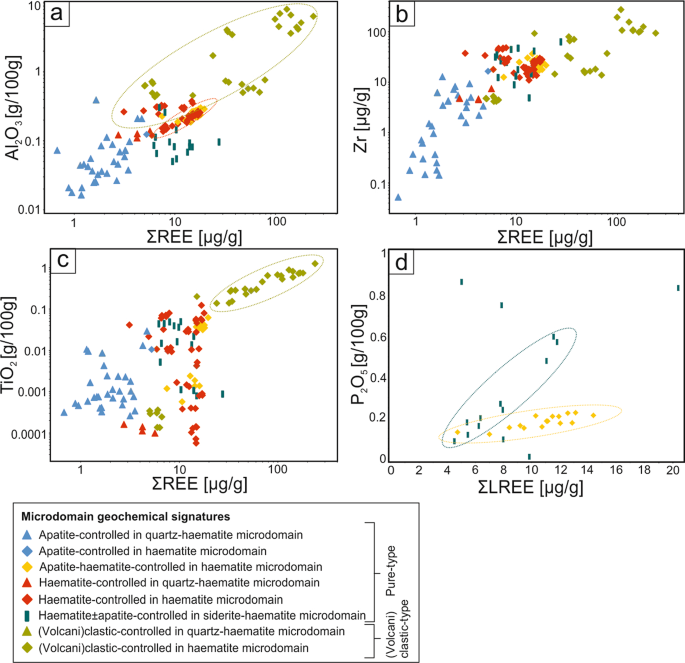
Plots of ƩREE vs. (a) Al2O3, vs. (b) Zr, and vs. (c) TiO2 of all microdomains. Brown-green circles in (a) and (c) highlight positive correlations in (volcani)clastic-type microdomains, whereas red circle in (a) highlights a positive correlation in haematite microdomains. d ƩLREE vs. P2O5 diagram showing a positive correlation in several haematite (yellow circle) and siderite-haematite (turquoise circle) microdomains
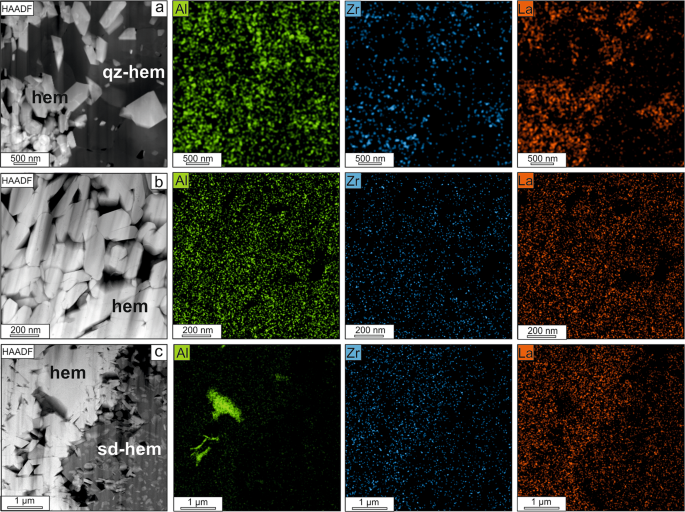
TEM EDX element maps of (a) quartz-haematite, (b) haematite and (c) siderite-haematite microdomains showing trace element (Al, Zr and La) distribution. qz-hem = quartz-haematite microdomain, hem = haematite microdomain, sd-hem = siderite-haematite microdomain
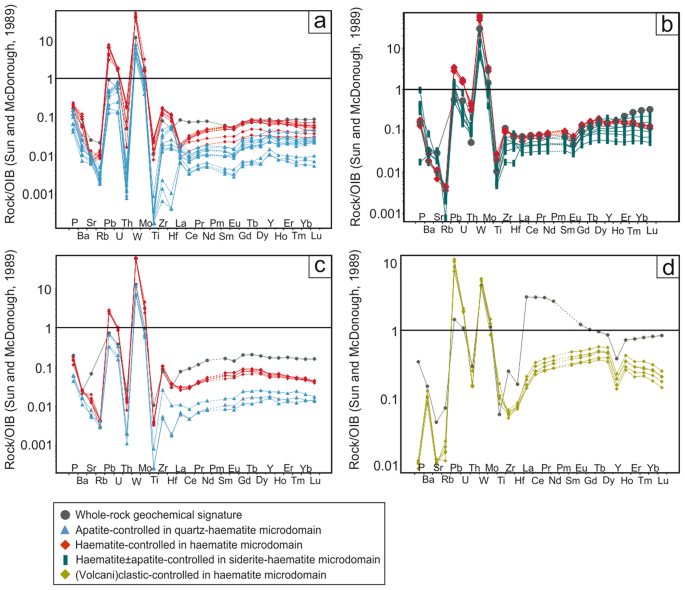
OIB-normalised (Sun and McDonough 1989) trace element patterns comparing whole-rock with microdomain geochemical signatures in (a) position B haematite-quartz ore sample DLFo008, (b) position B siderite-haematite ore sample DLFo028.2, (c) position B haematite-quartz ore sample DLFo034 and (d) position A haematite-quartz ore sample DLFo036
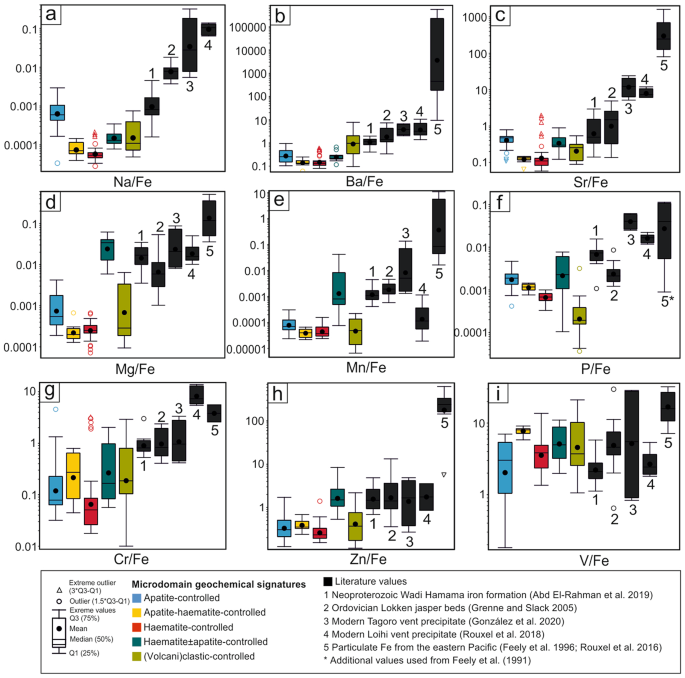
Box- and whisker diagrams for microdomains classified based on their mineralogical controls in comparison with literature values. Note that siderite-haematite domains are grouped together, despite their trace element control related to haematite and haematite-apatite
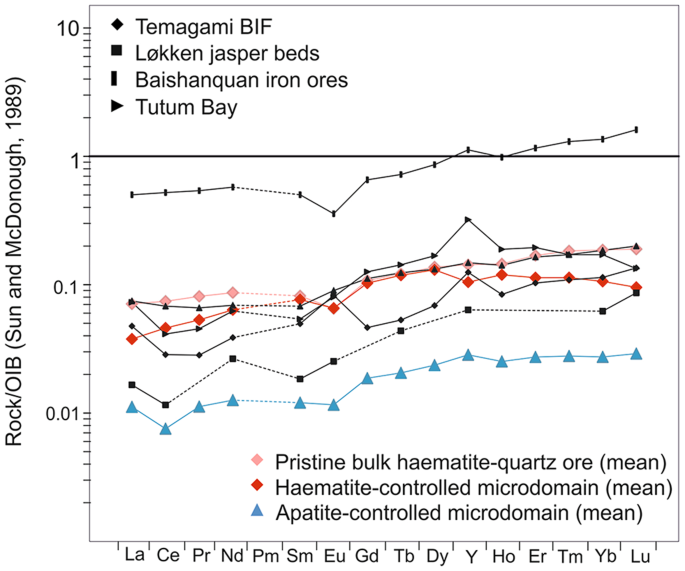
OIB-normalised REY spider diagram of averages of bulk Lahn-Dill-type iron ores (salmon-colour), as well as quartz-haematite (blue-coloured) and haematite (red-coloured) microdomains in comparison with marine Fe-oxide occurrences through time including the Neoarchean Temagami banded iron formation (Canada, Bau and Alexander 2009), the Ordovician Løkken jasper beds (Norway, Grenne and Slack 2005), the Carboniferous Baishanquan iron ore deposit (China, Yang et al. 2023), and the recent iron muds from Tutum Bay (Papua New Guinea, Pichler and Veizer 1999)
Disclaimer: This article is for academic exchange and dissemination only
ENDClick the QR code below to join the industry group of thousands

 Click the mini program code below to access the original material

Previous Recommendations
The Mystery of Sphalerite Genesis? Analysis of Mineral Zoning Controlled by Ancient Groundwater Levels
Citation:Zhuang et al. Nonsulfide Zn–Pb mineralization and vertical zoning in the world-class Angouran deposit, NW Iran: linked to water table-controlled supergene processes[J]. MINERALIUM DEPOSITA, (1432-1866).
Click to read
Are Porphyry-epithermal Deposits Related? Chronological Constraints on the Bangpu Polymetallic System
Citation:Zuo et al. Geology and geochronology of the Bangpu porphyry‒skarn‒epithermal Mo‒Cu‒Zn‒Pb‒Ag deposit in the Gangdese metallogenic belt, Tibet[J]. MINERALIUM DEPOSITA, (1432-1866).
Click to read
How Do Magmatic-hydrothermal Fluids Drive Tin Precipitation? Boron Isotope Tracing of Deposit Fluid Mixing Mechanisms
Citation:Yang et al. Constraints of in-situ elemental and B isotopic compositions of tourmaline on the origin of the Nong Sua Sn deposit, Thailand[J]. MINERALIUM DEPOSITA, (1432-1866).
Click to read
How Does Helium Exploration in China Break Resource Bottlenecks? Enrichment Patterns and Favorable Area Predictions
Citation:Xiong et al. Current Status of Helium Resource Research and Prediction of Favorable Areas for Helium Reservoir in China[J]. ENERGIES, 2024, 17 1530.
Click to read
Why Are Subduction Zones Enriched in Helium? Analysis of the Helium Belt of 1200 Kilometers in the Tibetan Plateau
Citation:Yinleihao et al. Discovery and genesis of helium-rich geothermal fluids along the India–Asia continental convergent margin[J]. GEOCHIMICA ET COSMOCHIMICA ACTA, 2023, 360.
Click to read
How Do Helium-rich Geothermal Fields Form? Mechanisms and Exploration Indicators of Cretaceous Granite
Citation:Li et al. Multi-isotopes (H, O, Sr, and Li) and element geochemistry constrain the formation of Kongchutso helium-rich geothermal field in western Tibet, China[J]. GEOTHERMICS, 2024, 120.
Click to read
How Has Geothermal Gas Research Evolved? A Bibliometric Analysis of Fifty Years Reveals the Path
Citation:Wang et al. Progress in geothermal gas research in the last 50 years: a bibliometric review[J]. EARTH SCIENCE INFORMATICS, 2025, 18.
Click to read
How Is Helium Enriched in Geothermal Systems? Analysis of Basement Structure and Sedimentary Mixing Mechanisms
Citation:Hao et al. Occurrence and enrichment mechanisms of helium in geothermal systems in continental China[J]. GONDWANA RESEARCH, 2025, 141.
Click to read
How Is Natural Hydrogen Stored Underground? Deciphering the Fracture Density of Mali’s Bourakebougou H2 Field
Citation:Maiga et al. Trapping processes of large volumes of natural hydrogen in the subsurface: The emblematic case of the Bourakebougou H2 field in Mali[J]. INTERNATIONAL JOURNAL OF HYDROGEN ENERGY, 2024,50.
Click to read
How Is Natural Hydrogen Explored in the Songliao Basin? Pore Structure Dominates Hydrogen Absorption Mechanisms
Citation:Wang et al. The occurrence pattern of natural hydrogen in the Songliao Basin, P.R. China: Insights on natural hydrogen exploration[J]. INTERNATIONAL JOURNAL OF HYDROGEN ENERGY, 2024,.
Click to read
What Is the Success Rate of Water Extraction from Wells Using High-Density Electrical Methods?
Click to read
What Opportunities and Challenges Exist in Deep Hydrogeological Research?
Click to read
What Contribution Does Magmatic Activity Make to Hydrothermal Ore Formation?
Click to read
Research on the Three-Dimensional Geothermal Geological Model Method in the Xiong’an New Area
Click to read
Geothermal Geological Conditions and Resource Formation Factors in the South China Sea Basin
Click to read
Geochemical Characteristics, Accumulation Patterns, and Prospects of Helium
Click to read