
Hello everyone, I am Tony Bai.
In a recent meeting summary from the Go compiler and runtime team, we were pleasantly surprised to discover a roadmap for 2026 (2026 planning, as shown in the image below). Although this roadmap is brief, the information it contains is enough to make any developer interested in the future of the Go language excited.
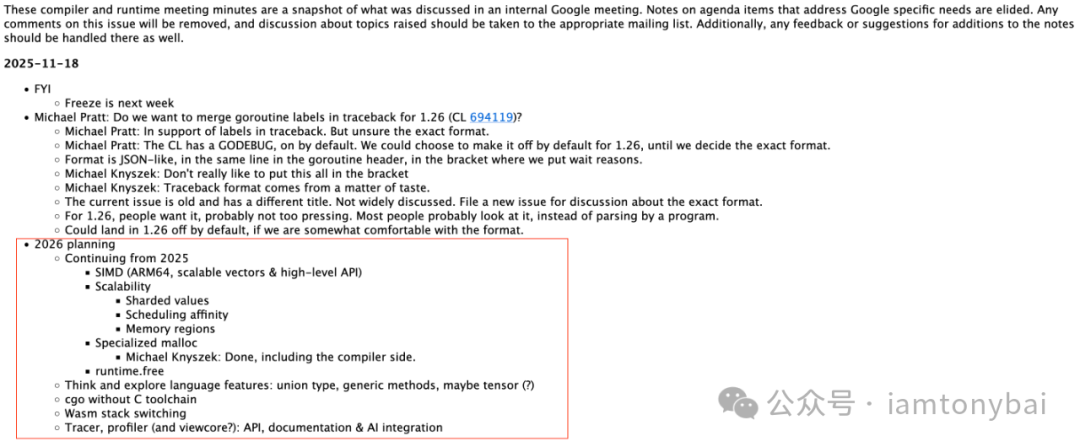
From squeezing every bit of potential from hardware with SIMD and runtime manual memory release (runtime.free), to the highly anticipated generic methods and union types, and finally to the complete resolution of cross-compilation pain points with CGO without C toolchain, the Go team is plotting a comprehensive transformation regarding performance, expressiveness, and engineering experience.
This article will analyze the technical details and strategic intentions behind the Go 2026 roadmap, combining the latest design documents, CL (Change List) records, and core community issues.
Breaking Performance Limits — Squeezing Every Drop of Hardware Potential
Historically, Go’s performance strategy has been “good enough.” However, in the 2026 roadmap, we see the Go team charging towards “extreme performance,” targeting fields that are extremely sensitive to latency, such as AI, scientific computing, and high-frequency trading.
SIMD: From “Assembly Black Magic” to “Native Citizen”
- Keyword:
<span>SIMD (ARM64, scalable vectors & high-level API)</span> - Interpretation:
- Current Status: Currently, using SIMD (Single Instruction Multiple Data) in Go mainly relies on hand-written assembly, which is not only difficult to maintain but also cannot be inlined optimized by the compiler, and may even hinder asynchronous preemption.
- Transformation: The plan clearly proposes a “high-level API”. This means Go will provide a set of native, type-safe SIMD libraries. Developers can write vectorized algorithms in pure Go code, which the compiler will automatically map to the underlying AVX-512 (x86) or NEON/SVE (ARM) instructions.
- Scalable Vectors: The specifically mentioned “scalable vectors” directly refers to ARM64’s SVE (Scalable Vector Extension) technology. This will allow the same Go binary code to automatically adapt on hardware with different vector lengths (from 128 bits to 2048 bits), achieving “linear scaling” of performance, which is crucial for AI inference scenarios.
- Progress: In the Go 1.26 release at the beginning of 2026, Cherry Mui’s proposal regarding architecture-specific SIMD intrinsics will be implemented as an experimental feature in Go, meaning Go developers will have a native
<span>simd</span>package implementation, and this work is currently underway.
<span>runtime.free</span>: Breaking the “Golden Rule” of GC
- Keyword:
<span>runtime.free</span>, ,<span>Specialized malloc</span> - Interpretation: This is a disruptive change. Go has always been known for its automatic GC, but in extreme performance scenarios, the CPU and STW overhead of GC remains a bottleneck.
- Explicit Release: According to the design document “Directly freeing user memory to reduce GC work” and related CLs (such as CL 673695),
<span>runtime.freegc</span>allows heap memory that is no longer in use to be immediately returned to the allocator for subsequent reuse, completely bypassing GC scanning. - Compiler Assistance: This does not mean users will manually manage memory (which would be too unsafe). Go’s vision is to allow the compiler to automatically insert
<span>free</span>calls through escape analysis and lifetime analysis. For example, during the expansion of<span>strings.Builder</span>, the old buffer can be immediately released. - Measured Data: In early prototype tests, the optimized
<span>strings.Builder</span>performance improved by 2 times! Coupled with a specialized allocator optimized for non-pointer objects (<span>noscan</span>), Go’s temporary object allocation performance will approach stack allocation.
New Heights of Scalability — Embracing the Era of Many Cores
As the number of CPU cores approaches 128 or even higher, traditional concurrency models begin to encounter “scalability walls.” The Go 2026 roadmap provides a set of combined solutions.
Sharded Values
- Keyword:
<span>Sharded values</span> - Pain Point: In high-concurrency scenarios, accessing the same global counter or
<span>sync.Pool</span>can lead to severe cache line contention, nullifying the advantages of multi-core. - Solution: The Go team proposed a proposal named
<span>sync.Sharded</span>(see Issue 18802), which aims to provide a “per P (Processor) localized” data structure. - Lock-free Read/Write: Each P only operates on its local shard, completely lock-free, with zero contention.
- On-demand Aggregation: Only when the total value needs to be read will all shards be traversed for aggregation.
- This will have an order of magnitude performance improvement over existing
<span>sync.Map</span>or<span>atomic</span>operations on high-core machines.
Scheduling Affinity
- Keyword:
<span>Scheduling affinity</span> - Interpretation: Although the Go scheduler’s “work stealing” mechanism balances the load, it also causes Goroutines to frequently “drift” between different CPU cores, disrupting the heat of L1/L2 caches.
- New Mechanism: In Issue 65694, the Go team plans to introduce a mechanism that allows a group of related Goroutines to be “bound” or “biased” towards a specific P or NUMA node. This is a huge benefit for cache-sensitive applications like databases and high-frequency trading systems, significantly reducing LLC (Last Level Cache) Miss.
Memory Regions
- Keyword:
<span>Memory regions</span> - Interpretation: After the failure of the Arena experiment, Michael Knyszek initiated a discussion on a proposal called
<span>Memory regions</span>(see Discussion 70257), whose core idea is to implicitly bind all memory allocations within a function scope to a temporary, goroutine-bound region through a<span>region.Do(func() { ... })</span>call. Behind this elegantly designed concept lies an extremely complex implementation. It requires enabling a special, low-overhead write barrier in the goroutine that opens the region to dynamically track memory escape. Although theoretically feasible, its implementation complexity and potential performance overhead make it a long-term and uncertain research topic. In 2026, the Go team aims to make breakthroughs in this proposal, but the road ahead remains challenging.
The Awakening of Language Expressiveness — Filling the Last Puzzle After Generics
After the introduction of generics, the Go community’s desire for language features has not stopped. Several features mentioned in the roadmap will further enhance Go’s expressiveness.
Generic Methods
- Keyword:
<span>generic methods</span> - Background: This is one of the biggest regrets after the introduction of generics. Currently, Go does not support defining additional type parameters in interface methods or struct methods.
- Outlook: Referencing Issue 49085, although the implementation difficulty is extremely high (involving runtime dictionary passing or monomorphization bloat), the core team has included it in the roadmap, indicating they are looking for breakthroughs. Once implemented, smooth chained calls like
<span>Stream.Map[T, U](func(T) U)</span>will become possible.
Union Types
- Keyword:
<span>union type</span> - Interpretation: Referencing Issue 19412, this is not just
<span>A | B</span>in generic constraints. True union types (similar to Rust’s Enum or TypeScript’s Union) can give Go more powerful pattern matching capabilities. Coupled with possible<span>match</span>syntax, it will completely change the way Go handles error processing and state machine writing, making it safer and more concise.
Tensor (?) — The Ticket to the AI Era
- Keyword:
<span>maybe tensor (?)</span> - Interpretation: This item with a question mark is full of imagination. It suggests that the Go team may be seriously considering providing native support for multi-dimensional arrays for AI/ML workloads. If Go can natively support efficient tensor operations and automatic differentiation at the language level, it will be qualified to challenge Python’s dominance in the AI infrastructure field. Of course, all of this is still speculation.
Toolchain Revolution — Pain-Free CGO
CGO Without C Toolchain
- Keyword:
<span>cgo without C toolchain</span> - Pain Point: Currently, enabling CGO means having to install GCC/Clang, losing the convenience of cross-platform cross-compilation (
<span>CGO_ENABLED=0</span>is the reluctant choice of many Gophers). - Solution: The Go team’s goal is to achieve “pure Go C interaction”. This may be realized through two paths:
- Runtime Loading: Similar to
<span>purego</span>, dynamically load shared libraries and call them at runtime without compile-time linking. - Built-in Mini Linker: The Go compiler directly parses C header files and generates calling code.
- Regardless of which of the above methods, or other methods, once realized, the promise of “Write once, compile anywhere” will also be fulfilled in the CGO scenario.
Wasm Stack Switching
- Keyword:
<span>Wasm stack switching</span> - Interpretation: This is to better support Go’s asynchronous model in the browser. Through stack switching, Go can more efficiently suspend and resume Wasm execution, seamlessly interoperating with JavaScript’s
<span>Promise</span>and<span>async/await</span>mechanisms, significantly reducing the size of Wasm products and improving performance.
Conclusion: A Dual Leap in Performance and Expressiveness
After reviewing this 2026 roadmap, we can’t help but exclaim: The Go language is undergoing its “coming of age”.
- In terms of performance, it is no longer satisfied with “sufficient” but is charging towards the “extreme performance domain” dominated by C/C++ through SIMD, manual memory management, and affinity scheduling.
- In terms of expressiveness, it is filling the last gap after generics, making code more elegant and safer through generic methods and union types.
- In terms of experience, it is committed to smoothing out the last hurdle of CGO and cross-compilation.
This is an ambitious plan. If these features can indeed be realized by 2026, Go will no longer be just a “cloud-native language”; it will become a versatile, extreme, and still simple general computing platform.
References
- Go compiler and runtime meeting notes – https://github.com/golang/go/issues/43930#issuecomment-3576250284
- Directly freeing user memory to reduce GC work – https://go.dev/design/74299-runtime-freegc
- runtime, cmd/compile: add runtime.freegc and runtime.freegcTracked to reduce GC work – https://github.com/golang/go/issues/74299
- 715761: runtime: support runtime.freegc in size-specialized mallocs for noscan objects – https://go-review.googlesource.com/c/go/+/715761
- simd: architecture-specific SIMD intrinsics under a GOEXPERIMENT – https://github.com/golang/go/issues/73787
- proposal: sync: support for sharded values – https://github.com/golang/go/issues/18802
- runtime: stronger affinity between G ↔ P ↔ M ↔ CPU? – https://github.com/golang/go/issues/65694
- https://github.com/golang/go/discussions/70257 – https://github.com/golang/go/discussions/70257
- Region-based memory management – https://en.wikipedia.org/wiki/Region-based_memory_management
- proposal: spec: add sum types / discriminated unions – https://github.com/golang/go/issues/19412
- proposal: spec: allow type parameters in methods – https://github.com/golang/go/issues/49085
If this article has been helpful to you, please like, recommend, and share it! 
Click the title below to read more valuable content!
– Unlocking Ultimate CPU Performance: A Preview of Go’s Native SIMD Package
– From Arena, Memory Region to Runtime.free: A Pragmatic Shift in Go’s Memory Management Exploration
– The Bottleneck of Atomic Operations and Go’s Pain in Multi-core Scalability: An In-depth Analysis of sync.ShardedValue and per-CPU Proposals
– A New Paradigm for Go FFI: How Purego and Libffi Allow Us to Embrace the C Ecosystem Pain-Free
– Goodbye Confusion: A Practical Gopher’s Introduction to Type Theory
– Dingo: Go Language’s “TypeScript” Moment? — An Experiment in Language Evolution Driven by the Community
🔥 Still troubled by “copy-pasting to feed AI”? My new Geek Time column “AI Native Development Workflow Practice” will take you:
- Say goodbye to inefficiency and reshape development paradigms
- Master AI Agent (Claude Code) to achieve workflow automation
- Evolve from an “AI user” to a “workflow conductor” driven by specifications
Scan the QR code below to start your AI native development journey.