Reported by Electronic Enthusiasts (Author: Li Wanwan)Recently, GigaDevice discussed the company’s AI MCU plans. The company stated that regarding AI MCUs, there are three levels:1. MCUs tailored for AI scenarios. These MCUs are primarily used in humanoid robots, robotic dogs, and other products related to embodied intelligence, responsible for joint control, sensor control, and more. GigaDevice’s long-standing technological advantages in the industrial control field can be directly applied to such scenarios, and the company currently has a high penetration rate in this market. For example, in the field of optical modules for AI server data communication, GigaDevice has also achieved a significant market share. The company’s high-performance new products are actively entering the digital power market related to AI servers, and after their launch, they have entered the design phase (design-in) and have gradually received design wins from leading domestic and international customers. Additionally, new wireless interconnection products assist edge devices in accessing cloud-based AI large model capabilities, such as applications in AI toys and smart homes. With the rapid development of the AI market, the sales of such MCUs are expected to continue to grow.2. Empowering existing MCU product families through AI algorithms and solutions. By integrating AI algorithms and solutions into the existing wide range of MCU product families, to meet customer demands for AI, such as signal anomaly detection, AI voice recognition, image recognition, etc. A typical example is the AI arc detection solution aimed at the photovoltaic market, which has outperformed some international competitors in projects with leading customers, driving sales of the H7 and G5 series new products.3. GigaDevice’s MCU products can accelerate AI computations, which is suitable for products with special requirements for AI computing power. Since the company’s MCUs are relatively low-power computing units, they mainly target applications that are even more edge-oriented than edge computing (endpoint AI). Currently, the company is actively developing new products, one of which is an AI MCU for the industrial sector, while another AI MCU for the consumer sector is in the early product definition stage. GigaDevice stated that the MCU product line is one of the company’s important strategic directions. The company has successfully mass-produced over 700 MCU products across 64 major series for market selection. In the first half of 2025, the company will continue to expand its technical capabilities in MCU products, deeply cultivating professional fields: in AI algorithms and solutions, the company’s DC arc detection solution is based on the high-performance GD32H7 series MCU as the hardware foundation and provides a complete set of AI algorithm tools, significantly improving detection accuracy. The AI large language model solution built on wireless MCU products supports AI intelligent voice dialogue, translation, story generation, and other functions, which can be widely applied in smart companion AI toys, smart homes, and other scenarios. Below, we will detail the GD32H7 series and the wireless MCU products GD32VW553 and GD32W515.
GD32H7 Series: A Model of High-Performance MCUs
GigaDevice’s high-performance MCU GD32H7 series, adopts a 600MHz Arm® Cortex® – M7 high-performance core based on the Armv7E – M architecture, making it the first MCU in China to achieve mass production based on the M7 core. It features advanced DSP hardware accelerators, a double-precision floating-point unit (FPU), a hardware trigonometric function accelerator (TMU), and a filtering algorithm accelerator (FAC), significantly reducing the burden on the core and improving processing efficiency. It is equipped with on-chip Flash ranging from 1024KB to 3840KB and 1024KB of SRAM, with 512KB configurable ultra-large tightly coupled memory (ITCM, DTCM) ensuring zero wait execution for critical instructions and data; 64KB L1-Cache (I-Cache, D-Cache) effectively enhances CPU processing efficiency and real-time performance. The GD32H7 series adds a wealth of general-purpose peripheral resources, including 8 USARTs, 4 I2Cs, 6 SPIs, 4 I2Ss, 2 SDIOs, and 2 octal OSPI (backward compatible with quad QSPI). It is equipped with 2 USB2.0 OTG interfaces, integrates 3 CAN-FD controllers, 2 Ethernet ports, and 1 EtherCAT® slave controller. The chip includes a TFT LCD driver and a graphics processing accelerator (IPA), integrates a serial audio interface (SAI) and SPDIF audio interface, as well as an 8-bit to 14-bit digital camera interface. It also features 4 32-bit general-purpose timers, 12 16-bit general-purpose timers, 4 64-bit/32-bit basic timers, and 2 PWM advanced timers. The 2 14-bit ADCs can sample at rates up to 4MSPS, while 1 12-bit ADC can sample at rates up to 5.3MSPS, integrating fast comparators (COMP), DACs, and other high-precision analog peripherals, supporting various motor control scenarios. The GD32H7 series operates on a supply voltage of 1.71V – 3.6V, supports advanced power management, and provides three power supply modes (LDO/SMPS/direct power) and five low-power modes, allowing for flexible power supply strategies while balancing overall energy consumption. At the same time, it supports various security mechanisms, providing solid protection for data security during communication. The GD32H7 series can be widely used in digital signal processing, motor frequency conversion, power supply, energy storage systems, civilian drones, audio and video, graphics and images, and various applications. Thanks to its ultra-high main frequency and large storage capacity, this series of MCUs is also suitable for many high-end innovative scenarios such as machine learning and edge computing. The GD32H7 series products include GD32H75E, GD32H759, GD32H757, and GD32H737. Among them, the GD32H75E product series supports EtherCAT® slave controllers, with a main frequency of up to 600MHz, supporting up to 3840K Flash and 1024K SRAM, integrating a series of digital and analog peripheral resources, providing BGA240 packaging options, and paired with GigaDevice’s GDSCN832 series EtherCAT® slave controllers. The GDESC series offers QFN64 packaging models, which can be widely applied in various application scenarios such as servo control, frequency conversion drives, industrial PLCs, and industrial communication modules, featuring 2 built-in PHY + 1 MII expansion interface, 8 Fieldbus Memory Management Units (FMMUs), 8 synchronization managers (Sync Manager Entities), 8KB DPRAM, 64-bit distributed clock (supporting master-slave synchronization with precision below 1uS), supporting 8/16-bit serial/parallel communication (supporting SPI/QSPI/OSPI slave interfaces, supporting EXMC synchronous mode), and supporting variable voltage I/O from 1.8V to 3.3V. The GD32H759 and GD32H757 product series both support CAN-FD, with a main frequency of up to 600MHz, supporting up to 3840K Flash and 1024K SRAM, integrating USB OTG, TFT-LCD, SAI, Ethernet, and other digital and analog peripheral resources, providing LQFP176 and BGA176, LQFP100, LQFP144, and BGA100 packaging options. The GD32H737 product series supports CAN2.0B, with a main frequency of up to 600MHz, supporting up to 3840K Flash and 1024K SRAM, integrating USB OTG, TFT-LCD, SAI, Ethernet, and other digital and analog peripheral resources, providing LQFP100, LQFP144, LQFP176, and BGA176 packaging options.
Wireless MCU Series GD32VW553 and GD32W515
With the explosive growth of generative AI, large language models (LLMs) have become the core driving force in fields such as AI programming assistants, intelligent dialogue systems, and automated office tasks. However, the current mainstream LLM deployments still heavily rely on cloud computing power, leading to high latency and strong network dependency, making it difficult to meet the real-time requirements of edge-side scenarios.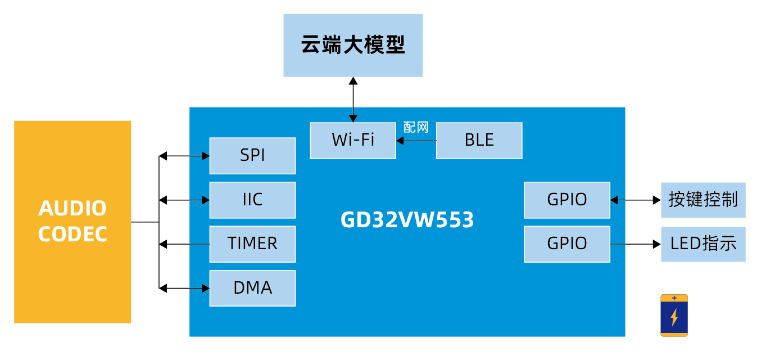 AI large language model LLM solution functional block diagram To address this challenge, GigaDevice has launched an AI large language model LLM solution based on the GD32 wireless MCU series. This solution provides powerful processing capabilities for edge-side LLMs through advanced RF performance, hardware-level security architecture, large-capacity storage expansion, and rich interface resources, combined with mature process technology and cost optimization advantages, enabling low-latency, high-privacy lightweight AI applications. The AI large language model LLM solution models include GD32AI-LLM-VW553/W515, with recommended MCUs being GD32VW553 and GD32W515. The GD32VW553 adopts a RISC-V core, with a main frequency of up to 160MHz, equipped with 4MB Sip Flash and 320KB SRAM, integrating Wi-Fi 6 and Bluetooth LE 5.2 RF modules, supporting information security features, with an operating temperature range of -40~105℃, and providing QFN32 and QFN40 packaging options. The GD32W515 adopts a Cortex®-M33 core, with a main frequency of up to 180MHz, equipped with 2MB Sip Flash and 448KB SRAM, integrating a Wi-Fi 4 module, supporting TrustZone security mechanisms, with an operating temperature range of -40~85℃, and providing QFN36 and QFN56 packaging options. The AI large language model LLM solution based on GD32VW553 establishes real-time, bidirectional communication connections with AI platforms such as Volcano Engine through the Websocket protocol, enabling rapid data transmission and interaction. This solution supports a 16KHz audio sampling rate, meeting the needs for high-quality voice communication and audio processing, and supports AI intelligent voice dialogue, translation, story generation, and other functions. The GD32W515 and GD32VW553 wireless MCU products can interface with multiple AI platforms such as Volcano Engine, iFLYTEK, Baidu, and Xiao Zhi AI, providing users with a rich array of AI application scenarios and solutions.

Disclaimer:This article is original to Electronic Enthusiasts, please indicate the source above when reprinting. For group communication, please add WeChat elecfans999, for submission, exposure, and interview requests, please send an email to [email protected].
More Hot Articles to Read
-
Commercialization Turning Point in Satellite Communication: T/R Chip Integration + GaN Empowerment, Entering Miniaturization
-
Tesla AI Chip Strategy Upgrade, “Epic” Chip Takes Over Dojo
-
Not HBM, Ultra-High Bandwidth DRAM for Endpoint AI! These Manufacturers Focus on Stacking Solutions!
-
Domestic Analog Chip Strong Recovery in the First Half of the Year, Manufacturer Revenue Surges Over 100%
-
Broadcom Receives “Billion Dollar Order” from OpenAI, AI Chip Business Revenue Soars
Click to Follow and Bookmark Us
Set us as a bookmark to not miss any updates!