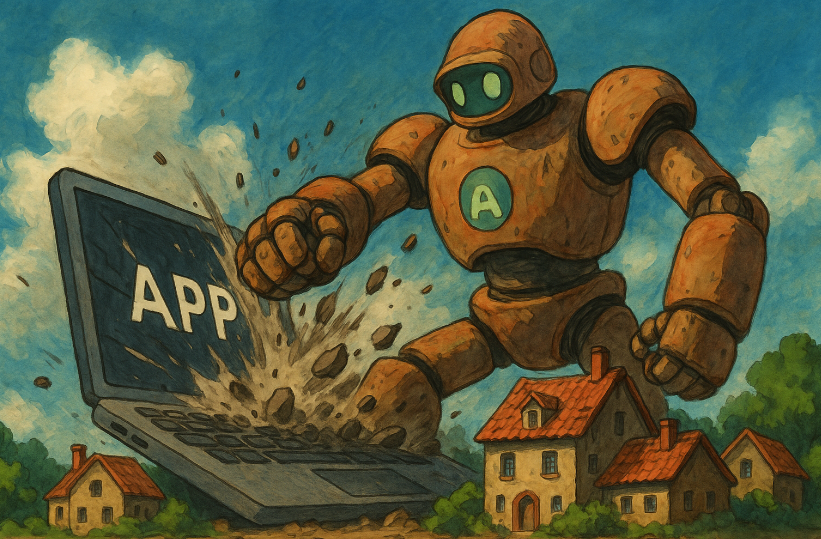
“SaaS is dead, long live the Agent?

Big Data Industry Innovation Service Media
——Focusing on Data · Changing Business
Ten years ago, we were still saying“Software is eating the world”; today, we might need to add:“Agents are eating software.”Have you noticed a trend quietly happening:• Users are opening fewer individual apps and instead directly asking a smart assistant: “Help me book a flight to Beijing and get reimbursed”;• Software products are no longer a bounded “stack of pages,” but rather a “capability module” invoked by Agents;• Functions are no longer triggered by clicks, but are scheduled, combined, and executed by agents through natural language intent.In the past, software was about us actively learning its logic, adapting to its buttons and processes.But the era of Agents is flipping all of this: users no longer click buttons, but issue commands; they no longer revolve around interfaces, but move towards goals.What does this mean?• For developers, it is a reconstruction of system architecture;• For product managers, it is a redefinition of interaction paradigms;• For software vendors, it is a redefinition of survival boundaries.Agents are not an upgrade of apps, but a mutation of how software exists.This is not a minor optimization, but a fundamental shock.In this article, we will delve into:• What exactly has changed in software due to Agents? Which logics have been overturned, and which will continue?• What have the “function, interface, and process” of software products become in the face of Agents?• For software vendors, transformation is necessary, but how should they transform, where should they turn, and what pitfalls should they avoid?This is a new starting point for an era, and we need to redefine the meaning of the word “software.”Essential Differences Between AI Agents and Traditional SoftwareMany people view AI Agents as “smart assistants with large models” or “talking software robots,” but in reality, they represent a shift in software paradigms.To clarify this change, we need to redefine it from three core levels:1. From “interface interaction” to “intent-driven”Traditional software: triggers functions through explicit operations like buttons, menus, and field inputs. Users must learn the “language” of the software: where to click, what to fill in, and the order of processes.Typical paradigm: GUI + manual execution processesAI Agent: Users only need to express “intent,” such as “Check last week’s sales data and summarize it.” The Agent understands the intent → breaks down the steps → autonomously calls tools to execute → provides results.New paradigm: Natural language + autonomous execution + feedback loopEssential change: Users no longer learn the system’s language; the system understands human language.2. From “function modules” to “task agents”Traditional software: is split into multiple functions (upload, edit, save, send, etc.); users need to “assemble functions” themselves to complete a task; users are the “callers of functions and orchestrators of processes.”AI Agent: The Agent receives the task goal, autonomously breaks down the task, selects tools, and arranges the order; users become “proposers of goals,” and the system becomes “executors of the agency.”Essential change: The Agent transforms “manual process assembly” into “autonomous capability assembly + task execution.”3. From “fixed processes” to “adaptive orchestration”Traditional software: has fixed logical processes, such as form → submit → approval → archiving; suitable for standardized business, but not adaptable to changing demands or mid-course modifications.AI Agent: supports dynamic planning, processes can adjust based on context; allows for failure retries, reflection, and re-planning; demonstrates “fault tolerance” and “adaptability” in complex scenarios.Essential change: From “preset processes” to “dynamic strategy orchestration,” software becomes “judgmental.”Summary Table: Agent vs Traditional Software Paradigms Comparison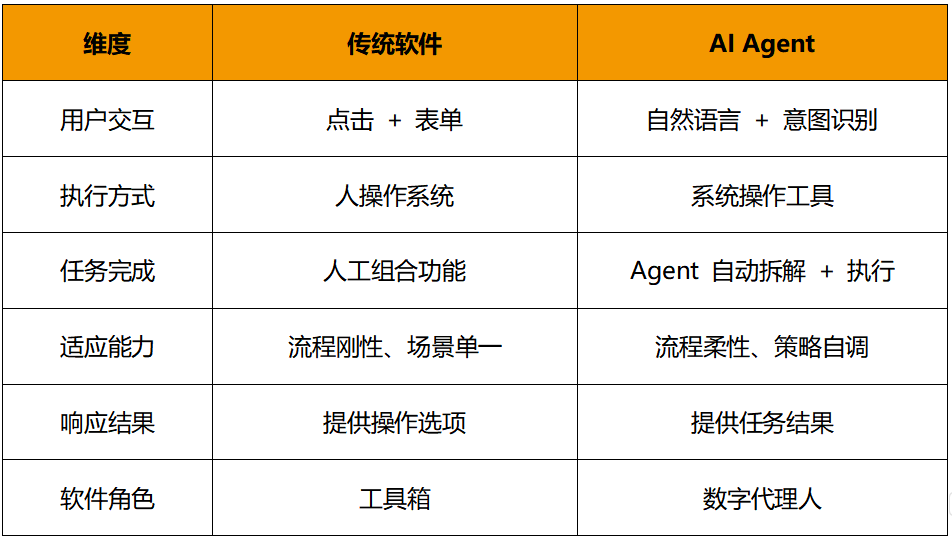 The emergence of Agents is not just about “making software smarter,” but is fundamentally reconstructing the relationship between “people, systems, and tasks.” It is not an upgrade of apps, but a paradigm shift: from “function equals software” to “goal equals software.”The Impact and Transformation of Agents on the Software EcosystemThe arrival of AI Agents is not just an addition of a new feature, but a fundamental redefinition of how software is used, its product form, and its industry role positioning.This impact is not just about “how users use software,” but is breaking the foundational logic of the existing software ecosystem, including the form of app existence, the competitive landscape of SaaS, the way functions are combined, and the control over commercial entry points.1. The form of software products will undergo fundamental changesThe entry position of apps is dissolving, and capabilities will be exposed in the form of tool interfaces.In the traditional software ecosystem, “whoever owns the user entry point owns everything.” But in an Agent-driven world, users no longer actively open individual apps, but issue intents through an Agent (such as GPT, Doubao, Xingye, etc.): “Help me generate a sales report”; “Book a flight to Shanghai next week and sync the schedule.”These tasks may involve multiple tools (CRM, calendar, Feizhu, corporate email, etc.), but users do not need to know which brand or interface these tools belong to.The form of software products is shifting from “one app” to “a combinable capability node,” with the front end taken over by Agents and the back end becoming capability service providers.2. Product boundaries will be broken, and systems will become “fluid”In the past: each vendor built closed “product boundaries”: you do finance, I do calendars, he does email; each app controls its own processes, data, and interactions.Now: Agents become “dispatch centers,” dynamically combining multiple tools to complete tasks; users care about “whether the result is achieved,” not “which product completed this task.”The boundaries between products are beginning to flow, functions are becoming atomic and service-oriented, and “function equals API, product equals module” will become the new norm.3. The role of software will shift from “provider” to “capability node”From the perspective of Agents, apps are no longer destinations but a part of the intermediate process.In the task chain driven by Agents, software products take on the role of “action nodes” that are called: you are no longer a product that “makes users click buttons,” but a capability that “allows Agents to call”; whether you can be called first depends on the usability, reliability, response speed, and interface standardization of your capabilities.Software vendors need to think not about “how to keep users in my app,” but “how to make my capabilities frequently accessed in intelligent workflows.”4. The dominant position of SaaS will be threatened by Agent platformsCurrently, SaaS vendors win users through “function aggregation + user data + UI experience.” But Agent platforms are launching direct attacks on these three points:
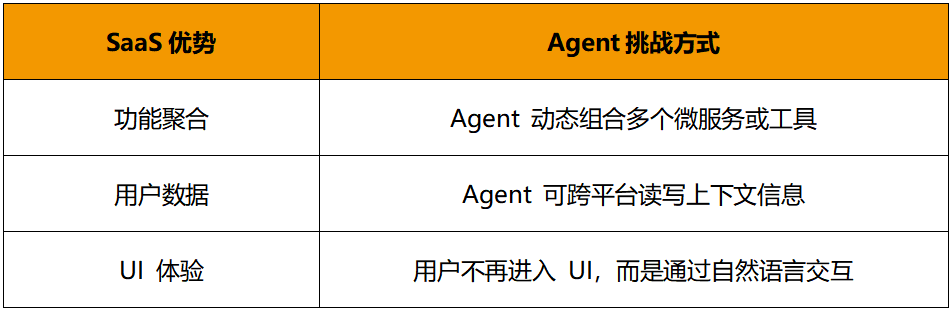 Giants like OpenAI, ByteDance, Baidu, and Alibaba are laying out “Agent OS” — incorporating third-party capabilities into the platform ecosystem, whoever controls the Agent platform will grasp the future application entry point.If software vendors cannot proactively connect to the platform or build their own vertical Agents, they are likely to be marginalized in the future.AI Agents are dismantling the three-in-one structure of traditional software: “function-interface-process,” turning software into “combinable, schedulable, and collaborative” capability nodes.The dominance of the software ecosystem is shifting from apps and software developers to Agent orchestration platforms.Which logics will continue? Which logics must be rewritten?In the wake of the impact brought by AI Agents, many people are most concerned about the question: “What familiar software logics can still be retained? What must be completely rewritten?”In fact, Agents do not overnight overthrow the old world; it is more like a “reconstruction of underlying logic + translation of surface semantics.” Some core values still hold, but the ways, interface mechanisms, and system architectures supporting these values are undergoing fundamental changes.Continuing Logic: The Underlying Goals Remain Unchanged
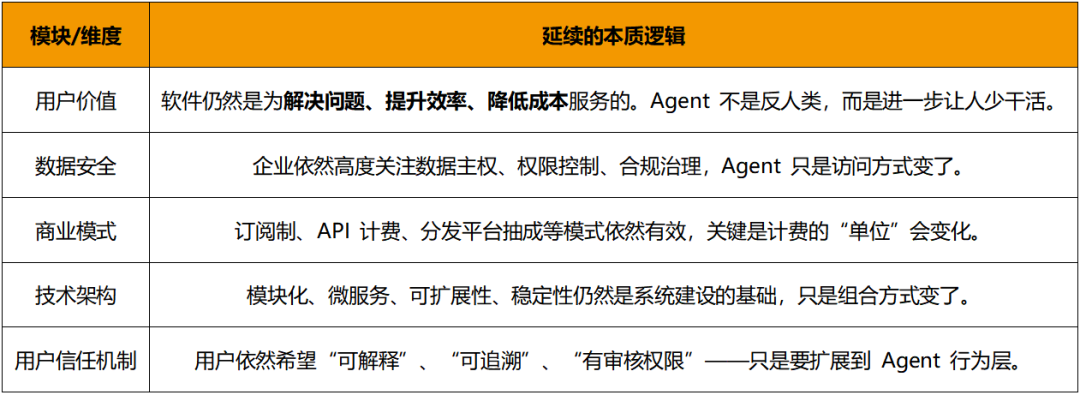 The goals remain unchanged, but the methods are updated. Agentization is not the goal, but the means; the core mission of software still stands.Logic That Must Be Rewritten: The Path to Implementation Has Changed Completely
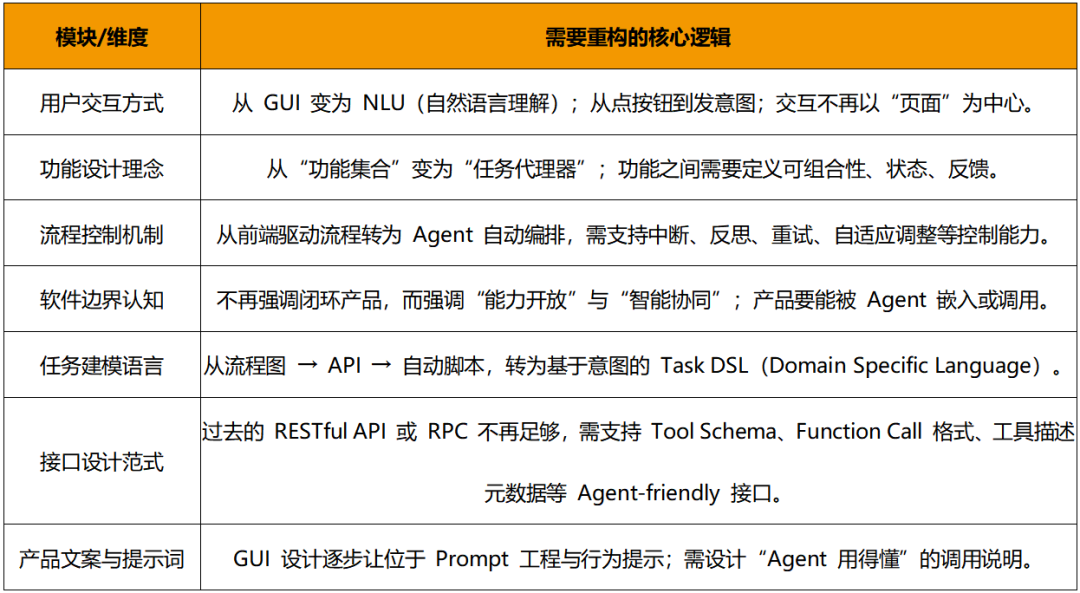 The path has changed, and the mindset must shift. To think “Agentization,” one must reconstruct the interaction layer, orchestration layer, and interface layer.Three “Mindset Shifts” You Must Accept1. From product design → capability design: not stacking functions, but exposing “callable actions”;2. From interface processes → intent responses: not drawing page flowcharts, but thinking about how Agents understand task breakdown;3. From leading usage → integrating scheduling: not making users use you, but allowing Agents to call you.How Should Software Vendors Respond to the Wave of Agentization?Agentization is not an option, but a trend.Just as “mobility” moved all software from desktops to mobile devices, and SaaS brought local programs to the cloud, today’s “Agentization” is forcing software vendors to answer a key question: when users no longer click but directly say “help me complete a task,” do you still exist?To avoid being marginalized, software vendors must start thinking from the ground up about “how to transform into a part of the intelligent ecosystem.”1. Product Design Layer: From “function components” to “task capabilities + calling interfaces”Transformation suggestion: Remap each functional module as “callable actions”; define intent input → parameter structure → expected output; adapt to Tool Schema or Function Calling formats for Agent orchestration use.Example:• Originally “invoice upload page,” now: a service action supporting upload_invoice(file) + documentation• Originally “export report,” now: generate_report({date_range, format})Design not for users to click, but for Agents to call “action capabilities.”2. Technical Architecture Layer: Open, Modular, Agent-readyTransformation suggestion: Standardize APIs + adopt Agent-friendly calling specifications (such as OpenAI Function schema, tool manifest); introduce state management mechanisms: support multi-round tasks, context persistence; open capability registration mechanisms: expose functional metadata for Agent platforms to index/search/combine.Technical keywords: JSON schema, Tool descriptor, LangChain tools, LangGraph, Semantic Actions; Tool abstraction layer + Tool result handler.Do not just build functions; build systems that can be “called, combined, and interpreted.”3. Business Strategy Layer: Actively Enter the Agent Platform EcosystemTransformation suggestion: Register core capabilities with mainstream Agent platforms (such as GPT, DeepSeek, Doubao, Tongyi, Baidu Wenxin, etc.); or build your own Agent framework to create vertical intelligent applications (such as for e-commerce, HR, healthcare, etc.).Path selection:
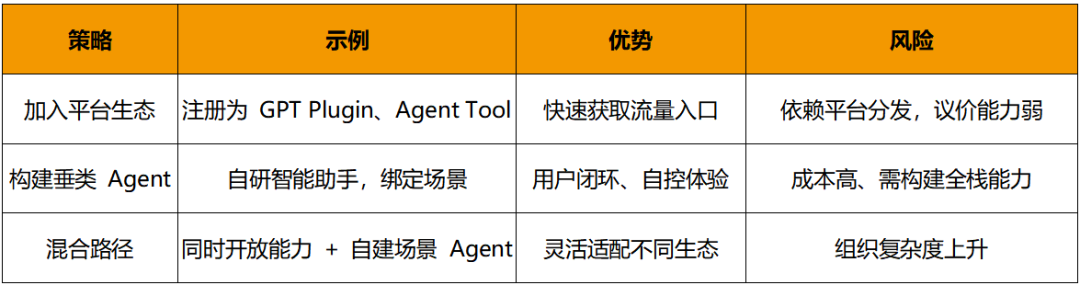 The core of competition after Agentization is no longer who has more functions, but who is easier to use by Agents.4. Organizational Capability Layer: Redefine Roles and Collaboration MethodsNew role suggestions to introduce:• Agent Architect: responsible for capability modeling, process breakdown, tool orchestration• Prompt/Product Engineer: knowledgeable in both interaction design and LLM behavior optimization• Tool API Designer: focused on exposing Agent capability interfaces• Multi-role collaboration mechanism: product, front-end, and back-end collaboration logic needs to be reconstructed around “tasks rather than interfaces”From UI-centered to Intent-centered, the organizational structure must evolve accordingly.Agentization is a systemic paradigm shift; vendors cannot just “adapt,” but must “reconstruct”: build schedulable, combinable, state-manageable capability modules; connect to or build Agent orchestration platforms; achieve “visibility” and “call priority” across platforms; reshape organizational collaboration models to serve intelligent systems rather than interfaces.Agents do not end software, but redefine how software exists.History does not simply repeat, but always follows the same rhythm:• From desktop software to web SaaS, it was a “rewrite of connection methods”;• From mobile apps to WeChat mini-programs, it was a “rewrite of entry logic”;• And this time, from apps to Agents, it is a triple rewrite of usage methods + system structure + software roles.We are witnessing an evolution of software forms: no longer organizing products by “pages,” but driven by “intent” to complete tasks; no longer emphasizing “module stacking,” but focusing on “capability registration + behavior orchestration”; no longer is it “people learning to use tools,” but “tools learning to understand people.”So we must understand: AI Agents will not kill software, but they are killing your old perception of “what software is.”Three Directional Judgments for Software Vendors:1. Are you a callable function node or a caller? ⟶ Are you being selected by Agents, or are you building your own scheduling capabilities?2. Is your capability a black box, or does it have “structured + semantic” combinability? ⟶ Can it be automatically identified, stitched, and interpreted?3. Are you willing to shift from “being an application” to “joining an ecosystem”? ⟶ Are you willing to accept that you no longer control the entry point but still retain value?The future winners will not be the companies with the most software applications, but the capability providers who can play a key role in the Agent world.This reconstruction has already begun. Those with a systematic perspective, technical reconstruction capabilities, and ecological connection strategies will truly navigate this wave of intelligent agents and become the backbone of the new ecosystem. Apps and application software are the past; Agents are the future; but software will not disappear, it will only exist in another way.
Written by: Yisuo Yanyu/ Data Monkey Edited by: Gazing into Deep Space / Data Monkey
 ☆ Previous Good ArticlesRecommended Articles☟
In the Age of Data Agents, Don’t Be a Lone Hero
Is There Hope for Big Data Vendors in the Face of Data Agents?
How to Choose a Supplier for Enterprise Deployment of Data Agents?