
Source: Machine Heart

This article is approximately 2500 words long and suggests a reading time of 5 minutes.
The aim of this article is to understand the differences between two methods of fine-tuning large language models: full fine-tuning and low-rank adaptation (LoRA).
This article aims to understand the differences between two methods of fine-tuning large language models: full fine-tuning and low-rank adaptation (LoRA). Both methods are used to adapt pre-trained models to specific downstream tasks, but they differ.
Fine-tuning is a key paradigm for applying pre-trained large language models to downstream tasks. Recently, methods like low-rank adaptation (LoRA) have been shown to achieve performance comparable to fully fine-tuned models while significantly reducing the number of trainable parameters.
This raises the question: Are the solutions they learn truly equivalent?
With this question in mind, researchers from MIT conducted an in-depth exploration in the paper titled “LoRA vs Full Fine-Tuning: An Illusion of Equivalence”.
 Paper link:https://arxiv.org/pdf/2410.21228v1
The authors analyze the spectral properties of the weight matrices of pre-trained models to investigate how different fine-tuning methods alter the model.
The study found that the singular value decomposition structures of weight matrices produced by full fine-tuning and LoRA are significantly different, and the fine-tuned models exhibit different generalization behaviors when faced with tests outside the adapted task distribution.
In particular, the weight matrices trained with LoRA exhibit new high-rank singular vectors known as “intruder dimensions”, which do not appear in full fine-tuning.
These results indicate that even when performance on the fine-tuning distribution is similar, the models updated with LoRA and full fine-tuning access different parts of the parameter space.
The authors delve into the reasons for the emergence of intruder dimensions in LoRA fine-tuned models, why they are undesirable, and how to minimize these effects.
Finally, the authors provide the following observations:
First, LoRA and full fine-tuning produce structurally different parameter updates, a difference arising from the presence of intruder dimensions. These intruder dimensions are singular vectors with large singular values and are approximately orthogonal to the singular vectors in the pre-trained weight matrix. In contrast, the fully fine-tuned model remains spectrally similar to the pre-trained model and does not contain intruder dimensions.
Second, behaviorally, LoRA fine-tuned models with intruder dimensions tend to forget more of the pre-trained distribution compared to full fine-tuning, exhibiting poorer robust continual learning capabilities: LoRA fine-tuned models with intruder dimensions perform worse outside the adapted task distribution, despite having comparable distribution accuracy.
Lastly, even when low-rank LoRA performs well on the target task, higher-rank parameterization may still be desirable. Low-rank LoRA (r ≤ 8) is suited for downstream task distributions, while full fine-tuning and high-rank LoRA (r = 64) enhance the model’s generalization ability and robustness. However, to leverage higher rank, the LoRA updated model must be rank-stable.
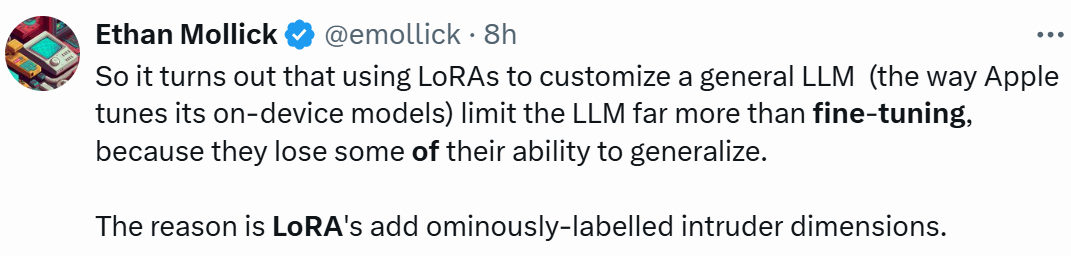
Wharton School Associate Professor Ethan Mollick commented: It turns out that using LoRA to customize general LLMs (like Apple tuning its built-in models) imposes far greater limitations on the LLM than fine-tuning, as they lose some generalization ability. The reason is that LoRA introduces undesirable intruder dimensions.
Differences Between LoRA and Full Fine-Tuning Models
This article employs the singular value decomposition (SVD) of neural network parameters to understand how fine-tuning alters pre-trained weights.
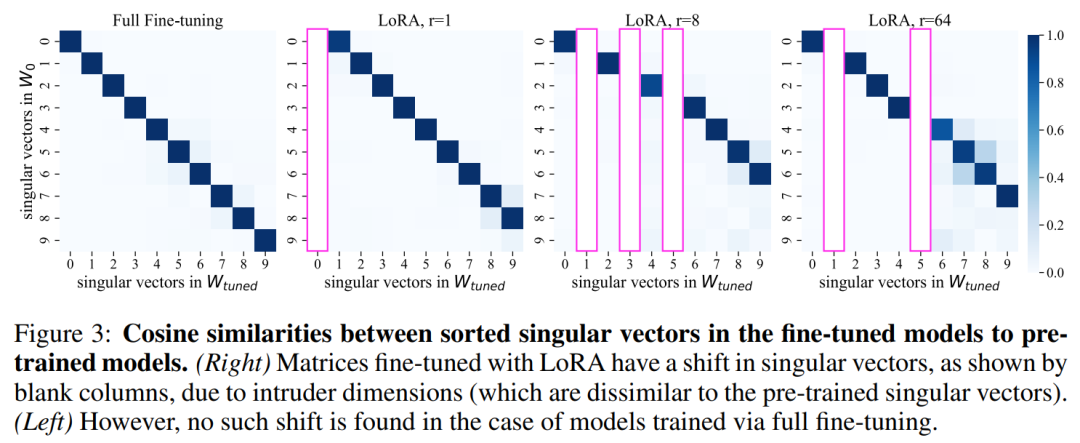
In particular, this article measures the degree to which the singular vectors in the LoRA fine-tuned weight matrix map to the singular vectors in the fully fine-tuned weight matrix, using their cosine similarities. These relationships are illustrated in Figures 1 and 3, where colors indicate the cosine similarity between pre-trained and fine-tuned singular vectors.
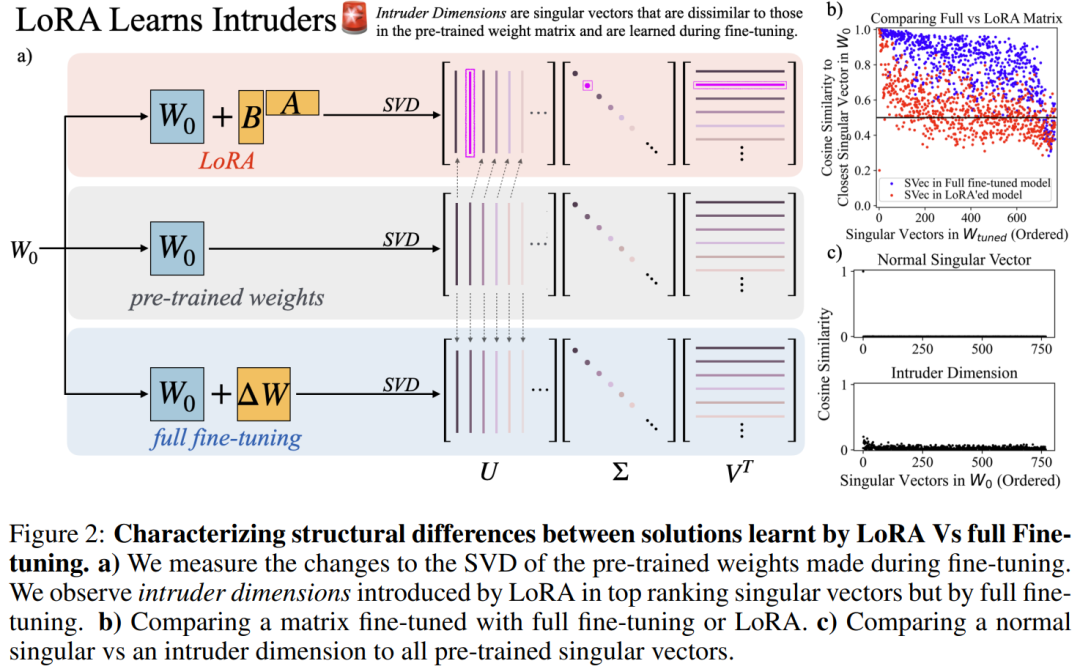
In Figure 2(b), it is observed that the similarity of singular vectors between LoRA and full fine-tuning is very different from that of the pre-trained singular vectors: the average cosine similarity of singular vectors from models fine-tuned with LoRA appears to be much lower compared to full fine-tuning.

In the lower left corner of Figure 2(b), there is a unique red point, which the authors name as intruder dimensions, defined formally as follows:
LoRA fine-tuned models contain high-rank intruder dimensions, whereas fully fine-tuned models do not. To quantify the size of the set of intruder dimensions for a specific weight matrix, the authors use the algorithm shown in Figure 4.
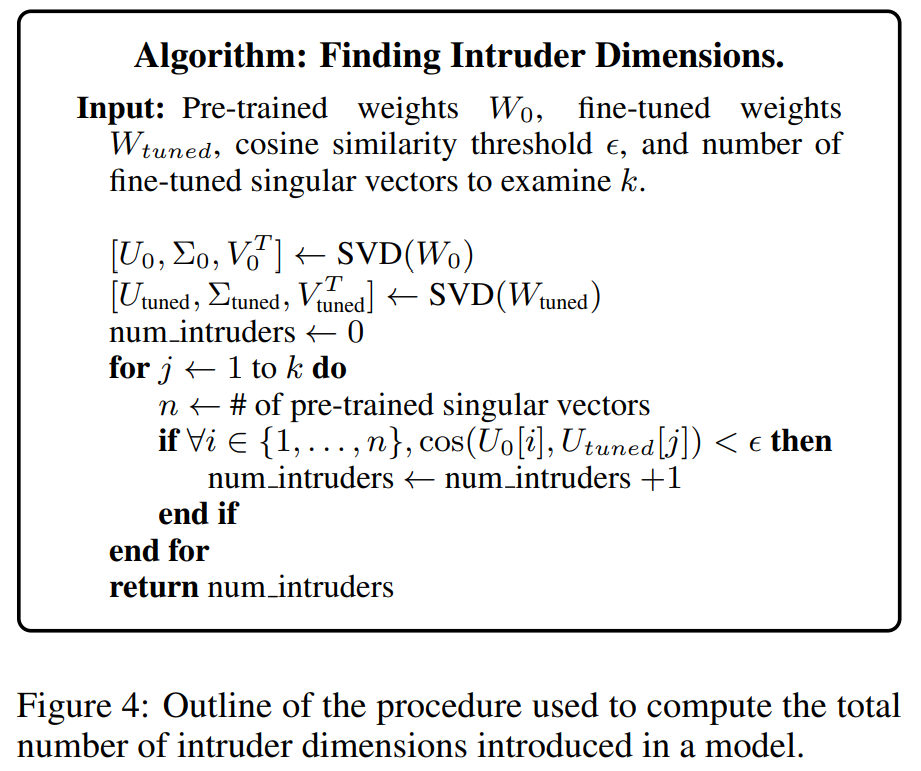
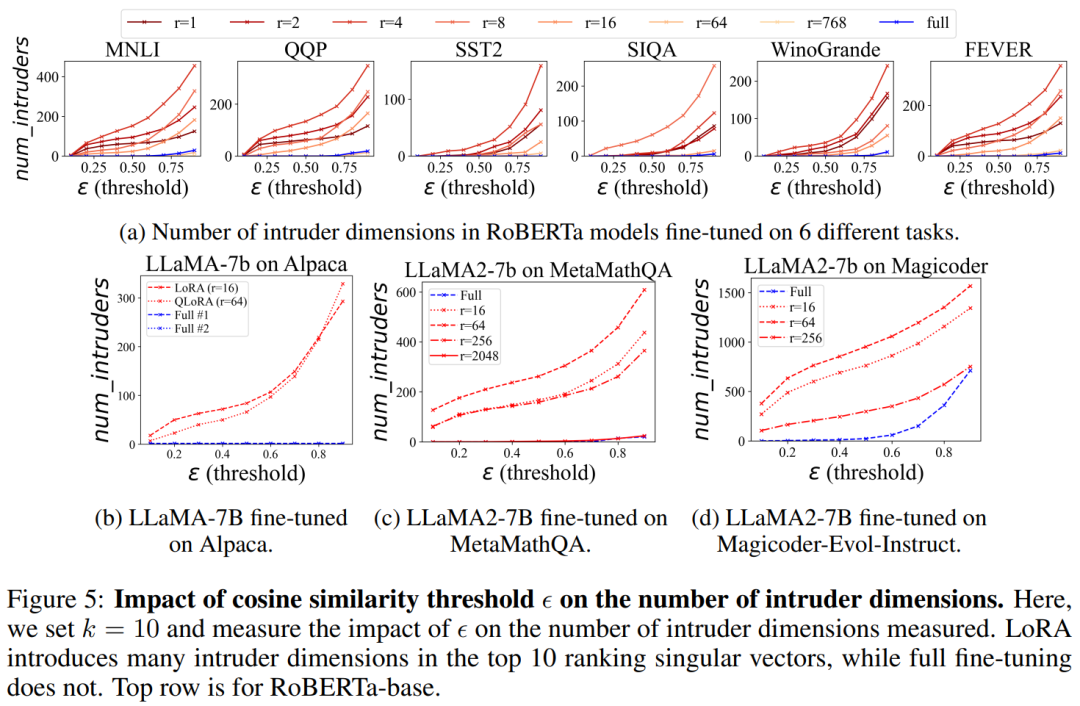
Even in tasks where LoRA fine-tuned models learn worse than fully fine-tuned models, intruder dimensions are present.
Observing Figures 5b, 5c, and 5d, we can clearly see that even with LoRA’s r=256, high-rank singular vectors still exhibit intruder dimensions. Importantly, when r=2048, there are no intruder dimensions, but the curve shows a very similar pattern to full fine-tuning. This supports earlier findings: as the rank exceeds a threshold, intruder dimensions disappear, and LoRA begins to resemble full fine-tuning.
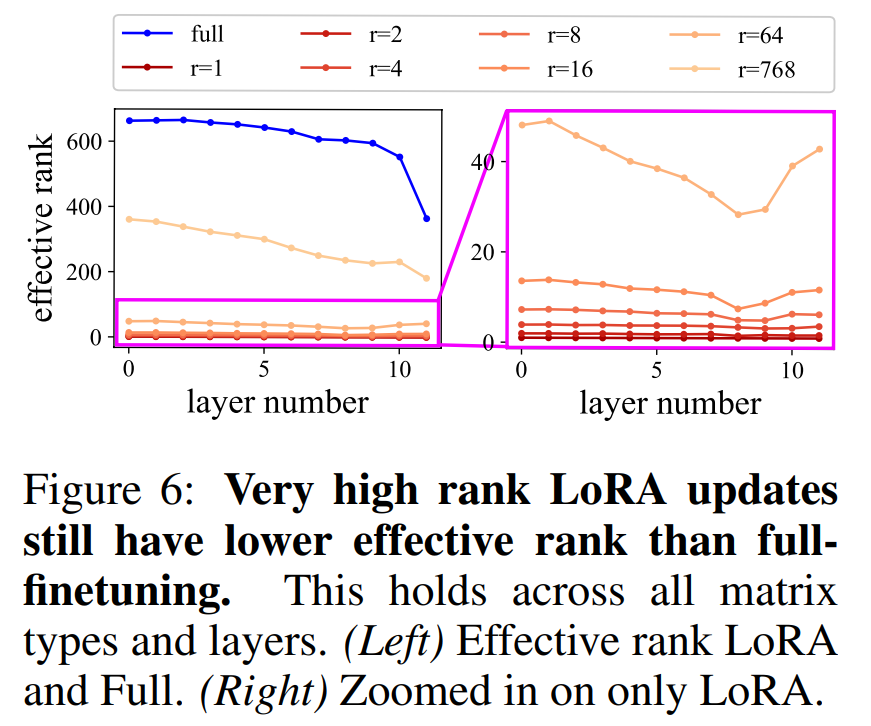
Even when using a full-rank matrix to perform LoRA, the updates from full fine-tuning have a higher effective rank than those learned through LoRA. As shown in Figure 6, the effective rank of the fully fine-tuned solutions is significantly higher than that of the solutions learned through LoRA, even when LoRA has a higher rank.
Behavioral Differences Between LoRA and Full Fine-Tuning
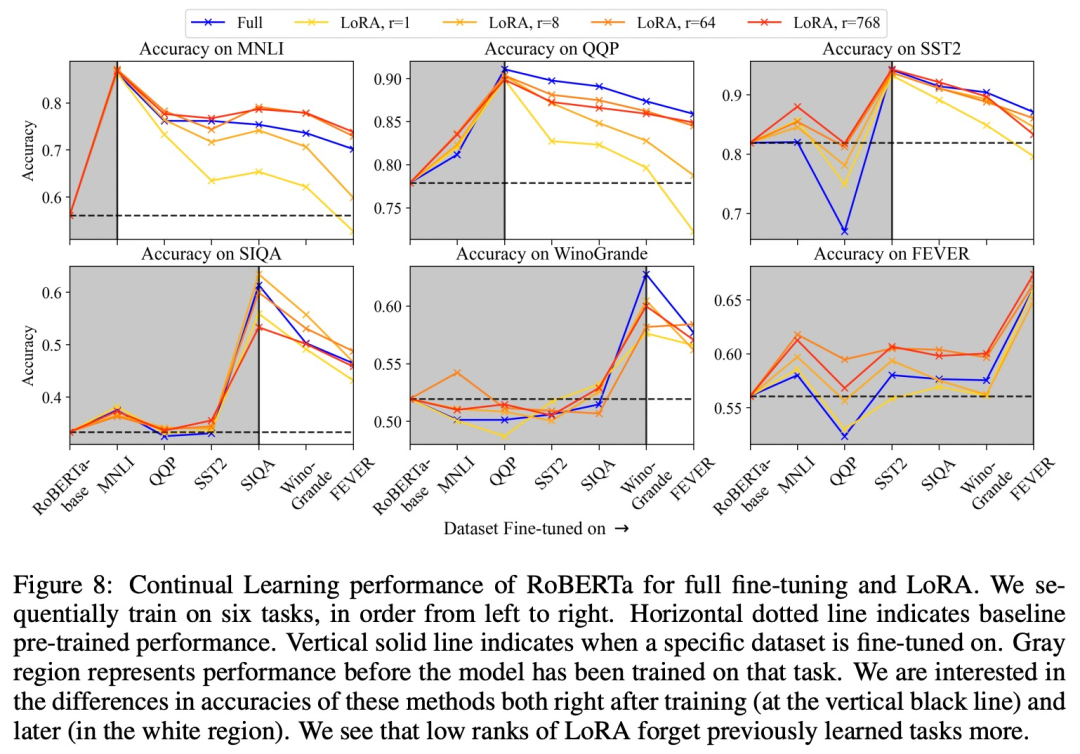
At lower ranks, LoRA exhibits poorer adaptability in a continual learning process, forgetting more previous tasks. This study sequentially trained RoBERTa on multiple tasks and measured the degree of performance change when learning new tasks.
The study used the same training schemes and datasets as before, but employed the following datasets (in sequence) for fine-tuning in a continual learning environment: MNLI, QQP, SST-2, SIQA, Winogrande, FEVER. After training on a particular dataset in the sequence, the LoRA weights were merged into the model, and the model was reinitialized before training on the next task to avoid being influenced by previous tasks.
After training on specific tasks, the study tested all tasks, and for each task, the classification head was retrained separately before testing the test set. This allows checking how the model performs on these tasks without actually changing the model itself.
The results are shown in Figure 8. While LoRA initially performed comparably to full fine-tuning, smaller LoRA ranks consistently showed greater performance decline during continual learning. In particular, for the first three training datasets, when r = 1, LoRA’s performance dropped below the pre-trained baseline. As the LoRA rank increased, we observed a reduction in this forgetting behavior, and it became closer to full fine-tuning, even exhibiting less forgetting on MNLI after completing continual learning.
The overall situation is subtle: while in some cases, LoRA appears to forget less, for certain tasks (and certain ranks), LoRA may actually forget more.
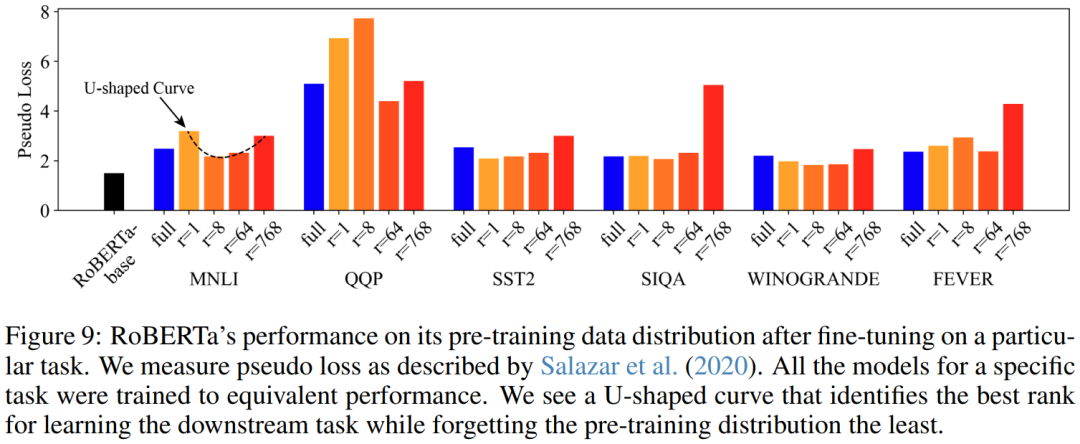
For LoRA models fine-tuned to equivalent test accuracies, a U-shaped curve can be seen, indicating the optimal rank suitable for downstream tasks while minimizing forgetting of the pre-trained distribution.
Figure 9 reports the measured pseudo-loss scores. It can be seen that there is a U-shaped trend between full fine-tuning and LoRA at r = 768.
Relative to full fine-tuning, both low-rank (r = 1) and high-rank (r = 768) lead to greater forgetting of the pre-trained distribution, while r = 64 exhibits less forgetting. In other words: when r = 1, models fine-tuned with LoRA are affected by intruder dimensions and seem to forget more than r = 64, which has no intruder dimensions. However, when r = 768, models fine-tuned with LoRA also exhibit worse forgetting, indicating that they overfit to the adapted task due to over-parameterization. When r = 8 and r = 64, the amount of forgetting is less than that of full fine-tuning.
Editor: Yu Tengkai
Proofreader: Lin Yilin
About Us
Data Pie THU, as a public account focused on data science, is backed by the Tsinghua University Big Data Research Center, sharing cutting-edge data science and big data technology innovation research dynamics, continuously propagating data science knowledge, and striving to build a platform for gathering data talents, creating the strongest group army in China’s big data.

Sina Weibo: @Data Pie THU
WeChat Video Number: Data Pie THU
Today’s Headline: Data Pie THU