Backend Reply「Join Group」Join the Modern Advertising Circle
| Author | Duan Chunlin, Zou Jiahua
| Abstract | The virtual idol industry, which has been at the forefront of traffic in recent years, is developing rapidly, and the virtualization of idols is becoming a new trend. The value symbols and business models behind it are constantly being shaped. Based on this, this article extracts the concept of “idol virtualization” and explores its cultural attributes, using experimental methods to analyze the impact mechanism of idol virtualization on consumer value co-creation. The study found that brands implementing the same idol virtualization strategy for both star-chasing communities and ACG (Anime, Comic, Game) communities do not effectively enhance consumers’ willingness to co-create value. Finally, this article also provides some strategic references for the future development path of idol virtualization.
| Keywords | Idol Virtualization; Community Culture; Value Co-Creation
| Classification Number | G206; F27
| Literature Identification Code | A
This article is a phased research result of the Key Laboratory Project of Philosophy and Social Sciences in Guangdong Universities “Key Laboratory of New Media and Brand Communication Innovation Application in Guangdong Province” (No: 2013WSYS0002), and the general project of the “13th Five-Year Plan” for the development of philosophy and social sciences in Guangzhou in 2020 “Research on Communication Strategies for Promoting the Integration of AI Big Data and the Brand of Manufacturing Industry in the Guangdong-Hong Kong-Macao Greater Bay Area” (No: 2020GZYB11).
South China University of Technology, School of Journalism and Communication, Guangzhou, 510006
The gradual independence of the Z generation economy and the continuous expansion of their areas of interest have led to an explosion in the domestic virtual idol market in recent years, with the virtual idol industry in a period of rapid growth. Among the young groups of the 90s and 00s, ACG culture has shifted from niche to mainstream, with over 300 million people in the country paying attention to virtual idols in 2019.[1][2] By 2021, due to the pandemic and external policy restrictions on real idols’ activities, the virtual idol industry has developed rapidly, with breaking dimensionality becoming an important way to capture the attention of young people.
From a global perspective, the development model and fields of “virtual idols” are gradually diverging, giving rise to many different connotations. For example, virtual singers represented by “Hatsune Miku” and “Luo Tianyi”; while anime IPs and game manufacturers will turn existing character IPs from anime, games, and movies into virtual idols or categorize them as virtual idols; companies will also design virtual characters and cartoon images based on their own culture and product characteristics. It is worth mentioning that many brands and companies are also planning to utilize the IP effect of celebrities to re-release the economic value of stars in the ACG field, thereby extending the industrial chain. More and more celebrities are beginning to have their own virtual IP images, and the value symbols and business models behind them are constantly being shaped.
The advantages of virtual idols and idol virtualization are obvious: such as stable personas, high controllability, and easy acceptance by the younger generation. At the same time, recent policies from multiple ministries have also corrected the chaos in fan circles and real idol elections, which also provides certain opportunities for the development of virtual idols in the abstract world. If the Z generation tends to exhibit emotional and conformist behaviors when faced with real idols, then virtual idols that operate under the guidance of socialist core values can better shape teenagers and form a positive online public opinion ecosystem. However, behind the halo of this new phenomenon, there are also numerous challenges and risks, including high production costs and an incomplete industrial chain, etc. Currently, most domestic and foreign research focuses on the head IP of traditional virtual idols, and has not yet refined and analyzed idol virtualization, which only exists as a phenomenon observed in the category of “virtual idols”. Therefore, this article will first analyze the text data of “virtual idols” on Sina Weibo, generalizing the concept of virtual idols as the main line of analysis, extracting the concept of “idol virtualization” and exploring its cultural attributes. Most importantly, it discusses the star-chasing community centered on “real idols” and the ACG community oriented towards “virtual”.
Secondly, if we sort out the ways in which fans create UGC content, imagine quasi-social interactions, and build communities around idols, we can find that these behaviors align with the connotation of “value co-creation”. The theory of value co-creation emphasizes that value is created by companies and consumers through direct interaction, jointly creating consumer experiences [3-5]. Idol virtualization can be seen as a way to attract relevant consumers to participate in interaction. But in a more macro context, can a brand’s implementation of the same idol virtualization strategy effectively promote consumers’ willingness to co-create value for the two subcultural communities? This article explores this issue.
01
Literature Review
The virtual idol industry is developing very rapidly. In an era of diverse marketing methods and highly developed technological capabilities, the classification of virtual idol types may not have been discussed clearly, and the emergence of the next virtual idol breaks the existing classification. It is difficult for academia to keep up with industry trends, and the classification of virtual idols is always prone to obsolescence. For example, in the past, some scholars believed that the commercial value of virtual singers like “Hatsune Miku” relied heavily on user-generated content (UGC), with their profit model primarily based on licensing and selling peripherals, leading to a relatively single monetization model. This view now seems outdated. In addition, in terms of research subjects, current domestic research lacks an understanding of the concepts, fields, and driving forces of virtual idols, with most studies focusing on case studies of “Hatsune Miku” and “Luo Tianyi,” which rely heavily on voice synthesis technology [6-9].
Researchers analyzing virtual idols often emphasize the special nature of the “technology” they rely on—including computer synthesis technology, 3D technology, voice synthesis software and sound source libraries, AR/VR technology, and motion capture technology, etc.—while downplaying the dialectical relationship between culture and technology. Although Yu Guoming and Yang Mingyi (2020) [12] proposed a seemingly clear division of driving forces, including content, technology, and industry-driven, this division lacks sustainable explanatory power and clear classification dimensions in the face of rapidly changing realities, as the technological and content driving forces point in opposite directions, while the industry direction is not parallel to the former two. Based on this, this article believes that the development path of virtual idols mainly relies on two driving forces: one is cultural driving force, and the other is technological driving force.
Moreover, a new type of virtual idol born from real idols is rapidly being pursued and imitated by major brands, but scholars have not focused on the phenomenon of idol virtualization, thus neglecting the underlying community mechanism. While scholars have defined and studied the two communities and cultures of “ACG” and “star-chasing,” they lack integrative and comparative thinking. In addition to emphasizing technological changes, both types of research view the formation mechanisms and psychological tendencies of different communities from a “fan culture” perspective. In fact, whether virtual idols or real idols, both have similar consumption patterns and spiritual demands for the two subcultural communities. Consumption patterns refer to the sharing and consumption of idols’ symbolic, textual, content, or emotional aspects, while spiritual demands reflect projection of self, emotional catharsis and satisfaction, identity recognition, and belonging [13-17]. However, scholars have not noted that with the emergence of idol virtualization, the two subcultural communities have developed from “each acting independently” to gathering around “real idols and virtual images.” This reflects that the formation mechanism of idol virtualization needs to consider both segmentation and a holistic planning approach; at the same time, it requires relevant companies to deeply understand the mechanisms behind consumers’ value co-creation behaviors when facing the production and dissemination mechanisms of the two subcultures. Otherwise, it would be difficult to truly collaborate with relevant consumer communities and achieve value co-creation.
02
The Connotation of
Idol Virtualization Born from “Virtual Idols”
2.1
Analysis Based on Sina Weibo’s “Virtual Idol” Relevant Content
Discussions on “idol virtualization” should return to the conceptual category and research of “virtual idols.” This is because in current marketing activities, whether it is a virtual singer like “Hatsune Miku” or a Virtual YouTuber (VTuber), or creating a virtual avatar for a star idol, they are all referred to as “virtual idols,” and the concept of “idol virtualization” has not been widely recognized in academia and industry.
This study crawled relevant Weibo content mentioning the term “virtual idol” from January 2012 to November 2020 to analyze the development trends of virtual idols and subsequently extract the concept of “idol virtualization.” The reason for choosing the Sina Weibo platform is that it is one of the early four major portal websites in China, and the relevant community content, discussions about virtual idols, and advertising marketing are richer and more comprehensive compared to Baidu Tieba and Bilibili.
Current crawling data shows that the earliest virtual idols mentioned appeared in the 1980s and 1990s, such as Japan’s Lin Mingmei, Ishutal, and the UK’s Gorillaz band. Since 2015, the number of mentions of “virtual idols” on Weibo has shown a linear explosive growth, with a certain proportion of virtual YouTubers being operated as idols. As of November 2020, there have been over 13,000 virtual YouTubers worldwide [18], but the VTubers referred to as virtual idols are mainly organizations or projects like Nijisanji, .live, VirtuaReal, etc.
2.2
Evolution and Interpretation of the Concept of “Virtual Idol”
Although the interpretation of the concept of “virtual idol” has always struggled to keep pace with industry developments, fundamentally, the basic attributes and analytical grasp of “virtual” and “idol” have not changed. On Sina Weibo, as long as the two meanings of “virtual” and “idol” are both met, they can be categorized as “virtual idols.” Scholars continue to attempt to define virtual idols from various perspectives, but there remains a certain degree of disagreement and gaps in the definitions and classifications of virtual idols between academia and industry.
2.2.1
Virtual: Virtual Images
Virtual images mainly refer to non-real images: visual images designed and launched by film companies or creators that lack life and independent thought, relying on modern imaging technology and means. [19] Zhang Zizhong (2018) further refined virtual idols from the perspective of technology and activity scenarios, defining them as images that exist in virtual or real scenes on the internet through certain algorithms, drawing, animation, CG, etc., without a real entity. [20] At the same time, the two-dimensional concept of “virtual” is often associated with ACG culture, but merely referring to flat images cannot encompass the entirety of ACG, as ACGN (Animation, Comic, Game, Novel) is the fundamental component of the “two-dimensional” world.
2.2.2
Idol: Stars, Actors, or Idols
Leo Lowenthal (2012) categorized idols into “production idols” and “consumption idols.” The former refers to figures who have made significant contributions to social development, while the latter refers to star idols related to mass consumption and entertainment. [21] In the current Chinese context, “idol” generally refers to individuals or groups that one admires, envies, or respects, and anyone with a certain influence and “fans” can be considered an “idol.” Due to the mature and increasingly segmented entertainment industry in Japan, idols, singers, actors, streamers, and voice actors have clear positioning, making “idol” a distinct profession and part of the performance group.
2.2.3
Virtual Idol
Virtual idols mentioned on Weibo are mostly created using CG technology, voice synthesis, facial capture, motion capture, and real-time rendering, and also incorporate the creators’ understanding of the personality and psychology of real people, thus having a certain fan base. Currently, domestic virtual idols mainly follow a broad definition, meaning any fictional character that can communicate and establish strong relationships with fans or has significant influence can be considered a virtual idol. In addition to traditional virtual singers, virtual idols mentioned on Weibo also include virtual character IPs like Ye Xiu, Wei Wuxian, and characters from the game “Onmyoji,” while self-created virtual images by brands include Harbin Beer’s “Ha Jiang 99,” Microsoft Xiaobing, and Yoghurt’s “Xiao You,” etc.
Internationally, the definition of virtual idols differs from that in China. If it is merely a popular character in the world of pure imagery or a non-real virtual image, it cannot be called a “virtual idol.” A virtual idol should leave some tangible and intangible traces in the real world [22], such as imitating real idols in performance activities or engaging in image operations, with its operational mechanism built on satisfying human needs for intimacy. Virtual models like Noonoouri and Shudu, although referred to as virtual idols in China, are still often called “virtual influencers/models” abroad. Only virtual characters like “Idol Master” and “Love Live,” who debut as idols in comics or animations, can be considered “virtual idols.” Moreover, current virtual YouTubers (VTubers), virtual UP hosts (VUP), or virtual streamers (VLiver) like Kizuna Ai, Siro, and Lengyuan Yousa are also largely categorized as virtual idols in China, but the accuracy of this categorization needs further verification.
2.2.4
Idol Virtualization
The virtualized image of idols is widely categorized as virtual idols in the industry and among netizens, as it meets the broad definitions of “virtual” and “idol.” This article defines “idol virtualization” within the context of China as a carrier of real idols in the virtual world, conducting idol activities and image operations through certain algorithms, drawing, animation, CG, etc., in virtual or real scenes on the internet. In current marketing models, the main applications of idol virtualization manifest as: real idols and their virtual images in advertising endorsements, comic creation, anime movies, and platform collaborations. So how do domestic consumers perceive idol virtualization? This study formulated an interview outline based on the current presentation forms of idol virtualization marketing, selecting Weibo users from star-chasing communities and non-star-chasing communities for interviews, discovering that users from different communities have different attitudes towards idol virtualization; users within the same community also exhibit slight differences in their attitudes; the degree of fans’ integration into the community and the different idol star-chasing communities will affect their attitudes towards idol virtualization (see Table 1).
Table 1 Attitudes Towards “Idol Virtualization” in Different Communities
|
“The stars chosen for idol virtualization are all traffic stars, aiming to maximize the value of the idol itself and create a more standardized product of fan economy. The interaction between the star themselves and fans is not much, but once the idol is turned into an IP, it can meet the expectations of how fans want the idol to present themselves.” — Interviewee 1 “Idol virtualization itself may enhance loyalty for the original fans of the star, making them like and invest more money. However, for many bystanders, they may really not know what idol virtualization is, nor will it trigger any emotional changes; even for brands, it may cause a certain degree of decline in recognition and reputation.” — Interviewee 2 “I think idol virtualization is still aimed at getting idol fans to spend money, but it’s actually quite difficult. Perhaps characters like Luo Tianyi and Hatsune Miku have some songs and dances that empower them, but if it’s just pushing out an image, I personally don’t really like that, so I wouldn’t understand. Additionally, I think it mainly targets the idol fans’ circle, and the core influence is still the cultural atmosphere within the fan circle; the effect of segmentation is quite evident. For ACG audiences, only pure virtual characters that are purely two-dimensional can attract them.” — Interviewee 3 “I think it shouldn’t be too ugly, as it can make me not have a strong aversion. That is to say, it (idol virtualization) will not be a plus. After all, I like it because it’s real people; the idol itself and the brand don’t necessarily have to connect.” — Interviewee 4 and Interviewee 5 |
Based on the concept of idol virtualization and its marketing model, interviews with netizens from different internet communities revealed that the marketing approach of idol virtualization is primarily a commercial model established for target communities, essentially a form of community marketing. From the relevant interviews, it was learned that “idol virtualization” can be disassembled into two subcultural forms: one oriented towards “virtual” ACG culture, which is gradually becoming mainstream; the other oriented towards “idol” star-chasing culture, which now has a diverse idol fan ecosystem, with the idol’s symbolism continuously strengthening. Due to the rise of community culture driven by internet technologies, different communities have begun to intersect: a person can exist simultaneously in different communities, and the degree of participation may vary. When interviewees from intersecting communities discussed idol virtualization, they would actively identify themselves as part of the star-chasing community, responding based on their understanding of the idols. Therefore, when this study hypothesizes and verifies whether idol virtualization moderates consumers’ value co-creation willingness across different communities, it classifies them into star-chasing communities and ACG communities.
03
Research Hypotheses and Research Design
3.1
Research Hypotheses
Value co-creation is a concept used to describe a consumer-centric approach where companies, consumers, and stakeholders create value for businesses through interactions. Its behavioral patterns are divided into two types: one emphasizes participation behavior within the consumer role, mainly including proactive brand information searching, sharing, responsible behavior, and active interpersonal interactions; the other is consumer citizenship behavior, which includes spontaneous value co-creation organized by consumers, such as feedback, advocacy, helping, and tolerance [23]. Spontaneous consumer citizenship behavior can vary in degree, for example, voluntarily participating in product evaluations, promotional activities, and new product ideation and design.
Consumer experience is the basis of value co-creation, with resource integration, continuous interaction, and service exchange being important ways to co-create value [3][24]. In this process, consumers can also become an operational resource: the knowledge and skills they possess can serve as advantageous resources for businesses to create value, a view emphasized by service-dominant logic. Although the concept of value co-creation is constantly evolving, some behaviors (such as responsible behavior and tolerance) do not belong to the realm of interaction, but the core elements of obtaining, sharing, advocating, feedback, and mutual assistance have been employed by academia [25][26].
3.1.1
Main Effect of Community on Consumers’ Willingness to Co-Create Value
Sicilia and Palazon (2008) believe that the emergence of internet and marketing communication media has provided a greater range of interactive opportunities compared to offline, making people’s impulses for self-expression and information sharing increasingly prominent [27]. Against the backdrop of the digital wave and the increasingly blurred boundaries between public and private spaces, a large number of virtual communities have emerged in China’s internet space, which exhibit strong hierarchy, clear division of labor, and exclusivity based on different attributes [28]. Some scholars define it as a group of individuals with common interests or goals, coalesced by interaction (communication, transactions, or knowledge sharing) in cyberspace (including the global information network, electronic bulletin boards, emails, and news groups). Furthermore, the continuously evolving internet technology has made online communities a notable branch among many online communities due to their high productivity, cohesion, and execution capabilities [29].
On one hand, emotionality is a very important characteristic of communities. Yuan Guangfeng (2014) argues that a certain “emotional interpretive community” has formed on the internet, and emotion has become a significant dimension in interpreting internet communities [30]. It can be said that communities with a shared emotional foundation are more likely to influence the value co-creation willingness of their consumer groups. On the other hand, different communities have different preferences for different brands. When the values and cultural attributes of brands or companies align closely with consumer needs, or when brands provide “spaces and methods for sharing with like-minded individuals and self-expression” and gain respect from community members [31], it is easier to foster a willingness to co-create value among communities, and this is true within fan communities as well. Based on this, this article proposes the following research hypotheses:
H1: In idol endorsement marketing, audiences within fan communities are more likely to enhance consumers’ willingness to co-create value compared to audiences outside the community.
H1a: In idol endorsement marketing, audiences within fan communities are more likely to enhance consumers’ willingness to participate in value co-creation compared to audiences outside the community.
H1b: In idol endorsement marketing, audiences within fan communities are more likely to increase consumer citizenship behavior compared to audiences outside the community.
3.1.2
Moderating Role of Idol Virtualization
In the past, idols as brand ambassadors primarily targeted the fans of the idols. Nowadays, idols can appear in the form of virtual images, which not only consolidates the existing star-chasing fan community but also aligns with ACG culture and audience preferences, further spurring related user-generated content production. Idol virtualization can evoke emotional resonance among relevant communities, thereby satisfying a range of needs: materials from idols and their virtualization can be reinterpreted by star-chasing or ACG community consumers through textual reconstruction and relational imagination, producing personality-setting symbols that gain widespread recognition and can be continuously generated and consumed. In this process, highly autonomous user-generated content and community interactions emerge in large quantities, promoting the emergence of five psychological states: catharsis, projection, recognition, compensation, and belonging, which can become an important form of value co-creation in community marketing [8][16][32]. Therefore, idol virtualization should integrate the ACG community that originally did not belong to the star-chasing community into a new hybrid community, enhancing consumers’ willingness to co-create value by meeting the psychological needs of both the ACG and star-chasing groups — including consumers’ willingness to participate in value co-creation and consumer citizenship behavior. Based on this, the following hypotheses are proposed:
H2: Idol virtualization has a moderating effect on the influence of communities on consumers’ willingness to co-create value.
H2a: Idol virtualization has a moderating effect on the influence of communities on consumers’ willingness to participate in value co-creation.
H2b: Idol virtualization has a moderating effect on the influence of communities on consumer citizenship behavior.
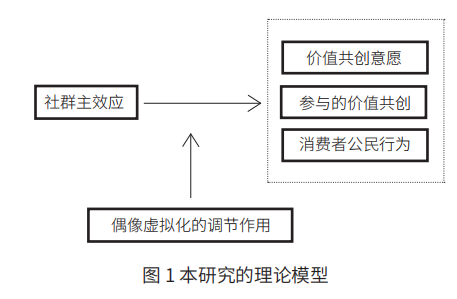
3.2 Research Design This study mainly uses experimental methods to test hypotheses and models, aiming to verify the impact of communities on consumers’ willingness to co-create value and reveal the moderating role of idol virtualization.
3.2
Research Design
This study primarily employs experimental methods to test hypotheses and models, aiming to verify the impact of communities on consumers’ willingness to co-create value and reveal the moderating role of idol virtualization. The experiment adopts a 2 (star-chasing community vs. ACG community) × 2 (idol virtualization vs. non-idol virtualization) design. The independent variable is the community (with a value of 0 for star-chasing communities and 1 for ACG communities), the dependent variable is consumers’ willingness to co-create value, and the moderating variable is whether the idol is virtualized (with a value of 0 for idol virtualization and 1 for non-virtualized). Before conducting the formal experiment, a pre-experiment was carried out on the stimulus materials used in the experiment to detect their impact on brand familiarity. Due to the specificity of the experimental materials, to ensure the internal effect of the experiment, all subjects are users of Sina Weibo: selecting relevant star-chasing and ACG community users on Sina Weibo and then selecting subjects with varying degrees of participation within the community to ensure that all subjects have experiences within relevant online communities.
The brand familiarity scale references the measurement methods of Kent et al. (1994) [33] (α=0.89), including a question: “How familiar are you with the brand X?” (1=“very familiar”; 7=“very unfamiliar”). While controlling for brand familiarity, to avoid any potential pre-existing emotional impact of virtual brands on experimental results, the method of Smith and Ellsworth (1985) [34] was also referenced to control emotions.
The value co-creation scale mainly references the scales proposed by Koh and Kim (2004) [35], Zwass (2010) [26], Groth (2010) [36], and Yi (2013) [23], and was adjusted according to the advertising slogan context and research by domestic scholars Jiang Ruocheng and Xu Dongli (2012) [37] (α=0.93). This scale is divided into consumer participation in value co-creation and consumer citizenship behavior. All questions are presented on a Likert 7-point scale, where 1=“strongly disagree” and 7=“strongly agree.” The questions are: (1) Are you willing to look for information related to the brand endorsed by the virtual image of this idol? (2) Would you share and communicate information about the brand endorsed by this idol’s virtual image with other consumers? (3) Would you actively participate in product idea collection, product evaluation, or promotional activities conducted by the brand? (4) Would you actively respond to and express your demands regarding product-related topics initiated by the brand? (5) Would you voluntarily share your thoughts, suggestions, or evaluations about this brand (product) with the enterprise? (6) Would you take the initiative to promote or advocate for the brand’s products? (7) Would you engage in discussions within the community and answer questions posed by other consumers or potential consumers? (8) For product or service issues caused by specific reasons, would you choose to forgive?
In addition, the recollection of the communities was also based on the methods of Smith and Ellsworth (1985) [34], awakening impressions of the relevant states of the communities previously experienced by subjects [38]. Before reading the experimental materials, subjects in the community group were asked to recall their recent experiences in the community. After completing the recollection, they answered questions about their past participation, ensuring that subjects had detailed recollections of their past experiences, stimulating a sense of community co-presence. After emotions were triggered, subjects were asked whether they felt they were currently part of this community (1=“strongly disagree,” 7=“strongly agree”). In addition to collecting subjects’ community participation experiences (including the longest duration of attention, degree of attention, type of activities participated in), this study also collected demographic information of the subjects.
04
Experimental Process
4.1
Stimulus Material Design
The experiment presented a brand advertisement for an ice cream brand named X to the subjects. In designing the brand name, the brand name “X” follows two principles: the brand name is virtual to prevent any associations with real ice cream brands; the virtual brand name should not contain too much content related to brand perception to ensure the accuracy of the experimental results.
Currently, idol virtualization advertisements mainly consist of text and posters, so the materials used in this experiment are also primarily in the form of images plus text. Advertisements operated using idol virtualization employ the virtual images of idols, while advertisements operated without idol virtualization only feature real idols. The content of the advertising slogans is kept consistent to avoid affecting the experimental results due to differences in thematic content. Examples of materials are as follows:
(1) Idol Virtualization Manipulation Group within Star-Chasing Community. If you have a favorite idol who is very famous: immo has a virtual image immo-chan. This virtual image is endorsing a certain ice cream brand X. The advertisement slogan is as follows: “Chasing the joyful heart cannot stop, hurry up and find the missing ice cream with immo-chan! It is said that finding immo-chan’s exclusive ice cream will give you a chance to win concert tickets and related merchandise from immo sisters!” Answer questions regarding the willingness to co-create value related to the brand and product endorsed by this idol’s virtual image.
(2) Non-Idol Virtualization Manipulation Group within Non-Star-Chasing Community. If you see a well-known idol immo whom you do not “fan,” endorsing a certain ice cream brand X. The advertisement slogan is as follows: “Chasing the joyful heart cannot stop, hurry up and find the missing ice cream with immo! It is said that finding immo’s exclusive ice cream will give you a chance to win concert tickets and related merchandise from immo!” Answer questions regarding the willingness to co-create value related to the brand or product endorsed by this idol.
4.2
Pre-Experiment and Formal Experiment
4.2.1
Pre-Experiment
A pre-experiment was conducted before the formal experiment to test the effectiveness of the experimental materials. All subjects were randomly assigned to the star-chasing community idol virtualization manipulation group and the ACG community non-idol virtualization manipulation group. First, subjects needed to answer questions regarding their familiarity with the virtual brand “X” and pre-existing emotional states to ensure that familiarity with the brand and idol would not affect the experimental results. Next, idol virtualization materials and non-idol virtualization materials were presented to the two groups of subjects, and finally, demographic variables of the subjects were measured.
A total of 32 subjects were invited to participate in the pre-experiment. After excluding incomplete samples, 30 samples remained, including 17 females and 13 males, with 93% of subjects aged in the 90s and 00s. Tests showed that gender (p> 0.05), age (p > 0.05), and pre-existing emotions (p > 0.05) did not significantly affect the experimental results. The results on brand familiarity aligned with expectations, with an average score of 5.79, indicating that the audience was relatively unfamiliar with the brand. After confirming the effectiveness of the experimental materials, the formal experiment was conducted.
4.2.2
Formal Experiment
A total of 120 subjects were invited to participate in the formal experiment. The study utilized a between-group design, randomly assigning subjects to the star-chasing community idol virtualization manipulation group, the ACG community idol virtualization manipulation group, the star-chasing community non-idol virtualization manipulation group, and the ACG community non-idol virtualization manipulation group. Before reading the materials, subjects were asked to recall their recent experiences in the community, followed by measurements of familiarity, emotional state, and willingness to co-create value, and finally demographic variables were measured.
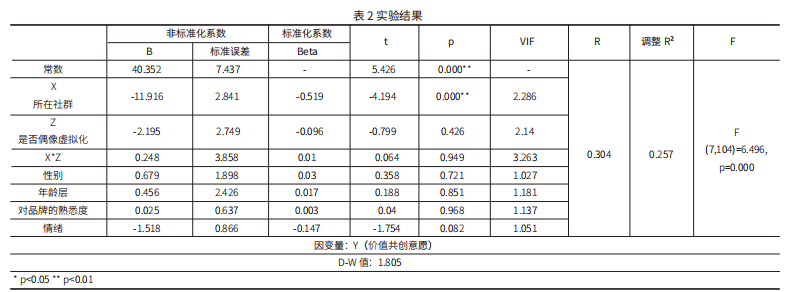
Experimental data were processed using SPSS26. After excluding incomplete and non-compliant samples, 112 samples remained, including 54 males and 58 females, with 92% of subjects aged in the 90s and 00s. Tests showed that gender and age did not significantly affect the experimental results (p > 0.05), and familiarity with the brand and emotional factors did not significantly impact willingness to co-create value (p > 0.05). To examine the moderating effect of idol virtualization, this article used consumers’ willingness to co-create value as the dependent variable, with community and idol virtualization as two categorical independent variables and their product as an independent variable for regression analysis. The results indicated that different communities had significantly different attitudes towards idol endorsements (p<0.05), and in idol endorsement marketing, audiences within fan communities were more likely to enhance consumers’ willingness to co-create value compared to audiences outside the community, which is consistent with hypothesis H1. In addition, although the results did not align with hypothesis H2, such results were actually expected. Idol virtualization did not exhibit significant interactive effects for audiences from different communities (p > 0.05), indicating that the idol virtualization depicted in the experimental materials did not significantly moderate the willingness to co-create value among different communities; subsequent measurements of consumers’ willingness to participate in value co-creation and consumer citizenship behavior also did not show any moderating effects (see Table 2).
05
Reflections and Insights
Although this article has certain shortcomings (including that the research subjects are mostly users of Sina Weibo, and the types of value co-creation primarily rely on previous discussions by scholars), this study still hopes to contribute to the exploration of the concept of idol virtualization and its impact mechanism on consumers’ willingness to co-create value. Based on the experimental results, the research team conducted follow-up interviews with relevant subjects to summarize and analyze the real needs of different community audiences.
5.1
Fitting Psychological Mechanisms Behind Two Different Community Operation Models
Both star-chasing communities and ACG communities share similar psychological mechanisms for consumption, information sharing, and content production regarding idols, but the demands of the two communities cannot be conflated. The positioning awareness of domestic enterprises and brands regarding idol virtualization is primarily based on the existing IP, attracting ACG communities through dimensional breaking. However, based on experiments and follow-up interviews, it was found that merely virtualizing idols and labeling them as “virtual idols” yields minimal results for the corresponding communities (see Table 3).
Table 3 Follow-Up Interviews with Some Subjects
|
Star-Chasing Community Audience A and B: “If the virtual idol connects with the real person, then I would transfer my feelings to them. If it is pushed out separately or directly grafted to be handled by a third party, the endorsement might be met with resistance.” “To engage fans in co-creation, the idol’s image needs to be particularly professional, and your own idol must also recognize such a model. If my opinions are taken into account, and it’s in line with my imagination, it would be more feasible than simply pushing out an image from them.” ACG Community Audience C and D: “I prefer pure virtual images, rather than virtual images of known real performers. The virtual image of a star is not considered two-dimensional in the eyes of the ACG community. I feel that if a popular star becomes a virtual image, it feels somewhat diluted.” “The star itself is a product and carries its own symbol. However, if we want to get closer to the ACG audience, we need to develop a good persona, story, values, and worldview, rather than just a single image; it needs to have content.” |
Therefore, for star-chasing communities, the new method of idol virtualization can make more young audiences aware of the idol itself, but the virtual image is not as important as the idol itself, as the core remains the three-dimensional star. Enterprises and brands should deeply understand these two subcultural communities or contexts to avoid directional errors in strategic planning.
5.2
Principles of IP Shaping for Idol Virtualization
5.2.1
Content Power: Content Classification Based on Community Utilization Principles
For ACG audiences, brands can generate relevant personas for the virtual images of idols, highly personify them, and integrate them into novels, animations, comics, games, etc., ultimately achieving the transformation of symbolic capital into economic capital. For star-chasing communities, enterprises can integrate resources around celebrity stars and textual content for expansion, ensuring that the virtual image is highly related to the idol, thereby reinforcing fan loyalty. Brands can also sell products highly related to the virtual image of idols to fans, such as books, films, products endorsed by stars, and membership services for idol communities.
5.2.2
Attraction: Building Connections and Focusing on Resource Coordination
In addition to unidirectional delivery from peripheral product production to fan consumption along the vertical consumption chain, producers can also utilize the internet to integrate and utilize resources across boundaries. Cultural products centered around stars should leverage popular, low-cost, and accessible methods to draw audiences back to the star symbols, jointly constructing the IP form of the idol. This process requires attention to creating immersive interactions from mobile scenarios; the basic approach is to connect users with brands using scenario-based and mobile technologies to form simple interactions. Next, utilizing VR/AR technologies to achieve simple interactive participation enriches interaction forms; finally, focusing on user attributes, behavioral preferences, etc., through data algorithms for interactive customization.
5.2.3 Technical Power: Choosing Suitable Methods Based on the Company’s Own Strengths
The positioning of enterprises regarding the application of idol virtualization is crucial, as not all enterprises have the capability to utilize high-tech means such as AI to shape idol virtualization images, which requires substantial R&D costs upfront and continuous content output afterward. Additionally, the ongoing iteration of the persona of virtual characters shaped after extracting IP content poses challenges for brands, as related artificial intelligence technologies cover multiple fields including text, voice, and images, requiring continuous creative input. However, high technology is not the only means to sustain a virtual image; media texts and stories can also fulfill that mission, making fan participation based on this approach simpler. Therefore, the communication path should not only be unidirectional but must also emphasize mutual exchange and information sharing between both parties, ultimately achieving effective communication or interaction.
Overall, idol virtualization essentially represents the re-shaping of star IP. When enterprises utilize idol virtualization strategies for marketing activities, they should not only focus on technology, comply with relevant national laws and regulations, but also understand and respect the underlying subcultural communities. Whether virtual images can replace real star presentations and ultimately feed back to the idols themselves is of utmost concern to fans, while ACG audiences are more focused on the texts, content, and interaction mechanisms behind such virtual images. How to keep cross-dimensional virtual IP from falling behind and not merely become a tool for consuming star popularity and topics requires constant activation of unique features.
(Author Information: Duan Chunlin, Professor at the School of Journalism and Communication, South China University of Technology; Zou Jiahua, Master’s Student of 2020 at the School of Journalism and Communication, South China University of Technology)
【References & Annotations】
【1】Netease Comics, LOFTER. Research Report on 90/00 Post ACGN Users [EB/OL]. Official Website of China International Brand Licensing Exhibition, (2018-06-17) [2021-02-02], http://www.chinalicensingexpo.com/exponews/170.html.
【2】iQIYI National Creative Planning Center. iQIYI: 2019 Virtual Idol Observation Report [EB/OL]. Chinese Internet Data Information Network, (2020-03-06) [2021-02-02], http://www.199it.com/archives/1004591.html.
【3】Prahalad, C. K., Ramaswamy, V.(2004). Co-creation experiences: The Next Practice in Value Creation. Journal of Interactive Marketing, 18(3):5-14.
【4】Vargo S L. & Lusch R F.(2004). Evolving to a New Dominant Logic for Marketing. Journal of Marketing, 68(1):1-17
【5】Lusch, R. F.,& Vargo, S.(2008). Service-Dominant Logic: Continuing the Evolution.Journal of the Academy of Marketing Science,6(1):1-10
【6】Zhu Zhao. A Brief Analysis of Virtual Idol “Hatsune Miku” and Cyberspace [J]. Modern Communication, 2010(09):59-60.
【7】Zhang Xu. From Virtual Manufacturing to Real Dissipation—Discussing the Impact of Digital Technology on Contemporary People Using “Hatsune Miku” as an Example [J]. Art Perspective, 2016(06):15-20.
【8】Li Jia, Chen Feiyang. Research on Online Interaction of Virtual Idols and Their Fan Groups—Taking the Virtual Singer “Luo Tianyi” as a Case Study [J]. Chinese Youth Research, 2018(06):20-25
【9】Zhao Yiyang. Research on the Virtual Idol Landscape from the Perspective of Youth Subculture—Taking “Luo Tianyi” as an Example [J]. Beijing Youth Research, 2020,29(03):47-54.
【10】Shuai Renyan, Shi Ce. Research on the Holographic Image of Virtual Idols in TV Programs Using 5G Technology [J]. Northern Media Research, 2019(06):29-32+52.
【11】Liu Jiamei. Research on the “Money Scene” of AI Virtual Idol Development [J]. Science and Technology Communication, 2019,11(24):106-107.
【12】Yu Guoming, Yang Mingyi. Virtual Idols: A New Type of Communication Medium with Relationship Attributes [J]. News and Writing, 2020(10):68-73.
【13】Wang Yixuan. The Legitimacy of Paradox: The Reproduction and Production of Fan Images by Online Fan Communities—Taking Lu Han’s Online Fan Community as an Example [J]. Chinese Youth Research, 2017(06):67-74.
【14】Song Lei Yu. Characteristics and Significance of Fan Participation Culture of Virtual Idols [J]. Modern Communication, 2019,41(12):26-29.
【15】Huang Tingting. Virtual Idols: Other Imaginations and Self-Constructs in a Mediated Society [J]. Youth Journalist, 2019(30):28-29.
【16】Yuan Mengqian. Cyber People and Virtual Idols Interaction: Cross-Media Art, Technology and Body in the Post-Human Era—Taking the Communication Practice of Virtual Idol “Hatsune Miku” as an Example [J]. Media Criticism, 2019(00):64-73
【17】Liu Shuliang, Zhu Qiaoqian. On the Conceptual Evolution of ACG Culture and Its Cultural Consumption Characteristics [J]. Modern Communication, 2020,42(08):22-26.
【18】User Local Co., Ltd. Virtual YouTuber, Today Exceeding 13,000 People (User Local Survey) [EB/OL]. (2020-11-09) [2021-02-28], https://www.userlocal.jp/press/20201109vi.
【19】Song Wenjia. The Phenomenon of Virtual Idols in the Age of Images [J]. Beauty and Times (Upper), 2012(01):13-16.
【20】Zhang Zizhong. Research on UGC Motivation in the Virtual Idol Industry [J]. News Forum, 2018(02):15-18.
【21】(USA) Lowenthal. Literature, Popular Culture and the World [M]. Gan Feng, Trans. Beijing: China Renmin University Press, 2012:151-156.
【22】Mu Sirui. A Brief Analysis of the Positioning of Virtual Idols and Their Differences from Other Anime Images [J]. Drama Home, 2018(10):89+114.
【23】Yi, Y. & Gong, T.(2013). Customer Value Co-Creation Behavior: Scale Development and Validation. Journal of Business Research, 66 (9):1279-1284.
【24】Grönroos, C. & Voima, P.(2013). Critical Service Logic: Making Sense of Value Creation and Co-creation. Journal of the Academy of Marketing Science, 41(2):133-150.
【25】Von Hippel E.(2007). Horizontal Innovation Networks by and for Users.Industrial and Corporation Change,16(2):293-315.
【26】Vladimir Zwass.(2010). Co-Creation: Toward a Taxonomy and an Integrated Research Perspective. International Journal of Electronic Commerce,(15):11-48.
【27】Sicilia, M. & Palazón, M.(2008). Brand Communities on the Internet: A Case Study of Coca-Cola’s Spanish Virtual Community. Corporate Communications: An International Journal,3(13):255 -270.
【28】Chen Yu. Shared Rituals and Gift Games—A Study of Virtual Fan Communities Using Baidu Tieba as an Example [J]. Contemporary Communication, 2013(06):27-29.
【29】Gupta, S.& Kim, H.W.(2007). Developing the Commitment to Virtual Community: The Balance Effects of Cognition and Affect. Information Resources Management Journal,20(1):28-45.
【30】Yuan Guangfeng. “Emotion” and Interpretive Communities in Internet Space—Understanding the “Emotional” Politics in the Internet [J]. Chinese Internet Communication Research, 2014(01):89-97.
【31】Pan Shuya, Zhang Yuqi. Virtual Presence: The Interactive Ritual Chain of Online Fan Communities [J]. International Journalism, 2014(09):35-46.
【32】Yu Guoming, Geng Xiaomeng. On the Technological Empowerment and Simulation Deconstruction of Virtual Idols in the Age of Artificial Intelligence [J]. Journal of Shanghai Jiao Tong University (Philosophy and Social Sciences Edition), 2020(01):23-30.
【33】Kent, R.J. & Allen, C. T.(1994). Competitive Interference Effects in Consumer Memory for Advertising: The Role of Brand Familiarity. Journal of Marketing, 58(3):97-105.
【34】Smith, C. A. & Ellsworthp, C.(1985). Patterns of Cognitive Appraisal in Emotion. Journal of Personality and Social Psychology, (48):813-838.
【35】Koh K.(2008). The Influence of On-line Brand Community Characteristics on Community Commitment and Brand Loyalty.International Journal of Electronic Commerce,12(3):57-80.
【36】Groth, W.(2010). Co-creation: Toward an Integrated Research Perspective.International Journal of Electronic Commerce,15(1):11-48.
【37】Jiang Ruocheng, Xu Dongli. Concept Definition and Scale Development of Virtual Brand Community Citizenship Behavior [J]. Soft Science, 2012,26(10):121-125.
Scroll to see more
Click below or read the original text to see submission details
↓↓↓
Call for Papers
Published by Modern Advertising Magazine

“Financial Report Observation” Huya | Bilibili | Tencent Music | Yiche | Dongpeng
“Listed Capital” JOOR | Atour | Hupu | Perfect Diary | JD Logistics
“Policy Regulation” Three Products and One Device | Epidemic | Financial Advertising | Live Broadcast Failures | Typical Cases
| 618 | P2P | 315 | Overseas Listing | Double 11
“Person Interviews”He Simin | Wang Qianwen | Yin Biaocai | Ishikawa Keita | Yang Yexin
| Shi Tuopei | Lin Youqin | Wu Shanyun | Zhang Min | Zheng Huijue