For a more detailed introduction, please contact the editor for the full PDF.
Accelerate product development, rapid iteration, and achieve small batch production at lower costs
In modern manufacturing, whether it is injection molding, thermoforming, or casting processes, the support of molds is indispensable. However, traditional metal mold manufacturing is costly and time-consuming, severely slowing down the product development process, especially unsuitable for small batch customization or prototype validation stages.
With the maturity of 3D printing technology, rapid tooling has become a new favorite in the manufacturing industry. It can produce molds suitable for various traditional processes in a very short time and at a very low cost, greatly enhancing the flexibility and efficiency of product development.
What is Rapid Tooling?
Rapid tooling is a type of technology used for the quick and low-cost manufacturing of molds, suitable for situations requiring short-term or small batch production.
Compared to traditional metal molds, rapid tooling has the following advantages:
Extremely fast: Molds can be manufactured within 24 hours;
Extremely low cost: Costs are close to rapid prototyping, far lower than traditional molds;
Strong applicability: Especially suitable for small batch production of 1–10,000 pieces, prototype validation, and transitional production.
Rapid Tooling vs. Rapid Prototyping
Many people easily confuse rapid tooling with rapid prototyping. Simply put:
Rapid prototyping is directly manufacturing part samples;
Rapid tooling is manufacturing molds, mold cores, or models used for producing parts, and then using traditional processes to manufacture the final parts.
Soft Molds vs. Hard Molds
Soft molds: Usually refers to silicone molds, suitable for prototyping and small batch production, often made using 3D printing for the master mold;
Hard molds: Generally refers to metal molds, which are durable and suitable for large batch production, but are costly and time-consuming.
Application Scenarios of Rapid Tooling
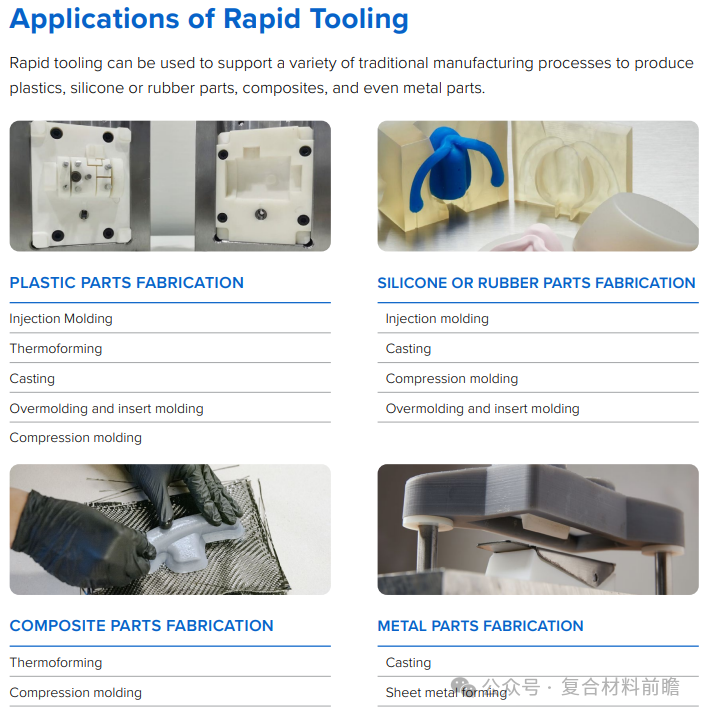
Rapid tooling can be widely applied in the following manufacturing processes:
1. Injection Molding
Using 3D printed injection molds can significantly save time and costs in small batch (10–1000 pieces) production. Formlabs’ SLA photopolymer printer combined with high-temperature resistant materials (such as Rigid 10K resin) can withstand the high temperatures and pressures of the injection molding process.
Case Study: A manufacturer in Shenzhen used the Form 3 printer and Rigid 10K resin to reduce the delivery cycle of 100 small batch injection parts from 4 weeks to 3 days.
2. Thermoforming (Vacuum/Pressure Forming)
3D printed molds are particularly suitable for small batch, customized, or prototype stage thermoforming needs. SLA technology can achieve complex mold structures, improving vacuum distribution uniformity.
Case Study: The cosmetics brand Lush used 3D printed molds to reduce the mold-making time for new products to under 24 hours, conducting over a thousand design tests annually.
3. Composite Material Molding
High-performance composite materials such as carbon fiber can be hand-laminated on 3D printed master molds. The molds printed with SLA have a smooth surface, suitable for layering processes.
Case Study: The student formula racing team at Berlin University of Technology used 3D printed molds to create carbon fiber steering wheel shells.
4. Insert Injection Molding and Overmolding
3D printed molds can be used for insert injection molding of silicone, rubber, or plastic, especially suitable for electronic device packaging, medical device prototypes, etc.
Case Study: A team reduced the testing cycle from 3 weeks to 3 days using 3D printed test pieces, saving over $100,000.
5. Compression Molding
3D printed molds can be used for compression molding of thermoplastics, silicone, rubber, and composites, especially suitable for prototype development of medium and small parts.
Case Study: The kitchenware brand OXO used 3D printed molds for compression molding silicone seals.
6. Casting
Whether for metal casting (such as lost-wax casting, sand casting) or silicone/plastic casting, 3D printing can quickly produce models or molds, greatly enhancing efficiency and design freedom.
Case Study: The medical company Cosm used 3D printed molds and medical-grade silicone casting to customize pelvic floor treatment devices for patients.
7. Sheet Metal Forming
SLA printed upper and lower molds have high precision, smooth surfaces, and do not scratch metal, making them suitable for small batch sheet metal part forming.
How to Manufacture Rapid Tooling?
Currently, there are two mainstream methods:3D printing and machining.
| Comparison Item | 3D Printed Rapid Tooling | Machined Rapid Tooling |
|---|---|---|
| Production Method | In-house | Mostly outsourced |
| Materials | High-performance photosensitive resin | Aluminum, tool plates, wood, plastics, etc. |
| Cost | Low | Medium–high |
| Delivery Cycle | 1–3 days | 1–4 weeks |
| Applicable Quantity | <500 pieces | 50–10,000 pieces |
| Applicable Scenarios | Prototyping, validation, customization, small batch production | Medium-small batch production, transitional production |
Conclusion:
For projects with high complexity, tight cycles, and small batches, 3D printing is the better choice; for projects with simple structures and slightly larger quantities, consider aluminum machined molds.
3D Printing Rapid Tooling Workflow
-
Design: Use CAD software to design the mold or model;
-
Print: Choose suitable 3D printing materials (such as high-temperature, high-rigidity resins);
-
Manufacture: Directly use the printed mold for production, or create the final mold through master mold replication;
-
Post-processing: Perform sanding, polishing, spraying, etc., as needed.
Conclusion
The 3D printing rapid tooling technology is fundamentally changing traditional manufacturing processes, especially suitable for prototype development, small batch, and customized production in fields such as composite materials, medical devices, consumer electronics, and automotive.