Enterprise-level AI chatbots have evolved from early simple customer service tools to a much higher level today. Platforms like Drift and Intercom laid the groundwork, but now the market is flooded with dozens of advanced solutions that offer much more than scripted responses. The real challenge today is not finding a chatbot, but choosing the right one. As these tools develop, the focus has shifted from basic automation to truly intelligent, scalable, and integrated systems that can fundamentally change how businesses interact with customers and operate behind the scenes.
A shocking reality is that, according to Gartner’s predictions, by the end of 2025, over 80% of customer interactions are expected to involve chatbots. This is not just a trend, but a fundamental shift in customer expectations.
Why are businesses racing to adopt this technology? The advantages are clear, regardless of size. Small businesses can compete with industry giants without the need to hire additional staff for round-the-clock support. Medium-sized enterprises can seamlessly scale their operations while serving more customers at a lower cost. Large enterprises can streamline complex processes and provide a consistent experience globally.
Ready to explore the driving forces behind this revolution? We will delve into cutting-edge voice technology, advanced AI integration, highly personalized customer journeys, and the expert predictions that the market size will reach $27 billion by 2030. Additionally, you will learn practical implementation strategies suitable for any business size.
 What is an AI Chatbot?
An AI chatbot is a digital assistant that can engage in real conversations, much like texting with a smart friend who happens to know about the company’s products or services. The key difference? It truly understands what you mean, not just what you input.
Old-fashioned chatbots are like those annoying phone menus—”Press 1 for billing, press 2 for support.” They can only respond to phrases that are programmed to be recognized. Ask, “What is your return policy?” and you will get an answer. But ask, “If my child doesn’t like this, can I return it?” and you hit a wall.
How Modern AI Chatbots Work
Today’s AI chatbots are entirely different. They can understand what you are saying even if you phrase it differently. They know that “this is broken,” “it doesn’t work,” and “there’s a problem” all mean the same thing.
These chatbots learn from every conversation. They learn local slang, understand when you are frustrated or just curious, and can even remember what you discussed earlier in the same conversation. It’s like talking to a real person who is genuinely listening.
 Why Businesses Should Use AI Chatbots
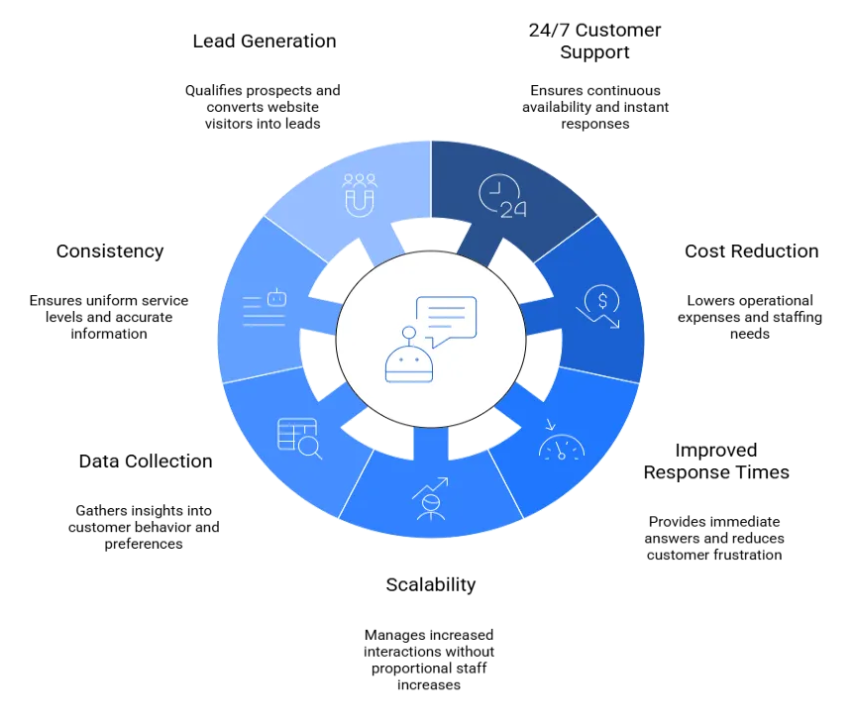
1. 24/7 Customer Support
-
Respond to customer inquiries at any time without human intervention
-
Meet modern consumers’ expectations for instant help and support
-
Prevent potential customers from abandoning purchases due to unanswered questions
-
Ensure continuous service regardless of time zones or holidays
2. Cost Reduction
-
Handle multiple conversations simultaneously, reducing staffing needs
-
While initial setup investments may be high, significant savings can be achieved in the long run
-
Especially beneficial for businesses with a high volume of daily inquiries
-
Eliminate overtime costs and reduce training expenses for customer service staff
3. Shorter Response Times
-
Instantly answer common questions without waiting
-
Eliminate customer dissatisfaction caused by long response delays
-
A key competitive advantage in a market where customer patience is limited
-
Maintain service quality during high traffic periods
4. Scalability
-
Manage increasing customer interactions without proportionally increasing staff
-
Handle spikes in inquiries during peak seasons or marketing campaigns
-
Maintain consistent service quality regardless of interaction volume
-
Adapt to business growth without major infrastructure changes
5. Data Collection and Analysis
-
Gain valuable insights into customer behavior and preferences
-
Identify common questions and issues
-
Track purchasing patterns and customer journey touchpoints
-
Provide data to improve products, services, and marketing strategies
6. Consistency
-
Ensure every customer receives the same level of service and accurate information
-
Reduce human error and maintain brand standards across all interactions
-
Provide uniform responses regardless of time or whether customer service staff are online
-
Maintain a professional tone and company information in communications
7. Lead Generation
-
Identify potential customers through automated questioning and data collection
-
Efficiently gather contact information and customer preferences
-
Guide potential customers through the sales funnel with targeted information
-
Convert website visitors into sales leads when no human sales representatives are available
 Key Features of Enterprise AI Chatbots
-
Natural Language Understanding (NLU) — It can understand different expressions of the same question from customers. Even with misspellings or slang, it can recognize customer intent. It can handle complex sentences and multiple questions simultaneously and respond in a natural way rather than mechanically.
-
Multi-channel Support — Supports websites, mobile apps, WhatsApp, Facebook Messenger, and other platforms. Maintains consistent conversations across different channels and allows customers to switch between platforms without losing conversation history. Additionally, it can connect with customers in their preferred communication methods.
-
CRM and Tool Integration — Connects with business systems like Salesforce, HubSpot, and Shopify. It can quickly access customer information to provide personalized responses. Automatically updates customer records after conversations and syncs with inventory, order tracking, and support ticket systems.
-
Personalization and User Context Memory — Remembers previous conversations and customer preferences, addressing customers by name and recalling their purchase history. Provides customized recommendations based on past interactions and maintains conversational context over long discussions.
-
Analytics and Performance Tracking — Displays the most common questions customers ask. Additionally, it tracks conversation success rates and customer satisfaction. It can also identify areas where the chatbot needs improvement and provide insights into customer behavior and preferences.
-
Escalation to Human Support — Identifies situations where issues are too complex for automated responses and smoothly transfers the conversation to human support, providing complete context information. It also allows customers to request human assistance at any time and retains conversation history for seamless transitions.
-
Security Compliance — Protects customer data through encryption and secure storage. It also adheres to data privacy regulations such as personal information protection laws, GDPR, and complies with healthcare industry standards like HIPAA. Additionally, it ensures the confidentiality of sensitive information.
 Real Business Cases for AI Chatbots
1. H&M — Fashion Shopping Assistant
-
The AI chatbot helps customers find clothes based on personal style preferences and sizes
-
Asks about fashion tastes, budget, and occasions to recommend the perfect outfit
-
Reduces customer service workload by handling common size and style questions
Impact: Increases online sales by making shopping more personalized and convenient
2. Domino’s Pizza — Order Chatbot
-
Customers can order pizza through Facebook Messenger with simple conversations
-
Remembers favorite orders and recommends deals based on past purchases
-
Handles order modifications, delivery tracking, and payment processing
Impact: Online orders increased by 30%, significantly reducing phone orders
3. Tidio’s Lyro — Small Business Support
-
Designed for small businesses, it can automatically handle customer support
-
Resolves 70% of common support queries without human intervention
-
Learns from business knowledge bases and previous customer interactions
Impact: Small businesses can save over 40 hours of customer service time per week
4. Bank of America’s Erica — Virtual Banking Assistant
-
Provides banking questions and account management services for over 35 million users
-
Helps customers check balances, transfer funds, and understand spending patterns
-
Offers financial advice and alerts for unusual account activity
Impact: Handles over 1 billion customer interactions annually, reducing branch visits
5. Sephora — Beauty Advisor Chatbot
-
Provides personalized makeup and skincare advice
-
Books in-store experiences and offers virtual try-on experiences
-
Sends beauty tips and product launch notifications
Impact: Increases customer engagement by 40%, boosting online sales
6. KLM Royal Dutch Airlines — Travel Support Assistant
-
Handles flight bookings, check-ins, and travel information in 13 languages
-
Sends flight updates, boarding passes, and gate change notifications
-
Assists with baggage tracking and travel document requirements
Impact: Handles over 15,000 conversations weekly, increasing customer satisfaction scores by 25%
These chatbots demonstrate how AI is transforming customer service across various industries, making businesses more efficient while enhancing customer experience.
 Challenges in Implementing AI Chatbots for Enterprises
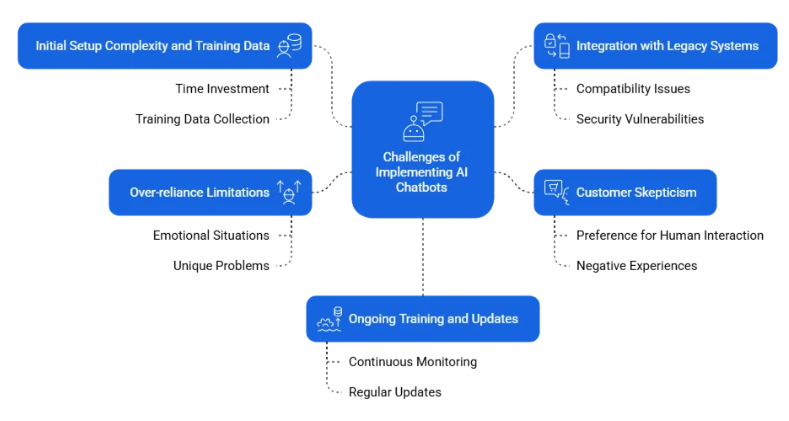
1. Initial Setup Complexity and Training Data
-
Requires significant time investment to configure chatbot parameters and conversation flows
-
Needs to collect a large amount of training data to ensure accurate and relevant responses
-
Involves complex decision tree mapping for various customer scenarios and queries
-
Requires a comprehensive testing phase to identify and resolve potential response gaps
-
Requires technical expertise that existing business teams may not possess
2. Integration with Legacy Systems
-
Compatibility issues arise when connecting chatbots to older business software and databases
-
Custom APIs often need to be developed to bridge communication between systems
-
Significant upgrades to IT infrastructure may be required to support seamless integration
-
Potential security vulnerabilities can arise during system interconnectivity
-
Data synchronization issues may occur between chatbot responses and backend systems
3. Customer Skepticism
-
Resistance from customers who prefer human interaction over automated responses
-
Negative experiences arise when chatbots provide irrelevant or incorrect information
-
Frustration occurs when customers cannot easily escalate issues to human support
-
Brand reputation can suffer if chatbot responses seem mechanical or unhelpful
-
Customer churn may occur if the implementation process feels impersonal or ineffective
4. Limitations of Over-Reliance
-
Struggles to effectively handle complex emotional situations or nuanced customer complaints
-
May struggle to resolve unique issues that exceed programmed response parameters
-
Lacks the human empathy and emotional intelligence needed to address sensitive customer issues
-
May escalate issues that could be quickly resolved by human judgment
-
Can alienate customers who require personalized attention and understanding
5. Ongoing Training and Updates
-
Requires continuous monitoring and improvement based on customer interaction data
-
Needs regular updates to handle new products, services, or policy changes
-
Involves ongoing costs for maintenance, updates, and performance enhancements
-
Requires dedicated resources to analyze chatbot performance and implement improvements
 How to Choose the Right AI Chatbot for Your Business
Choosing the right AI chatbot is not just about features; it’s about finding the solution that best aligns with your goals, tech stack, and customer needs. Here’s how to make an informed and strategic choice.
1. Define Your Business Goals
First, clarify the primary use case for the chatbot. Is it for customer support, sales inquiries, or for handling internal functions like employee issues or IT queries? Understanding the core use case helps narrow down platforms built for specific outcomes. Without clear goals, your chatbot may end up underperforming or misaligned with your strategy.
2. Off-the-Shelf vs. Custom Solutions
Next, decide whether to purchase an off-the-shelf chatbot or build one from scratch. Ready-made solutions like Tidio or Intercom deploy quickly with minimal technical setup, making them ideal for small to medium-sized businesses. On the other hand, custom bots are better suited for enterprises with complex workflows and technical resources to support ongoing development and training.
3. Compare Popular Platforms
Take time to evaluate the following top platforms:
Tidio for easy deployment and automation
Drift for real-time sales chat and lead capture
Intercom for multi-functional support and marketing
Dialogflow and IBM Watson for advanced AI and NLP
Each platform has its strengths, so compare based on scalability, user interface, integration options, and industry relevance. The right choice should meet your current needs while facilitating your business growth.
4. Evaluate Key Features
Look beyond surface-level features. Focus on analytics dashboards, multi-channel support, third-party integrations, and security controls. Additionally, consider the ease of updates and training after the bot goes live. Robust reporting tools are essential for tracking performance and continuously optimizing customer interactions.
5. Test Before Committing
Finally, be sure to start with a pilot project. A limited deployment allows you to gather feedback, address issues, and fine-tune workflows without impacting overall operations. This phased approach minimizes risk and helps ensure the chatbot performs well before scaling.
 Trends in the Development of AI Chatbots in Enterprises
The landscape of business communication is rapidly evolving, and AI chatbots are becoming increasingly sophisticated, becoming an integral part of customer experience strategies. Several key trends are shaping this transformation.
1. Voice Technology
As businesses increasingly recognize the natural appeal of conversational interfaces, voice chatbots represent a significant growth area. These systems are moving beyond simple command recognition to support nuanced, context-aware conversations, delivering a truly interactive experience. The integration of advanced voice processing capabilities allows customers to interact more intuitively, especially in mobile and hands-free environments.
2. Advanced AI Integration
Integration with powerful generative AI models like GPT-4 and Claude is revolutionizing chatbot capabilities. These advanced systems can understand complex queries, provide detailed explanations, and maintain coherent conversations across multiple topics. This technological leap enables chatbots to handle complex customer service scenarios that previously required human intervention.
3. Hyper-Personalized Customer Journeys
High levels of personalization are becoming the cornerstone of modern customer journeys. AI chatbots today leverage extensive data analytics to provide customized experiences, remembering individual preferences, purchase histories, and communication styles. This personalized approach fosters more meaningful interactions and enhances customer satisfaction and loyalty.
4. Market Growth Forecast
Market forecasts reflect this technological momentum, predicting that the AI chatbot industry will exceed $27 billion by 2030. As businesses recognize the competitive advantages of intelligent automation, this growth indicates widespread adoption of smart automation across various sectors, from e-commerce and healthcare to financial services and education.
Image and text sourced from the internetFor copyright issues, please contact for removal!
END