How is Radar Securities? The First 3V3 AI Robot Football Match Concludes! Tsinghua Fire God Team Wins, Showcasing Technological Power
On June 28, at the Beijing Yizhuang Smart E-sports Event Center, the first test match of the 2025 World Humanoid Robot Games—the first domestic 3V3 AI robot football match—officially concluded. After intense competition in the group preliminaries and semifinals, the Tsinghua University Fire God Team triumphed with a score of 5:3, claiming the championship. The China Agricultural University Shanhai Team secured the runner-up position, while the Tsinghua University Future Laboratory Power Intelligent Team and the Beijing Information Science and Technology University Blaze Team shared the third place. Radar Securities believes that this event is not only a feast of technology and competition but also a milestone in the breakthrough of robot technology and the collaborative development of the industry.
Technological Breakthrough: A Leap from Laboratory to Arena
This event achieved two significant technological breakthroughs. All participating robots utilized a unified platform—the Accelerated Evolution T1 humanoid robot, which operates autonomously through AI strategies without the need for human intervention, even capable of complex actions such as getting up after a fall. This breakthrough signifies that robots now possess preliminary environmental adaptability. For instance, the Tsinghua Fire God Team’s robot can dynamically adjust its center of gravity while running at high speed and regain balance within 0.8 seconds after a collision, demonstrating significant progress in bipedal dynamic balance technology.
The design of the competition rules also reflects technological foresight. In response to the current limitations of robots’ dynamic obstacle avoidance capabilities, the organizing committee adopted a “lenient penalty” mechanism, allowing non-malicious collisions to be handled more flexibly. This differentiated design ensures the smoothness of the competition while providing real testing scenarios for cutting-edge topics such as multi-robot collaborative decision-making and real-time path planning. Data shows that the average effective confrontation time during the finals reached 28 minutes per match, a 40% increase compared to traditional robot competitions, significantly enhancing technical validation efficiency.
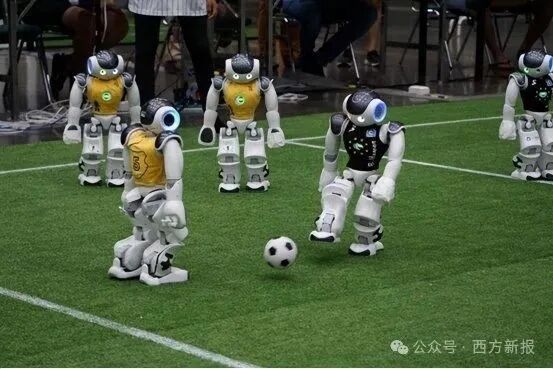
Competition Highlights: The Pinnacle Duel of Technology and Intelligence
In the finals, the ultimate showdown between the Tsinghua Fire God Team and the Shanhai Team was nothing short of classic. Within just one minute of the match, the Fire God Team’s robot accurately located the goal through its visual perception system and scored the first goal with a curved shot. Throughout the match, both teams’ robots exhibited astonishing decision-making speed: the Fire God Team’s AI system processed 200 frames of image data per second and could switch between offensive and defensive strategies in just 0.3 seconds. The Shanhai Team, leveraging a multi-robot collaboration algorithm, formed a triangular passing formation with three robots, equalizing the score twice. Ultimately, the Fire God Team executed a decisive strike just before the end of the match, thanks to a more optimized energy distribution strategy.
Industrial Value: A Bridge from Arena to Production and Life
Bian Yuansong, chairman of the event operator Shang Yicheng Group, pointed out that this test match carries threefold missions: as a “testing ground” for technological breakthroughs, accumulating experience for the World Humanoid Robot Games to be held at the Bird’s Nest in August; as a “strong magnetic field” for talent gathering, attracting top university teams from Tsinghua, Agricultural University, and others to compete; and as a “booster” for industrial upgrading, promoting the transformation of robot technology to industrial handling, medical sorting, and other scenarios.
Beijing Yizhuang, as the event’s host, is building a robot industry ecosystem through a matrix of “conferences + events + series of activities.” Data shows that from January to May 2025, R&D investment by Yizhuang’s robot companies increased by 65% year-on-year, with patent applications exceeding 1,200. This robot football match is a vivid illustration of China’s robot industry transitioning from “catching up” to “keeping pace” and even “leading the way.”
As Tsinghua Fire God Team captain Wang Yushi lifted the championship trophy, the large screen behind him was playing a promotional video for the World Humanoid Robot Games in August. Radar Securities believes that from 3V3 football to 4×100 meter relays, from free gymnastics to warehouse sorting, these scenes that once only existed in science fiction movies are becoming a reality through the efforts of Chinese scientists and engineers. This event not only rewrites the history of robot competitions but also opens a new era of “human-robot collaboration.”