This week, the first AI chip stock “Hanwang” exceeded the Shanghai Composite Index’s pillar stock Guizhou Moutai, reaching 1492 CNY per share, while Guizhou Moutai closed at 1480 CNY on Friday. There is a common practice that when the Shanghai Index breaks through the Moutai stock price, it generally faces adjustments. Hanwang reached a new high of 1595 CNY per share this week but saw a 6% drop on Friday. As shown in the figure below:
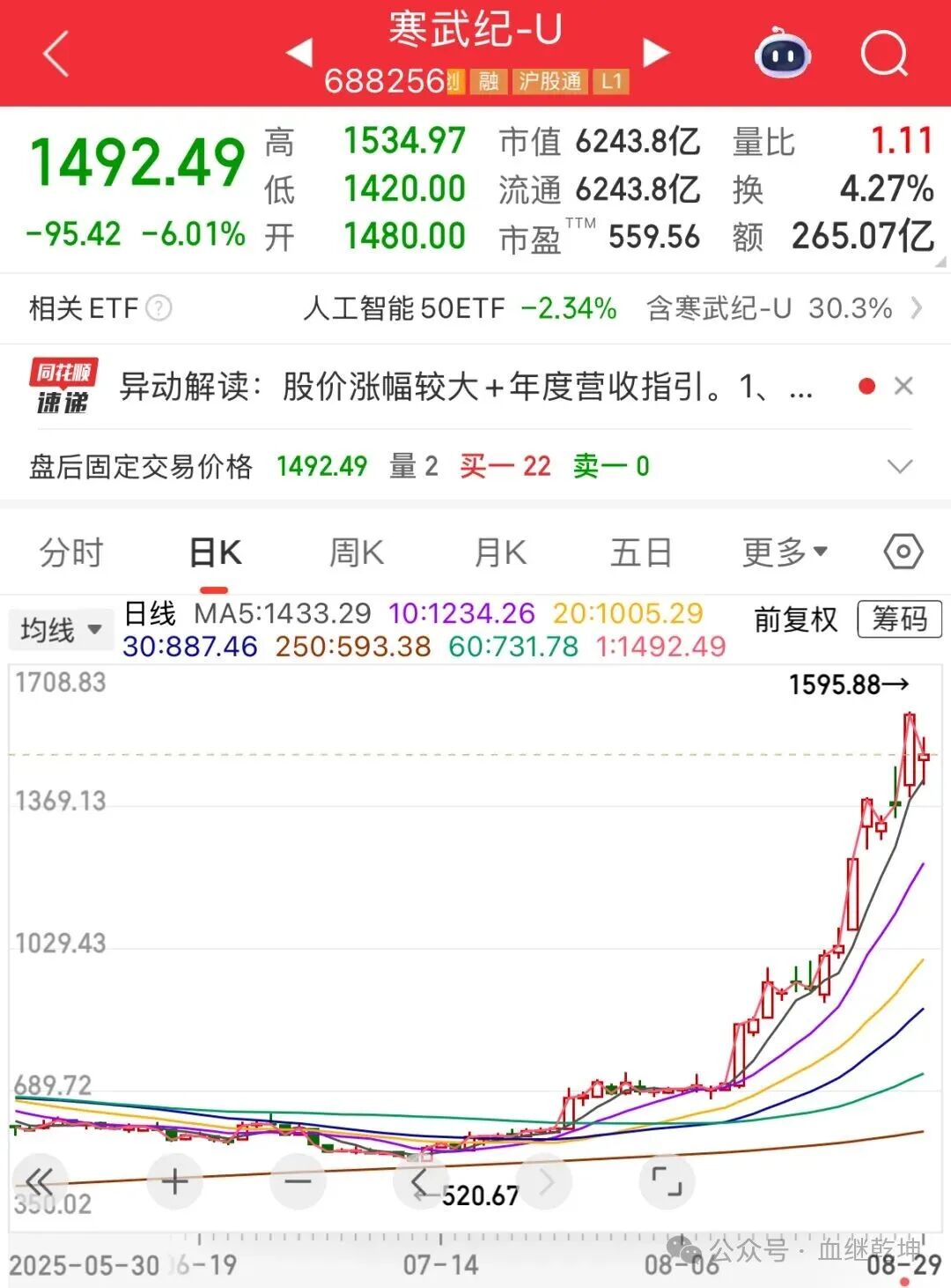
Hanwang’s stock price is around 1500, with a market value of 624.4 billion. This month, Hanwang has risen by 110%. Such a rapid increase in market value seems a bit precarious! This round of market activity is primarily driven by Hanwang’s company performance, which has ignited the entire industry chain, including ASIC chains, switching chips, wafer fabs, and advanced packaging. Demand side: domestic cloud manufacturers’ CAPEX continues to increase.
In terms of advanced processes, SMIC’s advanced process capacity is accelerating expansion, yield rates are recovering, and advanced process orders are full. In the past two weeks, there has been a continuous strengthening of guidance for the localization of AI chips, with the H20 from Da Zhi posing information security risks, leading to a ban on its purchase.
This situation likely indicates that SMIC’s yield recovery and Hanwang’s new 690 product testing performance are on par with or even exceed the H20.
The transmission sequence of the industry chain is as follows:
1. First Stage: Domestic Computing Power -> Storage Power -> Switching Chips. Solutions for domestically produced AI chips include: Huawei Ascend, Hanwang, Haiguang Information, Chipone, ZTE (ZTE Microelectronics is similar to Huawei’s HiSilicon subsidiary), Alibaba Pingtouge, Moore Threads, and Muxi Technology.
Ethernet switching chips: ZTE (subsidiary ZTE Microelectronics), Shengke Communication.
PCIe switching chips: Lanke Technology, Wantong Development (Shudu Technology).
Storage modules: Jiangbolong, Demingli, Baiwei Storage, Shannon Chip Creation, etc.
2. Second Stage: Wafer Foundry + Testing
Providing supply-side guarantees for domestic AI chips: Wafer fabs: SMIC, Hua Hong Semiconductor
Semiconductor testing factories: Tongfu Microelectronics, Changdian Technology, Yongxi Electronics, Weic Technology.
3. Third Stage: Semiconductor Equipment + Materials
Accelerating solutions for bottleneck issues under advanced process expansion: Lithography machines: Shanghai Micro Electronics, Maocai Optics, Huicheng Vacuum, Fuzheng Technology, Wavelength Optoelectronics, etc.
Equipment: Northern Huachuang, Zhongwei Company, Tuo Jing Technology, Xinyuan Micro, etc.
Materials: Anji Technology, Dinglong Co., Qiangli New Materials, etc.
This round of market activity in August is led by top AI chip leaders and advanced process chipmakers like SMIC, activating the entire market. The current market activation is also due to the surge in domestic generative AI (such as DeepSeek, Tongyi Qianwen, etc.) training and inference demand, driving accelerated investment in servers and supporting network facilities. In the first quarter of fiscal year 2026, NVIDIA’s data center business revenue grew by 69% year-on-year to 44.1 billion USD, confirming the rapid growth of global AI computing power demand.
Domestically, leading manufacturers disclosed last year that they would increase AI capital expenditures: (1) Alibaba: plans to invest 380 billion CNY in cloud computing and AI infrastructure over the next three years, exceeding the total of the past decade; (2) Tencent: plans 100 billion CNY in capital expenditures by 2025, with 34.9 billion CNY spent in Q4 2024, a year-on-year increase of 421%; (3) ByteDance: plans 160 billion CNY in capital expenditures by 2025, with 90 billion CNY for AI computing power procurement and 70 billion CNY for IDC infrastructure; (4) The three major telecom operators: a total capital expenditure of 289.8 billion CNY by 2025, with a significant increase in computing power investment.
Alibaba Cloud’s capital expenditure for fiscal year 2026 is 120 billion CNY, with 40-50 billion CNY allocated for computing power cards. Currently, the H20 is banned from purchase due to security concerns and its performance is comparable to domestically produced products. Purchasing domestic cards from Hanwang, Alibaba Pingtouge, Haiguang Information, etc., would benefit the performance of leading domestic AI chip companies.
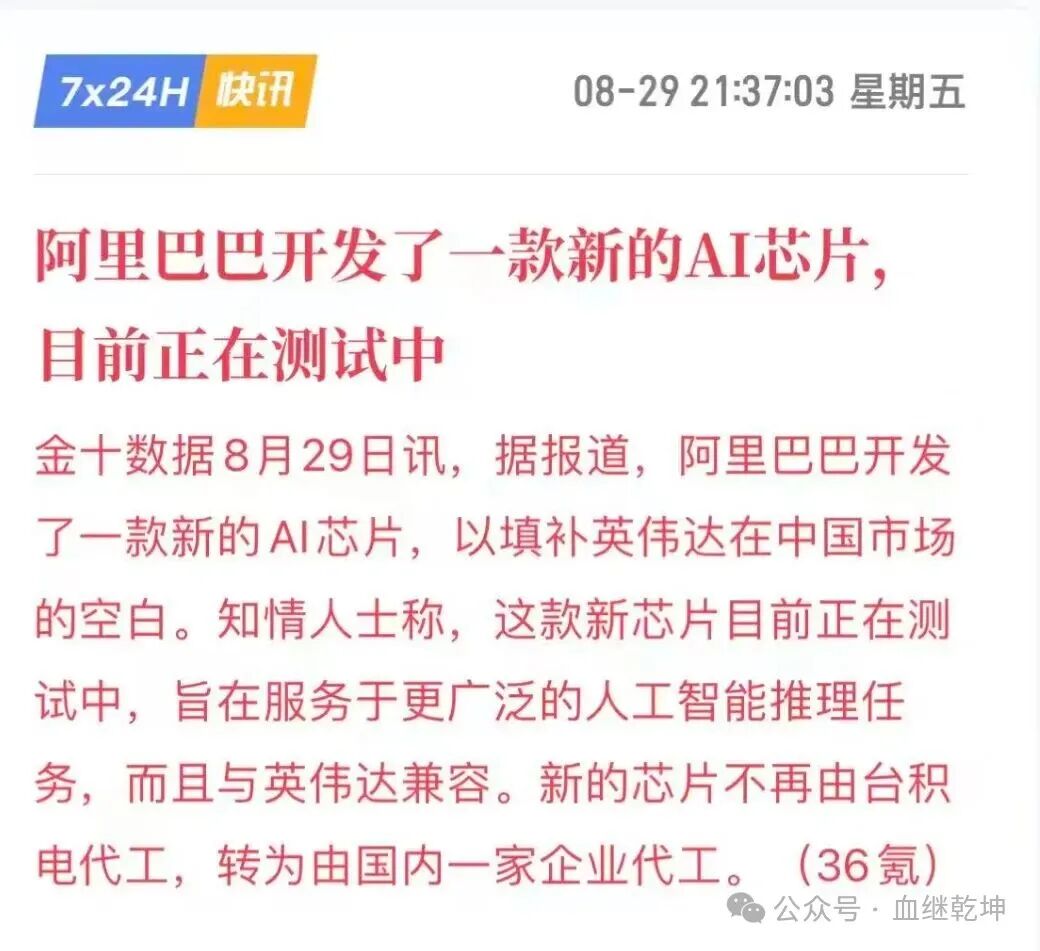
NVIDIA’s Huang predicts that today’s AI capital expenditure in China is 50 billion USD, with an expected CAGR of 50% growth (Wall Street’s expectation is 29%), thus the domestic space for 2027 is 800 billion CNY.
According to overseas forecasts, domestic capital expenditures will approach 1 trillion CNY in the next two years, opening up the imagination space for the semiconductor industry. However, companies like Hanwang, Dongxin, and SMIC have already seen rapid increases that may have overdrawn expectations for performance growth next year or even the year after.
This is also a downside of the domestic capital market; when expectations are low, prices are low, and when they rise, it is hard to imagine. Of course, this round of market activity does not need to focus solely on AI chips; the increase in domestic AI capital expenditure positively stimulates domestic segments such as switching chips, semiconductor supporting equipment, materials, semiconductor testing, AI data center generator sets, and AI liquid cooling. Currently, it seems that Hang Seng Technology and interconnect switching chips are expected to continue the second half of the AI wave, with equipment, materials, and testing likely to experience a supplementary rise in this round of market activity.
Risk Warning: All articles are personal investment research opinions shared by the author, intended for discussion and exchange, and do not constitute any investment advice. All data is sourced from publicly available channels online. Investment carries risks; please proceed with caution!