When developing applications using MCUs, I/O ports are among the most commonly used peripheral functions, often considered the simplest functionality, merely representing the H/L state of input pins or controlling the H/L output of pins. However, due to differences in MCUs or the construction of I/O ports, it is still important to pay attention to details in practical applications to achieve optimal performance. Today, we will discuss the selection of resistor values for pull-up and pull-down resistors on I/O ports.1. Minimum Value Limitation of Pull-Up Resistors:The resistance value of pull-up resistors has a minimum value limitation, but this minimum value is usually not reflected as an independent parameter in the electrical characteristics table. The reason for this limitation is to prevent damage to the port due to unexpected reasons (e.g., strong noise) causing the input port to be altered to an output port, especially when the output data is zero. The current flowing into this port is limited by the pull-up resistor, preventing it from exceeding the limit and causing damage to the port, as shown in the figure below.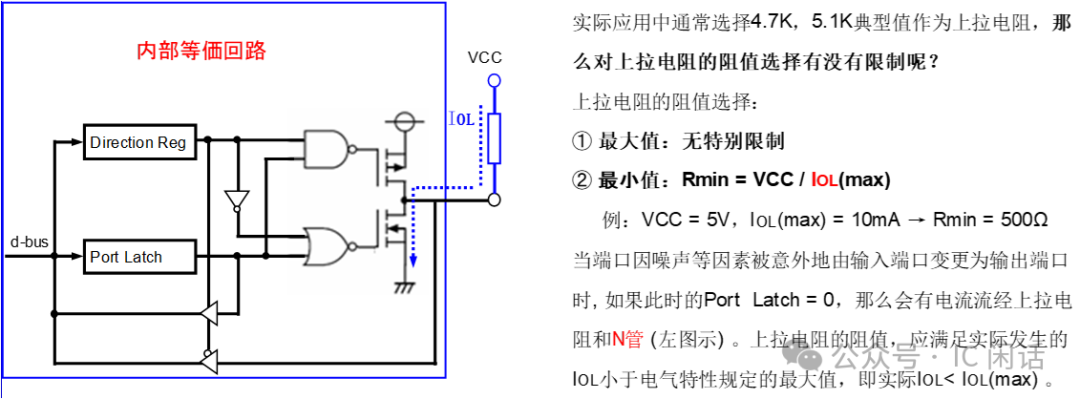 2. Minimum Value Limitation of Pull-Down Resistors:Similar to pull-up resistors, pull-down resistors also have a minimum value limitation, which is also to prevent unexpected factors from causing the I/O port direction to change, leading to overcurrent and damage to the internal MOSFETs.
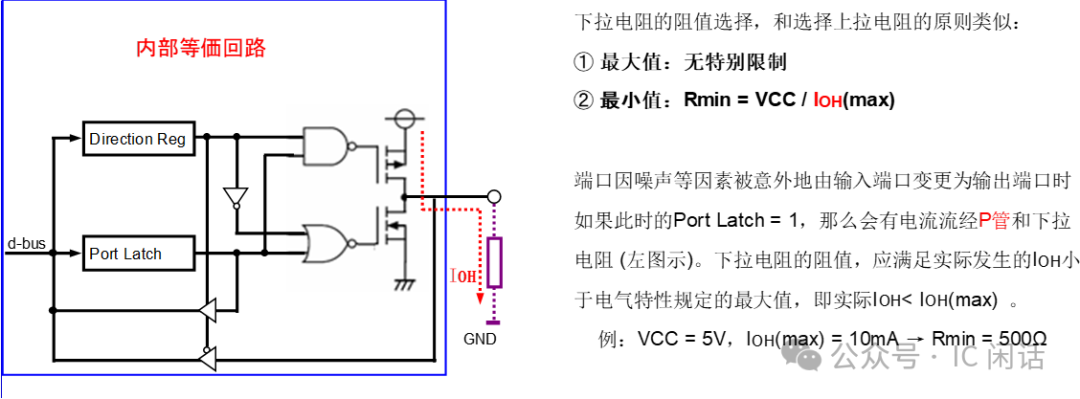 3. Calculation of Built-In Pull-Up Resistor Values:Some MCU models provide internal pull-up resistors for I/O ports, but the datasheet does not specify the value of this internal pull-up resistor. In this case, it is necessary to calculate the value of this internal pull-up resistor based on other electrical characteristic parameters, as shown in the calculation method in the figure below.
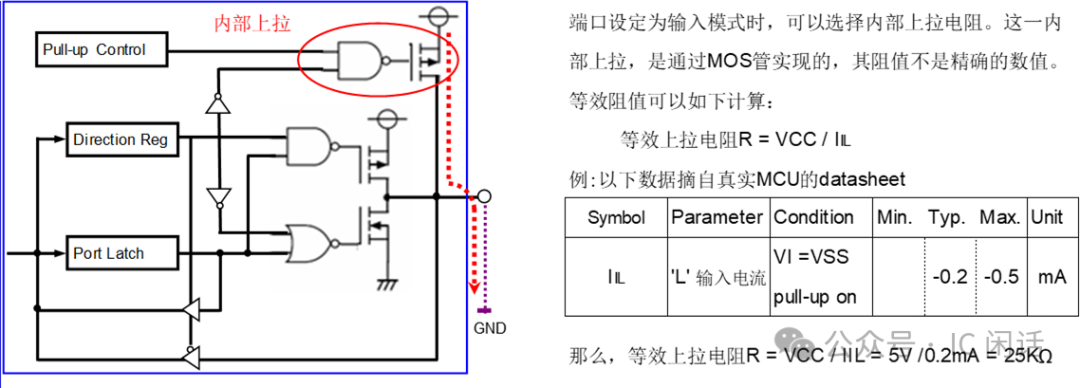 4. Incorrect Application Cases of Pull-Up Resistors:If multiple I/O ports share the same pull-up resistor (as shown in the left example of the figure below), then when two of these ports are unexpectedly altered to output mode due to noise or other factors, if one port’s Port Latch = 1 and the other port’s Port Latch = 0, a large current will flow from VCC through the P-channel and N-channel transistors (as indicated by the red dashed line in the left figure), and prolonged large currents can cause permanent damage to the I/O ports. Therefore, each port needs to use an independent pull-up resistor.
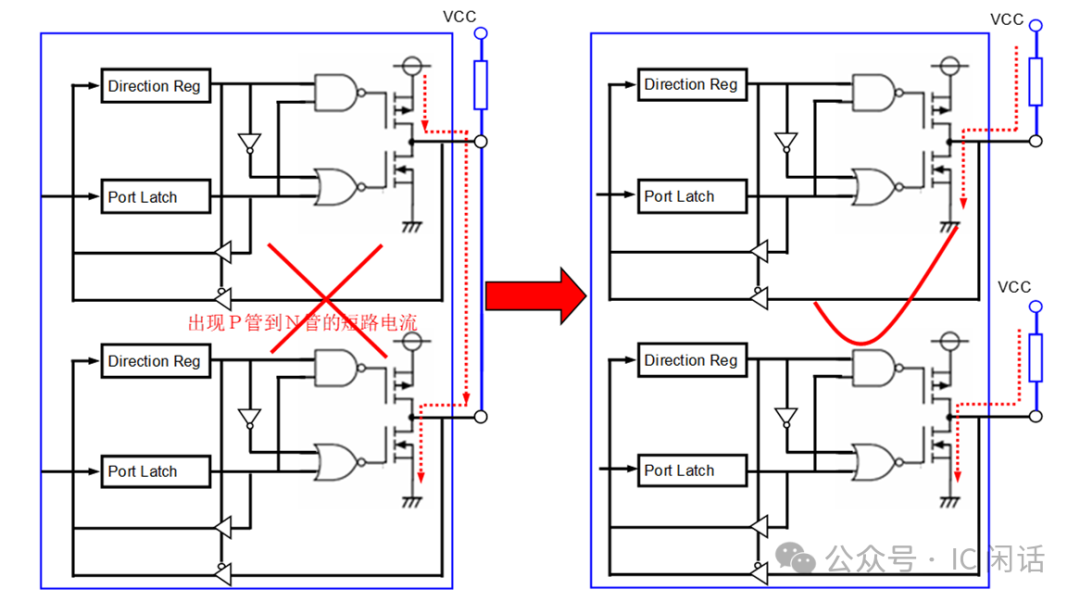 Conclusion:Although I/O is a relatively simple functional unit of the MCU, there are still many details worth noting in actual application development. Details are related to quality. Paying attention to details means paying attention to quality.