The report from Electronic Enthusiasts (by Electronic Enthusiasts) states that 38 years ago, an innovative RISC ISA was born at Stanford University in the United States, leading to the emergence of MIPS. With this project, several founders established MIPS Corporation, which successively launched the R2000 and R3000 microprocessors in the 1980s. Because of this, MIPS caught the attention of Silicon Graphics (SGI), which intended to use the MIPS architecture to build its computers.
However, due to cost constraints, MIPS was unable to compete with large companies in the market and began to fall into a research and development dilemma. In 1992, SGI, optimistic about MIPS, acquired it and supported MIPS in launching several generations of R series processors in the 1990s. MIPS in the 90s managed to make some progress, although it did not surpass x86 in the mainstream market, it achieved over a hundred million CPU sales through home game consoles like PlayStation, PlayStation 2, and Nintendo 64.
However, SGI later decided to abandon MIPS and turned to the development of the IA-64 architecture. Thus, MIPS chose to go for another IPO, and SGI soon completely divested from MIPS. Since then, MIPS’s situation has remained lukewarm, while its old rival ARM began to rise.
In 2013, Imagination stepped in, acquiring MIPS for $100 million, surpassing the offer from competitor CEVA. However, many patents were taken by Bridge Crossing, but fortunately, the core patents remained with MIPS.
When acquiring MIPS, Imagination’s flagship product was still its PowerVR series, and they planned to emulate ARM’s operating model for MIPS. Shortly after the acquisition, although MIPS’s market share in IoT still lagged behind ARM, there were still many opportunities in markets like automotive and data centers. For example, the Mobileye used by Intel before its acquisition was based on MIPS CPU.
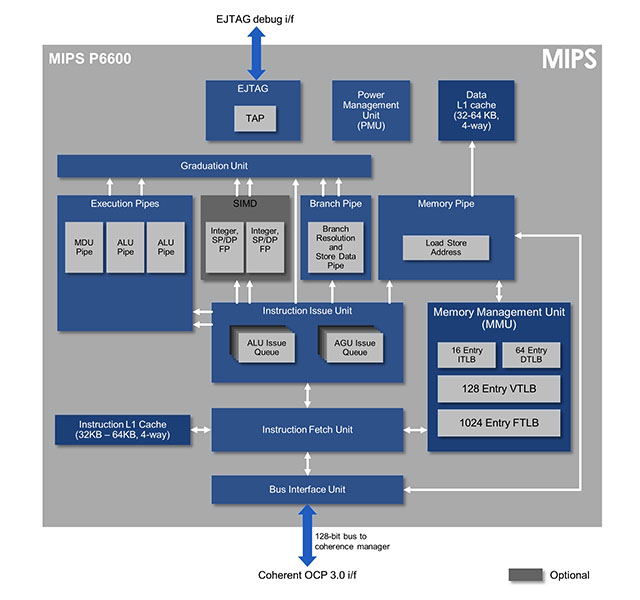
Imagination accelerated the release of MIPS processor cores, especially the Warrior series that supports hardware virtualization, multithreading, and SIMD. Meanwhile, to promote MIPS, Imagination began reaching out to academia, publicizing and explaining the working principles of the MIPS ISA at various universities.
However, good times were short-lived. In April 2017, Imagination’s largest client, Apple, announced it was terminating its partnership, causing the company’s stock price to plummet and plunging it into a difficult situation. Imagination began searching for buyers and ultimately sold itself to Canyon Bridge. MIPS was sold separately for $65 million to Tallwood Venture Capital, until it was acquired by Wave Computing in 2018.
Although Apple later resumed cooperation with Imagination, leading to a revival, MIPS had already parted ways with them. According to publicly available data on LinkedIn at the time, when MIPS was acquired by Wave Computing, the number of employees was even less than 50.
However, after being acquired by Wave Computing, MIPS did not find a better path. Except for the already mature x86, almost every ISA planned to leverage the open-source community to develop its ecosystem, and MIPS was no exception. Shortly after acquiring MIPS, Wave Computing announced the launch of the MIPS Open Initiative, allowing participants to freely use 32-bit and 64-bit MIPS ISA without any licensing or patent fees.
At that time, MIPS chip shipments had exceeded 8.5 billion, and it was following Wave Computing’s plan to advance into AI and next-generation SoC design, aiming to compete directly with companies like NVIDIA, Intel, and Graphcore. The MIPS Open project was set to become another tool for expanding their achievements.
However, shortly after the then-CEO Art Swift left, this initiative was abruptly halted within a year. Wave Computing announced that it would no longer provide free downloads of MIPS architecture, core, IDE tools, FPGA packages, and code. Although Wave Computing would not interfere with existing licenses and previous downloads, they advised developers, partners, and customers not to delve deeper into development, as they would no longer provide any maintenance or support.
Perhaps it was the failure of this initiative that led to the departure of Paul Burton and Ralf Baechle, two MIPS Linux kernel maintainers who had completed many fixes and improvements during their time at MIPS. Soon after, Wave Computing opted to file for bankruptcy protection and restructure its assets, with only a handful of employees left in the China region.
In 2021, Wave Computing completed its bankruptcy restructuring and rebranded as MIPS. However, the reborn MIPS no longer favored the MIPS ISA but chose to join the RISC-V International Foundation, becoming a member of the RISC-V development community and planning to launch solutions based on the RISC-V architecture.
After supporting for over 30 years, even predating ARM, did MIPS really “switch sides”? Today, besides the thriving Arm and RISC-V, the only RISC ISA left with potential is IBM’s Power and Oracle’s SPARC.
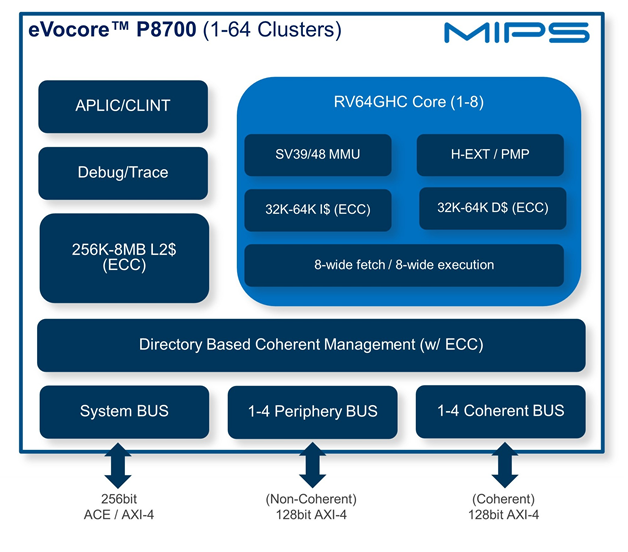
After collaborating with some tool solution providers, MIPS finally made information public again, releasing the RISC-V-based eVocore series CPU IP a year after its restructuring. The first two IPs inherited the naming from the Warrior series, namely the superscalar high-performance eVocore P8700 (16-stage pipeline) and the high energy-efficient eVocore I8500 (9-stage pipeline). Both have extremely high scalability, expandable up to 64 clusters and 512 cores. MIPS stated that it intends to leverage the new RISC-V IP to enter broader markets, including automotive, machine learning, 5G, data centers, storage, and high-performance embedded applications.
Interestingly, not only did MIPS itself choose to fully transition to RISC-V, but people and companies related to MIPS also began to move towards RISC-V. For example, its former CEO Art Swift is now the CEO of another RISC-V company, Esperanto, and even its former parent company Imagination has chosen RISC-V to develop CPUs.
The historical story of MIPS precisely proves the “unpredictability” of the semiconductor market. An ISA that cannot establish a foothold will quickly be eliminated by the market. MIPS’s choice to bet on RISC-V is also based on its potential. After all, compared to other RISC architectures, RISC-V is still in its infancy. Although its foundation is not as solid as Arm and x86, it can learn from past experiences to avoid repeating mistakes.


Disclaimer: This article is original by Electronic Enthusiasts, please indicate the source above. For group discussions, please add WeChat elecfans999,for submission, exposure, and interview requests, please send an email to [email protected].
More Hot Articles to Read
-
IGBT Car Chips Not Accepting Orders! Weilai, Xiaopeng, and Li Auto Layoffs! Can New Car Makers Return to Growth?
-
Electric Flosser Teardown | A 139 Yuan Electric Flosser Costs Only 20 Yuan?
-
Old Tricks? Canada Bans Huawei and ZTE from Participating in 5G Construction on National Security Grounds
-
Known as the “Father of Chinese Semiconductors”! What Has Zhang Rujing Left for the Mainland Chip Industry in 22 Years?
-
AIoT Market Demand is About to Explode! Xiaomi’s AIoT Business Revenue Exceeds 85 Billion, Smart Wearables May Be the Next Top Seller