JTAG interfaces come in 10-pin, 14-pin, and 20-pin configurations. Although the number of pins and their arrangement differ, some pins are common across these configurations. The definitions of each pin are as follows:
1. Pin Definitions
Test Clock Input (TCK) —– Required 1
TCK is mandated by the IEEE 1149.1 standard. TCK provides an independent, fundamental clock signal for the TAP operation, and all TAP operations are driven by this clock signal.
Test Mode Selection Input (TMS) —– Required 2
The TMS signal is valid on the rising edge of TCK. TMS is required by the IEEE 1149.1 standard. The TMS signal is used to control the transitions of the TAP state machine. Through the TMS signal, the TAP can be controlled to transition between different states.
Test Data Input (TDI) —– Required 3
TDI is mandated by the IEEE 1149.1 standard. TDI is the data input interface. All data to be input into a specific register is serially input one bit at a time through the TDI interface (driven by TCK).
Test Data Output (TDO) —– Required 4
TDO is mandated by the IEEE 1149.1 standard. TDO is the data output interface. All data to be output from a specific register is serially output one bit at a time through the TDO interface (driven by TCK).
Test Reset Input (TRST) —- Optional 1
This signal interface is optional according to the IEEE 1149.1 standard and is not mandatory. TRST can be used to reset (initialize) the TAP Controller. Since the TAP Controller can also be reset (initialized) through TMS, there is a distinction between four-wire JTAG and five-wire JTAG.
(VTREF) —– Required 5
The reference voltage for the interface signal level is generally directly connected to Vsupply. This can be used to determine the logic level used by the ARM JTAG interface (e.g., 3.3V or 5.0V?).
Return Test Clock (RTCK) —- Optional 2
An optional signal that is fed back from the target to the emulator, used to synchronize the generation of the TCK signal. If not used, it should be grounded.
System Reset (nSRST)—- Optional 3
An optional signal connected to the system reset signal on the target board, which can directly reset the target system. It can also detect the reset status of the target system; to prevent false triggering, an appropriate pull-up resistor should be added on the target side.
USER IN: User-defined input. Can be connected to an IO to receive control from the host computer.
USER OUT: User-defined output. Can be connected to an IO to provide feedback on a status to the host computer.
Since JTAG is often connected using ribbon cables, to enhance anti-interference capability, ground lines are added between each signal line, resulting in this 20-pin interface. However, in practice, RTCK, USER IN, and USER OUT are generally not used, leading to the existence of a 14-pin interface. For actual development applications, due to stable laboratory power supply and good electromagnetic environment, interference is minimal.
2. Correspondence of Pin Names and Numbers for 20, 14, and 10-pin JTAG
It is worth noting that different IC companies define their own proprietary JTAG headers for downloading or debugging programs. The signal arrangements for the commonly used 20, 14, and 10-pin JTAG in embedded systems are as follows:
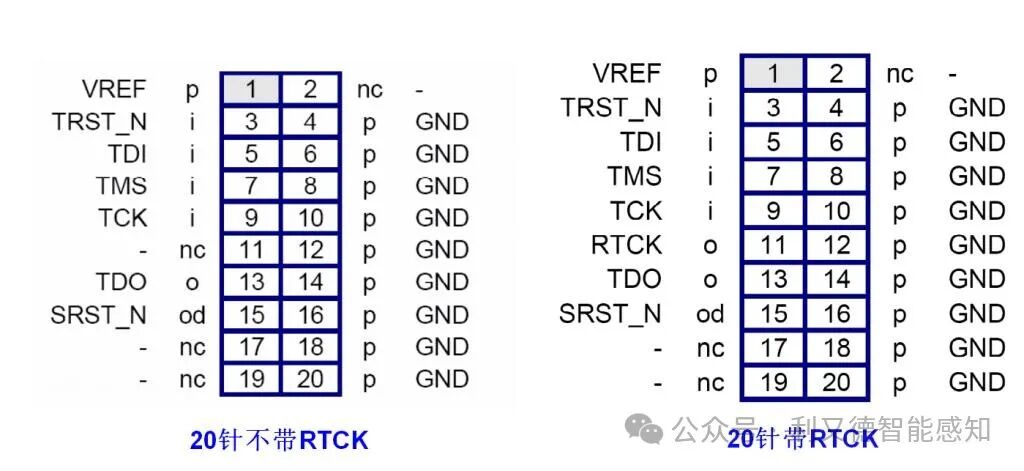
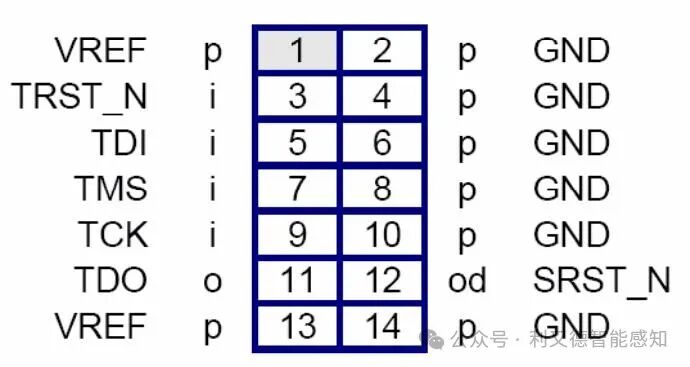
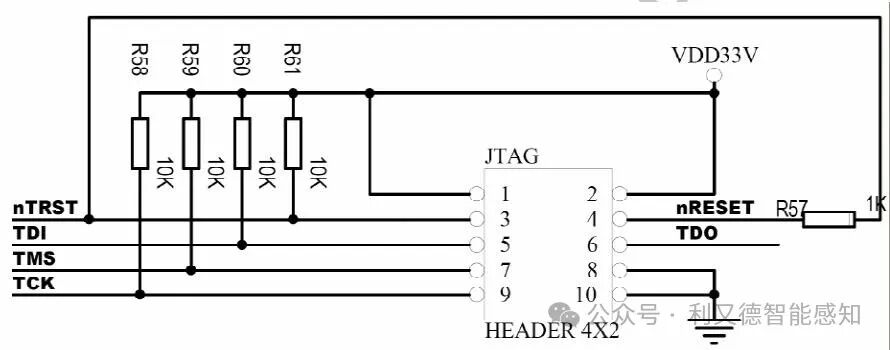
It should be noted that the pin names of the above JTAG headers are defined in relation to the IC. For example, the TDI pin indicates that this pin should be connected to the TDI pin on the IC, rather than indicating that data enters the download cable from this pin.
In fact, only 4 wires need to be connected for the 10-pin configuration; pin 4 is a self-loop and does not need to be connected. Pins 1 and 2 are both connected to pin 1, while pins 8 and 10 are connected to GND, which can also be left unconnected.

Wuhan Li You De Technology Co., Ltd.
TEL:027-83621617
CAL:13296589910