☞ This is the 7126 article published by Metal Processing (mw1950pub)

Introduction
Smartphones have become a part of almost everyone’s life, and their functions have far exceeded those of mere communication tools, encompassing gaming, socializing, payments, shopping, travel, maps, and more. The manufacturing process of smartphones is also very precise. Take the smartphone screen we see, for example; it consists of several layers. So how many layers are there? How are they assembled? Let’s take a look at today’s content:
The smartphone screens we typically use are made up of multiple layers of glass and electronic components that sense and process information. What role do these glasses play?
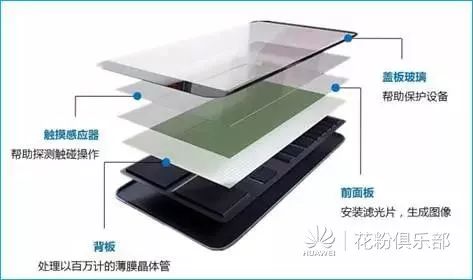
The top layer is the cover glass, primarily composed of silicon dioxide (SiO2). The hardness of glass on the Mohs scale is 6.5, serving to protect the internal structure of the phone. However, this layer is the most prone to scratches, causing many smartphone enthusiasts great distress. Therefore, many of them prefer to apply a protective film on top, which is made of plastic film, specifically polymer material. Currently, there are four main materials used for smartphone screen protectors: PP material, PVC material, PET material, and ARM material. The cover glass for smartphones on the market is mainly produced by Corning’s Gorilla Glass, while Lens Technology, which started with glass processing, has also created a market development myth.
Currently, sapphire materials have emerged as a replacement for glass materials. The Apple Watch uses sapphire materials. Sapphire is mainly composed of aluminum oxide (Al2O3) and is a single crystal material with a Mohs hardness of 9, making it the hardest material after diamond. In terms of scratch resistance, it has advantages over glass. However, sapphire still has technical disadvantages, such as poor toughness. Toughness differs from hardness; in simple terms, it refers to a material’s ability to resist crack propagation.
Indeed, at present, sapphire is still not a perfect substitute for glass. However, in the past two to three years, the cost of sapphire has significantly decreased. Additionally, the more mature manufacturing process has enabled sapphire screens to meet certain production requirements, contrary to rumors that “the yield rate is extremely low, making mass production difficult.” Perhaps a layer of sapphire film through CVD or PVD on the glass surface can combine the advantages of both glass and sapphire while solving the issue of “hard and brittle.”
The second layer is the touch sensor layer, which is primarily divided into resistive and capacitive types, with the main function being to detect touch operations. The touch sensor layer currently used is mainly coated with a layer of ITO (indium tin oxide) on glass through magnetron sputtering technology. It is a mixture of indium (III group) oxide (In2O3) and tin (IV group) oxide (SnO2), typically with a mass ratio of 90% In2O3 to 10% SnO2.
Currently, graphene is the most likely candidate to replace ITO as the mainstream material for touch screens. Graphene is the thinnest and hardest known nanomaterial in the world, and it is almost completely transparent, with a light transmittance of 97.7%. Its thermal conductivity reaches 5300 W/m·K, higher than that of carbon nanotubes and diamonds. At room temperature, its electron mobility exceeds 15000 cm2/vs, which is higher than that of carbon nanotubes or silicon crystals, and its resistivity is only about 1 Ω·m, lower than that of copper or silver, making it the material with the lowest resistivity in the world. Due to its extremely low resistivity and fast electron mobility, it is expected to be used to develop thinner and faster new generation electronic components or transistors.
Its advantages are mainly reflected in:
(1) The screen image is more realistic. The graphene touch screen supported by a graphene film has a light transmittance of 97.7%, better transparency, and thus more realistic and pure colors. Traditional smartphone screens have a light transmittance of around 95%, which can make the image appear yellowish in sunlight, but graphene is almost completely transparent, ensuring that smartphone screens do not show color bias and produce clearer images.
(2) Graphene has high electrical conductivity, which is very useful for touch screen smartphones, as graphene smartphones exhibit high sensitivity in multi-touch operations.
(3) Graphene has high flexibility, and in the future, it can achieve curved displays. It is not only ultra-thin and ultra-light but can also be bent to nearly 180° in hand. Smartphones assembled with such screens will be lighter while having higher toughness, providing shock resistance and drop protection.
The third layer is the front panel, which mainly installs the optical filter to generate images.
The bottom layer is the back panel, which processes millions of thin-film transistors.
Next, let’s go into the factory to see how smartphone displays are assembled:
Video materials, best viewed on Wi-Fi
-End-
☞ Source: Crazy Technology, Pollen Club ☞ Edited by: Qinghe ☞ Business Cooperation: 010-88379864
Statement: If there are any copyright issues with the videos, images, or text used in this article, please inform us immediately, and we will confirm copyright based on the proof materials you provide and pay remuneration according to national standards or immediately delete the content!
Statement: If there are any copyright issues with the videos, images, or text used in this article, please inform us immediately, and we will confirm copyright based on the proof materials you provide and pay remuneration according to national standards or immediately delete the content!

Hot News
Discussion: Promotion and wealth, please go elsewhere? Senior technicians deserve higher salaries!
Focus: 5000 Xiaomi employees will receive a house in Beijing’s second ring road
Technology: Do you really fully understand surface roughness?
Hot Topic: The first batch of ‘Post-00s’ has already started working in factories
Useful Information: Common Calculation Formulas in CNC Machining
Metal Processing APP
(☞ Click Download)