October 19, 2004, is a special day that may not mean much to most people. However, if you are part of the embedded community, you know that the microcontroller (MCU) industry underwent a revolutionary change on this day. ARM® released the first Cortex®-M processor, bringing the advantages of a general-purpose architecture to the microcontroller market.
Embedded developers quickly embraced the Cortex-M series processors due to their intuitive programmer model, excellent performance, and outstanding energy efficiency. This processor combines ease of use with extensive ecosystem support, accelerating innovation in the embedded industry and significantly expanding the use cases for microcontrollers. These compact MCUs based on Cortex-M are now ubiquitous, bringing invisible intelligence and enhanced functionality to the devices we use today. A decade later, most MCU and embedded device manufacturers adopted this industry standard, producing a total of 22 billion Cortex-M based devices.
 Implementing Embedded Intelligence on Cortex-M Based Devices
Innovation Requires Secure and Standard Platforms
Innovation never stops, and new challenges are emerging. Providing security for an increasing number of connected devices has become crucial, including protecting the confidentiality, functionality, and integrity of their data, as well as their connections from infrastructure to the cloud. This security not only needs to leverage proven best practices to meet extremely high standards but must also be simple to use and easy to program, minimizing the risk of misuse. The last important element for successful deployment is that this innovation needs to be built on industry-standard platforms to ensure broad ecosystem support and form a large developer community, thereby creating a diverse range of devices and accelerating the development of various IoT vertical markets.
Ensuring the security of connected devices is a well-known challenge and a significant opportunity for ARM. Currently, over 10 billion Cortex-A chips are used in various mobile devices, utilizing ARM TrustZone® technology to protect the trusted root from potential malicious software. ARM has assigned some of the most talented engineers to optimize this security foundation and transfer it to the new version of the M architecture. These engineers have achieved this goal, ensuring that this security foundation fits the various strict constraints of embedded environments:
• Real-time requirements, needing quick transitions between different security states
• Determinism
• Also requiring high energy efficiency.
The R&D achievement ARMv8-M architecture was successfully launched last year at the 2015 ARM TechCon, which brings advanced software isolation capabilities to the smallest processors and devices using ARMv8-M specific ARM TrustZone technology.
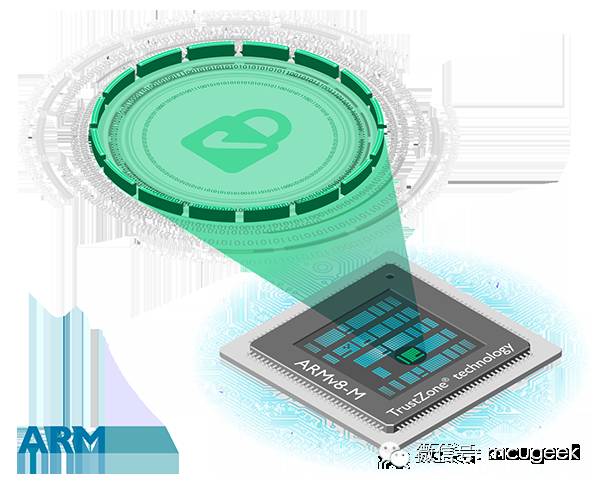 Expanding TrustZone to ARMv8-M Architecture to Ensure Security for Minimal Devices
Introducing Cortex-M23 and Cortex-M33
Today, I am very pleased to announce the release of two new ARM Cortex-M processors based on TrustZone technology. They are: Cortex-M23, based on the baseline ARMv8-M, suitable for most fields and applications with strict power requirements, and Cortex-M33, based on the mainstream ARMv8-M, suitable for high-performance systems. Both products feature ARM TrustZone technology as their security foundation and provide a simpler and easier-to-use MPU programmer model that can limit the visibility of debugging, thereby ensuring the confidentiality of software. The concept of security is holistic, transcending the boundaries of the processor and encompassing the entire system: bus/interconnect, memory, and peripherals, thus allowing the processor’s security state to be exported throughout the system using the AMBA® AHB5 standard.
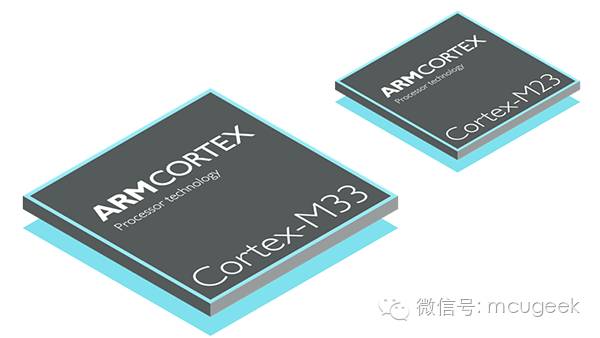 ARM Cortex-M33 and Cortex-M23 with Built-in TrustZone Security Technology
Connected devices built on Cortex-M23 or Cortex-M33 chips will benefit from the protection offered by the trusted world to perform functions that are critical for security, such as secure boot, cryptography, identity and key management, supply and device updates. In the conventional world of processors, the operation of guest applications and non-secure services is similar to that of previous Cortex-M based devices. TrustZone will allow these applications and services to access the security features of the trusted world while ensuring that secure resources are not misused, damaged, or inspected by guests. Notably, due to the forward compatibility of the programmer model, applications written for existing Cortex-M processors will run in the non-secure world of Cortex-M33 and Cortex-M23 without realizing they are running on ARMv8-M based processors. Experienced Cortex-M developers will feel familiar and can quickly transition existing applications to the new generation of microcontrollers.
Accelerating Development Speed
In addition to TrustZone and associated security features, these two processors also bring additional functionalities of ARMv8-M baseline and mainstream. They provide chip designers and software developers with a more consistent interface and features, such as: debugging, memory sharing, and pure execution memory support, as well as a higher interrupt count limit. In summary, all of these make system design and software development more scalable and efficient, which is crucial for the development of billions of IoT nodes.
Many partners have worked with us to define and develop these brand new processors, actively designing chips using the same standard TrustZone security technology. At the 2016 ARM TechCon, we were very excited to see seven of these partners launch products with us.
 Most of the world’s top ten MCU suppliers have been authorized for one or both of these two products
The ARM ecosystem has begun to focus on porting tools, RTOS, and firmware to prepare for the arrival of the first chips. Many ecosystem partners will showcase how their products fully leverage the ARMv8-M architecture and how the Cortex-M23 and Cortex-M33 processors will unleash new capabilities at the ARM TechCon.
 The leading global ecosystem has migrated to ARMv8-M
Does the launch of Cortex-M23 and Cortex-M33 mark another breakthrough in the embedded field? Perhaps only when billions of devices are released in a few years can we assert that. However, our current main focus is to work closely with ARM partners to provide excellent development elements for a wide range of developers and makers, allowing their creativity and vision to drive the world towards a more connected, intelligent, and secure future.
Stay updated on the latest news and related technical applications in MCU development, share insights on MCU innovative design, and connect with MCU development experts!

For more information, please feel free to contact us