In the digital age, data security has become a core issue that cannot be ignored by businesses and individuals. As the cornerstone of information security, cryptographic algorithms are widely used in areas such as email, network communication, digital signatures, and digital rights management. This article will start from the basic principles of cryptographic algorithms, deeply analyze their classifications, key technologies, and practical application scenarios, supplemented by rich examples to help readers comprehensively understand the system of modern cryptography.
1. Basics of Cryptography: The Four Pillars of Securing the Digital World
Cryptography is not just about “encryption”; it is one of the core technologies of information security that supports the trust system of the digital world.
1. Objectives
- Confidentiality: Prevent unauthorized access to data. For example, WeChat chat records are secured through end-to-end encryption, ensuring that only the sender and receiver can see the content.
- Integrity: Ensure that data has not been tampered with. Git uses the SHA-1 hash algorithm to verify the integrity of code submissions.
- Authentication: Confirm the identities of both parties. Two-factor authentication during system login is an example of an authentication mechanism.
- Non-repudiation: Prevent the sender from denying having sent the information. Digital signatures in electronic contracts are a typical application.
2. Common Terms
- Key Space: The number of possible combinations of keys, determining the difficulty of cracking; for example, the key space of AES-256 is 2 to the power of 256,which is virtually impossible to exhaustively search.
- One-way Function: Cannot reverse the input from the output.
- Nonce: A random number used to increase the difficulty of cracking; a one-time random number is used to prevent replay attacks.
- Zero-Knowledge Proof: Prove a fact without revealing information; the Zcash blockchain uses this technology.
- Secret Sharing: Operations require collaboration among multiple parties to enhance security. For example, the dual-key mechanism for bank vaults requires two people to operate simultaneously to unlock.
- Cost Function: Measures the resource cost required to crack the system.
2. Classification of Cryptographic Algorithms
1. Symmetric Encryption
Uses the same key for both encryption and decryption, fast, suitable for large-scale data processing. For example,internal file transfers in enterprises use AES-256 encryption to ensure sensitive data is not leaked; BitLocker uses AES to encrypt hard disk data.
Common algorithms include:
- DES / 3DES: Early standards that have been phased out.
- IDEA / Blowfish / Skipjack: Each has its characteristics, suitable for different scenarios.
- AES: The current mainstream standard, supporting 128/192/256-bit keys, widely used in BitLocker, TLS, etc. Encryption modes such as ECB, CBC, CFB, OFB, CTR, etc., determine how data blocks are processed.
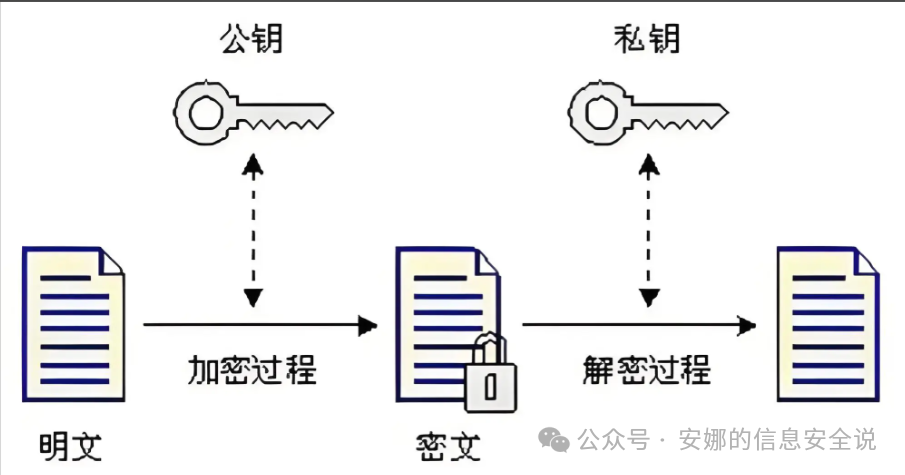
2. Asymmetric Encryption
Uses a pair of keys (public key and private key), suitable for authentication and digital signatures. For example,GitHub uses SSH public key authentication to verify developer identities; HTTPS websites use RSA for secure communication.
Representative algorithms:
- RSA: Based on the difficulty of factoring large prime numbers.
- DSA / ElGamal: Based on discrete logarithms.
- ECC: Elliptic curve cryptography, short keys but high security.
3. Comparison of Symmetric and Asymmetric Algorithms
| Characteristics | Symmetric Encryption | Asymmetric Encryption |
|---|---|---|
| Key Type | Single shared key | Public-private key pair |
| Encryption Speed | Fast (1000-10000 times) | Slow |
| Amount of Data Encrypted | Large volumes | Small blocks of data |
| Security | Confidentiality | Confidentiality, integrity, authentication, non-repudiation |
| Number of Keys | n(n-1)/2 | 2n |
3. Hash Functions and Digital Signatures
1. Hash Function
Used to verify data integrity, possessing one-way and collision resistance properties. For example,when downloading software, a SHA-256 checksum is provided, allowing users to verify whether the file has been tampered with; JWT uses HMAC-SHA256 for signature verification.
Common algorithms include:
- SHA Series: SHA-1, SHA-2 (256/512), SHA-3. Widely adopted by governments and financial institutions.
- MD Series: MD2, MD4, MD5 (no longer secure). Still used in non-secure scenarios such as file verification.
- HMAC: A hash algorithm combined with a key to enhance security.
2. Digital Signatures
Achieve non-repudiation and integrity verification. For example, digital signatures are used in corporate contracts to ensure the authenticity of the signatory. Blockchain transactions use signatures to verify the legality of transactions.
Standards include:
- FIPS186-4 DSA
- ANSI X9.31 RSA
- ECDSA (Elliptic Curve Digital Signature)
4. Key Management: The Core of Security
Key management is the “lifeline” of encryption systems; key generation, distribution, storage, and destruction determine the security of the system.
1. Symmetric Key Management
- Distribution methods: Offline distribution, public key encryption, Diffie-Hellman protocol.
- Storage recommendations: Separate keys from data, using the secret sharing principle, such as the dual-key mechanism for bank vaults.
- Lifecycle management: Regularly change keys, using SSL/TLS protocols to ensure transmission security.
2. Asymmetric Key Management
- It is recommended to use hardware security modules (HSM) for key management to prevent leakage.
- Cloud service providers such as AWS and Alibaba Cloud offer cloud-based HSM services.
- It is advisable to regularly rotate keys and maintain audit records.
5. Cryptographic Attacks and Protections
1. Common Attack Methods:
- Brute Force Attack: Exhaustively testing all key combinations.
- Rainbow Table Attack: Matching pre-computed hash values.
- Man-in-the-Middle Attack: Intercepting communication and impersonating identities.
- Replay Attack: Re-sending intercepted information.
2. Protective Measures:
- Salting: Adding random values to passwords to prevent rainbow table attacks.
- Using HTTPS / TLS1.3: Preventing man-in-the-middle attacks.
- Setting Expiration Times / Using One-Time Tokens: Preventing replay attacks.
6. Trends in Modern Cryptography
As the digitalization process accelerates, information security is no longer a topic exclusive to technical personnel; it is a core issue that every business and user must pay attention to. Cryptographic algorithms serve as a “moat” for ensuring data security, playing an irreplaceable role in areas such as email, financial transactions, cloud storage, and blockchain.
In the future, with the development of quantum computing, traditional cryptographic algorithms will also face new challenges. We need to continuously learn and update our understanding to remain competitive in the wave of technology.
👉Follow us to stay updated!
Please open in the WeChat client