If you are a long-time Python user, you are certainly familiar with the term “performance bottleneck.” Issues like ineffective multithreading, low efficiency in heavy computations, and relying on C extension packages to barely maintain performance often lead to both love and frustration. However, the emergence of Codon may truly address these longstanding challenges.
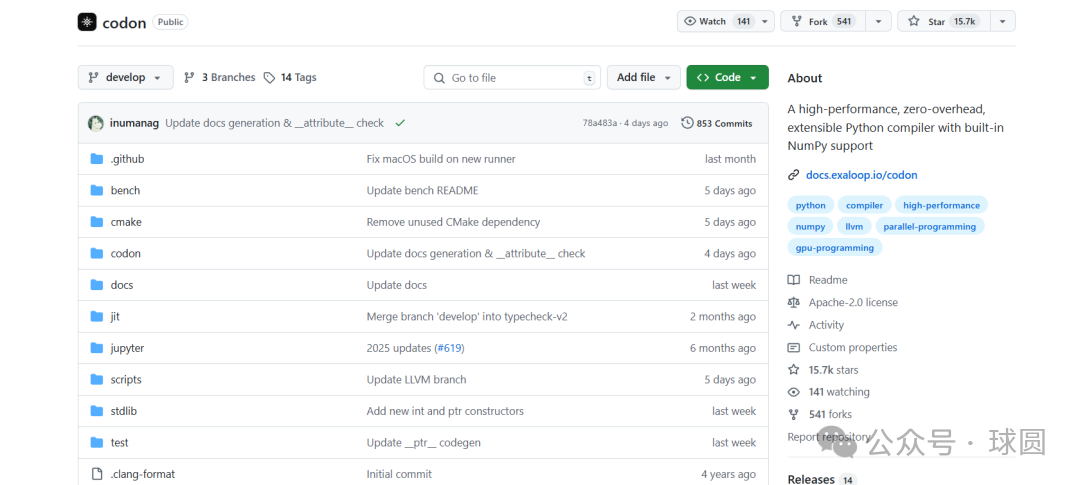
Codon is a brand new static compiler that can directly compile Python source code into native machine code, eliminating the reliance on CPython’s interpretation.
What are the results? In the words of the official documentation, the execution speed is typically 10 to 100 times faster than CPython, and in certain scenarios, it can even match or exceed C/C++. The key point is: you hardly need to change the way you write code.
Why is Codon Worth Trying?
Performance Explosion: Codon’s biggest selling point is speed! It does not rely on JIT or external compilation libraries; instead, it generates optimized machine code directly from Python code, achieving astonishing execution efficiency.
Native Multithreading: Without the GIL (yes, the pain you feel), Codon can achieve true parallel computing, automatically parallelizing loops with a single OpenMP annotation, resulting in a significant efficiency boost.
High Syntax Compatibility: The vast majority of Python syntax can run without needing to learn a new syntax or write additional type declarations like with PyPy or Cython.
Native GPU Support: By simply writing a <span><span>@gpu.kernel</span></span> decorator, you can offload functions to run on the GPU, such as calculating the Mandelbrot set or training neural networks.
Let’s Look at Performance Results
For a simple example, calculating the 40th Fibonacci number. The Python version takes 18.5 seconds, while Codon only takes 0.27 seconds. This is almost a “kill in seconds” level of difference.
Now, for a parallel example, a single annotation achieves multithreading:
@par(schedule='dynamic', chunk_size=100, num_threads=8)
for i in range(2, limit):
    if is_prime(i):
        total += 1
Automatically handles atomic operations and reductions in the background, no need to manually write locks!
What Are the Drawbacks?
Pros and Cons Comparison
| Feature | Advantages | Disadvantages |
| Performance | Static compilation + multithreading + GPU, 10–100× acceleration across platforms | Some dynamic features of Python (like runtime exec) are not supported |
| Compatibility | Syntax is almost identical to CPython, libraries can be interchanged | Not a complete drop-in replacement, requires minor adjustments |
| Learning Curve | No new syntax, mastering Python is sufficient | Parallel and GPU syntax requires additional understanding |
| Toolchain | Includes optimization framework, LLVM IR export, supports various levels of tuning | The community ecosystem is still developing, and documentation can sometimes be a bit scattered |
Codon is not just an accelerator; it redefines the notion that “writing Python can also be fast.” You don’t have to give up familiar syntactic sugar, worry about the GIL or performance bottlenecks, or rely on various C extensions for performance patches.
It may be the key to high-performance computing in Python for developers who need to maintain development efficiency while also requiring computational power. Codon is worth trying out right now.