On the evening of August 11, 2025, researcher Xu Cao from the Institute of Genetics and Developmental Biology, Chinese Academy of Sciences, led a smart breeding team to publish a research paper titled “Engineering crop flower morphology facilitates robotization of cross-pollination and speed breeding” in the journal Cell.
This study deeply integrates biotechnology (BT) and artificial intelligence (AI), proposing the concept of crop-robot co-design for the first time. By using gene editing to redesign crop flower morphology, the team rapidly and accurately created a “robot-friendly” structural male sterile line. They successfully developed the world’s first intelligent breeding robot, “GEAIR” (Genome Editing combined with AI-based Robotics), capable of automatic cross-pollination, breaking through the bottlenecks in hybrid breeding and seed production, significantly reducing breeding costs, shortening breeding cycles, and improving breeding efficiency (Figure 1).
The researchers integrated the robot breeding technology with next-generation breeding techniques such as de novo domestication and breeding accelerators,creating for the first time an “intelligent robot breeding factory”, achieving intelligent rapid customization of superior varieties(Figure 1).Applying the “GEAIR” system to soybeans, the team successfully created a structural male sterile line in soybeans for the first time, which is expected to lead to breakthroughs in soybean hybrid breeding in China, significantly increasing yield, providing a new generation of intelligent breeding technology and equipment with asymmetric advantages(Figure 1).This research opens up the “BT foundation + AI empowerment + robot (Robot) labor” intelligent breeding(BAR) model, marking China’s first completion of an independent intellectual property intelligent robot breeding closed-loop technology system, demonstrating significant application prospects for “AI for Science” in the innovation of biological breeding paradigms and the generation of new productive forces.
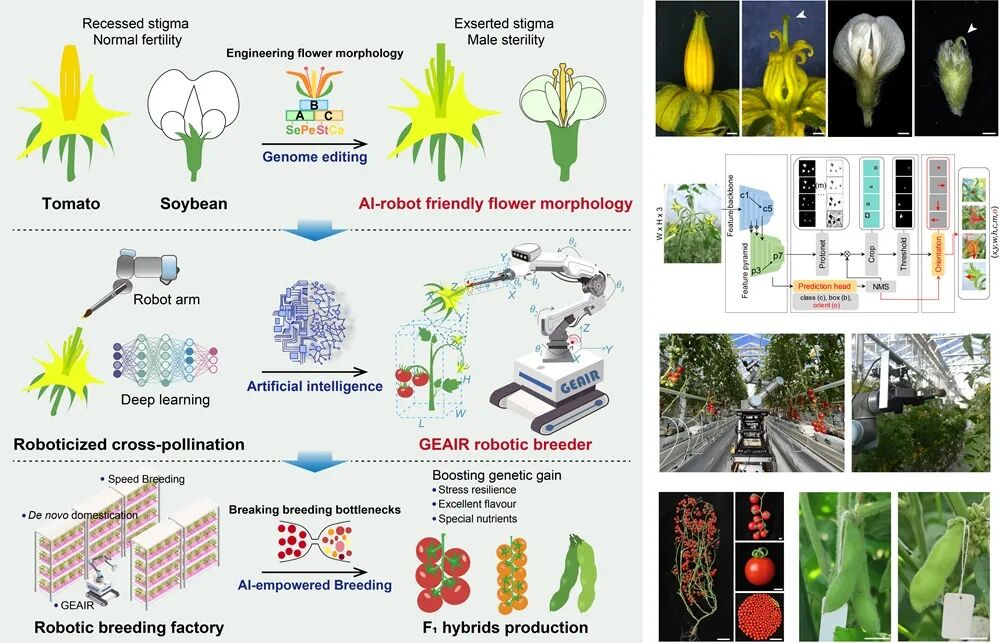
Figure 1. Reshaping crop flower morphology and achieving intelligent automated hybrid breeding through AI robot co-design
Reviewers of the journal Cell highly praised this research,calling it an exciting innovative breakthrough and a model for solving major scientific and industrial problems through the intersection of BT and AI, with broad application prospects.The technologies related to the creation of the above structural male sterile lines and intelligent breeding robots have applied for national patents and PCT international patents. The smart breeding team led by researcher Xu Cao is working on integrating BT and AI throughout the entire industry chain of “breeding – production – harvesting – traceability,” developing the robot breeder “GEAIR 2.0” and expanding the application of structural male sterile lines to different crops.
This achievement was made by a multidisciplinary team composed of the Institute of Genetics and Developmental Biology, Chinese Academy of Sciences, the Institute of Automation, Chinese Academy of Sciences, Shanghai Jiao Tong University, and Tsinghua University.
Background Knowledge
The utilization of hybrid vigor has made significant contributions to increasing crop yields and ensuring food security.In 1973, Mr. Yuan Longping proposed the hybrid breeding technology route of “three-line matching” for rice based on the naturally male-sterile wild rice “wild abortive,” applying the theory of hybrid vigor on a large scale to self-pollinating rice, cultivating high-yield hybrid rice varieties. This breakthrough laid the foundation for the research and promotion of hybrid rice in China. Hybrid varieties exhibit excellent performance in growth vigor, viability, fertility, and consistency, and are an indispensable part of modern agriculture.By 2024, the global hybrid seed market is expected to reach 383 billion yuan, and it is projected to reach 590.4 billion yuan by 2029; in 2024, the global market value of hybrid tomato seeds is expected to be 8.54 billion yuan, projected to reach 15.05 billion yuan by 2030【1】. However, the high costs and low efficiency of hybrid breeding and seed production have become significant bottlenecks restricting the utilization of hybrid vigor.
Hybrid breeding and seed production typically require the removal of the male parts from the maternal flower, followed by the application of paternal pollen to the stigma of the maternal flower. This entire process relies on skilled workers operating within a short window of time before the flowers bloom. Hybrid breeding requires repeating this operation with different parents, while hybrid seed production involves large-scale repetition with fixed parents, which is time-consuming and labor-intensive. For example, hybrid seeds account for over 90% of commercial seeds in tomatoes, but due to the closed flower morphology with retracted stigmas, global tomato hybrid breeding and seed production still entirely depend on manual labor, with labor costs accounting for over 25% of the total breeding costs for tomatoes, and the manual emasculation alone accounting for 40% of the hybrid pollination costs【2-4】. With the aging population, the labor costs for hybrid seed production are rising year by year. More importantly, some crops with closed flower morphologies cannot utilize hybrid vigor due to the high costs of hybrid seed production.Hybrid soybean seeds have over 30% yield potential, but the highly closed flowers of soybeans make hybrid pollination operations extremely difficult, preventing hybrid seed production【5】.Structural male sterile lines with exposed stigmas can eliminate the above operations and have always been a sought-after trait in hybrid breeding and seed production.
Structural male sterile lines can be obtained from natural variation populations or through large-scale genetic mutation and screening of specific breeding parents, butthese methods are not only difficult and time-consuming,but often unpredictable, and even if a sterile line is obtained, it only exists within a specific genetic background, requiring years of hybridization to be applied to other materials. With the rapid development of gene editing technology, researchers have begun to attempt to edit genes regulating pollen fertility and style elongation separately,trying to combine pollen sterility traits and style elongation traits to produce exposed stigma-type male sterile lines, but have not yet succeeded.
Researcher Xu Cao’s smart breeding team took a different approach, using gene editing to target the MADS-box gene GLO2, which specifically regulates stamen development in the ABC model genes of tomato floral organs,causing the originally closed stamens to split and become sterile, allowing the stigma to naturally expose without elongation, successfully creating a structural male sterile line, ending the long-standing lack of exposed stigma-type male sterile lines in tomato breeding, paving the way to eliminate cumbersome manual hybrid pollination operations and improve the efficiency of tomato hybrid breeding and seed production while reducing breeding costs.
To accurately create structural male sterile lines without affecting tomato fruit yield and seed quality, the team precisely edited the non-coding region of GLO2 (introns and 3′ UTR), achieving a redesign of flower morphology.(1) Precise micro-adjustments instead of complete knockout: Targeting the second intron and 3′ UTR region of the GLO2 gene, a series of structural variations were created, resulting in stamens that split and are completely sterile, with exposed stigmas.(2) No impact on fruit yield and seed quality: The edited plants did not affect flowering time, plant height, inflorescence structure, and other basic traits. After manual pollination, the fruit set rate, single fruit weight, and 100-seed weight and germination rate of the male sterile plants were unaffected.(3) Free from genetic background limitations, with universal applicability: The target sequence of GLO2 is highly conserved in 512 different tomato varieties. Using the same gene editing vector, gene structural variations and exposed stigma phenotypes can be rapidly reproduced in different tomato varieties, breaking through genetic background limitations.
The industrial revolution is often accompanied by agricultural revolutions, profoundly influencing trait selection preferences and agricultural biological breeding paths. For example, mechanical and chemical technologies have promoted the breeding of semi-dwarf wheat suitable for mechanical harvesting and fertilization, leading to the first green revolution【6. Artificial intelligence technology is driving a new round of industrial revolution and profoundly influencing the paths and directions of agricultural biological breeding,and the deep integration of biotechnology and artificial intelligence is expected to promote a new round of green revolution.Seeds are the source of agricultural revolutions, and innovations in breeding technology and variety upgrades are the core driving forces of green revolutions. The emergence of exposed stigma-type male sterile lines has removed the greatest obstacle to the use of artificial intelligence robots for hybrid pollination operations, making it possible for robots to replace humans in intelligent automated hybrid breeding and seed production.
Achieving robotic hybrid pollination is not an easy task and requires overcoming three technical barriers. First is interference elimination: Flowers are mixed with leaves, branches, etc., and their orientations are variable and unpredictable, requiring not only flower recognition but also interference elimination and accurate positioning of flower directions. Second is recognition accuracy: Flowers and stigmas are small, making recognition difficult. Traditional algorithms struggle to locate small stigmas in complex backgrounds in real-time, and millimeter-level accuracy is a prerequisite for successful pollination. Finally, the operation force: The stigma can only withstand gentle, brief touches; excessive force can cause injury or breakage, preventing fruit set.
Researcher Xu Cao collaborated with Associate Researcher Yang Minghao from the Institute of Automation, Chinese Academy of Sciences, to train and test flower positioning, segmentation mask marking, and stigma orientation detection using 12,800 images. They trained the YOLACT_Orient deep learning neural network model, achieving a flower detection accuracy of 82.0%, with a single-frame inference time of only 0.06 seconds. Using a pseudo-stereo distance measurement strategy, they calculated the 3D coordinates of the stigma through SURF feature matching and RANSAC algorithms, controlling the positioning error within 7.67 mm, with a calculation time of 0.045 seconds. Finally, a spiral servo pollination strategy combined with a lightweight neural network ensured that pollen could be accurately and gently delivered to the stigma surface, avoiding damage and ensuring a high pollination success rate. Based on artificial intelligence algorithms, the team developed an intelligent pollination robot that has been stably operating in commercial production greenhouses,with stigma recognition accuracy reaching 85.1%, taking only 15 seconds to pollinate a flower, achieving a success rate of 77.6% ± 9.4% for single cruise pollination, and the robot can continuously perform repeated cruise automated hybrid pollination to ensure successful fruit set for every flower. The localization rate of the robot’s components has reached over 95%, and the overall cost of the machine is highly promising for application..
The researchers further integrated the “GEAIR” robot with the “de novo domestication” breeding technology established by Xu Cao’s team in 2018【7】 and the “speed breeding” technology【8】 to establish an intelligent breeding factory (Breeding factory), reducing the breeding cycle of utilizing closely related wild species from 5 years to 1 year and saving labor costs, releasing the breeding potential of wild relatives of crops in enhancing the stress resistance and flavor characteristics of cultivated varieties, enabling the rapid mass breeding of flavorful tomatoes and high-yield, stress-resistant new tomato germplasm. This provides a new technological solution for addressing the top ten frontier scientific issues of the China Association for Science and Technology in 2025, particularly the breeding potential of wild relatives of crops in enhancing the stress resistance of cultivated varieties.
To overcome the high costs of hybrid pollination that prevent the application of hybrid vigor in soybeans, the researchers used the GEAIR strategy to edit the floral organs of soybeans, targeting the ABC model genes regulating stamen development,successfully creating a male sterile line with exposed stigmas in soybeans, which can save 76.2% of the time required for manual pollination operations, breaking through the bottleneck of soybean yield improvement and leading the way in utilizing hybrid vigor in soybeans, providing a technological solution for promoting intelligent automated hybrid breeding..
In the context of hybrid breeding in the era of artificial intelligence, combined with the rapid and precise creation of structural male sterile lines, researcher Xu Cao proposed the concept of transforming hybrid breeding from “multi-line matching (two-line/three-line)” to “robot matching”. By using cutting-edge biotechnology to redesign crop flower morphology, the resulting exposed stigma-type male sterile flowers provide a distinct “phenotypic marker” that can be accurately recognized by robots, eliminating the need for time-consuming and labor-intensive “molecular marker” biological experiments to identify sterile lines. At the same time, robots can automatically complete hybrid pollination of “restorer lines” and “maintainer lines” with respect to “sterile lines,” achieving intelligent automated hybrid breeding through “robot matching”.
Researcher Xu Cao from the Institute of Genetics and Developmental Biology, Chinese Academy of Sciences, is the corresponding author of this paper, with doctoral students Xie Yue and Zhang Tinghao, and Associate Researcher Yang Minghao from the Institute of Automation as co-first authors. Professor Lian Wenzhao from Shanghai Jiao Tong University, Professor Tao Jianhua from Tsinghua University, Researcher Han Hua from the Institute of Automation, Dr. Zou Yuping from the Institute of Genetics and Developmental Biology, and graduate students Lü Hongchang, Sun Yangchang, and Xiao Jun also participated in this research. Dr. Zhang Fengxia from the Institute of Genetics and Developmental Biology and members of Xu Cao’s research group, including Lu Yezhi, Zhang Xinyu, and Lü Yuyuan, as well as Qi Jingda, Wang Jinyang, Xiao Zhigang, and Liu Anqi from the Institute of Automation, and Li Xinxu, Li Shushan, and Wang Lili from Shou Nong Cuihu Factory provided important support and assistance for this research. This research was funded by major projects in agricultural biological breeding from the Ministry of Agriculture and Rural Affairs, the Strategic Priority Research Program of the Chinese Academy of Sciences, the National Natural Science Foundation, and the Beijing Intelligent Greenhouse Vegetable Innovation Team Project.
Related paper information:
https://doi.org/10.1016/j.cell.2025.07.028
References
1.Hybrid Seeds Global Market Report 2025. https://www.thebusinessresearchcompany.com/report/hybrid-seeds-global-market-report.
2.Analysis report on the development opportunities and competitive risks in the tomato seed industry in 2024. https://www.globalmarketmonitor.com.cn/.
3.Kumar, S., and Singh, P. K. (2005). Mechanisms for hybrid development in vegetables. J. New Seeds. 6, 381-407. https://doi.org/10.1300/J153v06n04_05.
4.Cheema, D.S., and Dhaliwal, M.S. (2005). Hybrid Tomato Breeding. J. New Seeds. 6, 1-14. https://doi.org/10.1300/J153v06n02_01.
5.Guard, A.T. (1931). Development of floral organs of the soybean. Bot. Gaz. 91, 0097-0102. https://doi.org/10.1086/334129.
6.Shah, L., Yahya, M., Shah, S.M.A., Nadeem, M., Ali, A., Ali, A., Wang, J., Riaz, M.W., Rehman, S., Wu, W.X., et al. (2019). Improving lodging resistance: Using wheat and rice as classical examples. Int. J. Mol. Sci. 20, 4211. https://doi.org/10.3390/ijms20174211.
7.Li, T.D., Yang, X.P., Yu, Y., Si, X.M., Zhai, X.W., Zhang, H.W., Dong, W.X., Gao, C.X., and Xu, C. (2018). Domestication of wild tomato is accelerated by genome editing. Nat. Biotechnol. 36, 1160-1163. https://doi.org/10.1038/nbt.4273.
8.Watson, A., Ghosh, S., Williams, M.J., Cuddy, W.S., Simmonds, J., Rey, M.D., Hatta, M.A.M., Hinchliffe, A., Steed, A., Reynolds, D., et al. (2018). Speed breeding is a powerful tool to accelerate crop research and breeding. Nat. Plants 4, 23-29. https://doi.org/10.1038/s41477-017-0083-8.