
Professor Li Xingshu from Fuzhou University, Professor Juyoung Yoon from Ewha Womans University, and Professor Zhang Hua from Henan Normal University have reviewed the relevant research on enhancing the biosafety of photodynamic therapy.
Key Points of the Article:
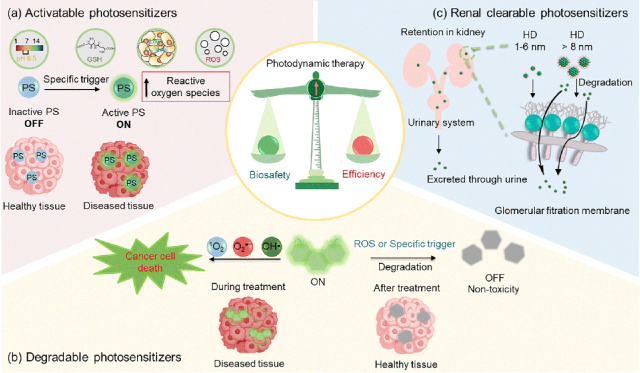
(1) Photodynamic therapy (PDT) is a non-invasive optical treatment method involving reactive oxygen species (ROS), characterized by extremely low drug resistance and high spatiotemporal selectivity. PDT is playing an increasingly important role in cancer treatment. Throughout the development of PDT, enhancing the therapeutic efficacy of photosensitizers (PSs) has been a focal point for researchers. However, with the continuous advancement and widespread application of PDT, the importance of its safety has become increasingly prominent. Traditional PSs often exhibit “always-on” activity, leading to severe phototoxic symptoms such as burning sensations, skin redness, and scabbing. Additionally, patients must avoid exposure to natural light for several weeks post-treatment. Furthermore, the metabolism and clearance pathways of PSs should be emphasized to ensure that excess PSs can be eliminated from the body after treatment to prevent toxicity and damage.
(2) The authors summarize the latest advancements in intelligent PSs that exhibit significant and efficient cancer treatment capabilities along with enhanced biosafety, which are expected to address the inconveniences posed by traditional PDT to patients. The authors also discuss the challenges faced in promoting clinical practice of PDT and facilitating its widespread clinical application, as well as future development prospects.
References
Yuan-Yuan Zhao. et al. Enhancing biosafety in photodynamic therapy: progress and perspectives. Chemical Society Reviews. 2025
DOI: 10.1039/d5cs00054h
https://pubs.rsc.org/en/content/articlelanding/2025/cs/d5cs00054h
Nanomaterials Custom Synthesis
Teacher Wang
198 2262 5523
Nanolab Nanomaterials Communication QQ Group: 937788022 If you want your prepared materials to be featured on the nanolab platform, please add the editor on WeChat 19822625523
Note: Name – Institution – Material Name (submissions without notes will not be accepted).