🔥 Content Introduction
The rapid development of autonomous driving technology has raised higher demands for precise and efficient vehicle control and trajectory planning. Traditional control methods often rely on pre-designed rules and complex mathematical models, making it difficult to cope with the complex and changing road environment. In recent years, the emergence of deep reinforcement learning technologies, particularly Deep Q-Networks (DQN), has provided new ideas for solving this problem. This article will explore how to combine deep Q-learning with the bicycle dynamics model to achieve more robust and intelligent vehicle control and trajectory planning.
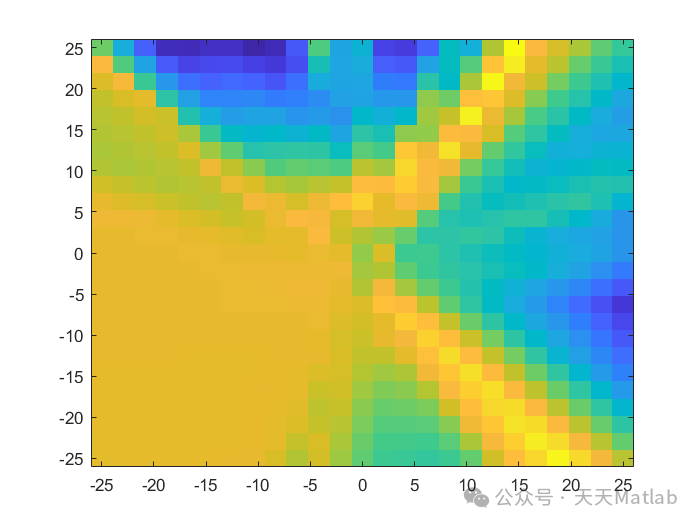
The bicycle dynamics model is an effective tool for simplifying the kinematic and dynamic characteristics of vehicle motion, capable of describing the vehicle’s motion state on a plane at relatively low computational cost. This model typically includes key variables such as the vehicle’s lateral and longitudinal speeds, steering angle, and geometric parameters. By using the bicycle dynamics model, we can transform the control problem into a decision-making problem based on states and actions, providing an ideal framework for applying deep Q-learning. The core of the DQN algorithm lies in the use of neural networks to approximate the Q-function, which represents the expected cumulative reward for taking a specific action in a specific state. Through continuous interaction with the environment, DQN can learn the optimal policy to guide the vehicle in precise control and trajectory planning in complex environments.
However, directly applying DQN to vehicle control presents many challenges. First, the vehicle control problem is a high-dimensional continuous control problem, while traditional DQN algorithms are primarily designed for low-dimensional discrete control problems. To handle continuous action spaces, we can adopt improved algorithms such as Deterministic Policy Gradient (DDPG) or Proximal Policy Optimization (PPO). These algorithms can effectively manage continuous action spaces and improve learning efficiency and stability. Secondly, the safety requirements of the vehicle control environment are extremely high; any erroneous control decision could lead to severe traffic accidents. Therefore, it is necessary to design an appropriate reward function to guide DQN in learning a safe and reliable control policy. The design of the reward function should comprehensively consider various factors, including driving speed, trajectory tracking accuracy, and collision avoidance, giving greater weight to safety factors. In addition, to accelerate the learning process and enhance generalization capabilities, techniques such as experience replay mechanisms and target networks can be utilized. Experience replay can effectively break the correlation between samples and improve learning efficiency; target networks can stabilize the learning process and avoid drastic fluctuations in target Q-values.
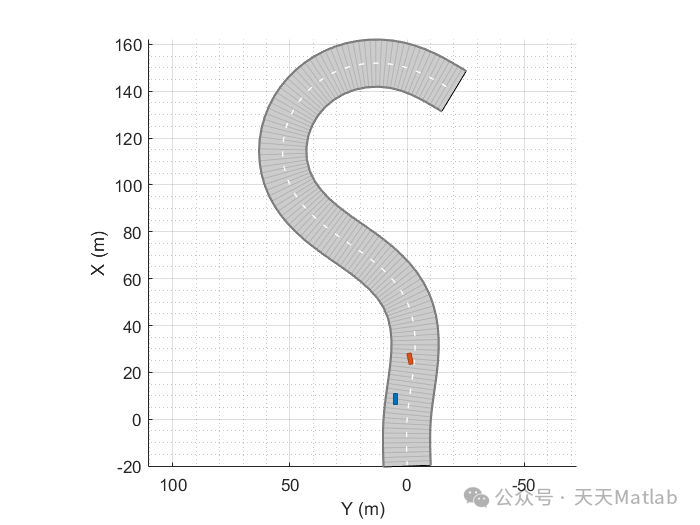
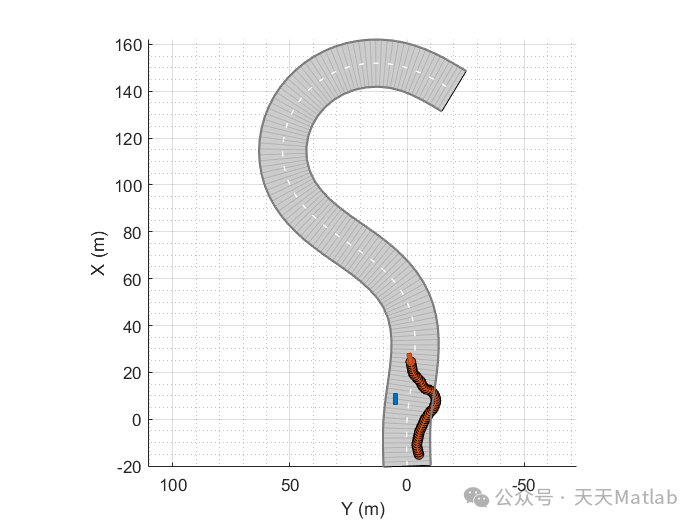
In the specific implementation process, we can use the bicycle dynamics model as the environment model and DQN as the control policy. At each time step, DQN selects an action (such as steering angle and acceleration) from the continuous action space based on the current vehicle state (e.g., speed, direction, position) and passes it to the bicycle dynamics model. Based on the model’s output, we can obtain the vehicle’s next state and the corresponding reward. DQN updates its parameters based on the received reward, continuously improving the control policy. Through repeated iterations, DQN can learn a policy that effectively controls the vehicle in complex environments, achieving precise trajectory tracking and safe obstacle avoidance.
To enhance the robustness of the algorithm, we can consider introducing some auxiliary technologies. For example, sensor data such as data from LiDAR or cameras can be utilized to perceive the surrounding environment and feed this information as additional input features to DQN, thereby enhancing the algorithm’s adaptability to environmental changes. Additionally, multi-agent reinforcement learning techniques can be employed to achieve cooperative control among multiple vehicles, further improving traffic efficiency and safety.
Of course, the method of vehicle control and trajectory planning based on deep Q-learning and the bicycle dynamics model also has some limitations. For instance, the bicycle dynamics model itself is a simplified model that ignores many details of the vehicle, such as tire side slip characteristics and the effects of the suspension system. Therefore, the control policy trained based on this model may have certain errors in practical applications. Moreover, the training process of deep reinforcement learning algorithms typically requires a large amount of sample data, which demands significant computational resources and time.
In summary, the method of vehicle control and trajectory planning based on deep Q-learning and the bicycle dynamics model provides a new direction for the development of autonomous driving technology. By combining the powerful learning capabilities of deep learning with the efficiency of the bicycle dynamics model, we can achieve smarter and safer vehicle control and trajectory planning. Future research can focus on improving model accuracy, reducing training data requirements, enhancing algorithm robustness, and exploring more advanced deep reinforcement learning algorithms to further enhance the performance and reliability of autonomous driving systems. However, in practical applications, it is crucial to fully consider the safety, reliability, and real-time nature of the algorithms and conduct rigorous testing and validation to ensure their safe and effective operation in real road environments.
⛳️ Operation Results
🔗 References
🎈 Some theoretical references are from online literature. If there is any infringement, please contact the author for deletion.
👇 Follow me to receive a wealth of MATLAB e-books and mathematical modeling materials.
🎁 Private message for complete code and data acquisition, as well as paper modeling simulation customization.
🌈 Various intelligent optimization algorithm improvements and applications
Production scheduling, economic scheduling, assembly line scheduling, charging optimization, workshop scheduling, departure optimization, reservoir scheduling, three-dimensional packing, logistics site selection, cargo position optimization, bus scheduling optimization, charging pile layout optimization, workshop layout optimization, container ship loading optimization, pump combination optimization, medical resource allocation optimization, facility layout optimization, visual domain base station and drone site selection optimization, knapsack problem, wind farm layout, time slot allocation optimization, optimal distributed generation unit allocation, multi-stage pipeline maintenance, factory-center-demand point three-level site selection problem, emergency life material distribution center site selection, base station site selection, road lamp post arrangement, hub node deployment, transmission line typhoon monitoring devices, container scheduling, unit optimization, investment optimization portfolio, cloud server combination optimization, antenna linear array distribution optimization, CVRP problem, VRPPD problem, multi-center VRP problem, multi-layer network VRP problem, multi-center multi-vehicle VRP problem, dynamic VRP problem, two-level vehicle routing problem (2E-VRP), electric vehicle routing problem (EVRP), hybrid vehicle routing problem, mixed-flow workshop problem, order splitting scheduling problem, bus scheduling optimization problem, flight shuttle vehicle scheduling problem, site selection and routing planning problem, port scheduling, port bridge scheduling, parking space allocation, airport flight scheduling, leak source location.
🌈 Time series, regression, classification, clustering, and dimensionality reduction in machine learning and deep learning
2.1 BP time series, regression prediction, and classification
2.2 ENS voice neural network time series, regression prediction, and classification
2.3 SVM/CNN-SVM/LSSVM/RVM support vector machine series time series, regression prediction, and classification
2.4 CNN|TCN|GCN convolutional neural network series time series, regression prediction, and classification
2.5 ELM/KELM/RELM/DELM extreme learning machine series time series, regression prediction, and classification
2.6 GRU/Bi-GRU/CNN-GRU/CNN-BiGRU gated neural network time series, regression prediction, and classification
2.7 Elman recurrent neural network time series, regression prediction, and classification
2.8 LSTM/BiLSTM/CNN-LSTM/CNN-BiLSTM long short-term memory neural network series time series, regression prediction, and classification
2.9 RBF radial basis neural network time series, regression prediction, and classification
2.10 DBN deep belief network time series, regression prediction, and classification
2.11 FNN fuzzy neural network time series, regression prediction
2.12 RF random forest time series, regression prediction, and classification
2.13 BLS broad learning system time series, regression prediction, and classification
2.14 PNN pulse neural network classification
2.15 Fuzzy wavelet neural network prediction and classification
2.16 Time series, regression prediction, and classification
2.17 Time series, regression prediction, and classification
2.18 XGBOOST ensemble learning time series, regression prediction, and classification
2.19 Transform various combinations time series, regression prediction, and classification
Directions cover wind power prediction, photovoltaic prediction, battery life prediction, radiation source identification, traffic flow prediction, load prediction, stock price prediction, PM2.5 concentration prediction, battery health status prediction, electricity consumption prediction, water optical parameter inversion, NLOS signal identification, subway parking precision prediction, transformer fault diagnosis.
🌈 In terms of image processing
Image recognition, image segmentation, image detection, image hiding, image registration, image stitching, image fusion, image enhancement, image compression sensing.
🌈 In terms of path planning
Traveling salesman problem (TSP), vehicle routing problem (VRP, MVRP, CVRP, VRPTW, etc.), drone three-dimensional path planning, drone cooperation, drone formation, robot path planning, grid map path planning, multimodal transport problems, electric vehicle routing problem (EVRP), two-level vehicle routing problem (2E-VRP), hybrid vehicle routing problem, ship trajectory planning, full path planning, warehouse patrol.
🌈 In terms of drone applications
Drone path planning, drone control, drone formation, drone cooperation, drone task allocation, drone safe communication trajectory online optimization, vehicle cooperative drone path planning.
🌈 In terms of communication
Sensor deployment optimization, communication protocol optimization, routing optimization, target location optimization, Dv-Hop location optimization, Leach protocol optimization, WSN coverage optimization, multicast optimization, RSSI location optimization, underwater communication, communication upload download allocation.
🌈 In terms of signal processing
Signal recognition, signal encryption, signal denoising, signal enhancement, radar signal processing, signal watermark embedding extraction, electromyography signals, electroencephalography signals, signal timing optimization, electrocardiogram signals, DOA estimation, encoding and decoding, variational mode decomposition, pipeline leakage, filters, digital signal processing + transmission + analysis + denoising, digital signal modulation, bit error rate, signal estimation, DTMF, signal detection.
🌈 In terms of power systems
Microgrid optimization, reactive power optimization, distribution network reconstruction, energy storage configuration, orderly charging, MPPT optimization, household electricity.
🌈 In terms of cellular automata
Traffic flow, crowd evacuation, virus spread, crystal growth, metal corrosion.
🌈 In terms of radar
Kalman filtering tracking, track association, track fusion, SOC estimation, array optimization, NLOS identification.
🌈 In terms of workshop scheduling
Zero-wait flow shop scheduling problem (NWFSP), permutation flow shop scheduling problem (PFSP), hybrid flow shop scheduling problem (HFSP), zero-idle flow shop scheduling problem (NIFSP), distributed permutation flow shop scheduling problem (DPFSP), blocking flow shop scheduling problem (BFSP).
Editor / Zhang Zhihong
Reviewer / Fan Ruiqiang
Rechecker / Zhang Zhihong
Click below
Follow us
Read the original text