“Machines” only have mobility
“Human” wisdom is the core

“Brick moving,” a routine task for construction workers, has now become a popular internet term for netizens to mock their hard work. However, there are many tasks on a real construction site that are even more strenuous than moving bricks.
Take the construction of a large shopping mall’s basement as an example. Workers first need to use a grinder to process the rough floor, and the dust and noise generated from the friction between the diamond grinding wheel and the cement is just the prelude. Then they mix the primer, intermediate coating materials, and topcoat materials, applying them evenly layer by layer on the floor. Finally, the glossy epoxy paint makes its appearance, requiring workers to mix bucket after bucket, bending over or lying down, stepping on wooden strips to paint.
In a basement space of tens of thousands of square meters, every construction step requires calculating the material hardening time, racing against the clock to mix materials and paints. For many construction workers, this kind of work can last for over a decade, leading to chronic back pain and other “occupational diseases.” Traditional construction sites are too tough.
Smart Construction Workers
The popular character “Iron Man” from Marvel was “born” in a cave deep in the desert. Engineer Tony Stark was trapped in a dire situation and built a powerful suit from a pile of scrap metal to fend off enemies and escape successfully.
Today, the construction industry is also in a predicament: China has the largest construction market in the world, but the willingness of young people to enter this industry is decreasing year by year. According to statistics, by 2020, the average age of migrant workers nationwide had risen to 41.4 years, compared to just 34 years in 2008.
The aging of migrant workers is behind the traditional construction industry’s extensive production model. Without reform on the front lines, it is difficult to change the status quo. Leading real estate company Country Garden Group has made innovative attempts and intelligent practices to help solve the industry’s “labor shortage” and improve construction site productivity.
In July 2018, Guangdong BGI Robotics Co., Ltd. (hereinafter referred to as “BGI”) was established. As a wholly-owned subsidiary of Country Garden Group and a provider of intelligent construction solutions, BGI’s solution is: let robots build houses.

Buildings constructed with the participation of BGI construction robots
This seemingly sci-fi proposition is actually very down-to-earth. Again, taking the construction of a large shopping mall’s basement as an example, from floor grinding to floor paint application, BGI has construction robots that can execute relevant procedures.
First, for processing the rough floor, BGI’s “floor grinding robot” can operate autonomously after the program is set, completing dust collection and vacuuming while grinding. Then the “basement spraying robot” comes into play, accurately spraying putty paint under the structure of a mechanical arm and dual spray guns, achieving uniform thickness and efficiency more than three times that of experienced “masters.” Finally, the “floor paint application robot” can fully automatically start the application of the primer, intermediate paint, and topcoat for the entire basement epoxy floor.
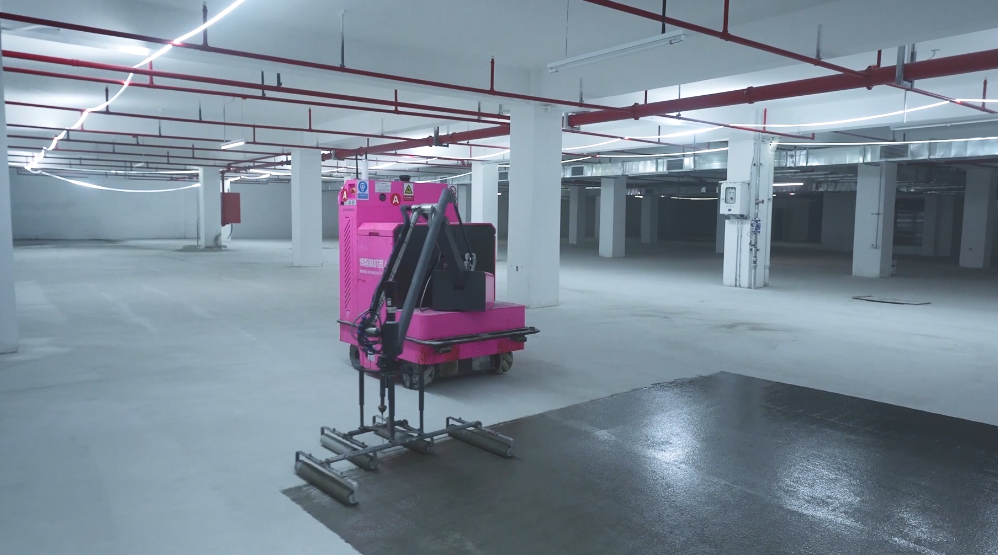
The “floor paint application robot” is working on the basement construction
These BGI construction robots, developed for the entire construction cycle, have already launched 18 models for commercial use. As of the end of January 2022, BGI construction robots have started intelligent operations across the country, covering over 350 projects in more than 25 provinces (municipalities and autonomous regions); over 730 construction robots have been delivered, with a cumulative application area exceeding 7 million square meters.
Independent Research and Development
Marshall McLuhan, a 20th-century original media theorist, once said: Tools are extensions of human organs. Construction robots can be seen as extensions of the hands of many skilled craftsmen.
From the perspective of “tools,” breaking down BGI’s “floor grinding robot” reveals it to be a large machine integrating laser measurement tools, grinders, and vacuum cleaners. It sounds simple, but to meet the requirements for continuous and stable operation in complex construction site scenarios requires persistent R&D efforts.
Dr. Liu Hengzhi, a representative of BGI’s robotics R&D, deeply understands this. “When BGI was initially developed, we also purchased components like robotic arms from other brands, but in the harsh conditions of construction sites, the lifespan of these purchased components was very short. To ensure that construction robots are truly usable and easy to use, we began independent research and development.”
Efforts do not betray the diligent; BGI’s key components and foundational shared technologies for robots cover eight core modules of construction robot hardware and software, and several independently developed technologies have filled gaps in the field of construction robots.
In BGI’s showroom located in Foshan, there is a dedicated area displaying the “predecessors” of various construction robots. Just from the progress in mechanical structure and craftsmanship, one can intuitively feel the dedication of the BGI R&D team.
Multi-Machine Collaboration
On BGI construction project sites, construction workers can be seen everywhere holding tablets.
The tablet is the terminal for controlling construction robots. According to the demonstrations by the workers, by touching the tablet to issue commands, the machines respond and initiate various construction actions along the designated paths.
However, if the collaboration between machines and humans stops here, its significance is merely as a tool to replace heavy manual labor, without qualitatively changing construction efficiency. To be called “robots,” the capabilities of the “machines” are fundamental, but the wisdom of “humans” is the core.
BGI’s R&D engineers think further; through technological and model innovations, they enable all robots working together on-site to become a collaborative whole.
In December last year, BGI completed the acceptance of the “BIM (Building Information Modeling) + FMS (Robot Collaborative Management System) + WMS (Warehouse Management System) + Construction Robots” multi-machine construction system for the first time at the Country Garden Shantou Jinping project. This marks that BGI construction robots have entered a new stage of systematic application in multi-machine collaboration, achieving significant results in exploring new paths for high-quality, intelligent construction, which has important benchmark demonstration significance for the construction industry.
To put it simply, BIM is like reconnaissance + sand table simulation at first. This powerful intelligent construction task planning center can generate customized construction maps, plan the construction paths and supply paths for robots, and correlate construction plans with material usage, ultimately forming robot construction work orders. Under the planning of the BIM system, the information required for construction, such as industrial technicians, building materials, and construction robot equipment, is laid out in advance, and the robot army is “ready to go.”
Next, the construction work orders generated by BIM will be sent to the FMS multi-machine construction system for processing. FMS acts like the “command center,” responsible for the control and task scheduling of all robots. In an instant, all robots operating on the construction site come to life, achieving orderly and efficient collaborative operations.
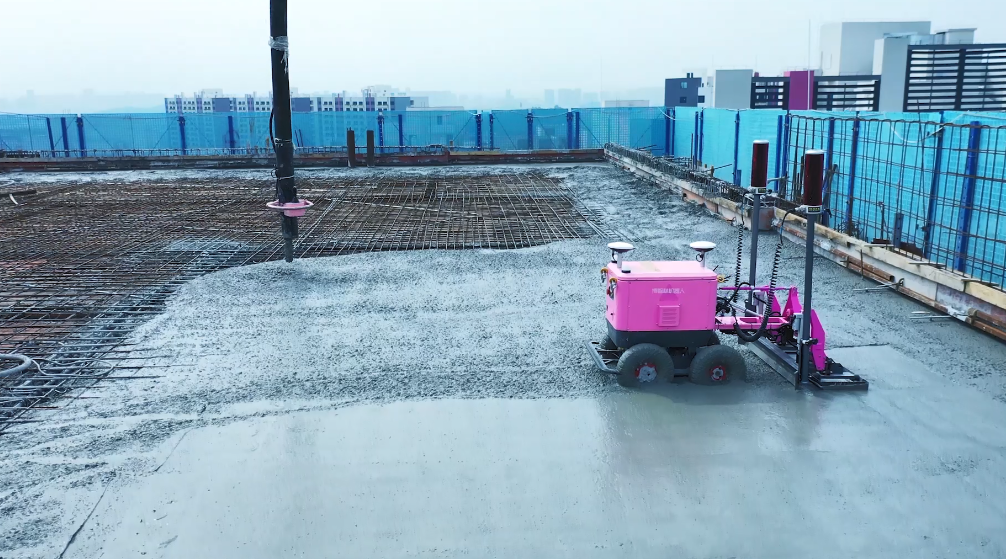
The “floor leveling robot” collaborates with the “intelligent moving fabric machine” for construction
Material allocation is the guarantee of efficient construction. The FMS system synchronously dispatches work orders to the WMS system through intelligent scheduling algorithms. This system is equivalent to the “logistics department” of the robot army. WMS can monitor the entire process of material outbound, transportation, and robot feeding. Under the intelligent scheduling of WMS, logistics robots will autonomously reach the intelligent elevator to various floors, complete tasks, and automatically return.
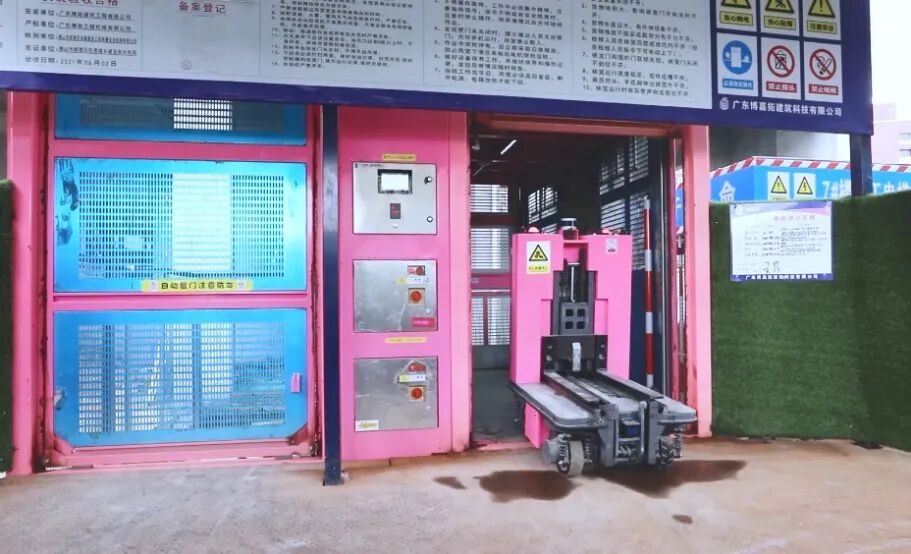
Construction robots autonomously use intelligent elevators
Serving Humanity
Of course, given the complex and variable construction environment, it is currently unrealistic to hand over all work to machines. Just like “driverless” smart cars need to operate under human supervision, construction robots also require the assistance of industrial technicians. Currently, in human-machine collaboration, humans mainly handle the operational control of construction robots, simple maintenance, and edge processing.
The development and application of intelligence do not replace humans but serve them better. Robots act as a bridge, connecting seemingly unrelated “construction” and “intelligence.” Through this bridge, more high-end talents can be attracted to enter the industry, as both BGI and construction robots have a long way to go in exploration and research.
Unlike “Iron Man,” who tinkers with his mech in a cave, movies require sharp characters and extreme individual heroism to attract attention and box office; in the real world, “construction robots” need more talents with dreams of changing the world to collaborate in research and advancement to truly transform the industry and write a beautiful future into the program of pursuing dreams.
From “Chinese construction” to “Chinese intelligent manufacturing,” digital transformation is an important way to promote the high-quality development of the construction industry and is also an inevitable trend. The future is here; robots building houses are no longer a movie.
Recommended Reading
▼
Production cost of a thousand-yuan down jacket is only 75 yuan? What happened to the once “favorite” clothing brand?