This article dives straight into the technical points, systematically organizing practical skills, common pitfalls, and engineering suggestions for macro programming, helping you leverage macros as productivity tools in real projects rather than as technical debt.
Conclusion in One Sentence
Macros are powerful text/code generation tools that operate before compilation. Prioritize type-safe alternatives (inline, _Generic, const), and use controlled and testable macro paradigms when necessary: do/while(0), X-macro, token-pasting, and mixed use of _Generic can achieve robust and maintainable engineering solutions.
Table of Contents (Quick Navigation)
- 1. Preprocessor Review: Functions and Basic Directives
- 2. Safe Macro Paradigms: From Statements to Expressions
- 3. Advanced Techniques: X-macro, token-pasting, stringize, _Generic
- 4. Common Pitfalls and Real Cases (with Fixes)
- 5. Debugging, Testing, and CI Practices
- 6. Engineering Suggestions: When to Use Macros and How to Replace Them
1️⃣ Preprocessor Review: Functions and Basic Directives (Quick Read)
The preprocessor stage runs before compilation, with common directives including:
- • #define / #undef
- • #if / #ifdef / #ifndef / #elif / #else / #endif
- • #include
- • #error / #warning
There are two types of macros: object macros (constants) and function macros (parameterized replacements). The preprocessor is merely a text replacement tool, but it can perform conditional compilation, code generation, and platform adaptation at compile time, making it an indispensable metaprogramming tool in engineering.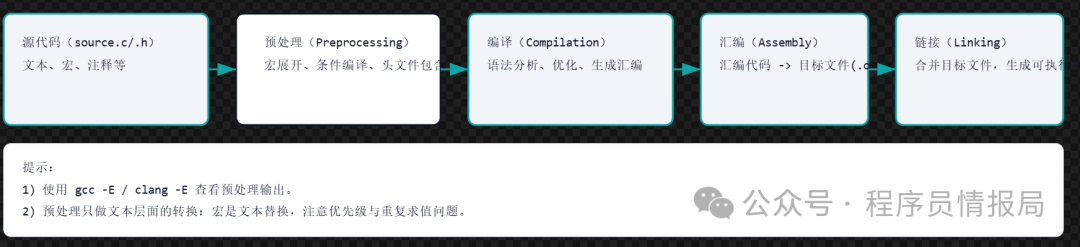
2️⃣ Safe Macro Paradigms: From Statements to Expressions
2.1 do { … } while (0) — Standard Wrapping for Statement Macros
#define LOG_ERR(fmt, ...)
    do { fprintf(stderr, "ERR: %s:%d: " fmt "\n", __FILE__, __LINE__, ##__VA_ARGS__); } while (0)
Advantages: Used like a statement, it does not disrupt the syntax structure of if/else.2.2 Parentheses and PrecedenceAny macro expression should enclose parameters and the overall expression in parentheses:
#define SQR(x) ((x) * (x))2.3 Preventing Multiple Evaluations (Most Common Pitfall)Issue: Parameters in macros are evaluated multiple times (side effects repeated).Solution: Use temporary variables in compilers that support typeof (GCC/Clang extension):
#define MAX_SAFE(a, b) ({
    typeof(a) _a = (a);
    typeof(b) _b = (b);
    _a > _b ? _a : _b;
})
Alternative: If feasible, use static inline functions for type checking and single evaluation.2.4 Variadic Macros and Optional Parameters
#define DEBUG_PRINT(fmt, ...) fprintf(stderr, "DEBUG: " fmt "\n", ##__VA_ARGS__)Note: For compatibility, gcc’s ##VA_ARGS is more friendly with empty parameters.
3️⃣ Advanced Techniques (Practical Collection)
3.1 X-macro: Reusing Data as CodePurpose: Maintain enumerations, mappings, and initialization tables while ensuring a single source of truth. Example file structure:
// status.def
// X(OK) X(ERROR) X(UNKNOWN)

// status.h
#define X(name) name,
typedef enum { #include "status.def" } Status;
#undef X

// status_names.c
#define X(name) #name,
const char *status_names[] = { #include "status.def" };
#undef X
Advantages: Adding a new enumeration item requires changing only one file, avoiding synchronization issues across different views.3.2 Token-pasting (##) and Stringize (#)
#define CONCAT(a,b) a ## b
#define TO_STR(x) #x

int CONCAT(foo, 1) = 42; // => int foo1 = 42;
printf("%s\n", TO_STR(hello)); // => "hello"
3.3 Using _Generic for Type Generalization (C11)Example: Generalized absolute value wrapper
static inline int iabs_i(int x) { return x < 0 ? -x : x; }
static inline long iabs_l(long x) { return x < 0 ? -x : x; }

#define my_abs(x) _Generic((x), int: iabs_i, long: iabs_l)(x)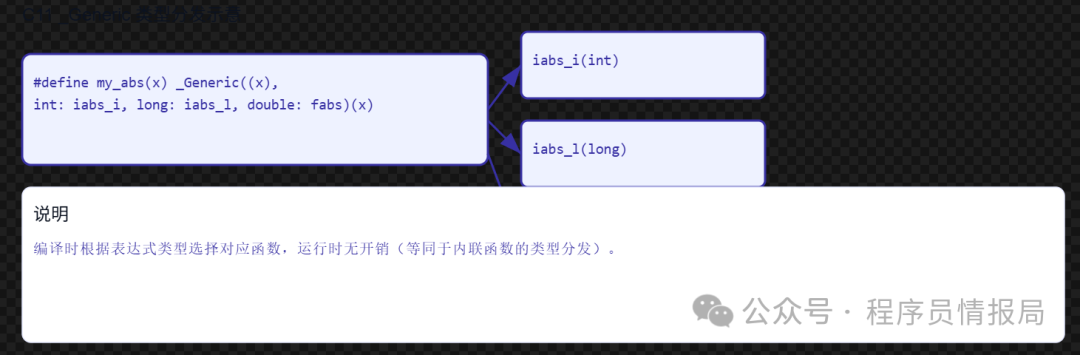
Advantages: More type-safe than macro expansion, recommended for priority use.3.4 Generative Code and Conditional CompilationUtilize conditional compilation and macros to achieve platform specialization:
#if defined(__x86_64__)
#define CACHE_LINE 64
#elif defined(__aarch64__)
#define CACHE_LINE 128
#else
#define CACHE_LINE 64
#endif
4️⃣ Common Pitfalls and Real Cases (with Fixes)
Pitfall A: Side Effects from Multiple EvaluationsIncorrect example:
int i = 0;
int m = MAX(i++, 10); // i is incremented twice
Fix: Use inline functions or temporary variables to store parameters.Pitfall B: Macros Changing Semantics (Precedence Issues)Incorrect:
#define SQR(x) x * x
int r = 1 + SQR(3); // unexpected calculation result
Fix: Add parentheses in the macro definition: #define SQR(x) ((x)*(x)).Pitfall C: Hidden Errors in Conditional Compilation CombinationsWhen multiple #if combinations are used, some compilation paths may be neglected and uncovered, leading to bugs in those paths being hard to discover.Fix: Increase multi-configuration builds and compile-time assertions (e.g., #error to catch unsupported combinations) in CI.
5️⃣ Debugging, Testing, and CI Practices
- • Review Preprocessor Output:
gcc -E -P myfile.c -o myfile.i
// -P removes line number comments for easier reading- • Write small unit tests for complex macros (boundary conditions, inputs with side effects)
- • Use the preprocessed file as a supplement for code review (to prove the expanded results)
• In CI, ensure: multiple compilations (different optimization levels), multi-platform builds, and static analysis (clang-tidy / cppcheck)
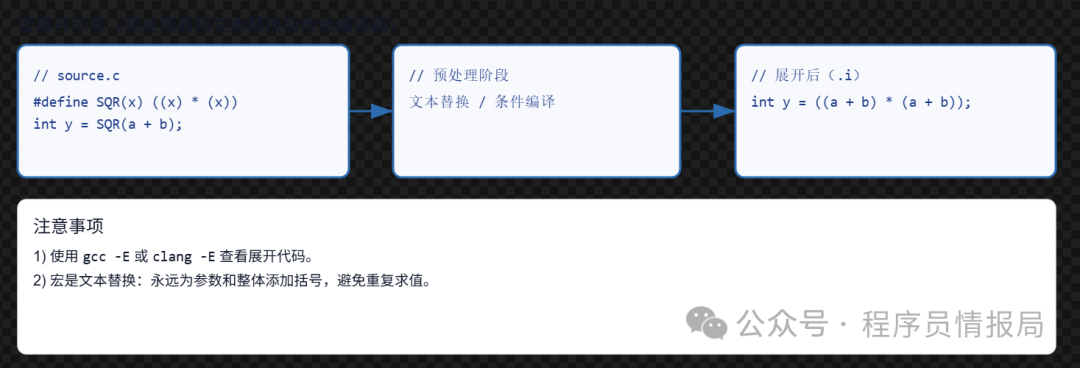
Macro Usage Flow
6️⃣ Engineering Suggestions: When to Use Macros and How to Replace Them
Priority replacement list (readability → portability priority):
- 1. const / enum / static inline functions
- 2. C11 _Generic (type generalization)
- 3. compiler intrinsics or built-in functions
- 4. Macros (controlled, well-documented, well-encapsulated)Macro applicable scenarios:
- • Compile-time code generation (X-macro)
- • Conditional compilation and platform adaptation
- • Macro syntax sugar that cannot be expressed with functions (e.g., token concatenation to generate multiple symbols)Macro usage rules:
- • Clearly state input/output contracts and limitations for all macros
- • Avoid exposing common and easily conflicting names in header files, use prefixes
- • Add expansion examples as documentation (to facilitate code review)
- • If possible, provide pure C alternative implementations for fallback
7️⃣ Common Templates and Quick Reference (Paste into Documentation or README)
- • Statement Macro: do { … } while (0)
- • Variadic: ##VA_ARGS (compatible with empty parameters)
- • Preventing Re-evaluation: typeof + temporary variables or static inline
- • X-macro: Single source of truth (enumeration + string mapping)
- • _Generic: Type dispatch
Conclusion (Publishable Statement)
Consider macros as “controlled metaprogramming tools”. First, ask yourself: can this requirement be solved in a safer way? If the answer is no, then use macros; and be sure to encapsulate, test, and document the expanded code. This way, you gain compile-time capabilities while keeping maintenance costs within acceptable limits.