
Click the aboveblue text to follow us
The core purpose of thread synchronization is to ensure that multiple threads can operate on shared resources in an expected manner, preventing data inconsistency issues.

Shared resources refer to variables or data structures that multiple threads may read or modify simultaneously.
For example, if there is a global variable a, and both thread 1 and thread 2 are performing read and write operations on this variable, a becomes the shared resource between them, and multiple threads need to access it.
The fundamental cause of data inconsistency lies in the concurrent access of shared resources by multiple threads.
Threads are executed concurrently in the operating system and can be scheduled by the operating system at any time.
As a result, multiple threads may operate on a shared resource simultaneously, and this concurrent operation can lead to competition.
Just like competition in real life, multiple threads “compete” for control over shared resources.
If one thread is modifying a shared variable while another thread reads that variable at the same time, it may read an incorrect or incomplete value.
1
When Is Thread Synchronization Necessary?
Thread synchronization is not always necessary; it is only required in the following situations:
- Multiple threads modify shared resources: If one thread modifies a shared variable, other threads may also modify or read that variable, which can lead to data consistency issues. For example, if thread 1 modifies the value of variable a, but thread 2 reads a before the modification is complete, thread 2 may obtain an incorrect value.
- Write operations on shared resources are non-atomic: Often, modifying shared resources is not an instantaneous, uninterruptible process, but requires multiple steps (such as read-modify-write operations). If another thread intervenes during these steps and operates on the same shared resource, inconsistent results will occur.
2
When Is Thread Synchronization Not Necessary?
- If the variable is a local variable (only within the scope of a single thread), or a global variable but accessed by only one thread, then there is no need to worry about data consistency issues.
- If the variable is read-only, multiple threads reading it simultaneously will not cause issues since they do not modify the data.
Suppose there are two threads A and B, both accessing the same shared variable x.
Thread A first reads the value of variable x and then prepares to write a new value back to x.
Assuming the write operation takes two clock cycles to complete, if thread B happens to read variable x while the write operation is not yet complete, thread B will obtain an old value rather than the expected correct value.
In this case, data inconsistency will occur.
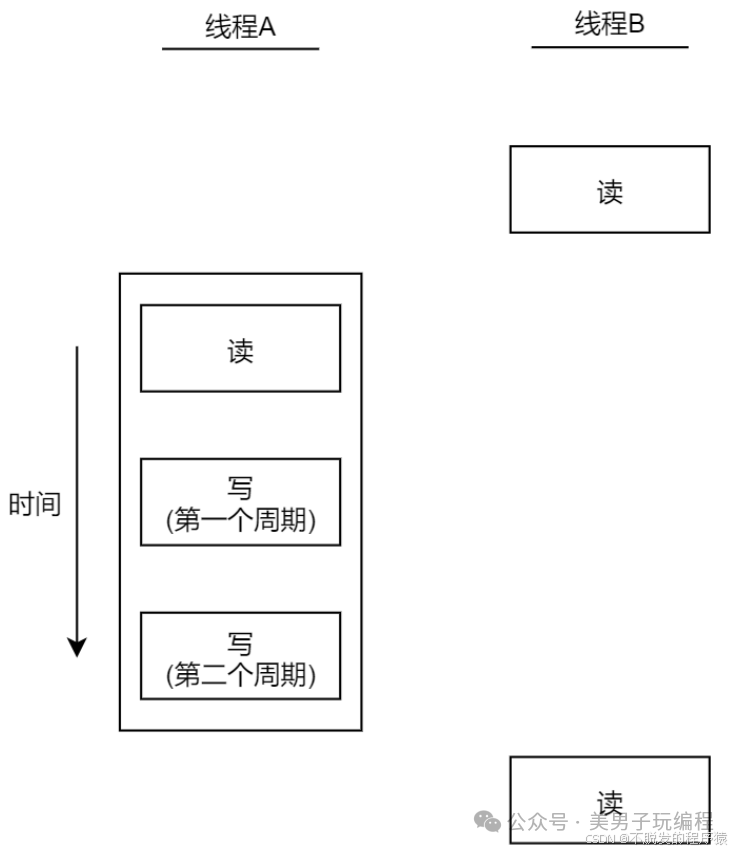
To avoid this situation, we introduce the thread synchronization mechanism.
Synchronization can be achieved through mechanisms such as mutexes and semaphores, ensuring that only one thread can modify the shared resource at any given time, preventing anomalies during concurrent access to data.
These mechanisms can effectively solve resource competition issues, ensuring that each thread can obtain a consistent state when accessing shared resources.

 Click to read the original text for more exciting content~