
Embedded system development often requires command line functionality, such as the uboot command line.
The command line can increase the flexibility of program execution, making it easier for us to debug programs and significantly improve our development efficiency.
This article teaches you how to implement a simple command line module through a simple example,
which can be easily ported to your own C projects.
For the complete source code, see the end of the article.
1. Design Philosophy
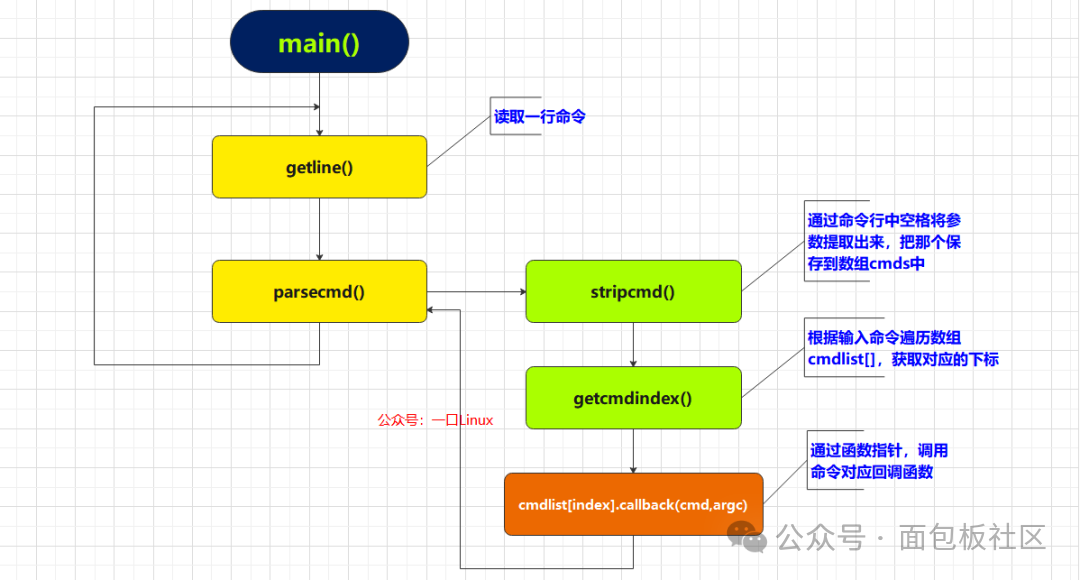
2. Implementation
1. Structure
We use a structure struct _cmdnum to maintain the command-related information supported by the module.
typedef void (* CMDFUNC)(char [][256],int argc);
typedef struct _cmdnum{
    char *cmd;
    int index;
    int paramcount;
    CMDFUNC callback;
    char *info;
}CMDNUM,*PCMDNUM;
| Member | Meaning |
|---|---|
| char *cmd | Command name |
| int index | Command index |
| int paramcount | Number of command parameters |
| CMDFUNC callback | Callback function corresponding to the command |
2. Supported Commands
This example adds 4 commands:
| Function | Number of Parameters | Callback Function | |
|---|---|---|---|
| help | Displays all command information | 0 | showhelp() |
| exit | Exits the current process | 0 | quit() |
| test | Prints all parameter information, for testing | 3 | test() |
| send | Converts the input hexadecimal string into a hexadecimal integer and stores it in an array | MAX_PARAM_NUM | send() |
Defined as follows:
CMDNUM cmdlist[] =
{
    {"help",1,0,showhelp},
    {"exit",2,0,quit},
    {"test",3,3,test},
    {"send",4,MAX_PARAM_NUM,send},
};
3. Related Functions
1. getline()
#include <stdio.h>
ssize_t getline(char **lineptr, size_t *n, FILE *stream);
Reads a line of data from the file stream stream, saving the result to *lineptr, including the terminating null character and newline character.
2. parsecmd()
void parsecmd(char *s)
Parses the command line content, mainly implemented through the functions stripcmd/getcmdindex.
- stripcmd
int stripcmd(char *s,char cmds[][256])
Utilizes the library function strtok to separate the parameters in the command line s by spaces, extracts the parameters, and stores them in the two-dimensional array **char cmds[256]**.
- getcmdindex
int getcmdindex(char *name)
Traverses the array cmdlist[] using the command name name to obtain the array index.
4. Core Code
CMDNUM cmdlist[] =
{
    {"help",1,0,showhelp,"show all cmd info"},
    {"exit",2,0,quit,"quit application"},
    {"test",3,3,test,"[param...]print params"},
    {"send",3,MAX_PARAM_NUM,senddata,"[xx...]converts data from sting to hex and store to buf"},
};

void parsecmd(char *s)
{
char cmd[MAX_PARAM_NUM][256];
int argc = 0;
int index = -1;

 argc = stripcmd(s,cmd);

//printf("argc=%d\n",argc);
 index=getcmdindex(cmd[0]);
if(index == -1)
 {
if(argc>0)
  {
   cprintf(RED,"\tNo such command \n");
  }
return;
 }
elseif(argc>0)
 {
  cmdlist[index].callback(cmd,argc);
 }
}

UINT8 hex2char(UINT8 ch)
{
if ((ch >= '0') && (ch <= '9')) {return ch - '0';}
if ((ch >= 'a') && (ch <= 'f')) {return ch - 'a' + 10;}
if ((ch >= 'A') && (ch <= 'F')) {return ch - 'A' + 10;}
return (UINT8)0xff;
}

UCHAR stringToByte(char* str)
{
 UCHAR bytes = 0;

if(strlen(str)==1)
 {
  bytes= 0 << 4 | hex2char(str[0]);
 }else
 {
  bytes= hex2char(str[0]) << 4 | hex2char(str[1]);
 }

return bytes;
}
//7e 01 02 01 00 07 07 01 00 00 00 c6 51 2a 7e

void senddata(char argv[][256],int argc)
{
int i = 0;
int len = 0;
 UCHAR buf[256] = {0};

if(argc < 2)
 {
return;
 }
for(i=1;i<argc;i++)
 {
   buf[i-1] = stringToByte(argv[i]);
 }
cprintf(GREEN,"\n  buf:");
for(i=0;i<argc-1;i++)
 {
  cprintf(GREEN,"%02x ",buf[i]);
 }
putchar('\n');

}
void test(char argv[][256],int argc)
{
int i = 0;

for(i=0;i<argc;i++)
 {
  cprintf(YEL,"\targv[%d]:%s\n",i,argv[i]);
 }

return;
}
void showsysinfo(void)
{
cprintf(D_GREEN_H,"---------------yikoulinux cmdline demo-----------\n");
}
void quit(char cmd[][256],int argc)
{
cprintf(RED_H,"exit to system \n");
    exit(0);
}

void showhelp(char cmd[][256],int argc)
{
int i = 0;

for(i=0;i<sizeof(cmdlist)/sizeof(CMDNUM);i++)
 {
    cprintf(GREEN_H,"\t%s",cmdlist[i].cmd);
  cprintf(YEL_H,"\t%s\n",cmdlist[i].info);
 }
return ;
}

int main(int argc, char* argv[])
{
    char *line;
    int ret = 0;
size_t len_line = 0;

    showsysinfo();

while(1)
 {
  fflush( stdin );
  cprintf(D_GREEN_H,DEV_NAME"# ");

  ret = getline(&line, &len_line, stdin);
if(ret == -1)
  {
   break;
  }
  parsecmd(line);
free(line);
  line = NULL;
 }

    return0;
}
3. Testing
1. help

2. test

3. send

4. exit

END
Popular Recommendations:
Type-C’s CC pin is indeed designed quite ingeniously~
The RS485 communication transceiver mechanism is actually like this!
Which comes first, the fuse or the TVS? Two groups of engineers are arguing!
Profitable products can be easily cracked like this.
Disassembling a telecom set-top box, a textbook case of hardware design to reduce costs!
Why is it often required for MOSFETs to turn off quickly, but not to turn on quickly?
Why do MOSFETs need driver circuits?