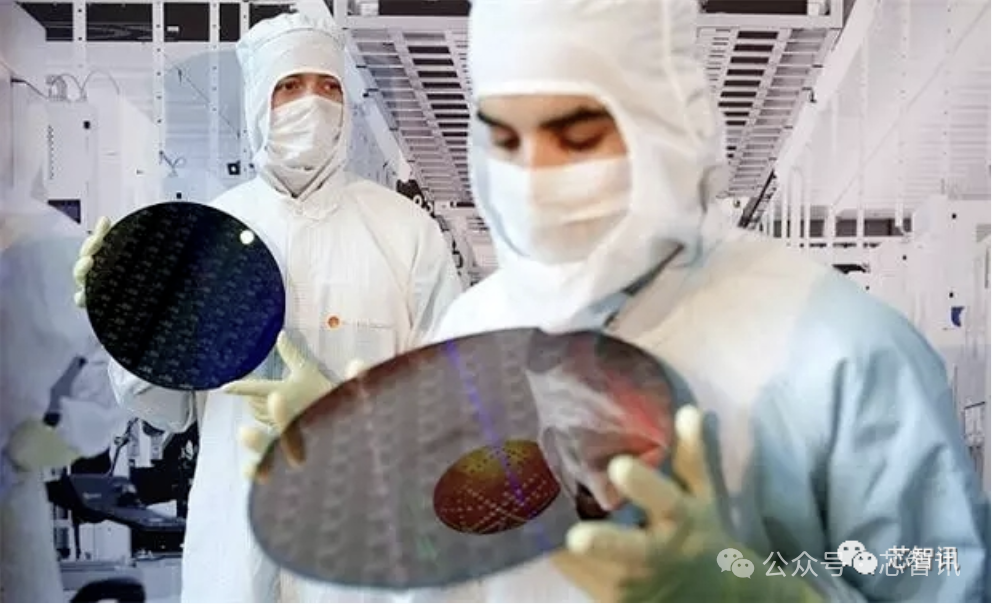
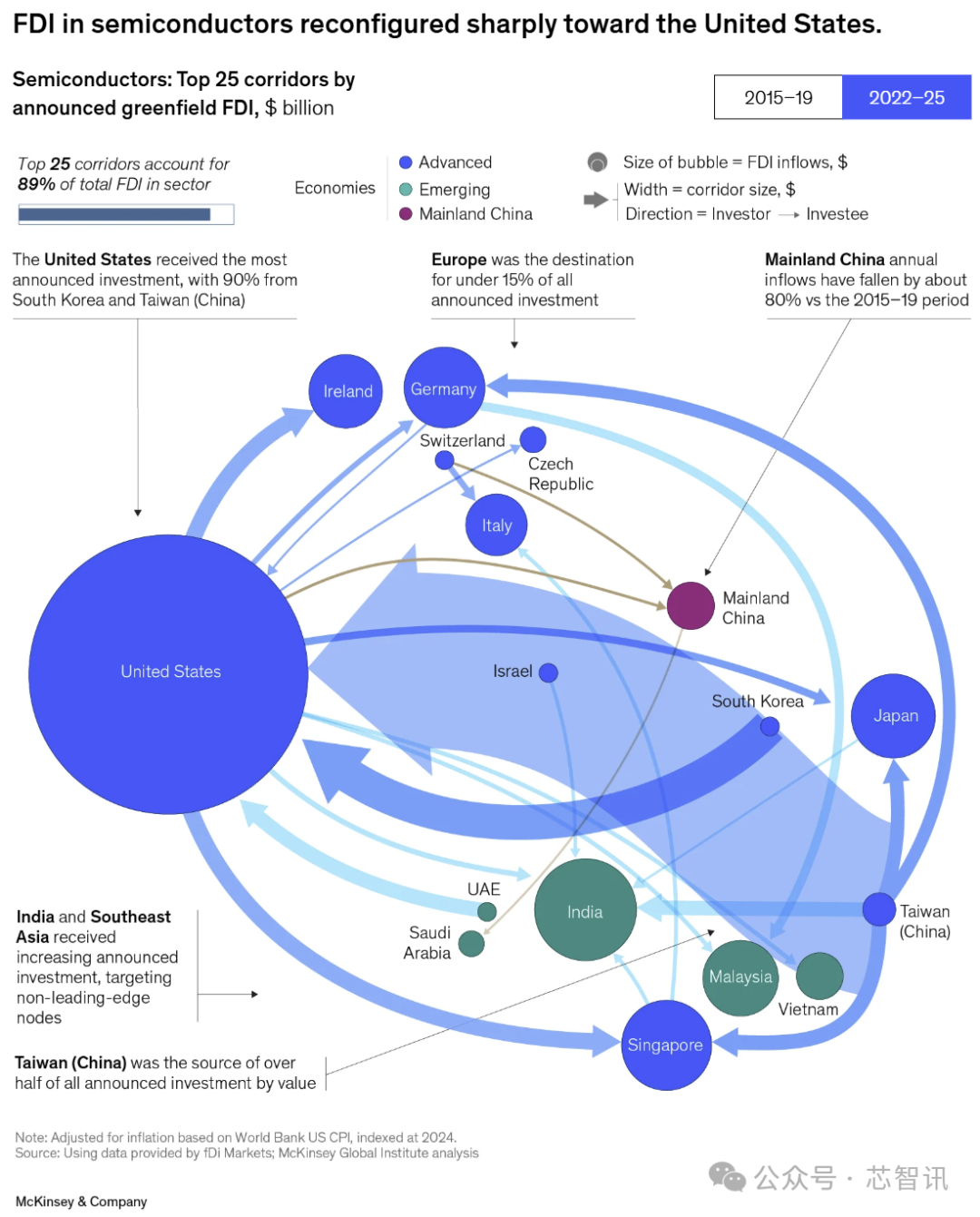
On November 27, according to a recent research report released by McKinsey, nearly 90% of foreign direct investment (FDI) in the semiconductor industry flowed to the United States after the Trump administration took office in 2025, primarily driven by companies from Taiwan and South Korea.
Among them, TSMC has the largest investment scale, aiming to establish a complete advanced process supply chain in the United States. Currently, TSMC’s Arizona plant has begun mass production of 4nm technology and plans to expand to A16 process. Additionally, Samsung is also expanding its advanced process capacity in Taylor, Texas. Although it has experienced multiple delays, it has recently returned to the right track and is moving towards mass production of 2nm process in the United States, while also securing a major contract for Tesla’s AI chips.
According to statistics from WSTS, as of July 2025, companies in the semiconductor ecosystem have announced over $500 billion in private sector investments to revitalize the U.S. chip ecosystem, with expectations that U.S. chip manufacturing capacity will triple by 2032. These projects are expected to create and support over 500,000 jobs in the U.S.—including 68,000 factory jobs in the semiconductor ecosystem, 122,000 construction jobs, and over 320,000 other jobs across the U.S. economy.
McKinsey states that the pace of development in the U.S. semiconductor industry has far outpaced other regions. Based on current progress, it may gradually develop into a global semiconductor hub alongside Taiwan.
McKinsey analyzes that one of the main reasons for the recent boom in the U.S. semiconductor manufacturing industry is due to the Trump administration’s view of semiconductors as a national security issue. Trump even warned TSMC that if it did not mass-produce in the U.S., it could face tariffs as high as 100%. Since TSMC’s main customers are concentrated in the U.S., the company must also ensure a robust capacity layout locally.
With the influx of global chip manufacturing giants like TSMC and Samsung, the scale of related investments in the U.S. is rapidly expanding, coupled with the agglomeration effect of the industry chain, the U.S. is experiencing an unprecedented wave of semiconductor investment.
The report points out that the future global economy will rely on the most advanced semiconductors, which are the most advanced chips produced today. Potential applications cover generative artificial intelligence, robotics, defense, and many other fields. Training a large language model may require hundreds of thousands of such chips.
However, against the backdrop of escalating geopolitical tensions, global companies and countries are seeking to diversify production to avoid over-reliance on Taiwan and South Korea, and to build semiconductor manufacturing capabilities closer to home. Accordingly, announced foreign investments have begun to grow. Since 2022, the announced amount of foreign direct investment in the semiconductor field has reached $115 billion annually, five times higher than the period from 2015 to 2019. Notably, half of this funding is used to build new frontier semiconductor manufacturing facilities, which did not appear in the previous round of foreign investment.
Moreover, the production of frontier chips is mainly concentrated in Taiwan and South Korea. In 2022, these two economies accounted for approximately 65% and 25% of global advanced process capacity, respectively. The geographical concentration may pose significant vulnerabilities to the supply chain. For example, export controls have recently been applied to semiconductor-related raw materials and manufacturing equipment, as well as the chips themselves, especially frontier chips. In fact, some researchers have found that export controls primarily target the semiconductor value chain.
However, large-scale construction of frontier semiconductor production capacity is neither easy nor cheap. The cost of a wafer fab can reach $10 billion or even higher. They are extremely complex and precise, and only a few companies globally have the capability to develop these technologies.
In this context, foreign direct investment has become the driving force behind the expansion of global semiconductor capacity. In fact, if all announced foreign direct investment projects are realized, 2022 would account for nearly 60% of the total leading capacity globally. Foreign direct investment could increase existing capacity outside of Taiwan and South Korea by five times, significantly expanding the industry’s influence. The total share of Europe, Japan, and the U.S. in global frontier semiconductor capacity could increase from about 10% in 2022 to over 30% by 2030, with more than half of the growth driven by foreign direct investment projects.
The report predicts that by the early 2030s, the United States is expected to become the second largest frontier chip producer, with over 20% of global capacity, thanks to investments from TSMC and Samsung, the leading companies from Taiwan and South Korea. This additional capacity may reduce the U.S.’s dependence on foreign frontier chips. However, if there are no significant changes in other segments of the semiconductor value chain, overseas dependence may still exist. For example, the U.S. relies on imports for some semiconductor manufacturing equipment and many raw materials and chemicals used in manufacturing, as well as dependence on overseas semiconductor assembly, packaging, and testing capabilities.
Among them, Europe (mainly Ireland) and Japan’s shares may also rise, but may still remain in single digits, as currently only a few projects have been announced.
With the increase in foreign direct investment announced by developed economies, the value of semiconductor-related investments announced by mainland China has decreased by about 80% since 2022. In contrast, from 2015 to 2019, mainland China was the primary destination for global semiconductor investment funds. The outflow of foreign direct investment may lead to difficulties or delays in scaling up frontier chip production, partly due to reduced technology inflow from global leading companies, coupled with limited access to advanced semiconductor manufacturing equipment.
Early signs of the impact of foreign direct investment in developed economies have already emerged. At TSMC’s Arizona wafer fab, the first 4nm wafer fab is expected to begin mass production by the end of 2024, the second has also completed structural construction, and the third is under construction.
In Europe, projects driven by foreign direct investment have promoted frontier chip production in Ireland, and more foreign projects have been announced to expand production scale, including more advanced nodes.
Since 2022, of the 20 largest super deals announced globally, two have already gone online, and another ten are under construction. Among the eight super deals that have not yet started, five were announced in 2025.
In addition to frontier semiconductors, foreign direct investment is also involved in the production of mature and advanced chips. These chips have important applications in automotive, home appliances, and industrial equipment. In Japan and Germany, foreign direct investment has helped expand production scale. India is also building large projects, one of which may be the first domestic company to achieve semiconductor capacity construction.
However, the success of foreign direct investment-driven projects in building frontier semiconductor capabilities is not guaranteed. Developing new, competitive frontier manufacturing centers outside of Taiwan and South Korea is a daunting task, especially in the absence of the same value chain partners and talent ecosystems.
Moreover, new investment projects may face different regulatory or environmental requirements, as well as challenges in accessing utilities and infrastructure. Especially in Europe, obtaining low-cost electricity may be difficult. In fact, cost issues are particularly prominent: the operating costs of semiconductor manufacturing facilities in Europe and the U.S. may be 30% higher than in Taiwan.
Editor: Chip Intelligence – Wandering Swordsman
Previous Exciting ArticlesIntel CEO Pat Gelsinger: Fully Supports Rao Wei Ren, TSMC’s Accusations Are Groundless!China’s Ministry of Commerce Reaches Consensus with the EU: Urges Nexperia to Conduct Internal Communication!HP Announces Global Layoffs of 4,000 to 6,000 People!Once a Huawei “Genius Boy”, the post-90s “Zhi Hui Jun” Becomes Chairman of Shangwei New Materials!TSMC Sues Rao Wei Ren: Accused of Stealing 2nm Secrets to Join Intel!ADATA Chairman Chen Li Bai: Memory Shortage, Even with Money Can’t Buy!Memory Prices Surge, NVIDIA and AMD Can’t Stand It Either!Yangtze Memory Temporarily Shuts Down Production Line? Fake News!Investment of 500 million yuan! Yidao Information Partners with Huafeng Technology to Enter Advanced Packaging!Changxin Memory Showcases DDR5 and LPDDR5X New Products for the First TimeWintek Technology Has Filed an Appeal Against the Dutch Government!Jensen Huang: AI Chip Revenue in the Chinese Market is Zero!Demand is Three Times Supply, Samsung Plans to Shift Some NAND Production Lines to DRAMResults of the Academy of Sciences and Engineering Election Announced! BYD’s Lian Yubo, CATL’s Wu Kai, and others ElectedBan on Sales Crisis Resolved, BOE and Samsung Display Reach Settlement!The Netherlands Suspends Control Over Nexperia! Wintek: Still Restricted! Ministry of Commerce RespondsSamsung/SK/Hyundai and Other 7 Korean Companies Announce: $890.4 Billion Investment Plan!
For industry communication and cooperation, please add WeChat: icsmart01
Chip Intelligence Official Communication Group: 221807116