
Click the image for details
As early as 2013, BMW replaced camera SerDes with Ethernet to create a 360-degree panoramic view based on Ethernet. However, as camera pixel counts have continued to rise and the prices of SerDes chips have continued to decline, the cost-effectiveness of Ethernet-based 360-degree panoramic views has gradually diminished. Ultimately, around 2020, BMW switched back to using SerDes chips for video transmission. But with the rise of the Zonal architecture, the demand for Ethernet to replace SerDes for video transmission has become increasingly strong.
Comparison of Video Transmission Standards
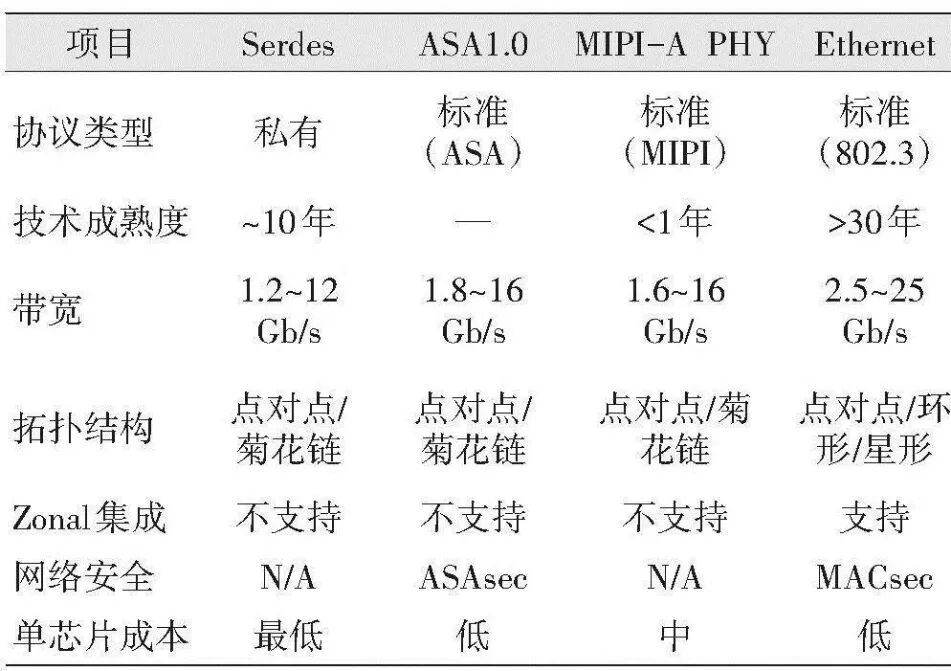
Image Source: Internet
Here, SerDes refers to the deserialization process, also known as P2PP (Point to Point Protocol). The most well-known SerDes is ADI’s GMSL, which almost monopolizes the automotive camera field, while another is Texas Instruments’ FPD-Link, primarily used in video and serialization. Additionally, there is the Clockless Link from Japan’s Rohm, which is used across Huawei’s product line. Among various video transmission standards, only Ethernet supports the Zonal architecture, as the core backbone of the Zonal architecture is Ethernet. Of course, the latest GMSLE standard supports the Zonal architecture, but it is more of a serial plus Ethernet conversion than a true SerDes. It is well known that Software Defined Vehicles (SDV) or central computing architectures are inseparable from Zonal, which is the trend of the future and is recognized as the next generation of automotive E/E architecture.
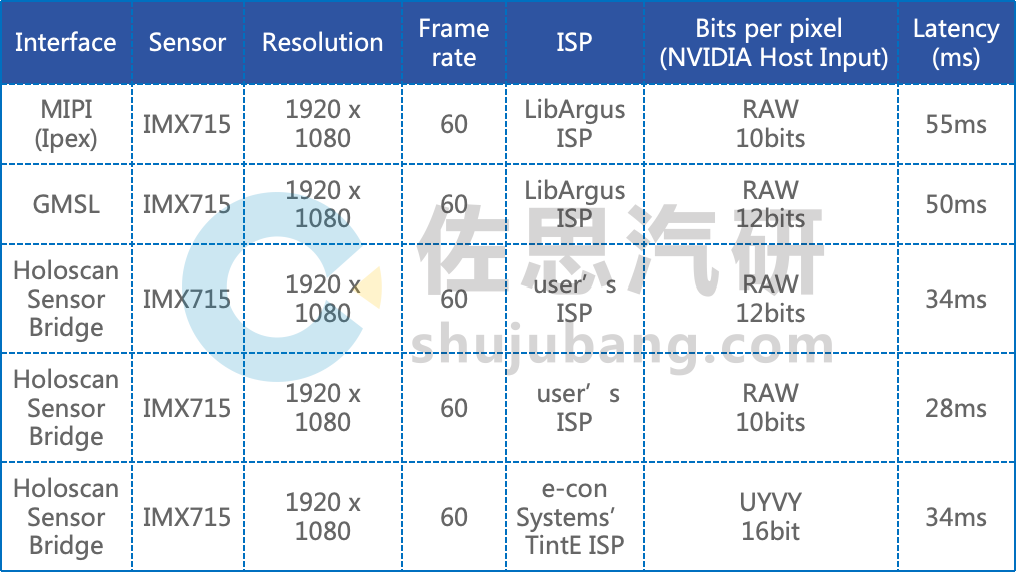
In addition to supporting the Zonal architecture, Ethernet also has advantages such as higher bandwidth. Currently mass-produced SoC chips, such as NVIDIA’s Thor-X, have four 25Gb Ethernet interfaces, and 10Gb automotive Ethernet physical layer chips and Ethernet switches were mass-produced by Broadcom in November 2020. The 50Gb fiber Ethernet standard 802.3cz was also completed in March 2023, with corresponding transceiver chips available. Higher bandwidth means higher transmission capacity, higher resolution, more sensors, and lower transmission latency.
Data Source: e-con Systems
The IMX715 used here has 8.29 million effective pixels, but it uses horizontal and vertical two-line binning pixel merging, reducing the resolution to 1920*1080. The Ethernet-based NVIDIA HSB has lower transmission latency.
SerDes has the following disadvantages compared to Ethernet:
① Current mainstream SerDes solutions are based on proprietary protocols from various chip suppliers, such as ADI’s GMSL, which are not compatible with each other; this reduces the flexibility of the supply chain.
② Point-to-point transmission prevents video data from being directly shared between domain controllers;
③ P2PP requires pairs of SerDes chips for transmission, which is costly;
④ The point-to-point connection cable from the camera to the domain controller is long and expensive.
Both 802.3ch and GMSL physical layers use PAM-4 encoding, so even at the maximum data transmission rate, the channel bandwidth (Nyquist frequency) does not exceed 3.5GHz. Comparing the two at the same frequency, 802.3ch has a lower insertion loss limit, allowing for the use of thinner, lower-cost cables. Additionally, due to the Ethernet bridging method, the cables can be significantly shortened, resulting in better performance. Furthermore, 802.3ch does not exclude the use of coaxial cables; future Ethernet bridges can also use coaxial cables similar to current P2PP to achieve better cost efficiency.
Broadcom’s All-Ethernet SDV Solution
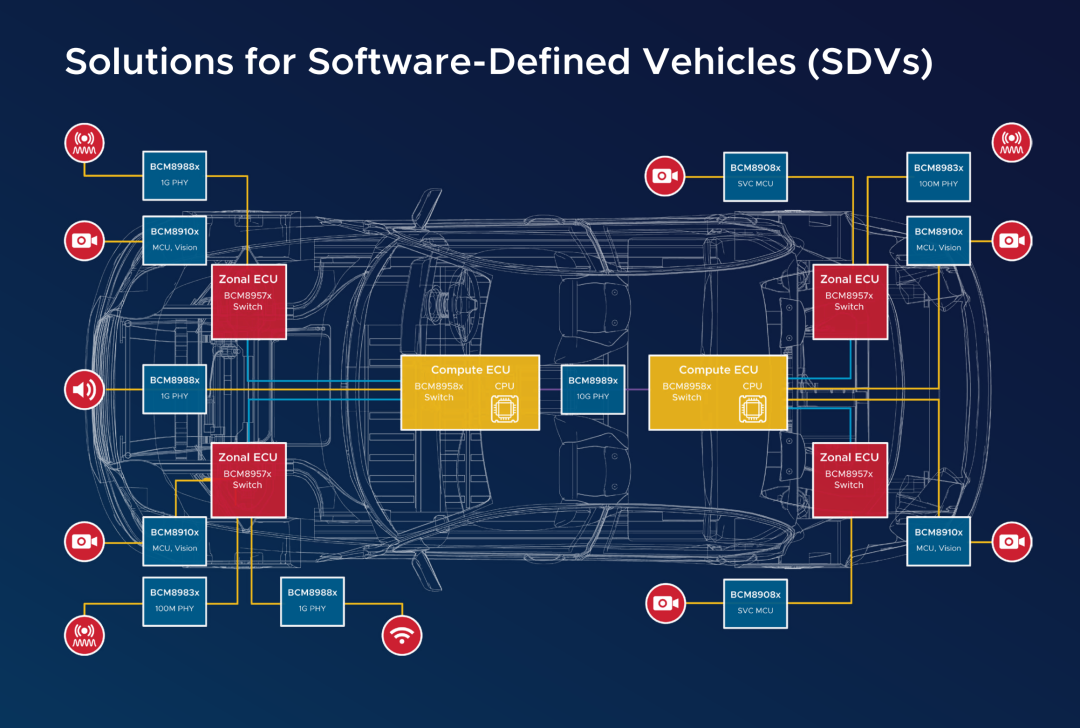
Image Source: Broadcom
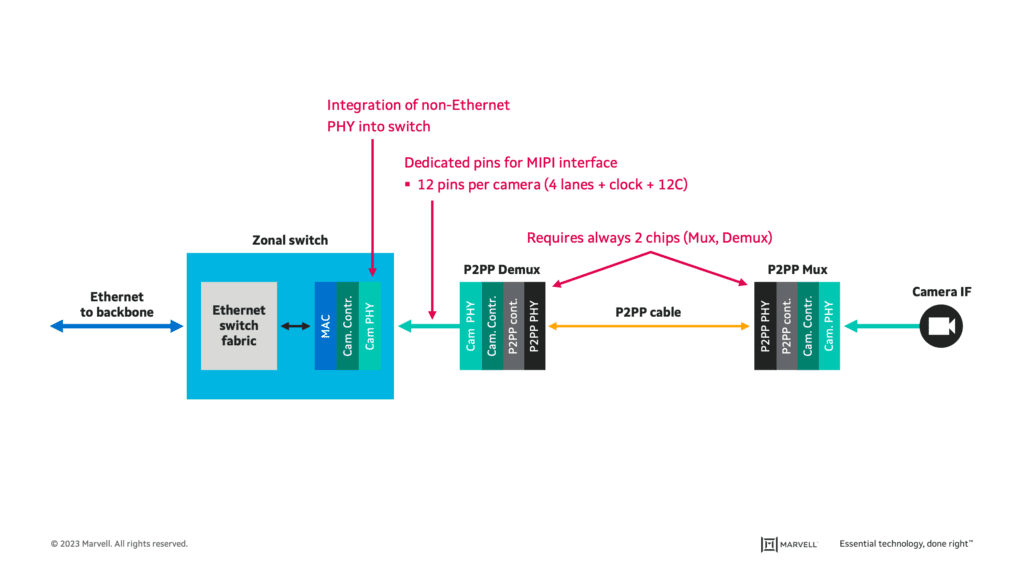
Image Source: Marvell
Integrating SerDes into the Zonal architecture requires adding 1-2 chips and custom Zonal Ethernet switches.
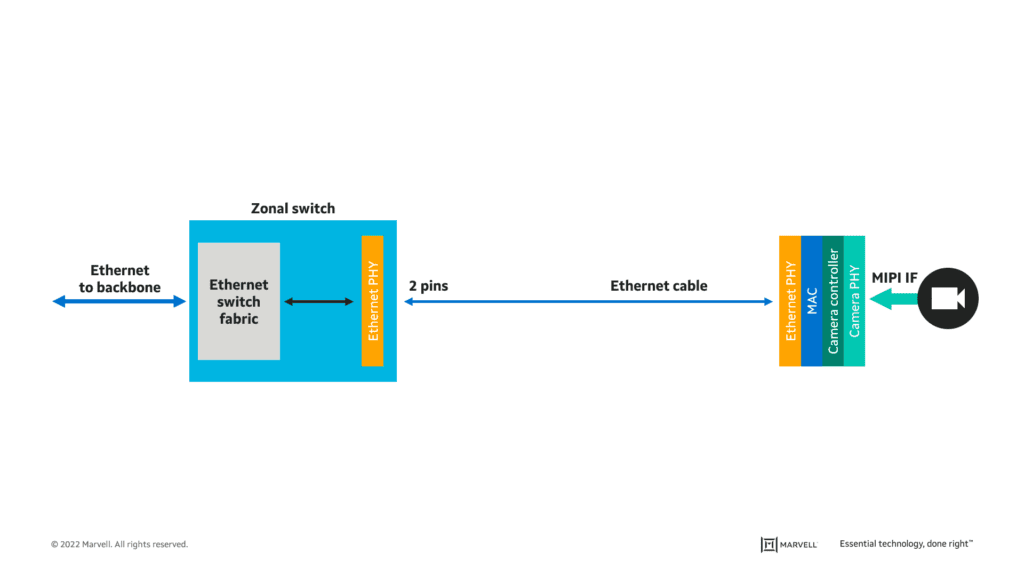
Image Source: Marvell
Automotive Ethernet is very friendly to Zonal support.
Connection of Automotive Ethernet Cameras to ECUs Based on 802.3ch
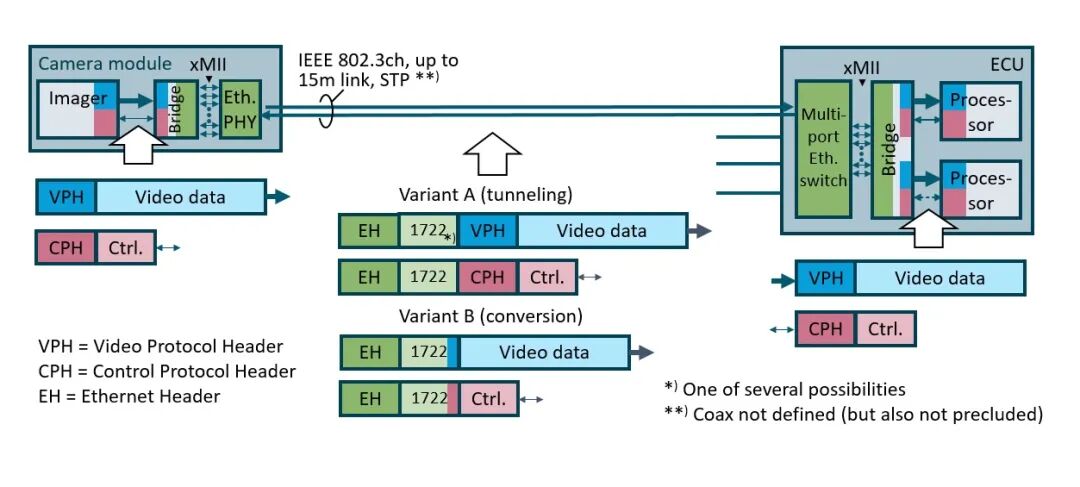
Image Source: BMW
The current 802.3ch standard for automotive Ethernet is already sufficient to replace SerDes technology, but its competitiveness is not very strong, mainly because the price of 10G Ethernet physical layer chips is relatively high. However, if there is an urgent need for a Zonal all-Ethernet architecture, a slight increase in physical layer costs can be overlooked.
802.3ch Ethernet operates in a full-duplex symmetric transmission mode, and its internal design currently includes echo cancellation and ADC/DAC circuits, which increases costs and slightly raises power consumption. In April 2024, the IEEE ISAAC (Improved Support of Asymmetrical Application for MGbps Ethernet Cameras) task force will establish corresponding standards for this asymmetric transmission method in vehicles, named IEEE 802.3 dm. Its main protocol content is to provide an optimized electrical physical layer for automotive cameras and other sensors to support the high data rate and low latency requirements of automotive Ethernet. Its cost and power consumption will align with the current GMSL, adopting an asymmetric design. In fact, as early as 2010, the IEEE established the 802.3az asymmetric Ethernet standard for energy-sensitive fields, which can be considered a precursor to 802.3dm.
Thanks to the groundwork laid by 802.3az, the progress of the 802.3dm standard is relatively fast. A draft is expected in November this year, with the complete standard finished by November next year. By July 2025, Keysight will support 802.3dm protocol testing, and the standard will be completed in 2026, at which point Marvell (whose automotive Ethernet division was acquired by Infineon) and Broadcom will be able to launch related products.
Introduction to ASA-MLE (where E stands for Ethernet)
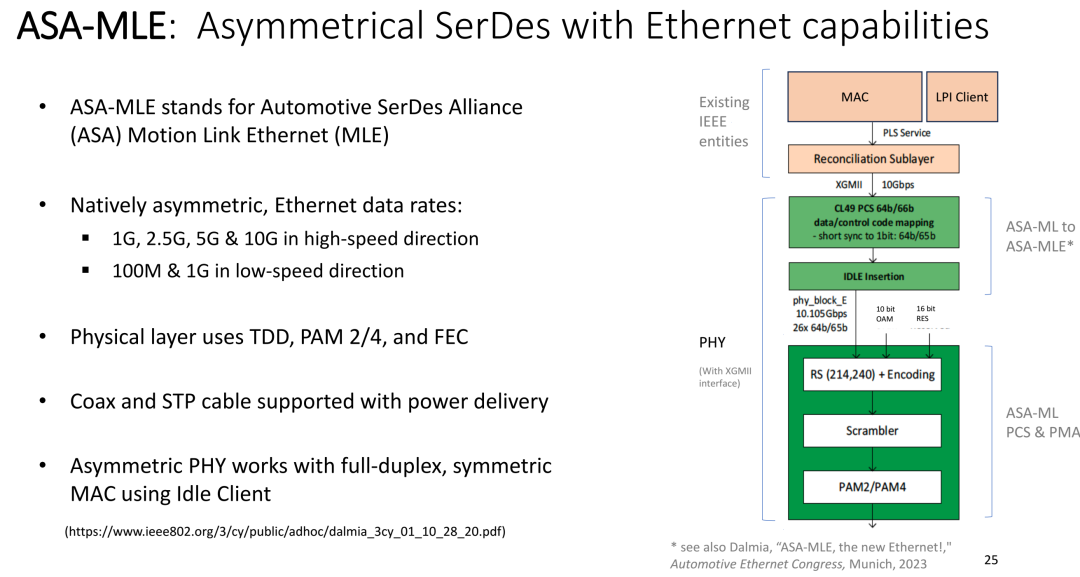
Image Source: IEEE
However, IEEE is actually a step behind. As early as 2020, there were ideas for asymmetric Ethernet for video transmission, which is the ASA-ML (Automotive SerDes Alliance). It established a compatible Ethernet version 2.0 standard in 2023; related products are expected to be released in February 2024, specifically from AVIVA Link. In December 2024, NXP acquired the company for $242.5 million. ASA-ML was originally intended to break the proprietary protocol blockade of ADI and Texas Instruments, allowing smaller companies to enter the SerDes field. However, in 2022, it realized the importance of Ethernet compatibility and thus developed a TDD-based asymmetric Ethernet. The IEEE’s work on 802.3dm came too late. However, ASA-ML and MIPI are integrated, meaning that the output end of ASA-ML cameras is still MIPI CSI, while IEEE aims to completely use Ethernet. Considering ASA-ML’s strong capabilities, many companies have already commercialized, forcing IEEE’s 802.3dm to split into two standards: TDD led by ASA-MLE and ACT led by IEEE.
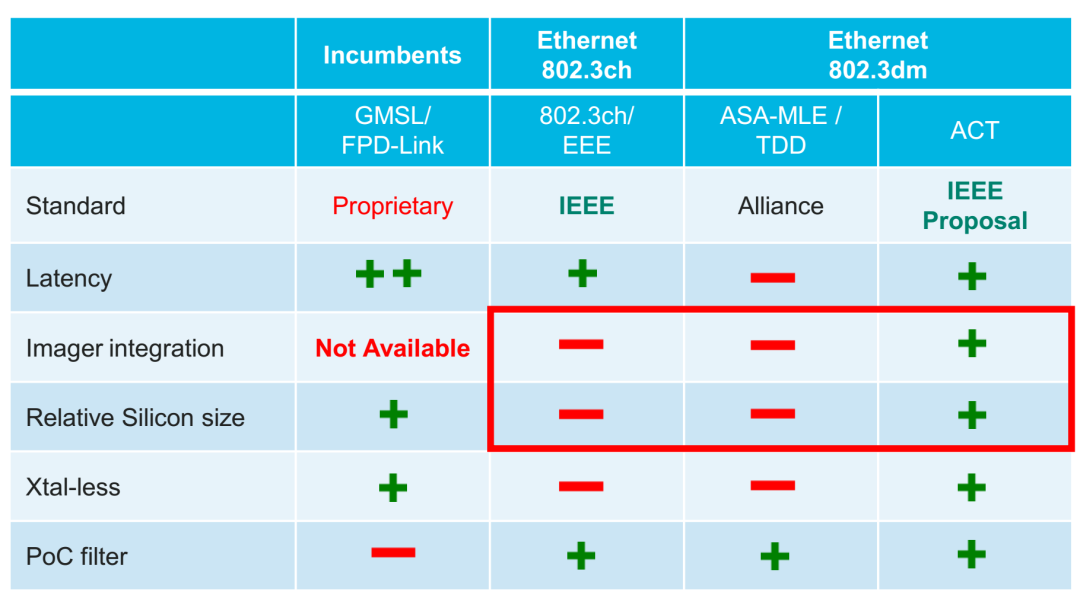
Image Source: Marvell
The ACT camp mainly consists of Infineon, which just acquired Marvell’s automotive Ethernet division, and Ethernet chip giant Broadcom, along with ADI and Texas Instruments, which should also be part of the ACT camp. Essentially, it is a rivalry between two types of duplex communication: FDD versus TDD. Theoretically, TDD is more suitable for asymmetric scenarios, with higher resource utilization, but it increases the complexity of management control, making the system more complicated.
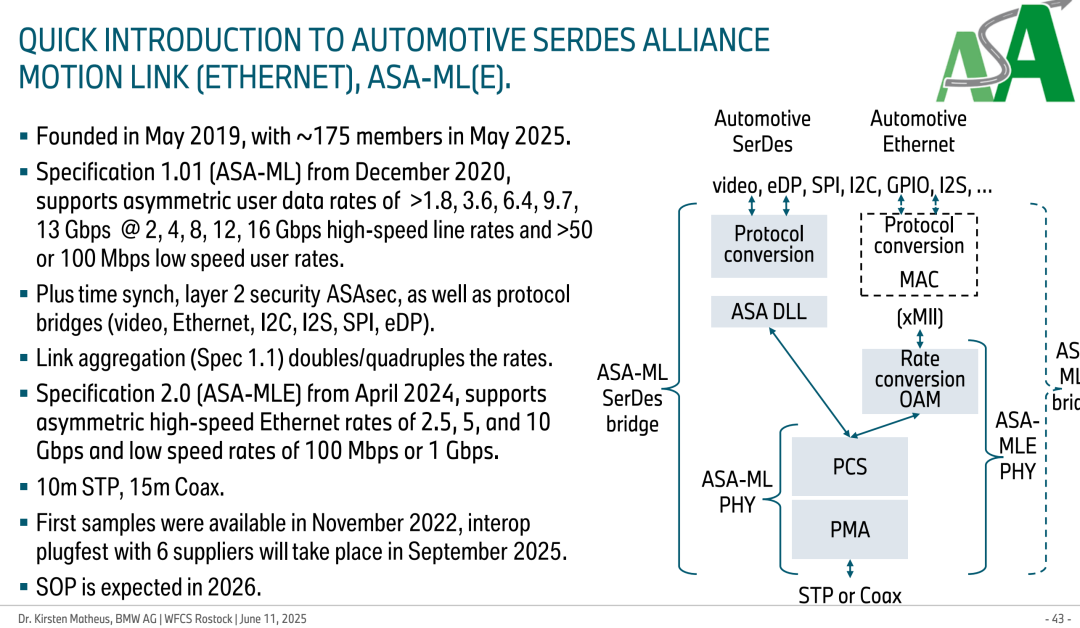
Image Source: Marvell
The biggest advantage of the TDD camp is its strong ecosystem and early start. BMW has already confirmed that it will use ASA-MLE in mass production models early next year.
TDD Camp
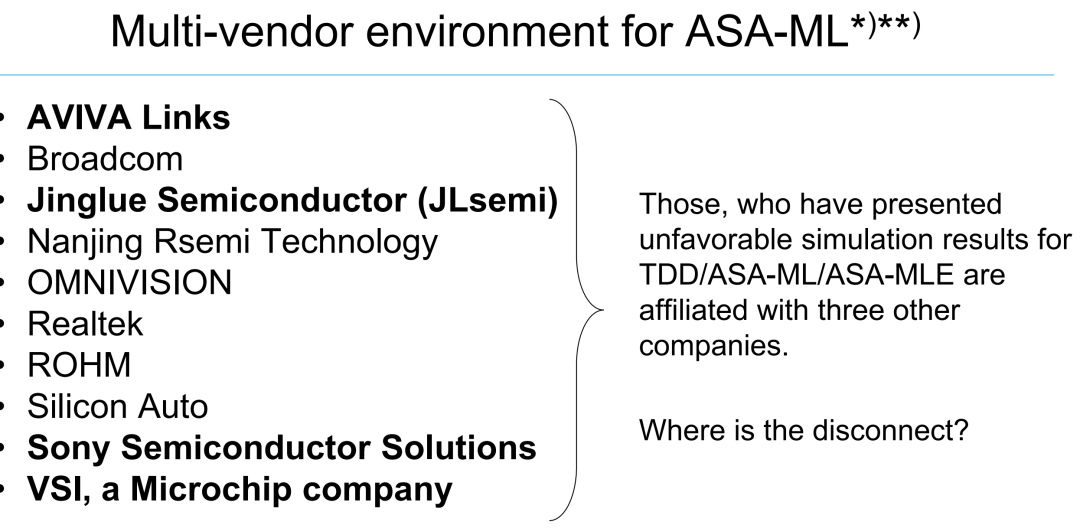
Image Source: BMW
Among them, Broadcom holds the most weight, but it is betting on both sides. Besides Broadcom, Realtek and Rohm also have significant influence. However, Realtek has almost no physical layer chips, mainly focusing on Ethernet switches. Excluding car manufacturers, the TDD camp and ACT camp are evenly matched.
Comparison of GMSLE with GMSL3/2
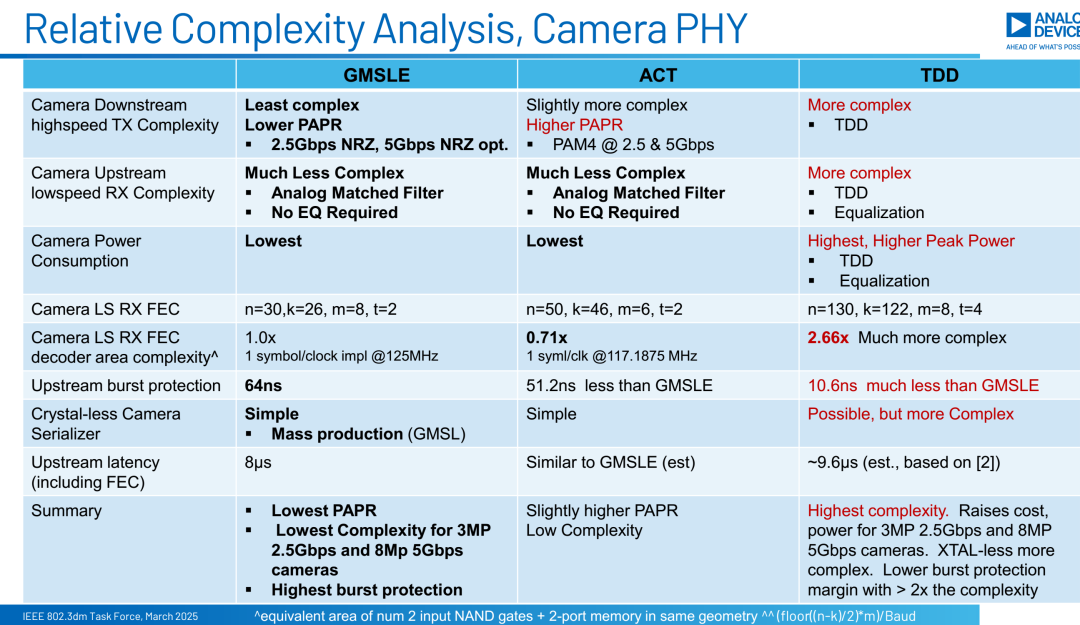
Image Source: ADI
Comparison of Physical Layers on the Camera Side
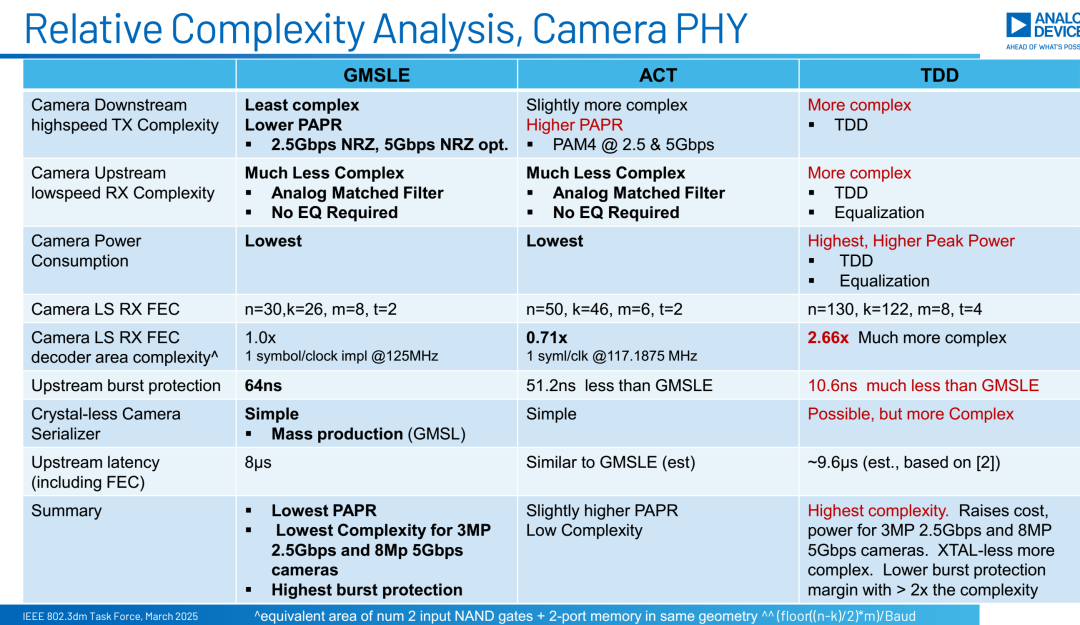
Image Source: ADI
ADI’s GMSL has not been idle either. In March of this year, ADI launched GMSLE, which is compatible with Ethernet, and in June established OpenGMSL. ADI’s GMSLE uses technology similar to ACT, both being FDD. The difference between GMSLE and ACT lies in the modulation technology; GMSLE uses NRZ, while ACT uses PAM4. NRZ (Non-Return-to-Zero) uses two signal levels to represent 1/0 information, transmitting 1 bit per cycle, which is less efficient but has high signal interference tolerance and low cost. PAM4 (Pulse Amplitude Modulation with Four Levels) uses four signal levels to transmit, sending 2 bits per cycle, doubling the data rate of NRZ, improving transmission efficiency, and reducing baud rate and channel loss. However, the system requires more complex digital signal processing (DSP) technology and forward error correction (FEC) to compensate for signal integrity issues, leading to relatively higher power consumption and increased costs.
GMSLE supports up to 10Gb Ethernet, while ACT should reach 25Gb. In the future, with many players in the mix, it is difficult to predict who will win. In China, apart from Huawei using Rohm’s Clockless, the rest are dominated by GMSL.
Disclaimer: The views and data in this article are for reference only and may differ from actual situations. This article does not constitute investment advice, and all views and data represent the author’s position, without any guidance, investment, or decision-making opinions.
More Zosi Reports
Zosi 2025 Research Report Writing Plan
Panorama of the Intelligent Connected Vehicle Industry Chain (December 2024 Edition)
| Cloud and AI | ||
| Vehicle Cloud | OTA Research | Intelligent Driving Simulation |
| Automotive Cloud Service Research | Autonomous Driving Maps | |
| TSP and Application Services | V2X and Vehicle Road Cloud Integration | |
| Data Closed Loop Research | Roadside Intelligent Perception | |
| AI Large Models | Automotive AI Large Model Research | Impact of AI Large Models on Vehicle Intelligence |
| Cockpit AI Application Research | In-Vehicle AI Agent Product Development and Commercialization | |
| AI Defines Vehicles | VLA Large Model Applications | |
| Driver Assistance System Integration and Application Layer | ||
| Autonomous Driving Application Framework | ADAS and Autonomous Driving Tier 1 – Domestic | Domestic Brand ADAS |
| ADAS and Autonomous Driving Tier 1 – Foreign | Foreign OEM ADAS Research | |
| L3/L4 Level Autonomous Driving and Startups | Ideal L8/L9 Function Breakdown | |
| Top 10 Comparisons of Intelligent Driving Tier 1 | Advanced Technology Research of Japanese Tier 1 | |
| Autonomous Driving Algorithms and Systems | End-to-End Driver Assistance Research | Integrated Parking Research |
| Redundant Systems | Cabin Parking Integration | |
| Driver Assistance Fusion Algorithms | Cabin Driving Parking Fusion | |
| Automotive Vision Algorithms | Unmanned Delivery Vehicles | |
| Navigation Assistance Driving (NOA) | ||
| Perception | Millimeter Wave Radar | Automotive Vision |
| LiDAR Research | Infrared Night Vision | |
| LiDAR Core Components | Automotive Ultrasonic Radar | |
| Software Defined Radar | In-Vehicle Cameras Tier 2 | |
| MEMS Sensors | Front View Integration | |
| ADAS Cameras | ||
| Intelligent Cabin System Integration and Application Layer | ||
| Intelligent Cabin Application Framework | Intelligent Cabin Tier 1 | Cabin Design Trends |
| Intelligent Cabin Platform | ||
| Cabin Display | In-Vehicle XR Research | HUD Industry Chain |
| Instrument and Central Control Display | Electronic Rearview Mirror | |
| Cabin Multi-Screen and Linked Screens | Dash Cameras | |
| HUD Industry Research | Intelligent Glass | |
| Cabin Interaction | In-Vehicle Voice | In-Vehicle Fragrance and Air Purification |
| In-Cabin Monitoring Research | Automotive Audio | |
| Automotive Multimodal Interaction | Intelligent Surfaces | |
| Gesture Interaction Development | ||
| Cabin Interconnected Entertainment and Ecosystem | Automotive Ecosystem Domain | Domestic Brand Vehicle Networking |
| Automotive Digital Key | Joint Venture Brand Vehicle Networking | |
| In-Vehicle Payment | New Force Brand Vehicle Networking | |
| In-Vehicle Information and Entertainment | Commercial Vehicle Vehicle Networking | |
| Automotive eCall System | Commercial Vehicle Intelligent Cabin | |
| Other Cabin | Automotive Seat Research | Intelligent Doors |
| Automotive Lighting | 75 Trends from the Shanghai Auto Show | |
| In-Vehicle Wireless Charging | Two-Wheeled Vehicle Intelligence | |
| AI/AR Glasses Research |
Cabin Patent Analysis |
|
| OS and Supporting Layers | ||
| SDV Framework | SDV: OEM Software Development and Supply Chain Deployment Strategies | Automotive Software Business Models |
| SDV: SOA and Middleware | ||
| Basic Software/System Platform | AUTOSAR Research | Automotive Operating Systems |
| Digital Instrument OS | ||
| Information Security/Functional Safety | Automotive Information Security | Automotive Functional Safety |
| Electronic and Electrical Architecture Layer | ||
| E/E Architecture Framework | E/E Architecture | Automotive Electronics OEM |
| 48V Low Voltage Power Supply Network | ||
| Intelligent Driving Domain | Autonomous Driving SoC | ADAS Domain Control Components |
| Autonomous Driving Domain Control | ||
| Cabin Domain | Intelligent Cabin Platform | Cabin Domain Control |
| Cabin SoC | 8295 Cabin Domain Controller Breakdown | |
| Vehicle Control Domain | Body (Zone) Domain Control Research | Automotive VCU Research |
| Electric Drive and Power Domain Controllers | ||
| Communication/Network Domain |
Central + Regional Communication Networks and Chips |
Commercial Vehicle T-Box |
| Wireless Communication Modules | High Precision Positioning | |
| Automotive Gateway | In-Vehicle Antennas | |
| Passenger Vehicle T-Box | Automotive UWB Research | |
| Cross-Domain Integration | Multi-Domain Computing and Regional Controllers | |
| Regional and Central Computing | Body (Zone) Domain Control Research | |
| Other Chips | Automotive MCU Research | Automotive RISC-V Research |
| In-Vehicle Storage Chips | Sensor Chips | |
| Power Management Chips | Automotive CIS Research | |
| Automotive Chip Supply Chain Research |
In-Vehicle RF SoC Research |
|
| Power Layer | ||
| Power | Hybrid Power Report | Power Management Chips |
| 800-1000V High Voltage Platform | Electric Drive and Power Domain Research | |
| IGBT and SiC Research |
High Voltage Power Supply Architecture Research |
|
| Energy | Integrated Batteries | Charging and Swapping Research |
| Fuel Cells | Mobile Charging Robots | |
| Solid-State Batteries | Digital Power and Chips | |
| Other | Thermal Management Systems | Integrated Die Casting |
Research on Automotive Micro Motors and Motion Mechanisms |
||
| Mechanical Layer | ||
| Chassis/Actuation | Passenger Vehicle Chassis Domain Control | Electric Control Suspension |
| Line Control Braking & AEB | Key Components of Intelligent Steering | |
| Steering Systems | Commercial Vehicle Intelligent Chassis | |
| Skateboard Chassis Research | Digital Chassis Research |
| AI Robots | ||
| AI Robots | PBV and Automotive Robots | Unmanned Delivery Vehicles |
| Mobile Charging Robots | Flying Cars | |
| Embodied Intelligence Research | Tactile Sensor Research | |
| Robot Controller Research | ||
| Other Macro | ||
| Vehicle Model Platforms | Automaker Modular Platforms | OEM Vehicle Planning Research |
| Going Global | OEM Overseas Layout | Cabin Going Global Research |
| Intelligent Assisted Driving Going Global Research | ||
| Policies, Standards, and Access | Intelligent Assisted Driving Regulations and Automotive Going Global | Autonomous Driving Standards and Certification |
| Other |
New Technology Application Trends |
Trends for New Vehicles and Suppliers in 2024-2025 |
| Analysis of New Vehicle Configurations in Q1 2025 |
「Zosi Research Monthly Report」
ADAS/Intelligent Vehicle Monthly Report | Automotive Cabin Electronics Monthly Report | Sensor Monthly Report | Battery, Motor, and Electric Control Monthly Report | In-Vehicle Information System Monthly Report | New Technology Monthly Report | China AI and Robotics Monthly Report

「Contact Information」
Mobile number same as WeChat number

Industry Research Department丨Mr. Fu 15810027571
Mr. Zhao 18702148304
Data Services Department丨Ms. Zhang 13716037793
Strategic Consulting Department丨Ms. Han 15810133447
Promotion and Communication Department|Ms. Liao 13718845418