🌐 Best Edge AI Development Boards for Summer 2025
Author: David Tischler Published 1 month ago • AI and Machine Learning
As July reaches its peak, what better way to welcome the “Summer of Edge AI” than by reviewing the best edge AI hardware and devices of the season?
Over the years, edge AI hardware has continuously evolved (and shrunk in size), now available in a variety of shapes and sizes. Of course, the “best” hardware ultimately depends on your project requirements, goals, budget, and technical specifications. So while these are Hackster’s selections, keep in mind that there are many other options available on the market. If we missed any boards, or if you find some development boards that are perfect for your project, please let us know!
Given the diverse range of hardware, we decided to create several different groupings and categorize the hardware into similar device categories. For this comparison, we will divide them into the following four categories:
Microcontrollers (MCU): Hobbyists/Makers/Individual Developers
Microcontrollers (MCU): Professional Developers (from Prototyping to Mass Production)
Application Processors (CPU): Hobbyists/Makers/Individual Developers
Application Processors (CPU): Professional Developers (from Prototyping to Mass Production)
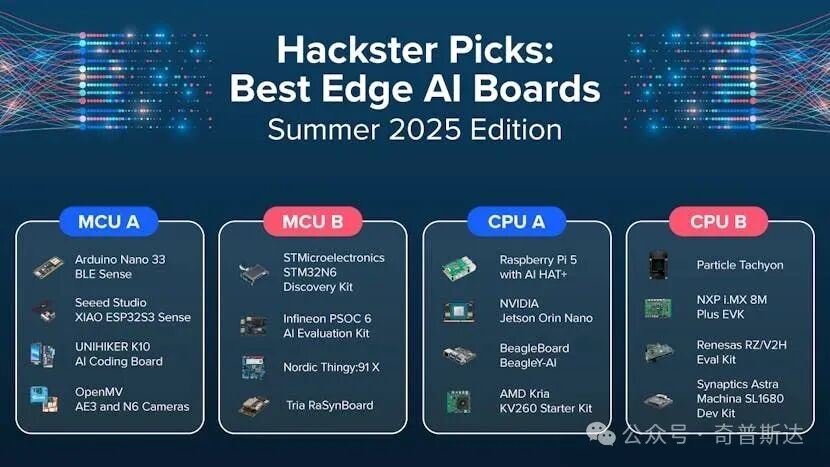
Essentially, this means we are dividing the boards into two categories: one running some version of Linux, and the other based on some embedded firmware or RTOS. Another division is by market segmentation and target audience; some boards are relatively inexpensive, aimed at beginners and home users, while others are specifically designed for integration into product designs, featuring long-term supply, enterprise support, certification and compliance, and other characteristics required for product development (such as payment terminals, medical devices, ATMs, home appliances, automotive loads, human-machine interface panels, military and defense, robotics, etc.).
Now that the categories are defined, let’s dive into Hackster’s best edge AI development boards for Summer 2025! We will start with the most accessible and popular group—MCU devices suitable for hobbyists and makers. Next will be enterprise-grade MCUs, followed by single-board computers for beginners and home users, and finally, professional-grade Linux SBCs.
Group A – MCU: Personal/Home Users
These development boards are known for being beginner-friendly and low-cost, and because they are based on MCUs, they perform excellently in edge AI scenarios where battery life is crucial.
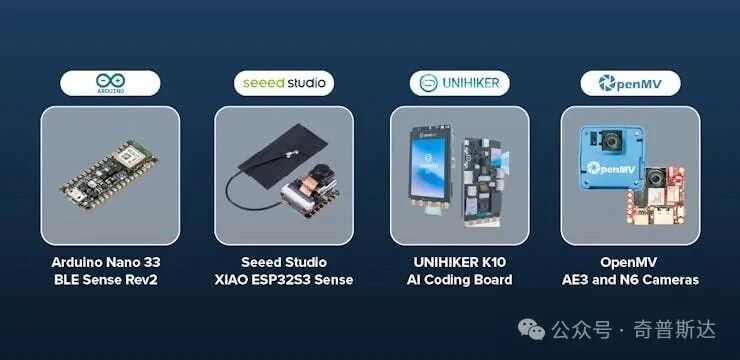
Arduino Nano 33 BLE Sense Rev2 The Arduino Nano 33 BLE Sense Rev2 may be the gold standard for tinyML and entry-level edge AI. It is affordable, easy to use, and can be found almost anywhere in the world. It also comes with a range of onboard sensors, including an IMU (for motion and orientation), gesture, light, proximity, and color sensors, temperature, pressure, and humidity sensors, as well as a microphone. These built-in sensors, along with the ability to expand with more sensors, make it an excellent starting point for edge AI projects. It is important to note that limited processing power and memory mean that most computer vision use cases cannot be achieved, but sensor and small audio applications work perfectly on this board.
Seeed Studio XIAO ESP32-S3 Sense For beginners looking to learn computer vision, the Seeed Studio XIAO ESP32-S3 Sense is a better choice. While it does not have as many sensors as the Arduino Nano 33 BLE Sense, it does add a camera (and microphone) and is powered by a more powerful Xtensa LX7 dual-core 32-bit ESP32 processor, with a clock speed of up to 240MHz, equipped with 8MB PSRAM and 8MB Flash. Most importantly, it is only $15! Seeed also provides a wealth of tutorials and example projects to help you get started quickly.
UNIHIKER K10 AI Programming Board Developed by the DFRobot team, the UNIHIKER K10 AI programming board may be the easiest development board for students and hobbyists to get started with. The UNIHIKER K10 comes pre-installed with various AI examples that can run directly, including face detection, cat and dog detection, action classification, and more. The device also features a 2.8-inch LCD display, making it more interactive and intuitive for learning edge AI. The board supports visual “block” programming, as well as MicroPython, again targeting new developers to make it easier for them to program the K10. Due to its educational attributes, DFRobot also provides a complete set of excellent learning tutorials that users can follow to start building their own edge AI applications.
Additional Recommendation: OpenMV AE3 and N6 Cameras While they cannot officially be listed among the best edge AI development boards for Summer 2025, they are worth mentioning. These two devices recently achieved great success on Kickstarter, bringing dedicated AI acceleration capabilities to the OpenMV ecosystem for the first time and will be compatible with the powerful OpenMV IDE. The AE3 version is powered by the Alif Ensemble E3 MCU and is only the size of a postage stamp; while the N6 version will adopt the classic OpenMV Cam form factor, powered by the STM32N6 MCU (which will be detailed later). Once they are fully launched, we expect many exciting projects to be built based on them!
Group B – MCU: Professional/Mass Production Level
This category still retains the low-power advantages of MCUs but is aimed at professional engineers and product developers who will ultimately customize PCBs around the chip design or integrate the platform into existing products and devices for scalability.
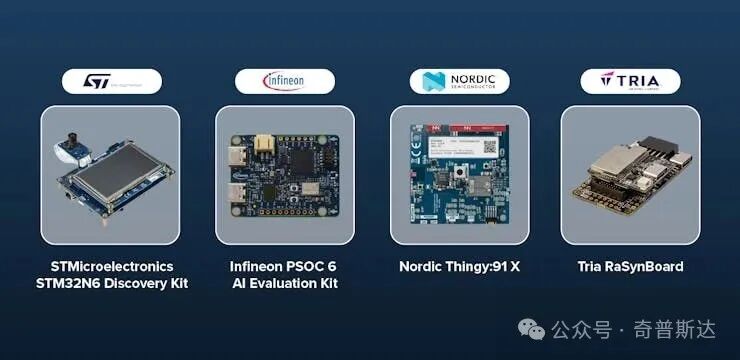
STMicroelectronics STM32N6570-DK The STM32N6 Discovery Kit was released earlier this year and quickly sold out due to high demand and popularity! The supply chain is now catching up, and it is available for purchase again. This Discovery Kit is feature-rich, with an excellent out-of-the-box experience, and the built-in demo applications run automatically at startup, showcasing high-speed video inference and smooth video playback, thanks to its integrated Neural-ART AI accelerator. The kit also comes with a camera and includes USB interfaces, Ethernet, a microSD card slot, and a microphone, making it easy to build, expand, and integrate.
Infineon CY8CKIT-062S2-AI For enterprise-grade MCU projects that do not focus on computer vision, the Infineon PSOC 6 AI Evaluation Kit is an excellent choice. It is compact and comes with various onboard sensors, but unlike hobbyist development boards, it also includes USB expansion, battery interfaces, and Qwiic expansion. Additionally, it is supported by Infineon’s machine learning platform DEEPCRAFT™ Studio (formerly Imagimob Studio). This capability alone can significantly accelerate product development, as the platform is a web-based model development environment that allows for quick and easy deployment of models to the development board.
Nordic Thingy:91x The latest addition to Nordic Semiconductor’s “Thingy” series, Thingy 91:X, is an upgraded version of the previous Thingy:91 and is the only development board in our MCU category with cellular connectivity. Cellular networks can be crucial for edge AI projects that need to be deployed in the real world, away from Wi-Fi or Ethernet. The Thingy 91:X features built-in accelerometers and gyroscopes for motion sensing, as well as temperature, humidity, air quality, and pressure sensors for environmental monitoring. The board connects to Nordic’s nRF Cloud service, supporting firmware updates, location services, and more, effectively enabling your IoT products to achieve AI capabilities.
Additional Recommendation: Tria RaSynBoard As an additional recommendation in this category, the Tria RaSynBoard is a truly unique board with few similar products on the market. It is a very small SoM and carrier board containing a Renesas RA6 MCU and a Syntiant NDP120 neural decision processor. It is entirely focused on audio applications, such as wake word detection, keyword recognition, audio classification, etc. Its small size allows for easy integration into product designs, such as smart remotes, home appliances, and home automation hubs, low-power always-on environmental monitoring solutions, etc.
Group C – CPU: Personal/Home Users
Moving beyond the MCU world into the realm of microprocessor-based Linux, developers can build more robust applications while running multiple services and leveraging greater processing power and memory. These development boards particularly emphasize ease of use and are an excellent starting point for expanding edge AI capabilities compared to MCU options.
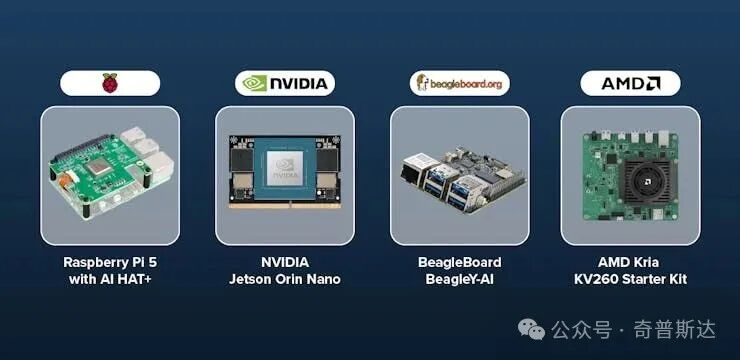
Raspberry Pi 5 with AI HAT+ For developers who have hardly run AI on a single-board computer, the Raspberry Pi 5 with the AI HAT+ accessory is the easiest way to get started! Like all Raspberry Pi products, it emphasizes documentation, ease of use, example projects, and user support, providing a smooth development experience. The AI HAT+ comes in two computing power specifications: 13 TOPS (with Hailo-8L accelerator) and 26 TOPS (with Hailo-8 accelerator). Installation is straightforward, just like other HATs, plugging into the Raspberry Pi’s GPIO pins and connecting via a PCIe ribbon cable. The built-in camera application in Raspberry Pi OS can directly utilize the NPU for post-processing and provides examples for object detection, pose estimation, and image segmentation, with more models available from the Hailo Model Zoo.
NVIDIA Jetson Orin Nano For developers looking to learn and explore generative AI (such as LLM and VLM) topics, the NVIDIA Jetson Orin Nano is an ideal choice. It is the successor to the original Jetson Nano, priced higher but with significantly more power and a more modern software stack. With Dustin Franklin’s Jetson AI Lab project, it can easily run LLM, VLM, Whisper, LlamaSpeak, etc., in a containerized manner, and has excellent documentation. Its built-in Ampere architecture GPU also supports robotics and autonomous driving projects and is compatible with CUDA and Deepstream. It is an excellent starting point for learning GPU programming and the software ecosystem before gradually moving on to large data center-level products.
BeagleY-AI The BeagleBoard series has always had a passionate and highly supportive community, making BeagleY-AI a great platform for prototyping, teaching, learning, and exploring robotics and edge AI. It adopts the same form factor as the Raspberry Pi but is based on the Texas Instruments AM67A SoC, featuring a 4 TOPS AI accelerator. The board is open-source, and its design can be iterated or modified based on specific use cases.
Additional Recommendation: AMD Kria KV260 This development board has been on the market for a while but has recently been updated, making it worth a second look if you haven’t paid attention before. Some believe that FPGAs should fall into Group D (Professional/Mass Production Level), but AMD Xilinx’s entry-level FPGA development board Kria KV260 uses the Zynq UltraScale+ MPSoC, is relatively inexpensive, and can run Ubuntu on its Arm Cortex cores, designed to make it easy for developers to get started with FPGAs rather than facing those expensive professional-grade FPGA products. It includes example applications, comprehensive documentation, and is a great aid for learning FPGA programming.
Group D – CPU: Professional/Mass Production Users
Leading the professional engineer category is the Particle Tachyon, a turnkey solution for edge AI projects that require off-grid connectivity. It is easy to use and has an impressive out-of-the-box experience, which means it could also be categorized among Group C consumer boards. But its true strength lies in Particle’s seamless cellular connectivity and device fleet management capabilities. Tachyon is powered by the Qualcomm Dragonwing 6490 SoC, an octa-core CPU paired with a Hexagon NPU, providing 12 TOPS of accelerated AI inference performance. Tachyon has just started shipping after a successful Kickstarter crowdfunding campaign, and the team has maintained good communication throughout the process.
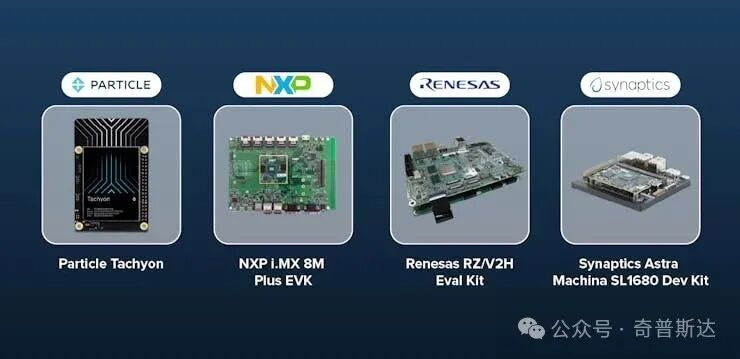
NXP i.MX 8M Plus EVK The i.MX8MP SoC appears in many professional-grade boards across the ecosystem, covering a wide variety of shapes and sizes. But before entering mass production and scaling, the best way to familiarize yourself with this SoC and the NXP software stack is to use the official NXP i.MX 8M Plus EVK. In addition to the quad-core Arm Cortex-A processor, this SoC also includes a 2.3 TOPS AI accelerator, allowing your edge AI applications to run accelerated inference directly on the device. Of course, NXP also provides comprehensive documentation, support, and long-term supply assurance, enabling developers to confidently enter the market.
Renesas RZ/V2H Eval Kit The Renesas RZ/V2H is one of the most powerful edge AI SoCs on the market (as of July 2025), capable of delivering up to 100 TOPS of inference power in a compact form factor, designed for edge deployment. To make application and product development easier, Renesas has also just announced a partnership with Canonical to bring Ubuntu support to this development board—allowing for faster prototyping. If security and reliability of Yocto are needed later in the product development cycle, it can be switched over. In addition to the official RZ/V2H Eval Kit, there are various other boards from different manufacturers based on the same SoC to meet different form factors and price needs.
Additional Recommendation: Synaptics Astra Machina SL1680 Dev Kit As a new member of the edge AI ecosystem, the Synaptics Astra Machina Foundation series looks like an excellent edge AI solution, with a form factor similar to the Jetson Orin Nano. The SL1680 SoC is a quad-core Cortex-A73 processor with an 8 TOPS NPU for AI acceleration. From Synaptics’ product website, you can see high-quality documentation, a comprehensive developer zone (including resources, examples, and model libraries), and a wealth of GitHub repositories to help developers get started quickly and begin building applications. We are very much looking forward to trying out this device soon!
Conclusion
That concludes Hackster’s selection of top edge AI development boards, covering a range of price points and use cases from entry-level to high-end professional.
But remember, this list is just a starting point. Ultimately, the “best” edge AI development board is always the one that best meets your project’s actual needs. So if you are using other development boards, that’s great too! In fact, please let us know, as it might appear in our future lists!
Wishing everyone a creative Summer of Edge AI! 🌞🤖