Pengpai News Reporter Chen Qinhang
On the evening of August 29, Indian Prime Minister Modi held a summit meeting with Japanese Prime Minister Kishida Fumio in Tokyo. Both countries have their needs: India, facing a tariff impact of up to 50% from the United States, hopes to expand economic cooperation with Japan. The Japanese government, on the other hand, aims to incorporate the vitality of India, the world’s most populous country with vast market expansion prospects, into its own growth trajectory.
During the Japan-India summit, the two sides reached the “Japan-India Economic Security Initiative,” ensuring the supply of critical materials and cooperation in key technologies, focusing on areas such as semiconductors, critical minerals, pharmaceuticals, clean energy, and information communication. Japan proposed a new target of 10 trillion yen (approximately 486.7 billion yuan) in private investment in India over the next decade.
Additionally, Japan and India revised the “Joint Statement on Security Cooperation,” explicitly including economic security, joint research and development of defense equipment, and technology management in emerging fields such as cyberspace and space. The statement signed in 2008 primarily focused on joint training of the Indian military and Japan’s Self-Defense Forces and maritime security cooperation.
Regarding the high-speed rail project that India is currently constructing, the leaders of Japan and India agreed to cooperate in introducing the new Shinkansen train “E10 series” being developed by JR East.
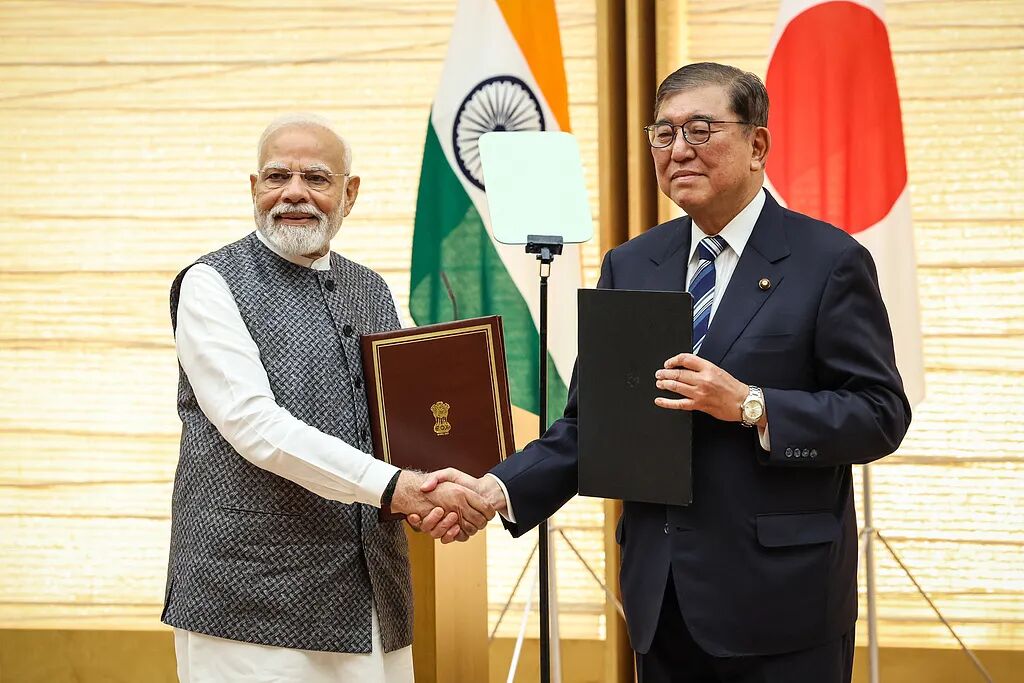
On August 29, 2025, local time in Tokyo, Indian Prime Minister Modi and Japanese Prime Minister Kishida Fumio shake hands at a joint press conference. Modi is on a diplomatic visit to Japan. Visual China Photo
“Semiconductors and Rare Earths are Top Priorities”
According to NHK, Kishida Fumio stated in his opening remarks at the summit that the Japan-India relationship has made significant progress over the past decade, “thanks to Prime Minister Modi.” Modi expressed his gratitude and stated at the post-meeting press conference: “Our special strategic global partnership has entered a new era, and we have established a roadmap for the next decade.”
The leaders of Japan and India reached the “Japan-India Economic Security Initiative.” Modi pointed out that under this framework, the two countries will advance a comprehensive strategy in key strategic sectors, stating, “Semiconductors and rare earths are top priorities.” “I believe that Japan’s technology combined with India’s talent is the ideal combination.”
On August 30, Modi and Kishida Fumio will visit Miyagi Prefecture to inspect the base of Tokyo Electron, a giant in semiconductor manufacturing equipment.
Tata Electronics, a subsidiary of the large Indian conglomerate Tata Group, announced last September a partnership with Tokyo Electron. Tata Group is advancing the construction of semiconductor factories in India, with Tokyo Electron providing support, including talent training.
The Modi government has proposed the “Make in India” strategy to revitalize manufacturing, promoting the introduction and cultivation of the semiconductor industry through subsidies and other means. Japanese companies are also seeking to enter the Indian market, with Tokyo Electron having established a marketing base in India and further expanding its business.
Vaidya Baladwaj, the head of Tokyo Electron’s India project, stated in an interview with the Economic Times of India in March this year that, in the long term, Tokyo Electron plans to establish part of its supply chain in India. He mentioned that although India’s semiconductor industry is still in its early stages, the government and industry are following a “pragmatic approach”—first focusing on traditional process nodes and gradually moving towards high-end chips, laying a “solid foundation”. It is expected that in the next four to five years, India will become an important investment destination in this field.
According to Nikkei Asia Review on August 28, Japan and India are taking measures to transfer Japan’s outdated semiconductor and LCD technology production to India. Many products still require the use of these traditional technologies. Older semiconductors can be used for voltage control in electric vehicles and for improving the efficiency of air conditioners and refrigerators.
Analysts point out that although India’s electronics industry is growing, it still relies on imports from China for core semiconductor components. Modi hopes that these products can be produced domestically, establishing a large-scale production model by introducing Japan’s traditional technology and leveraging the cost competitiveness of the local workforce.
Indian Ambassador to Japan, Sibi George, recently stated in an interview with NHK that there is complementarity between Japan and India, and he hopes to further promote cooperation in areas such as AI. He called on Japanese companies to expand their investment in India, stating, “Currently, about 1,500 Japanese companies have entered India, but we hope to increase that number to 15,000 in the future.”
India’s Introduction of Japan’s Shinkansen Delayed Again
The joint statement issued by the two leaders includes a “Japan-India flagship project,” confirming the promotion of India’s high-speed rail project to introduce Japan’s new Shinkansen train “E10 series.”
The cooperation between Japan and India on the high-speed rail project dates back to 2015 when the Modi government proposed the “Diamond Quadrilateral” development plan, which aims to connect major cities such as Delhi, Mumbai, Chennai, and Kolkata with high-speed rail. In December of that year, then-Japanese Prime Minister Shinzo Abe and Modi reached an agreement on India’s introduction of the Japanese Shinkansen during a summit meeting.
India’s first high-speed rail line—from Mumbai to Ahmedabad—has decided to adopt the Japanese Shinkansen, with a total length of about 508 kilometers, including 12 stations such as Baroda and Surat. If the project is completed smoothly, the travel time from Mumbai to Ahmedabad can be reduced from over six hours to two hours.
In September 2017, Modi and Abe announced the official launch of the high-speed rail cooperation project, with plans to open it in 2023. The two governments initially estimated the total project cost to be about 1 trillion rupees (approximately 81.1 billion yuan), with 80% of the funding provided by Japanese government development assistance (ODA) in the form of yen loans, with an interest rate of 0.1% and a repayment period of 50 years. To date, contracts for approximately 1 trillion yen in loans have been signed.
However, contrary to the expectations of both governments, the progress of land acquisition has been unusually slow, especially in Maharashtra, where many generations of farming families are unwilling to give up their land and oppose the construction of the high-speed rail. As the land acquisition progress delays, material prices and labor costs have risen, causing project costs to continue to climb.
According to the original plan, India intended to introduce the JR East “E5 series” trains currently used on the Tohoku and Hokkaido Shinkansen, but due to “prices far above international standards” and delays in delivery, India is inclined to consider using domestically produced trains. In December of last year, to break the negotiation deadlock, the Japanese side proposed to switch to the next-generation Shinkansen “E10 series” currently under development.
If the E10 series is adopted, issues related to the scope of technology transfer and increased vehicle costs will arise. According to Kyodo News, during this summit meeting, both sides reached an agreement on cooperation to introduce the “E10 series” train and the Japanese-style system.
The maximum speed of the “E10 series” is the same as that of the “E5 series,” both at 320 kilometers per hour, with the main upgrade being the installation of new devices with higher seismic resistance, thereby enhancing safety. India plans to procure 24 trains (each with 10 carriages), some of which will be produced domestically. Japan plans to start commercial operation of the “E10 series” in 2030 and will almost simultaneously introduce it to India.
Thisissuewasedited by Zou ShanRecommendedReadingList