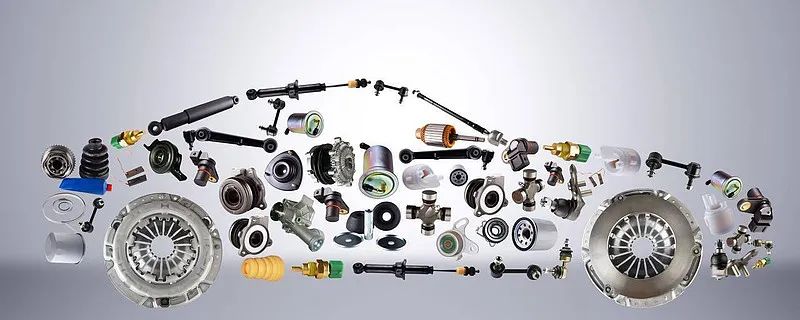
 What are Automotive Grade Chips
Automotive chips are the core components of automotive electronic systems and are an important foundation for the transformation and upgrading of the automotive industry. In the automotive manufacturing industry, the reliability requirements for automotive grade chips are undoubtedly higher than those for commercial and industrial grade chips. As the name suggests, automotive grade chips are chips used in vehicles, which differ from consumer and industrial products in that they have higher reliability requirements, such as operating temperature range, operational stability, and defect rates. At the same time, automotive grade chips that meet these reliability requirements are also regarded as the highest entry threshold in the industry.
 Classification of Automotive Chips
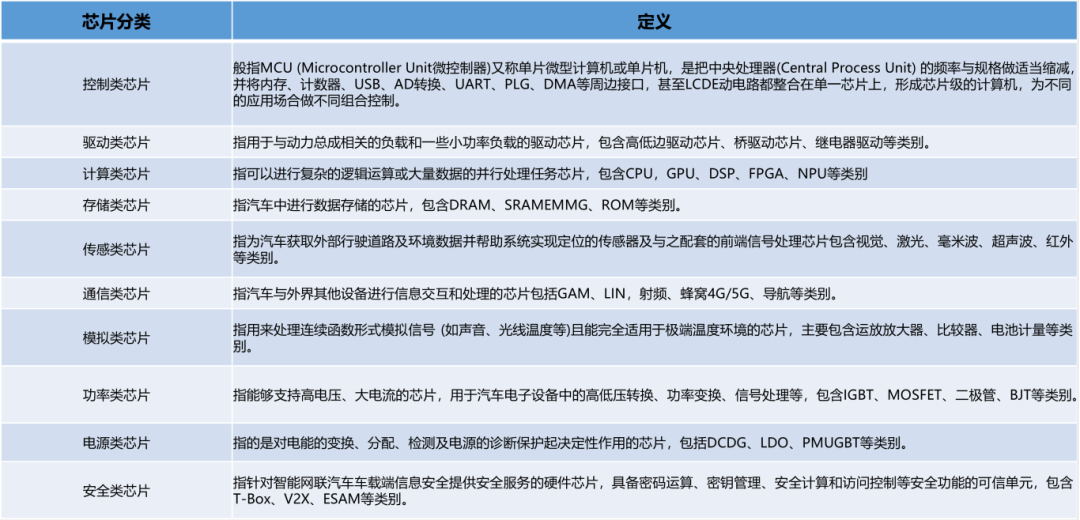
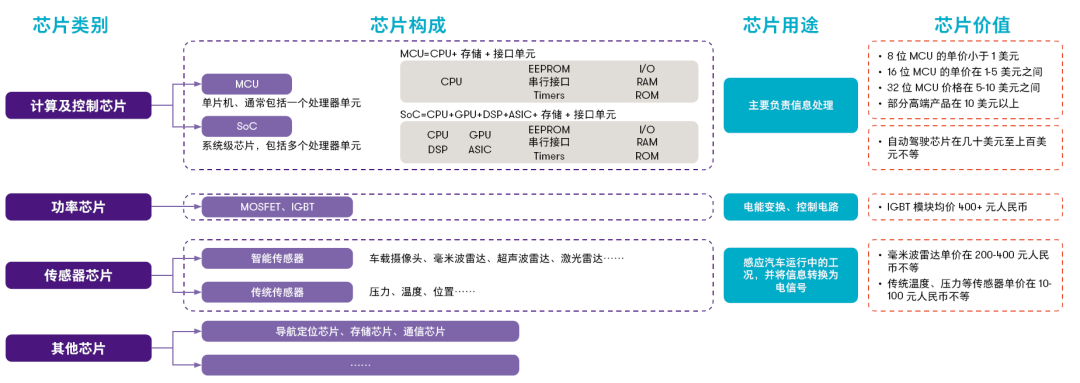
According to different functional implementations, automotive chip products are divided into ten categories: control chips, computing chips, sensor chips, communication chips, storage chips, security chips, power chips, driver chips, power management chips, and other types of chips.
-
Control chips mainly involve technologies related to power system control, chassis system control, etc.;
-
Computing chips include smart cockpit and smart driving chips;
-
Sensor chips mainly involve technologies related to visible light images, infrared thermal imaging, millimeter-wave radar, lidar, and other types of sensors; communication chips mainly involve cellular, direct connection, satellite, dedicated short-range transmission, Bluetooth, wireless local area network (WLAN), ultra-wideband (UWB), and Ethernet communication technologies inside and outside the vehicle;
-
Storage chips mainly involve static storage (SRAM), dynamic storage (DRAM), non-volatile flash memory (including NOR FLASH, NAND FLASH, EEPROM), etc.;
-
Security chips refer to chips that exist in the form of independent chips and provide information security services for the vehicle;
-
Power chips mainly involve insulated gate bipolar transistors (IGBT), metal-oxide-semiconductor field-effect transistors (MOSFET), etc.;
-
Driver chips mainly involve power driving, display driving, etc.;
-
Power management chips mainly involve battery management systems (BMS), digital isolators, etc.;
-
Other types of chips include system base chips (SBC), etc.
Characteristics of Automotive Chips
Automotive grade chips, compared to consumer and industrial grade chips, have characteristics of high reliability, high safety, and high stability, requiring zero defects and long-term supply (generally a supply cycle of 10-15 years), and must meet the AEC (Automotive Electronics Council) standards for automotive grade chips.
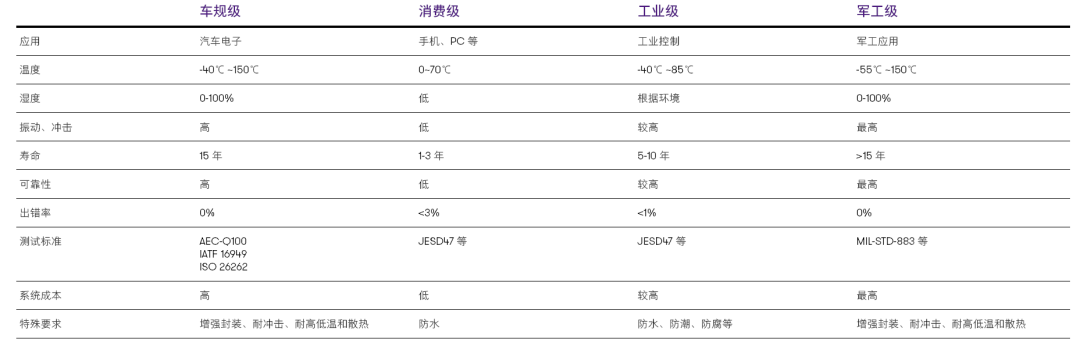 Process of Automotive Grade Chips “Going to Market”
Generally speaking, it takes about 3.5 to 5.5 years for automotive grade chips to go from design to mass production, and after going to market, they are expected to be supplied in bulk for 5-10 years.
-
Considering the overall vehicle project development process and the chip design and development process, it takes 3.5 to 5.5 years for chips to go from design to mass production, and once the chips are in the vehicle, they must meet the OTA (Over-The-Air) upgrade iteration requirements within the 5 to 10-year lifecycle of the automotive product.
-
The certification work for entering Tier 1 or OEM mainly includes: 1) certification AEC-Q100; 2) compliance with zero defect supply chain quality management standards IATF16949.
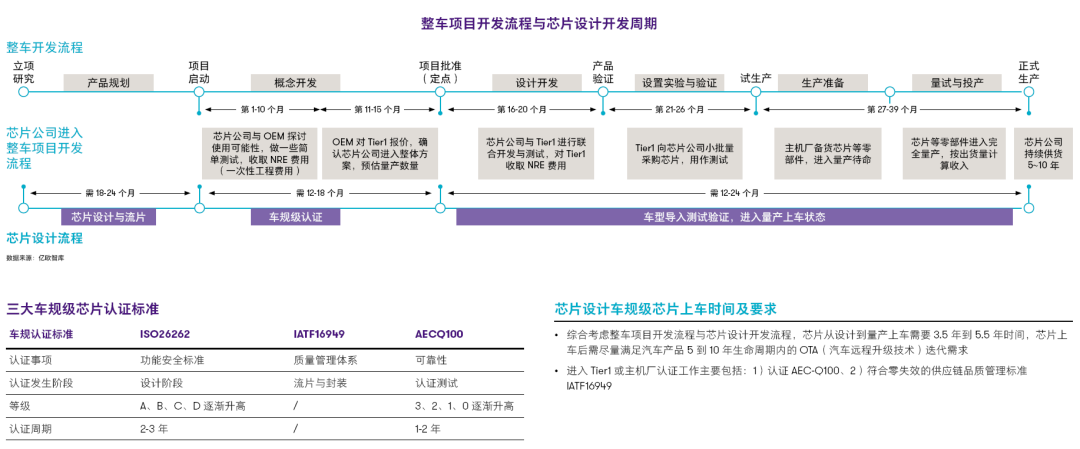
Introduction to Automotive Grade Certification
Regarding “automotive grade certification”, there is currently no clear definition in the industry. Generally speaking, automotive grade certification refers to a series of standards and certifications that electronic components used in the automotive field must meet. (However, there may be differences in different contexts)
These standards aim to ensure that automotive electronic control systems can operate stably and reliably in various complex environments. Automotive grade products need to undergo strict quality control and testing verification, possessing high reliability, high durability, and high safety, providing sufficient assurance for the performance and safety of vehicles.
Why Emphasize Automotive Grade?
The number of components in a vehicle is extremely high, and the probability of failure is cumulative.
For traditional vehicles, an ECU unit is typically composed of about 300 ICs, with 50 ECUs making up a vehicle. Assuming each IC has a failure rate of 1 PPM (parts per million), then an entire vehicle would have 15,000 PPM, meaning 1.5 vehicles out of 100 would fail.
Even if upstream and downstream manufacturers in the supply chain cooperate, a 1.5% failure rate would have terrifying consequences for vehicles with high safety requirements. Therefore, the automotive manufacturing industry often emphasizes one metric, zero defects.
Moreover, the operating environment of vehicles is extremely variable and harsh. Temperature fluctuations, extreme weather conditions, vibrations, collisions, and humidity all impose high demands on automotive components. For example, the temperature distribution inside a vehicle is uneven; areas close to the engine may be very hot, while brake pads can instantaneously reach temperatures exceeding 100 degrees Celsius during operation. These conditions must be fully considered during the design phase and rigorously verified during the final testing phase.
Thus, meeting automotive grade standards is of high difficulty and time cost, and considering that high performance is sometimes also required, it is reasonable for projects to use “automotive grade” as a selling point.
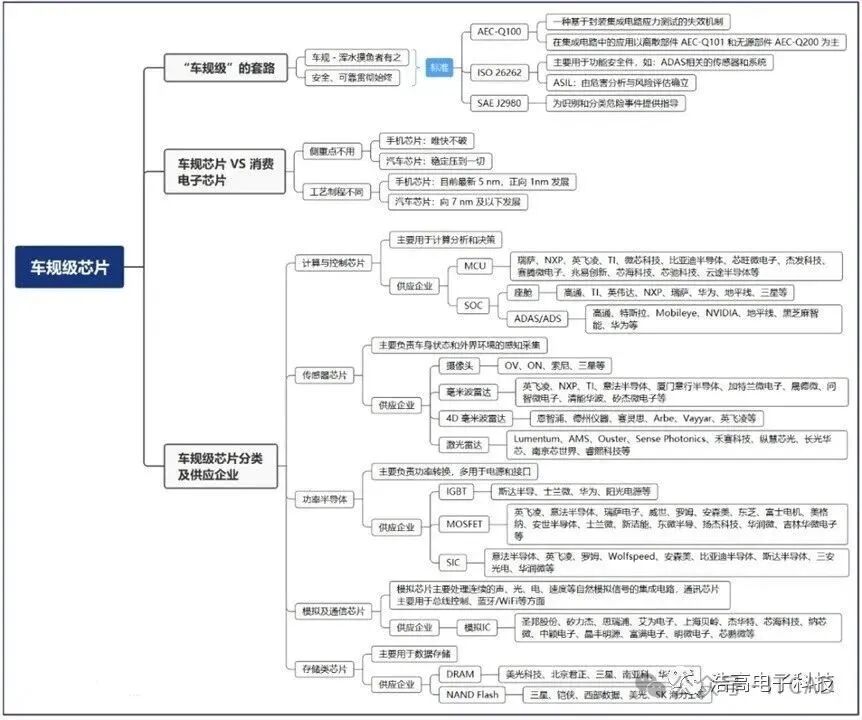
Before chips are truly put into mass production, they often undergo a series of strict testing and verification to ensure the reliability of processes and products, meeting automotive grade requirements. The automotive grade certification of chips is mainly controlled from three dimensions: system, functional safety, and reliability. IATF16949 is the standard specification for the quality management system of automotive design, development, and production; ISO 26262 is the assessment and certification for automotive functional safety; the AEC-Q series mainly focuses on the reliability assessment specifications for automotive electronic components. For reliability standards, familiar ones like GB are mainly aimed at consumer, commercial, and industrial products. For automotive components, the main standards are the AEC-Q series and JEDEC. For military standards, the main ones follow MIL-STD-883, 202, 750 standards, and GJB.
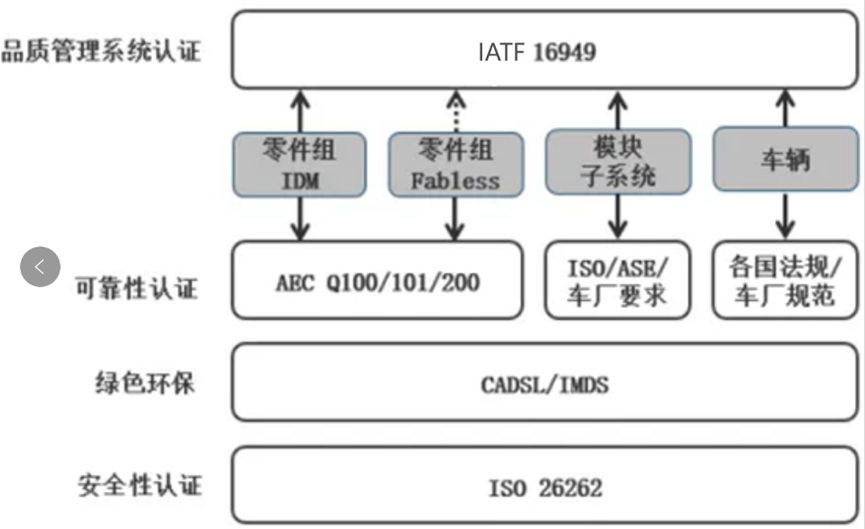
The main standards related to automotive grade include technical standards, system standards, functional safety standards.
AEC-Q100 and JEDEC are technical standards that have strict, specific, and standardized working procedures.
ISO9001 and IATF16949 only propose a requirement, but do not have strict and specific data representation.
ISO26262, while involving many technical standards and specifications during implementation (such as hardware design specifications, software coding standards, etc.), is not a technical standard. It focuses on the functional safety of automotive electronic systems, ensuring that systems can meet specific safety objectives during design, development, and production.
|
Serial Number |
Technical Standards JEDEC/AEC Q |
Quality Management System Standards ISO 9001/IATF 16949 |
Functional Safety Standards ISO 26262 |
|
1 |
Has strict, specific, standardized working procedures |
Only proposes requirements |
Focuses on functional safety, ensuring that products are safe and reliable in specific functions |
|
2 |
Has unified, absolute judgment standards |
No absolute, unified judgment standards, determined by the company’s own situation |
Has clear functional safety objectives and safety levels (ASIL) |
|
3 |
Basically application-oriented |
Only elaborates on management ideas, management logic, management methodology |
Focuses on product functional safety and risk management |
|
4 |
Is a target to be achieved |
Is a specific means of realization |
Ensures that products meet functional safety requirements during design, development, and production |
|
5 |
Product itself |
Daily production and operation activities |
Focuses on the product itself |
IATF16949, AEC-Q, ISO26262 Introduction
1IATF 16949
To coordinate international automotive quality system specifications, major automotive manufacturers and associations established a specialized organization in 1996, known as the International Automotive Task Force, abbreviated as IATF. IATF 16949: 2016 is based on ISO 9001: 2015, released in October 2016, replacing ISO/TS 16949.It is not an independently implementable quality management system but includes specific supplementary requirements for the automotive industry, implemented in conjunction with ISO 9001:2015.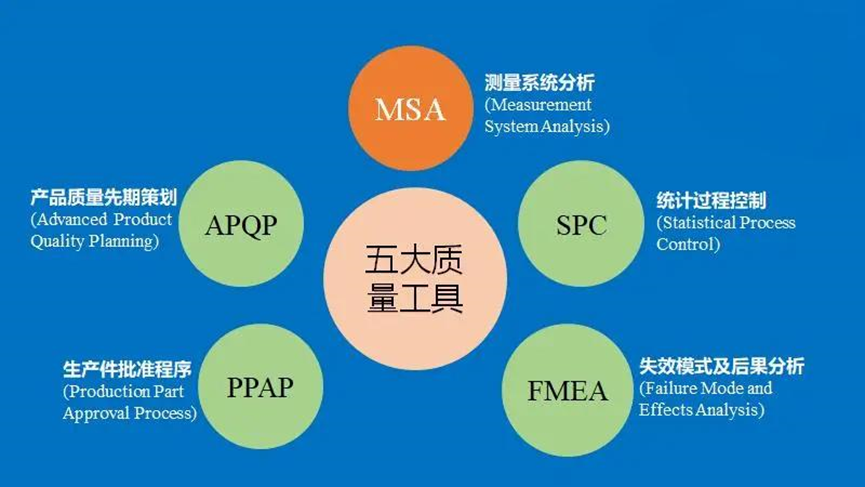 The IATF 16949 standard has five major tools:Advanced Product Quality Planning (APQP), Failure Mode and Effects Analysis (FMEA), Measurement System Analysis (MSA), Statistical Process Control (SPC), Production Part Approval Process (PPAP)..① Advanced Product Quality Planning (APQP)is the planning and arrangement of the overall production and manufacturing process for each enterprise, especially manufacturing enterprises.② Failure Mode and Effects Analysis (FMEA)is mainly a reference for how to analyze after obtaining failure results.③ Measurement System Analysis (MSA)is mainly about how to test the product after production, whether the testing equipment is complete, and whether it can ensure that the quality of the entire product meets the standards.④ Statistical Process Control (SPC)ensures that there are no errors in the manufacturing process.⑤ Production Part Approval Process (PPAP)controls the entire production process, with corresponding regulations from development to small batch shipment and then to mass production.Therefore, IATF16949 is a very detailed methodology, and all automotive or automotive parts-related enterprises will follow the IATF16949 quality system process.
2AEC-Q Series
The AEC-Q standards are a series of automotive qualification standards established by the Automotive Electronics Council (AEC) to ensure the reliability and quality of automotive electronic components. AEC-Q is the reliability testing standard for automotive applications established by the AEC organization, serving as an important ticket for component manufacturers to enter the automotive electronics field and penetrate the Tier 1 supplier chain.
AEC-Q100 is the first standard of AEC, designed for integrated circuit products used in automotive applications, and is a set of stress testing standards. This specification is crucial for enhancing product reliability and quality assurance. AEC-Q100 strictly confirms the quality and reliability of each chip, especially testing the functional and performance standards of the product.
According to the type of components, it is divided into:
AEC-Q100 (IC chips), AEC-Q101 (discrete devices), AEC-Q102 (optoelectronic devices), AEC-Q103 (MEMS, micro-electromechanical systems), AEC-Q104 (MCM, multi-chip modules), AEC-Q200 (passive devices, resistors, capacitors, inductors), AEC-Q007 (BLR, board-level reliability).
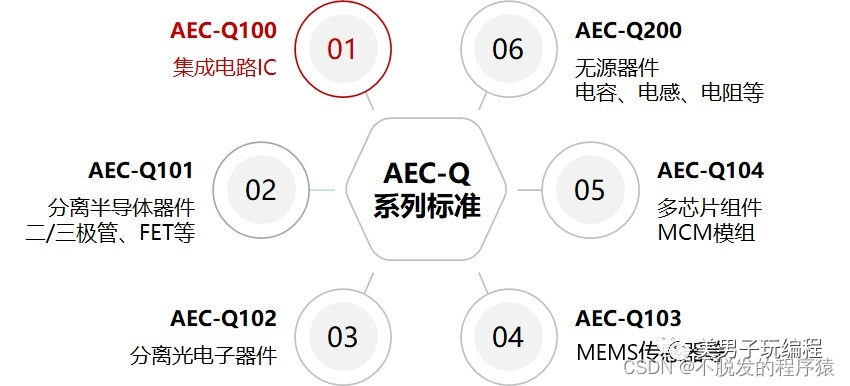
The AEC-Q series certification is a recognized universal testing standard for automotive grade components. IC design companies wishing to enter the automotive electronics field and the automotive electronic component supply chain must obtain AEC-Q series certification. Automotive grade chips must pass AEC-Q testing, with different testing types required for different semiconductor devices, and different levels of testing required for different applications. The certification requirements for various automotive chips are as follows:
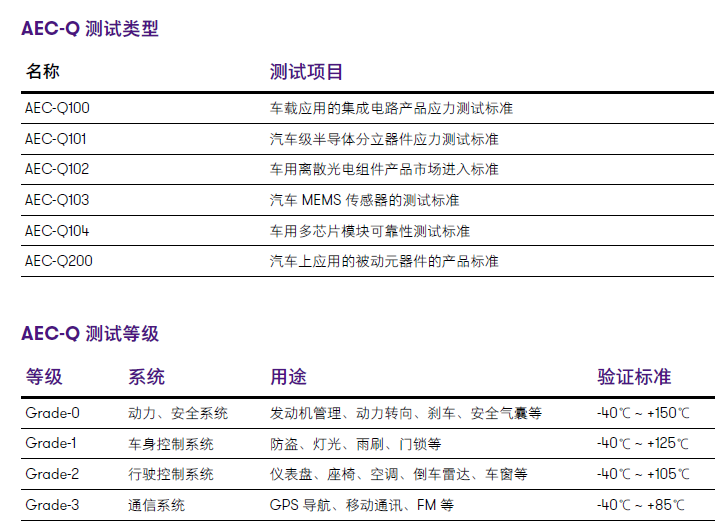 ① AEC-Q100AEC-Q100 is a reliability testing certification standard for integrated circuits based on failure mechanisms, suitable for comprehensive reliability testing certification standards for automotive IC chips, and is the basic threshold for chip products applied in the automotive field.② AEC-Q101AEC-Q101 is a stress testing standard for automotive grade semiconductor discrete devices, mainly for automotive discrete devices, component standard specifications, such as automotive optocouplers: used for automotive isolation components, interface converters, optocouplers, touch control panels, and other discrete devices.③ AEC-Q102AEC-Q102 certification targets all discrete optoelectronic semiconductor components used inside and outside vehicles. The application of LED light sources in vehicles is increasing, with high-quality LEDs required for applications such as vehicle lighting, intelligent systems, and blind spot detection. Therefore, many LED component suppliers are actively entering the automotive LED field, and passing AEC-Q102 verification is one of the important tickets.④ AEC-Q103AEC-Q103 is the testing standard for automotive sensors.⑤ AEC-Q104AEC-Q104 certification mainly targets the reliability testing of automotive multi-chip modules and is the newest automotive electronic specification in the AEC-Q series family. AEC-Q104 increases sequential testing to verify the difficulty of passing based on the actual usage environment of MCM in vehicles. There will also be different testing items based on whether the components have passed other AEC-Q series tests.⑥ AEC-Q200AEC-Q200 is the product standard for passive components used in automotive applications. The overvoltage protection in automotive electronics has stricter circuit conditions, so manufacturers are generally required to pass ISO/IATF16949 quality system certification, and related discrete devices are required to pass AEC-Q101 certification, while passive components are required to pass AEC-Q200 certification, which is a very stringent certification specification.Special Features of the AEC-Q SeriesAEC (Automotive Electronics Council) is a coalition organization, not a certification committee.AEC has not established a certification committee, so there is no such thing as “AEC Certification”. Unlike ISO or IATF, which have standardized committees globally, AEC’s standards are mainly used for the reliability verification of automotive electronic components. Companies can announce their products as AEC Qualified after completing verification according to AEC standards (i.e., obtaining AEC Qualified), or they can obtain an AEC Qualified report from a neutral third-party laboratory. The certification process for ISO or IATF is different, and companies cannot self-declare.
3ISO 26262
ISO 26262 “Functional Safety of Road Vehicles” applies to safety-related systems that include one or more electronic and electrical systems installed in mass-produced road vehicles. It mainly targets specific electrical devices, electronic equipment, and programmable electronic devices used in the automotive industry, aiming to improve the international standard for functional safety of automotive electronic and electrical products.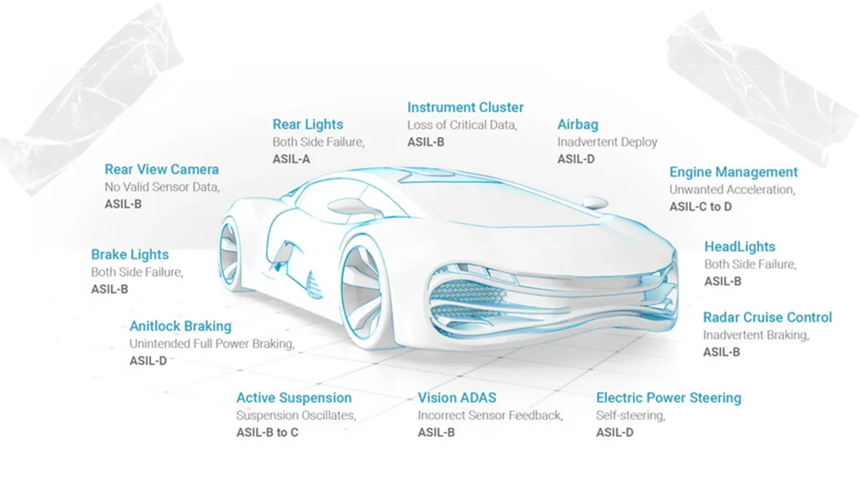
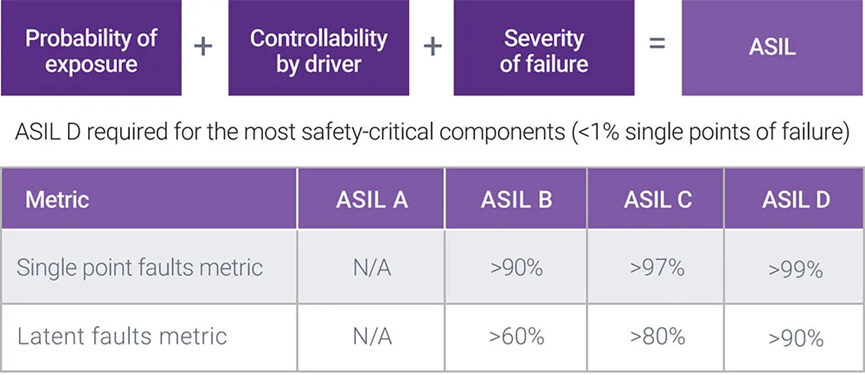
ISO 26262 classifies all electronic and electrical systems in vehicles based on Severity, Exposure, and Controllability. Safety airbags, anti-lock braking systems, and power steering systems must reach ASIL D level, which is the most stringent level applied to safety assurance due to the highest risk of failure. The lowest safety level range, such as rear lights, only needs to reach ASIL A level. Headlights and brake lights are usually ASIL B level, while cruise control is ASIL C level.The ISO 26262 standard provides:① Automotive lifecycle (management, R&D, production, operation, service, disposal) and necessary modification activities during the lifecycle.② Specific risk assessment methods to determine risk levels (Automotive Safety Integrity Level, ASIL).③ Necessary safety requirements to achieve acceptable residual risk using ASIL methods.④ Measures to ensure the effectiveness and certainty of achieving sufficient and acceptable safety levels.⑤ Functional safety is influenced by the development process (including specific requirements, design, execution, integration, verification, effectiveness, and configuration), production process, service process, and management process. The standard addresses potential hazards caused by the failure behavior of safety-related electronic and electrical systems (physical damage or destruction to human health), including potential hazards caused by the interaction of these systems.—END—
Previous Highlights:
Hardware Simulation Accelerators Palladium, Zebu, and Veloce
GPU Market Analysis and Industry Chain (Including Introduction of Domestic GPU Four Little Dragons)
Global AI Computing Platform Comparison: NVIDIA CUDA, Huawei CANN
Introduction to Yield Management System YMS
Comprehensive Introduction to Semiconductor IP
Overview of IC Design Process and R&D Environment
Introduction to PDK and Foundry IP
Introduction to Chip Tape Out