
Arm is known for its Cortex series processors in mobile devices, but the mainstream Cortex-A series CPUs are not the only CPUs offered by the company. Arm also provides the Cortex-R series “real-time” processors for high-performance real-time applications. The last time we discussed the Cortex-R products was with the R8 released in 2016, when the company proposed that the R8 would be widely used in 5G connection solutions within modem subsystems.
Another major market for the R series is storage solutions, where Cortex-R processors serve as the primary processing element in HDD and SSD controllers.
Today, Arm has launched the all-new Cortex-R82, marking the company’s first 64-bit Armv8-R architecture processor IP, which means it is the company’s first 64-bit real-time processor, thus expanding the product line of the R series.
So far, the previous generation R processors were based on the 32-bit architecture of the previous Armv7-R or ArmV8-R, such as the Cortex-R52. Over the years, this has been sufficient for the use cases deploying these processors. However, in modern products, we see the need for designs with larger memory addressing. For example, modern solid-state drives often use up to 2GB of DRAM memory on their controllers, which approaches the 32-bit 4GB memory addressing limit of the R8 CPU.
In terms of real-time applications, the Cortex-R82 is similar to the Cortex-R series, but it is the first Cortex-R to support 64-bit, while slightly shifting its focus towards the needs of real-time and data processing. One specific application of the Cortex-R is for compute storage (as shown in the figure below).
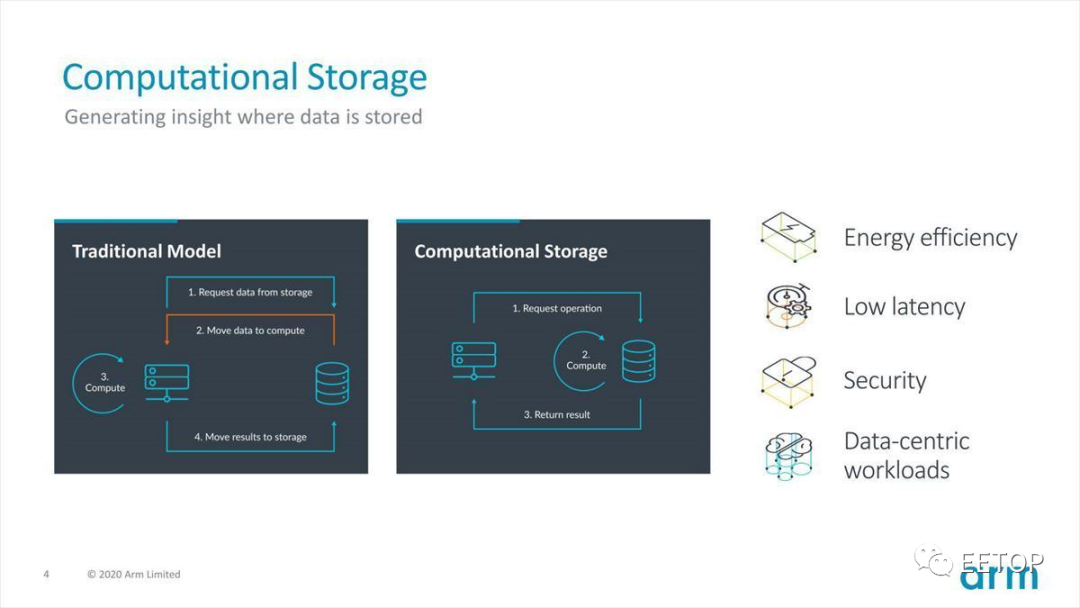
So-called “compute storage” is a new trend that essentially offloads some data processing tasks directly to the storage layer, with the simplest form being SSDs with built-in processors. Compute storage can reduce the main processor’s data calls, thereby improving overall speed and reducing latency during massive data calculations. When this concept was first proposed, some companies integrated ARM Cortex-A53 processors into NVMe SSD controllers to achieve simple on-site data processing.
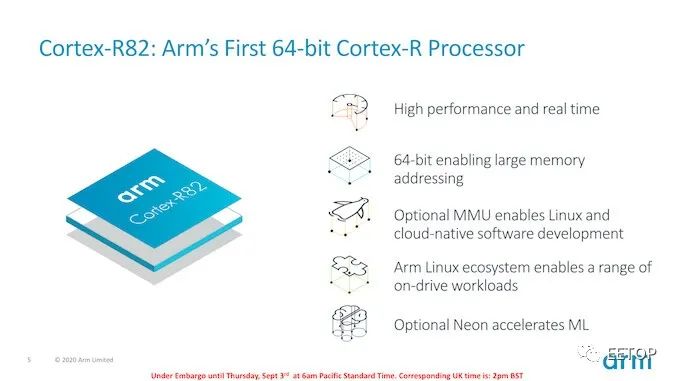
The newly launched Cortex-R82 processor by ARM is designed for this application scenario. ARM states that currently more than 85% of hard drive controllers and SSD controllers are built on ARM architecture, giving them an inherent advantage in this area.
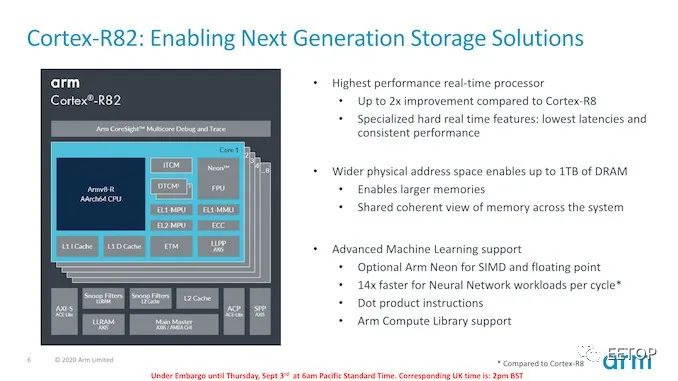
The R82 processor can run Linux, and depending on the workload, performance can be up to 2 times better than previous products (R8). Therefore, storage devices equipped with the R82 processor can perform machine learning directly, significantly reducing latency compared to traditional solutions. Additionally, the R82 supports up to 1TB DRAM or ARM Neon technology to meet the needs of high-end compute storage data processing. The R82 processor also introduces a more optimized memory management unit, allowing some operating systems to run directly on the memory.
From an architecture and microarchitecture perspective, an important new feature is the optional NEON unit for SIMD processing, including new dot product instructions. This will enable the processor itself to have higher performance parallel processing capabilities, providing greater flexibility for customers such as SSD controller designers.
Another significant change in the microarchitecture is the addition of an MMU, which allows the Cortex-82 to function effectively as a general-purpose CPU for rich operating systems like Linux. If the processor can run its own operating system, this represents a substantial shift for the future market potential of the R series. Arm’s product introduction mainly focuses on storage controllers, which can run real-time workloads as they do now while also incorporating rich operating systems to implement more complex algorithms and higher-level applications, which are not feasible on bare-metal and real-time operating systems.
As the storage market evolves, one of the biggest demands from partners is flexibility. The new features of the Cortex-R82 processor allow partners to design multi-core implementations with up to 8 cores and adjust the types of workloads running on the storage controller based on external demands in the software. For example, parking lots often use video surveillance to recognize license plate information, which will later be used for billing.
During the day, vehicle license plate data will be collected, meaning most cores are used for intensive storage. At night, these cores will be used to process billing data and adjust to the required data analysis and machine learning. As storage controllers become more diversified to meet different markets and functionalities, the architecture provided by the Cortex-R82 can offer this extreme flexibility.
Source: EETOP
Reminder:
Please search for “AI_Architect” or “scan code” to follow the public account and track technical trends, click “Read Original” for more technical and exciting content.