01Basic Understanding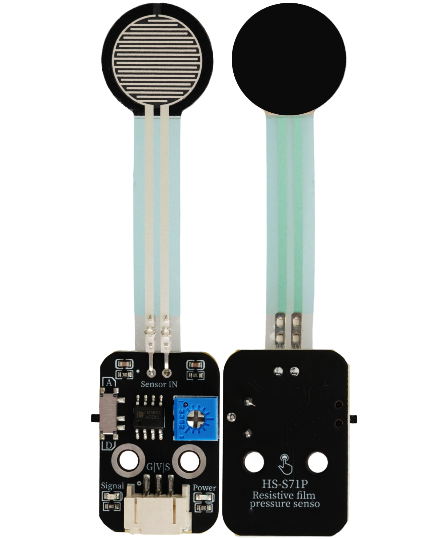 Model:HS-S71PName:Resistive Thin Film Pressure SensorSeries:Force Sensitive Detection ModuleDescription:This is a flexible pressure detection sensor based on the resistance change of conductive film, composed of two layers of conductive film. When pressure is applied, the contact area of the film increases, resulting in a decrease in resistance. It converts the pressure magnitude into a resistance signal inversely proportional to the pressure, which is then converted into a measurable voltage signal through a circuit. It features good flexibility, a wide range, and easy installation, making it a core component for pressure distribution detection and deformation perception.Usage Scenarios:Smart seating pressure sensing (detecting correct sitting posture, reminding during prolonged sitting); robotic tactile feedback (sensing pressure when a mechanical claw grabs an object to prevent pinching); sports training equipment (e.g., insoles with built-in sensors to analyze foot pressure distribution while running); rehabilitation medical devices (monitoring patient limb pressure, adjusting orthotic tightness); primary and secondary school science experiments (understanding the relationship between pressure and resistance by pressing sensors with different weights), in line with the “Guidelines for Artificial Intelligence General Education in Primary and Secondary Schools (2025 Edition)” practical requirements; interactive art installations (controlling light brightness or sound effects through touch pressure).Disciplinary Integration:Physics, Mathematics, Materials Science, Information TechnologyEthical Education:Pressure data (e.g., sitting habits) may reflect user behavior characteristics, requiring privacy protection; when sensors are installed in public facilities (e.g., seats), data collection notification obligations must be clarified; different pressure sensitivity requirements (e.g., children vs. adults) need differentiated calibration, reflecting inclusive design; environmental disposal of discarded film sensors must focus on the recycling of conductive materials; over-reliance on pressure sensing may reduce human judgment ability, requiring a balance between technology and experience.Note: Images are sourced from the internet, and products are based on actual purchases.
02Technical Parameters
Working Principle:
The core of the sensor consists of two layers of flexible conductive film (with a conductive coating on the surface), separated by an insulating lattice in the middle. When there is no pressure, the two layers of film do not contact, and the resistance approaches infinity; when pressure is applied, the film is compressed and deformed, increasing the contact area of the conductive region with increasing pressure, resulting in a decrease in overall resistance (pressure and resistance have a nonlinear inverse relationship). A voltage divider circuit is formed by connecting a fixed resistor in series, converting the resistance change into a voltage change (the greater the pressure, the higher the output voltage). The microcontroller reads the voltage value through AD conversion and calculates the pressure magnitude.
Parameter Analysis:
G(GND): Power input negative/cathode
V(VCC):Power input positive/anode
S(Signal):Signal output interface (digital signal)Pressure detection range: 0-100N (approximately 0-10kgf, range can be adjusted through the circuit)Resistance change range: 10MΩ (no pressure) – 1kΩ (full-scale pressure)Output type: Analog signal (requires external voltage divider circuit)Response time: ≤50ms (time for pressure change to stabilize resistance)Film size: 50mm×50mm (standard size, can be cut)03Code Example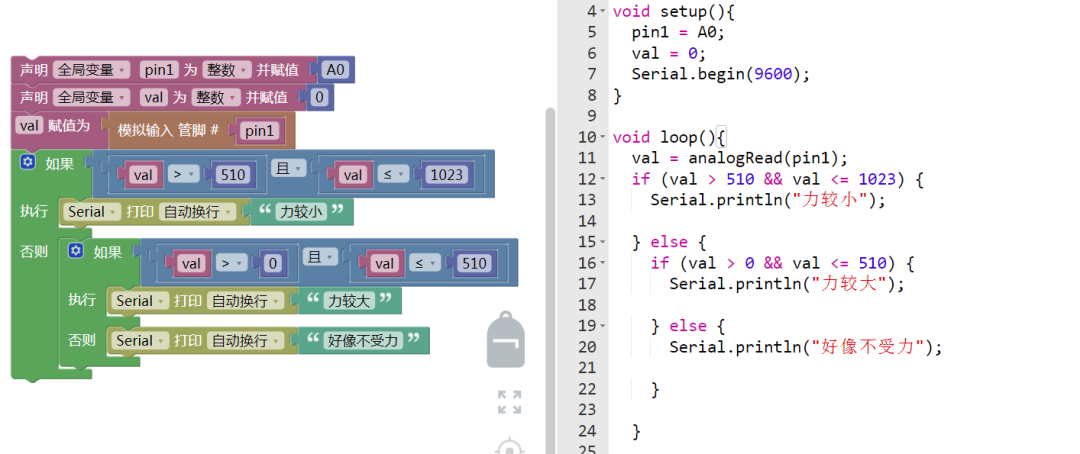
The connection pin is A0.
Note: Students should carefully check the range to ensure it is appropriate; the free membership group will start charging after August 20.
 04Safety Measures
1. Avoid pulling the lead wires when wiring; the connection between the film and the wire is fragile and prone to breakage;
2. Do not exceed 100N of pressure (approximately 10kg), as it may cause permanent deformation of the film;
3. Avoid sharp objects directly pressing on the sensor surface to prevent puncturing the film;
4. Avoid contact with oil or corrosive liquids, as they will damage the conductive coating;
5. Ensure the sensor is installed flat; wrinkles can lead to measurement errors;
6. In humid environments, sealing treatment is required (e.g., covering with waterproof film) to prevent short circuits;
7. When storing for a long time, it should be placed flat to avoid folding or heavy pressure.
05Extensions
Students can try the following methods:
1. Create a “Posture Monitoring Chair”: install the sensor on the backrest of the chair, and when pressure distribution is uneven, use the HS-F07P buzzer to remind adjustments to sitting posture;2. Build a “Smart Grabbing Device”: link with a mechanical claw to control the grabbing force through the pressure sensor, gently pick up an egg, and firmly grab a stone;3. Design an “Interactive Floor”: an array of multiple sensors that trigger different LED effects when stepped on different positions, combined with HS-S49A-PL MP3 module playback sound effects;4. Develop a “Pressure Recorder”: connect to the HS-S64-L SD card module to record the pressure-deformation relationship curve of an object (e.g., the pressure-deformation relationship of a compressed spring). Arduino Sensors: HS-S01A Infrared SensorArduino Sensors: HS-S02P Infrared Sensor (Obstacle Avoidance)Arduino Sensors: HS-S03P Ultraviolet SensorArduino Sensors: HS-S05P Sound SensorArduino Sensors: HS-F07P Active BuzzerArduino Sensors: HS-S08P Flame SensorArduino Sensors: HS-S09LB Raindrop SensorArduino Sensors: HS-S09PC Soil Moisture Sensor
Arduino Sensors: HS-S10P Mist Sensor
Arduino Sensors: HS-S11-L Gas Sensor
Arduino Sensors: HS-S20P Ambient Light Sensor
Arduino Sensors: HS-S21P Tilt SensorArduino Sensors: HS-S22P Grayscale SensorArduino Sensors: HS-S24P Digital Temperature SensorArduino Sensors: HS-S26A Temperature and Humidity SensorArduino Sensors: HS-S28P Potentiometer
Arduino Sensors: HS-S31P Touch Sensor
Arduino Sensors: HS-S37PS Water Level Sensor
Arduino Sensors: HS-S38P Human Sensor
Arduino Sensors: HS-S40P Hall Magnetic Sensor
Arduino Sensors: HS-S45P Barometric Pressure Sensor
Arduino Sensors: HS-S46P Weighing Sensor
Arduino Sensors: HS-S59P Slot Photoelectric Sensor
Arduino Sensors: HS-S70P Heart Rate and Blood Oxygen Sensor
Arduino Sensors: Infrared Receiver Module
Arduino Sensors: Infrared Transmitter Module
Arduino Sensors: Clock Module
Arduino Sensors: Rotary Encoder Module
Arduino Sensors: Dual-axis Joystick Module
Arduino Sensors: Gyroscope Module
Arduino Sensors: Voice Broadcast Module
Arduino Sensors: Voice Recognition Control Module
Arduino Communication Module: Bluetooth ModuleArduino Control Module: Self-locking Button ModuleArduino Storage Module: SD Card Module
Arduino Control Module: Conductive Switch Module

— Previous Recommendations —