01Basic Understanding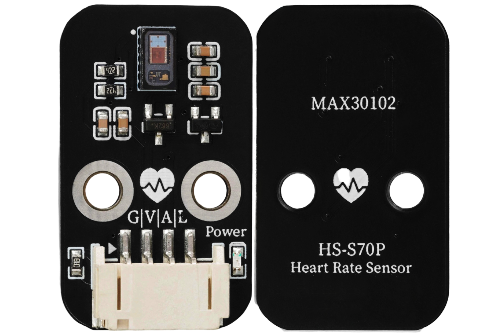 Model:HS-S70PName:Heart Rate and Blood Oxygen SensorSeries:Biological Sensing ModuleDescription:This is an integrated biological sensing module based on the Max30102 chip, utilizing dual light source detection technology with red and infrared light. It can simultaneously collect heart rate and blood oxygen saturation data, outputting digital measurement results via I2C communication. It features non-invasive detection, high accuracy, and low power consumption, making it a core component for health monitoring and exercise physiology assessment.Usage Scenarios:Sports health wristbands (real-time monitoring of heart rate and blood oxygen changes during exercise); sleep quality monitoring devices (recording physiological parameters during sleep); portable health terminals (daily health data collection for elderly at home); sports training assistance (assessing athletes’ physical condition and recovery); scientific experiments in primary and secondary schools (exploring the impact of exercise on heart rate and blood oxygen), in line with the “General Education Guidelines for Artificial Intelligence in Primary and Secondary Schools (2025 Edition)”; health warning devices designed for chronic disease patients, automatically alerting when parameters are abnormal.Disciplinary Integration:Physics, Mathematics, Biology, Information TechnologyEthical Education:Heart rate and blood oxygen data are sensitive personal health information and must be encrypted for storage and transmission to prevent privacy leaks; detection results are for reference only and cannot replace professional medical diagnosis, requiring clear boundaries for technical application; the impact of different skin tones or physical conditions on detection accuracy necessitates discussion on algorithm inclusivity design; the safety of materials in contact with the skin must consider biocompatibility and environmental standards; over-reliance on device monitoring may reduce awareness of self-health management, necessitating a balance between technological tools and health knowledge.
02Technical Parameters
Working Principle:
The core of the module is the Max30102 chip, which includes a 660nm red LED, an 880nm infrared LED, and a photodiode. During operation, the two wavelengths of light penetrate the skin, and the absorption of these lights differs between oxygenated hemoglobin and deoxygenated hemoglobin in the blood: oxygenated hemoglobin absorbs more infrared light, while deoxygenated hemoglobin absorbs more red light. The photodiode detects changes in reflected light intensity, and algorithms calculate: heart rate (based on periodic fluctuations in light intensity caused by blood flow) and blood oxygen saturation (based on the ratio of light absorption at the two wavelengths). The data is processed digitally and output via the I2C interface.
Parameter Analysis:
G(GND): Power input negative/cathode
V(VCC): Power input positive/anode
A(SDA):I2C data transmission interface
L(SCL):I2C clock synchronization interfaceDetection Parameters: Heart rate, blood oxygen saturation (SpO₂)Heart rate measurement range: 30-240 beats/minuteBlood oxygen measurement range: 70%-100%Heart rate accuracy: ±2 beats/minute (at rest)Blood oxygen accuracy: ±2% (within 80%-100% range)03Code Example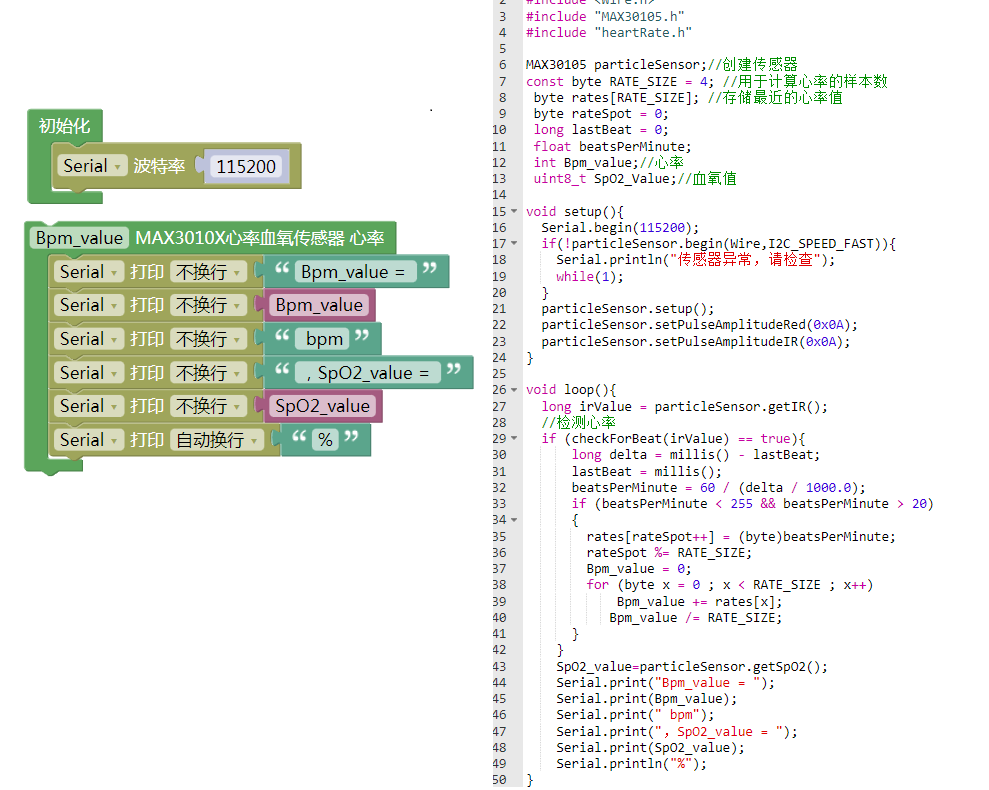
The connection pins are SDA:A4\SCL:A5.
Note: Students need to load the library for testing. If you don’t know how to load it, please discuss in the comments section or scan the code to join the member group for research (price increase mode starts after August 20: 19.9-69.9-169.9-299.9).
 04Safety Measures
1. Power must be turned off before wiring, and ensure VCC is 3.3V (5V connection is prohibited); incorrect voltage can burn the Max30102 chip;
2. Ensure good contact between the sensor and the skin when wearing, but avoid excessive pressure (which can affect blood circulation);
3. Do not expose the sensor’s receiving end to strong light, as it will interfere with light signal detection;
4. The sensor surface must be cleaned regularly (wipe with an alcohol swab) to prevent sweat or grease from affecting optical performance;
5. Avoid continuous use for long periods (over 2 hours) to prevent local skin allergies or discomfort;
6. When measuring during exercise, the sensor must be secured, as vigorous shaking can lead to data distortion;
7. Avoid pressing the sensor probe during storage to prevent damage to the LED or photodiode.
05Extensions
Students can try the following:
1. Create a “Health Monitoring Wristband”: combine with an OLED display to show real-time heart rate, blood oxygen, and measurement time, alerting with the HS-F07P buzzer when data is abnormal;2. Build a “Sports Physiology Analysis System”: link with an accelerometer to analyze heart rate and blood oxygen variation curves at different exercise intensities, storing data in the HS-S64-L SD card module;3. Design a “Breathing Training Assistant”: calculate breathing rhythm based on heart rate variability, guiding users to adjust their breathing frequency through LED blinking;4. Develop a “Sleep Quality Monitor”: connect to the HS-S30P clock module to record nighttime heart rate and blood oxygen fluctuations, assessing sleep depth. Arduino Sensor: HS-S01A Infrared SensorArduino Sensor: HS-S02P Infrared Sensor (Obstacle Avoidance)Arduino Sensor: HS-S03P Ultraviolet SensorArduino Sensor: HS-S05P Sound SensorArduino Sensor: HS-F07P Active BuzzerArduino Sensor: HS-S08P Flame SensorArduino Sensor: HS-S09LB Raindrop SensorArduino Sensor: HS-S09PC Soil Moisture Sensor
Arduino Sensor: HS-S10P Mist Sensor
Arduino Sensor: HS-S11-L Gas Sensor
Arduino Sensor: HS-S20P Ambient Light Sensor
Arduino Sensor: HS-S21P Tilt SensorArduino Sensor: HS-S22P Grayscale SensorArduino Sensor: HS-S23P Infrared Receiver ModuleArduino Sensor: HS-S24P Digital Temperature SensorArduino Sensor: HS-S26A Temperature and Humidity SensorArduino Sensor: HS-S28P Potentiometer
Arduino Sensor: HS-S29P Infrared Transmitter Module
Arduino Sensor: HS-S30P Clock Module
Arduino Sensor: HS-S31P Touch Sensor
Arduino Sensor: HS-S32L Rotary Encoder Module
Arduino Sensor: HS-S34P Dual-axis Joystick Module
Arduino Sensor: HS-S37PS Water Level Sensor
Arduino Sensor: HS-S38P Human Sensor
Arduino Sensor: HS-S40P Hall Magnetic Sensor
Arduino Sensor: HS-S45P Barometric Pressure Sensor
Arduino Sensor: HS-S46P Weight Sensor
Arduino Sensor: HS-S48P Gyroscope Module
Arduino Sensor: HS-S49A-PL Voice Broadcast Module
Arduino Sensor: HS-S57-L Voice Recognition Control Module
Arduino Sensor: HS-S59P Slot Photoelectric Sensor
Arduino Communication Module: Bluetooth ModuleArduino Control Module: Self-locking Button ModuleArduino Storage Module: SD Card Module
Arduino Control Module: Conductive Switch Module

— Previous Recommendations —