01Basic Understanding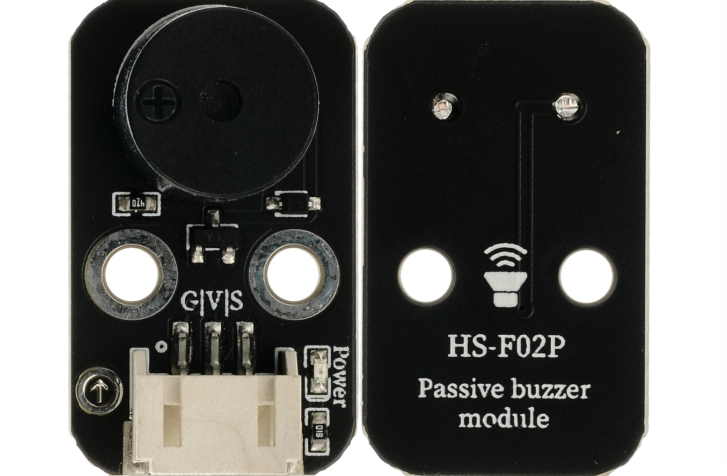 Model:HS-F02PName:Passive Buzzer ModuleSeries:Audio Output ModuleDescription:It is an audio generation module based on the principle of electromagnetic vibration, with a built-in electromagnetic coil and metal diaphragm. It requires an external alternating pulse signal (of different frequencies) to produce sound. It supports tone control through PWM (Pulse Width Modulation), featuring rich timbre, strong controllability, and low power consumption. It is a core component for audio prompts, music playback, and alarm devices.Usage Scenarios:Electronic device operation feedback (e.g., a “beep” sound prompt when a button is pressed); smart home alarm systems (warning sounds for smoke or gas leaks); children’s programming teaching tools (playing music through code control to understand the relationship between frequency and pitch); industrial equipment fault indication (different faults correspond to different frequency alarm sounds); middle and primary school science experiments (exploring sound generation and frequency characteristics), in line with the practical requirements of the “Guidelines for Artificial Intelligence General Education in Primary and Secondary Schools (2025 Edition)”; environmental prompt devices designed for visually impaired individuals (e.g., sound assistance for traffic lights at intersections).Disciplinary Integration:Physics, Mathematics, Music, Information TechnologyEthical Education:The volume and frequency of the buzzer may affect others (e.g., high decibel noise interference), requiring reasonable audio parameter design; alarm sounds in public places need to consider inclusivity (e.g., incorporating flashing assistance for hearing-impaired individuals); the recycling of metal diaphragms and coils in electronic waste requires attention to environmental responsibility; excessive reliance on sound prompts may reduce visual observation ability, necessitating a balance of multi-sensory interaction; differences in cultural interpretation of sound signals (e.g., specific frequency warning sounds) should reflect universal design.Note: Images are sourced from the internet, and the product is based on the actual purchase.
02Technical Parameters
Working Principle:
The core of the module is a passive buzzer, consisting of an electromagnetic coil, permanent magnet, and metal diaphragm. When the control pin inputs an alternating pulse signal (with alternating high and low levels of different frequencies), the coil generates a changing electromagnetic field, interacting with the permanent magnet to drive the diaphragm to vibrate, thus producing sound. The pitch of the sound is determined by the pulse frequency (the higher the frequency, the higher the pitch). By programming to output different frequency PWM signals, different musical notes can be simulated, forming music or alarm sounds.
Parameter Analysis:
G(GND): Power input negative/cathode
V(VCC): Power input positive/anode
S(Signal):Signal output interfaceFrequency range: 200Hz-5kHz (sensitive range of human hearing)Sound pressure level: 85dB@1kHz (at a distance of 1 meter)03Code Example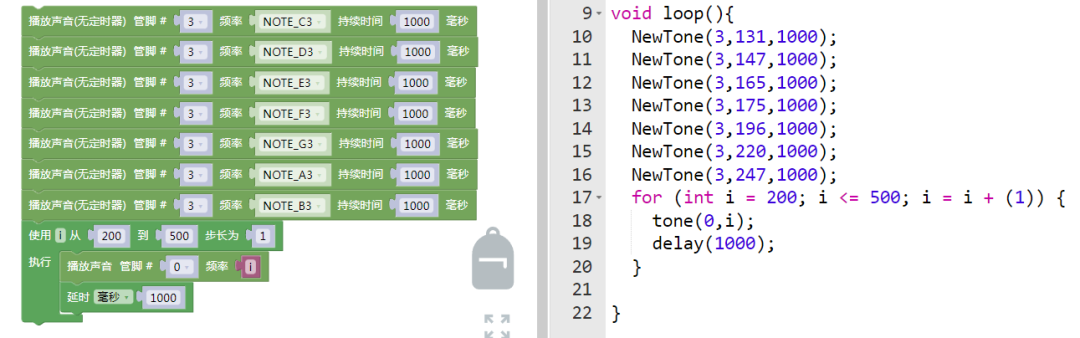
The connection pin is D3.
Note: Students should control the frequency range; membership group limited-time free remaining7 days, charging mode will start after August 20.
 04Safety Measures
1. Power off before wiring, confirm the positive and negative terminals of VCC and GND; reverse connection may cause the coil to burn out;
2. Do not exceed 5V power supply; prolonged high voltage may cause the coil to overheat and damage;
3. Avoid continuous sound for long periods (over 1 minute) to prevent diaphragm fatigue affecting lifespan;
4. When soldering, keep the soldering iron temperature ≤300℃, soldering time ≤3 seconds to prevent high temperature damage to the pins;
5. If the module is used in public places, control the volume (by reducing the duty cycle) to avoid noise pollution;
6. If there is no sound or abnormal sound during debugging, check if the pulse frequency is out of range (it is recommended to first test with a 1kHz signal);
7. When storing, avoid pressing on the surface of the buzzer to prevent diaphragm deformation leading to sound distortion.
05Extensions
Students can try the following methods:
1. Create a “smart alarm device”: link with the HS-S38P human sensor to play a 1kHz alarm sound when an anomaly is detected, and stop when normal;2. Build a “musical doorbell”: combine with the HS-S39A touch keyboard, pressing different keys plays different musical notes, forming custom doorbell music;3. Design a “frequency tester”: output a signal from 200Hz to 5kHz in a loop through code, observe the frequency response range of the buzzer, and understand human auditory characteristics;4. Develop an “interactive sound effect toy”: in conjunction with the HS-S71-L resistive film pressure sensor, different pressure levels correspond to different pitches, achieving a “pressure piano” effect. Arduino Sensor: HS-S01A Infrared SensorArduino Sensor: HS-S02P Infrared Sensor (Obstacle Avoidance)Arduino Sensor: HS-S03P Ultraviolet SensorArduino Sensor: HS-S05P Sound SensorArduino Sensor: HS-F07P Active BuzzerArduino Sensor: HS-S08P Flame SensorArduino Sensor: HS-S09LB Raindrop SensorArduino Sensor: HS-S09PC Soil Moisture Sensor
Arduino Sensor: HS-S10P Fog Sensor
Arduino Sensor: HS-S11-L Gas Sensor
Arduino Sensor: HS-S20P Ambient Light Sensor
Arduino Sensor: HS-S21P Tilt SensorArduino Sensor: HS-S22P Grayscale SensorArduino Sensor: HS-S24P Digital Temperature SensorArduino Sensor: HS-S26A Temperature and Humidity SensorArduino Sensor: HS-S28P Potentiometer
Arduino Sensor: HS-S31P Touch Sensor
Arduino Sensor: HS-S37PS Water Level Sensor
Arduino Sensor: HS-S38P Human Sensor
Arduino Sensor: HS-S40P Hall Magnetic Sensor
Arduino Sensor: HS-S45P Pressure Sensor
Arduino Sensor: HS-S46P Weight Sensor
Arduino Sensor: HS-S59P Slot Photoelectric Sensor
Arduino Sensor: HS-S70P Heart Rate and Blood Oxygen Sensor
Arduino Sensor: HS-S71P Film Pressure Sensor
Arduino Sensor: HS-S72P Metal Detection Sensor
Arduino Sensor: Infrared Receiving Module
Arduino Sensor: Infrared Transmitting Module
Arduino Sensor: Clock Module
Arduino Sensor: Rotary Encoder Module
Arduino Sensor: Dual-axis Joystick Module
Arduino Sensor: Gyroscope Module
Arduino Sensor: Voice Broadcast Module
Arduino Sensor: Voice Recognition Control Module
Arduino Display Module: LED Light Module
Arduino Display Module: RGB Light Module
Arduino Communication Module: Bluetooth Module
Arduino Control Module: Self-locking Button Module
Arduino Storage Module: SD Card Module
Arduino Control Module: Conductive Switch Module
— Previous Recommendations —